


EdBray
Suspended / Banned
- Messages
- 7,179
- Name
- Edward Bray
- Edit My Images
- Yes
What can I say, since being advised by Alan to try Caffenol I have really enjoyed the process of making my own developer, my first attempt was with Caffenol CH which is designed for ISO400 films and above and the results were okay, but not any better than I could have got with an off the shelf developer albeit with a bit more fun.
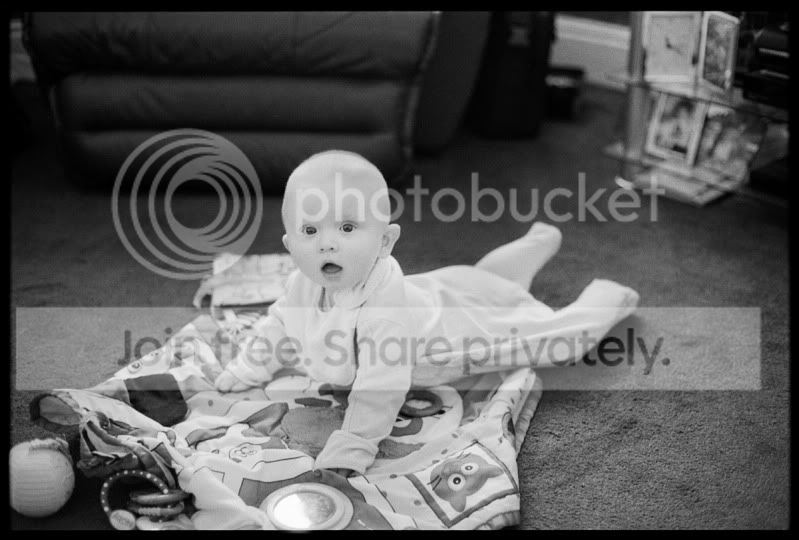
I had been taking some images of my Grandson who was playing on the floor using a Pentax LX with my SMC 50mm f1.4 lens (at f1.4 1/60sec) I was using the Ultrafine Extreme ISO400 film which as seen in an earlier thread hasn't got the finest grain when processed normally, but it has a good tonal range and offers a cheap option for taking non too important images, that is, until I tried using the Caffenol CL formula processed using a semi-stand technique as this is supposed to give better tonality and smoother, finer grain.
Wow! what a difference the film is beautifully processed and the grain is not so obtrusive as it was previously. This developer and process has now changed my perception of this film and the Caffenol and I will now use it for a lot more than I would have previously.
The formula I used was:
500ml of distilled water
8g Sodium Carbonate
5g Vitamin C
0.6g Potassium Bromide
20g Instant Coffee
The Semi-stand technique I used was:
5 mins prewash
65 mins developer with agitation as follows:
30 seconds initially..................................count up count down
3 inversions after an additional 2 minutes (2.5 mins) (62.5 mins)
3 inversions after an additional 4 minutes (6.5 mins) (58.5 mins)
3 inversions after an additional 10 minutes (16.5 mins) (48.5 mins)
3 inversions after an additional 20 minutes (36.5 mins) (28.5 mins)
empty tank after (65 mins) (0 mins)
3 water washes to get rid of the evil smelling dev
30 seconds alkali stop
water wash
6 minutes of alkali fix
5 minutes of washing with multiple changes of water
I then dried the film in my film dryer before scanning at 4800dpi on my Epson V750 using Silverprint AI Studio software in 16bit greyscale.
So onto the results, the first image is a 100% crop of the full sized scanned image (no PP at all) which would measure 195" x 132" (16' 3" x 11') at 72dpi or 47" x 32" (3' 11" x 2' 8")at 300 dpi.

The following image is a resized (to 1200 pixel on the width) image of the whole frame including the borders. This has had some PP with some slight localised tonal changes in the brightest areas (using Nik Silver Efex Pro2) and some USM in CS5 and other than a few dust spots cloned and a slight vignetting at the corners there are no other changes.
I had been taking some images of my Grandson who was playing on the floor using a Pentax LX with my SMC 50mm f1.4 lens (at f1.4 1/60sec) I was using the Ultrafine Extreme ISO400 film which as seen in an earlier thread hasn't got the finest grain when processed normally, but it has a good tonal range and offers a cheap option for taking non too important images, that is, until I tried using the Caffenol CL formula processed using a semi-stand technique as this is supposed to give better tonality and smoother, finer grain.
Wow! what a difference
the film is beautifully processed and the grain is not so obtrusive as it was previously. This developer and process has now changed my perception of this film and the Caffenol and I will now use it for a lot more than I would have previously.The formula I used was:
500ml of distilled water
8g Sodium Carbonate
5g Vitamin C
0.6g Potassium Bromide
20g Instant Coffee
The Semi-stand technique I used was:
5 mins prewash
65 mins developer with agitation as follows:
30 seconds initially..................................count up count down
3 inversions after an additional 2 minutes (2.5 mins) (62.5 mins)
3 inversions after an additional 4 minutes (6.5 mins) (58.5 mins)
3 inversions after an additional 10 minutes (16.5 mins) (48.5 mins)
3 inversions after an additional 20 minutes (36.5 mins) (28.5 mins)
empty tank after (65 mins) (0 mins)
3 water washes to get rid of the evil smelling dev
30 seconds alkali stop
water wash
6 minutes of alkali fix
5 minutes of washing with multiple changes of water
I then dried the film in my film dryer before scanning at 4800dpi on my Epson V750 using Silverprint AI Studio software in 16bit greyscale.
So onto the results, the first image is a 100% crop of the full sized scanned image (no PP at all) which would measure 195" x 132" (16' 3" x 11') at 72dpi or 47" x 32" (3' 11" x 2' 8")at 300 dpi.
The following image is a resized (to 1200 pixel on the width) image of the whole frame including the borders. This has had some PP with some slight localised tonal changes in the brightest areas (using Nik Silver Efex Pro2) and some USM in CS5 and other than a few dust spots cloned and a slight vignetting at the corners there are no other changes.
Last edited:


 I'm curious about finding out more about Caffenol.