Accelerating quickly is more economical

Messages
1,160
Name
John Stewart
Edit My Images
Yes
What with the current high fuel prices, and some local fuel stations running out (they were 5p/litre cheaper than others), it's worth noting that accelerating quickly to your target/cruising speed is significantly more fuel efficient than accelerating gently over a much longer period of time.

Many drivers are under the assumption that to save fuel, they need to accelerate as gently as possible, when in fact it's accelerating intensively and shifting up into higher gears as quickly as possible that saves fuel. This is backed up by various scientific papers, including this one from Poland a few years ago: https://www.sciencedirect.com/science/article/pii/S0360544221006782

"As shown in Table 3, it is advantageous, in terms of energy, to accelerate the car intensively at low gear ratios to reach the assumed final speed or distance. This leads to a significant reduction in the energy consumed by the car’s powertrain. At the same time, after stopping the acceleration process and maintaining a constant travel speed, there is a natural energy recovery in the powertrain from the car’s inertia, which drives the car in a situation of insufficient driving force (zone III)."

Speaking in 2005, Mark Dougherty, a professor at Dalarna University, said:
“It’s not commonly understood by people who drive. They think that the way to get the best fuel economy is to accelerate very gently, but that proves not to be the case.
The best thing is to accelerate briskly and shift. Don’t give it everything the car has, but push down when you’re going to shift, using maybe two-thirds of the available power, and change through the gears relatively quickly.”
 
Last edited:
Which is a theory that ignores the real world effects of gradient and atmospheric conditions.
If you can use a downhill slope to gain momentum, you don't need to add (as much) power; conversely you might consume power just to maintain speed on an uphill segment.
Also, the ICE produces more power in cold weather due to the density of the air incoming to the engine for combustion.
 
It's something I've thought about for the past few weeks and performed some informal/completely unscientific testing on my own. I drive a diesel 3 series BMW, which has 3 engine settings, eco pro, comfort and sport. On my daily commute, where I've got about 10 miles of dual carriageway with several long inclines, followed by 4 miles of city centre, 30mph stop/start traffic. I assumed that Eco mode would give me the best fuel consumpion. However, on reaching my destination, the average mpg for the trip never seemed to be any better than when I used the default comfort mode. Acceleration is best described as sluggish and the car feels very unresponsive when using the eco setting and selects the next gear quickly. What I did note though, as that if I set the cruise control to 70mph, even in eco mode when resuming from a slower speed, the car would accelerate much more quickly than I would have done manually.

At the weekend, I decided to do a long range test, driving 120 miles each way on a mix of roads (mosty 70mph dual carriageway). I averaged 52.1 in eco mode on the drive there, and 54.9 in comfort mode on the way back with about 80% of the drive on cruise control at 70mph. The engine was warm when starting the return journey, but I did have a lot more stop/start traffic through Dundee city centre as it was later in the day instead of early morning. The ambient temp was about 5 degrees warmer on the return leg.

This morning I tried something different and used sport mode which helped a lot getting up to speed, particuarly on the steeper hills. The result was a best ever 54mpg instead of my usual 49/50mpg for the same journey in eco mode. Hence some searching this morning to see if anyone else had experienced similar as it defied logic and I came across the above scientific article. There was also something from the Sun newspaper from 2022 which seemed to agree that getting up to cruising speed quickly is the best option. I'm now thinking that eco mode likely only helps in slow moving, city centre stop/go traffic, and isn't any benefit on dual carriageways.
 
My Evoque is my newest car and it has a display which shows how many MPG you're doing. My other cars are too old and basic for things like this. Anyway. When accelerating quickly I might see 9mpg and when accelerating slowly I might see 75mpg.

I'm not saying the theory is wrong... just that I might need some convincing :D
 
I posted this in another thread, which I find quite interesting and might be somewhat relevant.

1774870093553.png 1774870097946.png
 
I posted this in another thread, which I find quite interesting and might be somewhat relevant.
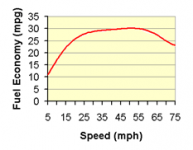
Yes, it shows what has frequently been said: the best economy for a petrol engine is to cruise at around 55 MPH.
 
My Evoque is my newest car and it has a display which shows how many MPG you're doing. My other cars are too old and basic for things like this. Anyway. When accelerating quickly I might see 9mpg and when accelerating slowly I might see 75mpg.

I'm not saying the theory is wrong... just that I might need some convincing :D
That was my thinking originally until I gave it a try and monitored the average mpg for the same journey with different driving styles. The theory is you do 9mpg for say 15 seconds, followed by 9 minutes 45 seconds of steady state driving, compared to say 1 minute at 20mpg, followed by 10 minutes at steady state driving. The second option takes longer which ultimately uses more revolutions of the engine and more fuel to complete the same journey. There say is a sweet spot (3/4 power) above which extra acceleration/more revs uses more fuel versus the speed gained and journey time.
 
I posted this in another thread, which I find quite interesting and might be somewhat relevant.

View attachment 477993 View attachment 477994
I wondering if some modern diesel cars with better aerodynamics and much taller gearing might have a more gentle slope at higher speeds? I was getting about 58-60mpg at a steady 70mph, but about 62-63mpg at a steady 60mph.
 
That was my thinking originally until I gave it a try and monitored the average mpg for the same journey with different driving styles. The theory is you do 9mpg for say 15 seconds, followed by 9 minutes 45 seconds of steady state driving, compared to say 1 minute at 20mpg, followed by 10 minutes at steady state driving. The second option takes longer which ultimately uses more revolutions of the engine and more fuel to complete the same journey. There say is a sweet spot (3/4 power) above which extra acceleration/more revs uses more fuel versus the speed gained and journey time.

Altering our driving style is going to depend at least in part on traffic, ie, take too long moving off and we're going to get beeped. I don't drive at the limits these days like I used to on the twisties in N. Yorkshire in my sports cars, I just pootle along now and I think I've decided not to worry about fuel consumption.
 
The main thing I noted on skimming the study is that it was discussing accelerating from 40 km/h and not a static stop. It seems to be just saying that gearing down in order to accelerate in a better gear ratio with more torque and less drag is more beneficial. Which makes sense if you've ever been in too high of a gear and tried to accelerate...
 
Yes, it shows what has frequently been said: the best economy for a petrol engine is to cruise at around 55 MPH.

The peak is yes, but pretty much 35mph through to 60mph all returns near enough the best mpg which isn't so widely advertised.

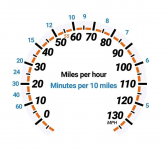
It's more the paceometer I find interesting, especially with the argument some have that our motorways should have a higher speed limit, but the time you save becomes exponentially lower compared to the lower speeds and the fuel consumption drops as well.
 
The main thing I noted on skimming the study is that it was discussing accelerating from 40 km/h and not a static stop. It seems to be just saying that gearing down in order to accelerate in a better gear ratio with more torque and less drag is more beneficial. Which makes sense if you've ever been in too high of a gear and tried to accelerate...
Won’t work for mr, I drive in mph! ;)
 
Back
Top