A Question About "Crop" Sensors and Lens.

Knikki

Suspended / Banned
Messages
1,901
Name
Nick (yes there is more than one of us)
Edit My Images
Yes
OK I get the idea of crop factors and lens altough why we have to have everything related to 35mm frame is, well beyond me.

Anyway a hyperthotical situation:

I have three cameras, one is a 35mm sensor, one is smaller and gives a 1.5x crop and the other is 2x crop factor.

On a tripod is a 300mm f2.8 lens which has the ability to mount all three cameras.

There is a model standing some 25 yeards away.

The question, what will I see either in the view finder or print? will it be like the following?

35mm mounted the models face will be seen with their full face, ears, neck and top of the head and at f2.8 DOF has the eyes nose and mouth in focus the rest is bokeh.

1.5x crop mounted now because of the crop it is more of the face, the next is lost, you can still see some of the ears and the very top of the head is missing, DOF is now more.

Finally 2x crop all that can be seen is the eyes, nose and mouth.

Because ff the crop the image does note "magnify" it is just that the field of view is more centered and reduced because of the crop?
 
Last edited:
In essence Yes.

I’ve reluctantly come to the conclusion that crop factors are easy shorthand for many.

Like you though, I never saw the 35mm frame as ‘normal’ it’s slways been just one of the many sizes of film available.

I used to shoot MF film and I never considered the ‘factor’ I just knew my 75mm was std, 150 was Tele and 50mm was relatively wide.
 
... altough why we have to have everything related to 35mm frame is, well beyond me. ...
I guess it is just a point of reference, given the majority of film shot was 35mm (or 135 if you prefer) and even then we had "crop" bodies (126 for example) whether it was intentional or just a "happy accident" I guess the same logic was followed when digital appeared.
 
I guess it is just a point of reference, given the majority of film shot was 35mm (or 135 if you prefer) and even then we had "crop" bodies (126 for example) whether it was intentional or just a "happy accident" I guess the same logic was followed when digital appeared.
I thought 126 was larger than 35mm :thinking:
28mm square negatives are taller than the 24mm of 135 film.

Or the earlier version which was 4.5 x 6.5 inches??
 
Last edited:
35mm 'FF' is just a reference point that most of the world seems to relate to. It doesn't really matter that there were once many other film formats available, or that there are now many other sensor sizes, just like it doesn't matter that we used to measure distance in furlongs, cubits or chains. The important thing is to have a common reference point or 2 that everyone commonly understands and can relate to.
 
I thought 126 was larger than 35mm :thinking:
28mm square negatives are taller than the 24mm of 135 film.

Or the earlier version which was 4.5 x 6.5 inches??
Wasn't that half plate? So offcource there was a full plate
Then you had 4x5", 5x7", 8x10", 11x14", 16x20" etc
And all the different sizes on 120 film
 
Last edited by a moderator:
why we have to have everything related to 35mm frame is, well beyond me.

I think the reference to 35mm is a result of most amateur photographers for many years have used a 35mm camera whether a rangefinder or SLR. DSLRs look pretty much identical to 35mm film SLR cameras and if you did not know a particular model there would be no way of knowing the sensor in a DSLR was not the same size a 35mm film, so it fairly natural to relate the effect of many DSLRs having a smaller sensor to the 35mm frame.

In practice it is not very relevant. If the a 200mm lens mounted on a camera with a crop factor of 1.5 doesn't allow you to fill the frame the way you want to, it doesn't matter that the field of view the lens gives is the same as a 300mm lens on a 35mm camera.

Dave
 
got me thinking about half frame cameras 18 x 24 on a normal 35mm film

has anyone ever seen a Nikon S3M ... a modified Nikon S3 ..... I believe only about 200 were produced ...... when I collected Nikons I could never find one anywhere advertised

here's my Olympus Pen EE ... Japans first half frame camera produced in 1959

Pen_EE.jpg
 
Last edited:
Snip:
I used to shoot MF film and I never considered the ‘factor’ I just knew my 75mm was std, 150 was Tele and 50mm was relatively wide.

What is 'standard' as a lens on 120 roll film (med format) depends on the size of the negative taken, on a 6x4.5 frame then 75mm is about 'standard', whereas on a 6x9 frame 105mm is about 'standard'. It's as confusing as crop ratio really... but then again, it is the crop ratio. :confused: :banghead: It's all too much for a simple badger to take in, so I'll just stick to taking photos rather than wondering too much about how things happen inside the camera. :D
 
Snip:

What is 'standard' as a lens on 120 roll film (med format) depends on the size of the negative taken, on a 6x4.5 frame then 75mm is about 'standard', whereas on a 6x9 frame 105mm is about 'standard'. It's as confusing as crop ratio really... but then again, it is the crop ratio. :confused: :banghead: It's all too much for a simple badger to take in, so I'll just stick to taking photos rather than wondering too much about how things happen inside the camera. :D

I suppose a full 35mm film and a 50mm lens was/is "a standard"
 
Last edited:
I thought 126 was larger than 35mm :thinking:
28mm square negatives are taller than the 24mm of 135 film.

Or the earlier version which was 4.5 x 6.5 inches??
I dunno if it is larger, nominally 26x26 (though as you say often 28mm square) but not 35x24 which is what I was aiming at, but yes taller even at nominal. Maybe I should have used 110 or APS but didn't want to confuse using APS as a film size when most will think in digital terms (APS-C) ... either way there are a sometimes bewildering array of sizes (be it film or digital). The point I was trying to make though was simply that 35mm (i.e. 36x24mm) was/is/has been decided upon as a "standard" reference point for discussing sensor sizes (be they digital or analogue or any other variation ;) ).
 
I don't know what would be seen at the given distance and focal length without putting on a lens and checking. But in a way I don't have to.

The same lens will produce the same image irrespective of the camera it's mounted on - lenses are stupid that way. The camera won't change the image in any way either; all that the camera does is record less and less of the image as the sensor size goes down.

Depth of field depends on how big a circle can get before the eye no longer accepts it as a point; the smaller the sensor, the more you have to enlarge the image to get the same size print, and the bigger this circle gets. Hence, in these circumstances, depth of field will be less as sensor size goes down.

Crop factors are a wonderful shorthand, particularly in enabling people to quickly arrive at an equivalent focal length. "Equivalent" in angle of view, but in no other optical properties. The only advantage they have that I can see is that they let the ad men use marvellously long focal lengths for compact digital cameras as a sales point - because bigger is always better (and they don't tell you how small the sensor is :D).
 
Last edited:
I suppose a full 35mm film and a 50mm lens was/is "a standard"
50mm was pretty much the 'standard' lens supplied with SLRs in their heyday from around the early 1960s to the late 1980s, but by then zoom lenses had begun to take over as the 'kit' lens usually offered with an SLR camera. When used on a 35mm SLR, 50mm was meant to most closely resemble the field of view from the human eye, but I seem to recall that it might actually be nearer 40mm than 50mm. But apart from that, I think the answer is yes! (y)
 
Depth of field depends on how big a circle can get before the eye no longer accepts it as a point; the smaller the sensor, the more you have to enlarge the image to get the same size print, and the bigger this circle gets. Hence, in these circumstances, depth of field will be less as sensor size goes down.
I entirely agree, except that with digital what often happens is the images are displayed/printed at different sizes due to their pixel resolution. And in that case there is no difference other than what is included in the image. Or the larger sensor image is cropped due to a lack of FL resulting in no differences at all.
Because ff the crop the image does note "magnify" it is just that the field of view is more centered and reduced because of the crop?
Correct; take an 8x12 print and cut it in half lengthwise and horizontally to 1/4 the size... that's a 1.5x crop. Do that again and it's a 2x crop. The only question remaining is what you do with what is left.

A lot make a big deal about increased pixel density the smaller sensors typically provide... but that's irrelevant if the lens is not providing more resolution than the larger sensor can resolve (it's usually not), or if the large sensor is not resolving more than you need (it usually is/can). In a whole lot of cases the differences are much more like cutting down the print regardless of the pixel densities (MP's) in question.

That said, higher pixel density can/do often show some nominal increase in recorded detail due to oversampling/sampling frequency.
 
Last edited:
In the scenario given Depth of Field is going to be roughly equal on all sensors, where a difference will show is if you move to maintain the same framing on each format, i.e. you need to be further away to have the same framing as the sensor size reduces.
 
Last edited:
In the scenario given Depth of Field is going to be roughly equal on all sensors
It really depends... if the three sensors have the same MP count and the images are displayed at the same pixel dimensions or print size, then the smaller sensor will have less DOF and include less (due to enlargement of sensor area). If the composition is kept the same by changing distance, then the smaller sensor will have more DOF (due to the increased distance). The DOF only remains the same if the 3 sensors get the same relative amount of enlargement (of sensor area, not MP).
 
Last edited:
35mm 'FF' is just a reference point that most of the world seems to relate to. It doesn't really matter that there were once many other film formats available, or that there are now many other sensor sizes, just like it doesn't matter that we used to measure distance in furlongs, cubits or chains. The important thing is to have a common reference point or 2 that everyone commonly understands and can relate to.

The sensible common reference point would be horizontal angle of view. I note that many binoculars give a version of that printed on them somewhere, such as 10m wide visible at 100m. I find it much more significant to know that on my crop sensor an 8mm lens has a horizontal angle of view of more than 90 degrees, which means you can shoot all four walls from inside a room, whereas 10mm has less and can't. Much more informative than knowing that 8mm on my crop sensor has the same angle of view as 12mm on FF, 10mm as 15mm.
 
I entirely agree, except that with digital what often happens is the images are displayed/printed at different sizes due to their pixel resolution. And in that case there is no difference other than what is included in the image. Or the larger sensor image is cropped due to a lack of FL resulting in no differences at all.

Correct; take an 8x12 print and cut it in half lengthwise and horizontally to 1/4 the size... that's a 1.5x crop. Do that again and it's a 2x crop. The only question remaining is what you do with what is left.

Right idea, but wrong numbers. The APS-C sensor doesn't divide the FF sensor area by 2 longitudinally, and 4 times in area, but by 2/3 longitudinally (1/1.5), 4/9 in area. It's nearly twice as big in area as you suggest.
 
No, I've never seen one, Bill & I think less than 200 were ever produced. The S3's command a fair bit of money, but ........... £125,000 for the M ? :jawdrop: (limited edition chrome) http://www.graysofwestminster.co.uk/products/secondhand.php?cat1=8&pg=1

Thanks Carlos

well they have one at Grays - a chrome model, (I thought that they were all black), for £125k ...............I should have held on to my S3 which I sold for not much over 10 years ago, I bought it used in Japan as I spent a lot of time in Tokyo from 1985 to 1993 ........ the only things I have left is a beat up S and a couple of 50mm lens plus a Nikon screw mount 135mm lens.
 
The question, what will I see either in the view finder or print?

A Lens is a lens is a lens.... does't matter what size 'sensor' it projects an image onto, for any given camera-to-subject distance, and aperture, 'on the lens'.... that image will be the same.....

ALL that changes with the sensor-size is how much of the image area projected onto the sensor, by 'the lens' the sensor captures.......

will it be like the following?

Apply the above.... remember the lens projects the 'same' image onto the sensor, so with a smaller sensor, you just capture less of it, and because you have 'cropped' a smaller section from the image projected by the lens, when viewed, IF you enlarge that smaller 'section' to the same frame size as you would the larger area from a larger sensor camera.. err... the littler 'bit' captured, has to be enlarged more, so 'looks' bigger, as if you had used a longer lens to take it with.... but you didn't.. your sensor just recorded less area of the scene the lens you used projected, and you enlarged it more in post-capture.

The the trifficulty is that few will ever use the exact same lens at the exact same camera to subject range, with different sized sensor cameras behind it. With a smaller sensor camera, the lens will give more 'effective' zoom, so they will be inclined to shoot at a larger subject range, whilst with a larger sensor they will get less 'effective' zoom and be inclined to close up subject range, and changing that the camera-to-subject-distance, will change the Depth-of-Field..... the crop factor 'alone' shouldn't.

Gets more confusing when folk try ad equate the f-number via the crop factor, and start suggesting that on a crop-sensor camera, the f-number is also magnified by the crop-factor, because they get more DoF from the shorter lens...... err... no... not really. they get the same DoF as they would with that lens! The DoF changes only with the aperture, and the Subject-to-Camera range, that they will likely change co-incidentally or even consequentially to changing the lens.

why we have to have everything related to 35mm frame is, well beyond me

Because for half a century before Widgetal came along, 35mm was the most usual 'format', for interchangeable lens cameras, where the lens-length was of more import, and to which convention most 'hobby' photographers were already familiar with, when Widgetal came along, and likely already possessed interchangeable lenses for 35mm cameras, that could be fitted to crop-sensor widgetal camea's..... and it gave the makers an excuse to flog shorter 'wide angle' lenses for widget cameras, where they rare;y went 'that' short for film.

But Y-e-r-s... it does seem to rather over-confuddle matters, when APS-C s the market-dominant format these days, and folk try applying the 'crop-factor' to things like, err... the F-Number!
 
got me thinking about half frame cameras 18 x 24 on a normal 35mm film

has anyone ever seen a Nikon S3M ... a modified Nikon S3 ..... I believe only about 200 were produced ...... when I collected Nikons I could never find one anywhere advertised

here's my Olympus Pen EE ... Japans first half frame camera produced in 1959

Pen_EE.jpg
When 35mm film is run vertically as originally intended for cine cameras then 18x24mm (ish) is the frame size. The only still half-frame camera I know of that runs the film vertically so photos are landscape format is the Canon Dial.
 
Thank you all for the info :D
 
The sensible common reference point would be horizontal angle of view. I note that many binoculars give a version of that printed on them somewhere, such as 10m wide visible at 100m. I find it much more significant to know that on my crop sensor an 8mm lens has a horizontal angle of view of more than 90 degrees, which means you can shoot all four walls from inside a room, whereas 10mm has less and can't. Much more informative than knowing that 8mm on my crop sensor has the same angle of view as 12mm on FF, 10mm as 15mm.

That would be sensible for a person who could think in terms of angle of view. TBH I can relate much more easily to what I expect to see through a 24mm FF equivalent lens than I can from knowing it has a 73.7 degree horizontal AoV, though no doubt given time and incentive that would change, just like I can work in miles and kilometers. But why should I bother to learn a new set of units when the world has effectively standardised itself without fuss or confusion.
 
OK I get the idea of crop factors and lens altough why we have to have everything related to 35mm frame is, well beyond me.

Anyway a hyperthotical situation:

I have three cameras, one is a 35mm sensor, one is smaller and gives a 1.5x crop and the other is 2x crop factor.

On a tripod is a 300mm f2.8 lens which has the ability to mount all three cameras.

There is a model standing some 25 yeards away.

The question, what will I see either in the view finder or print? will it be like the following?

35mm mounted the models face will be seen with their full face, ears, neck and top of the head and at f2.8 DOF has the eyes nose and mouth in focus the rest is bokeh.

1.5x crop mounted now because of the crop it is more of the face, the next is lost, you can still see some of the ears and the very top of the head is missing, DOF is now more.

Finally 2x crop all that can be seen is the eyes, nose and mouth.

Because ff the crop the image does note "magnify" it is just that the field of view is more centered and reduced because of the crop?


A very similar scenario has been done by Tony Northrup. Lens on tripod, 1x full frame camera, 1x crop sensor and 1x Micro 4/3 (ie 2x crop factor).
See if this helps:
View: https://www.youtube.com/watch?v=f5zN6NVx-hY&t=2s
 
That would be sensible for a person who could think in terms of angle of view. TBH I can relate much more easily to what I expect to see through a 24mm FF equivalent lens than I can from knowing it has a 73.7 degree horizontal AoV, though no doubt given time and incentive that would change, just like I can work in miles and kilometers. But why should I bother to learn a new set of units when the world has effectively standardised itself without fuss or confusion.
That's far too scientific....
I was one of the first generation of post metrication... people probably far younger than I am now, used to ask shop-keepers..... (remember them?!?!?) things like, "Yeah, I know the label says 16p.... but what's that in REAL money?!" I used to get 5p pocket money, so aged relatives would hand me a six-pence, 'half' a five 'new' pence piece, and tell me I'd 'made'on the deal?!?!?! Err.... how many shillings were there in an ounce? LOOK! I used to have teacher's sneak into their desk, and look at a duel-scale ruler, marked in inches and centipdes, to check my answers when I'd drawn a triangle! LoL!
Miles vs Kilometers?
Look, wide angle, standard angle, ZOOM!!!!!! If you have to look at the number's, you're working too hard!!
 
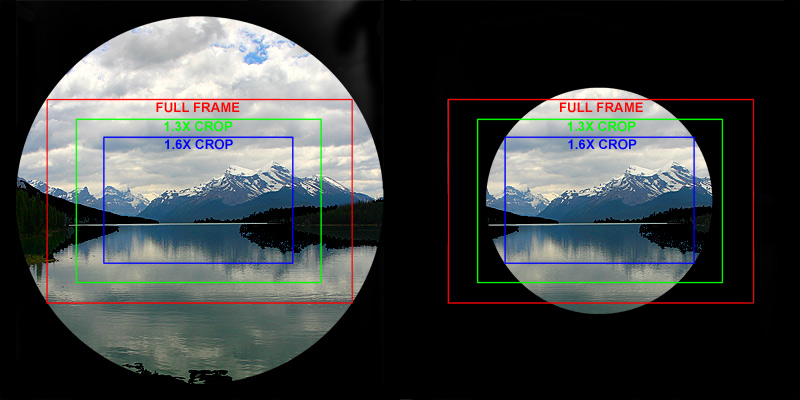
This appeared on TPF years ago, can't remember who originally posted it :)

Crop-factor.jpg
 
When 35mm film is run vertically as originally intended for cine cameras then 18x24mm (ish) is the frame size. The only still half-frame camera I know of that runs the film vertically so photos are landscape format is the Canon Dial.
I bet Olympus Pen users took a disproportionate number of shots in portrait format (like smartphone users today).
 
We've been here before Mike. Please check it out ;)
http://www.dofmaster.com/dofjs.html

<snip> and changing that the camera-to-subject-distance, will change the Depth-of-Field..... the crop factor 'alone' shouldn't.

It does.

Gets more confusing when folk try ad equate the f-number via the crop factor, and start suggesting that on a crop-sensor camera, the f-number is also magnified by the crop-factor, because they get more DoF from the shorter lens...... err... no... not really. they get the same DoF as they would with that lens! The DoF changes only with the aperture, and the Subject-to-Camera range, that they will likely change co-incidentally or even consequentially to changing the lens.<snip>

In terms of DoF, it is.
 
Last edited:
OK I get the idea of crop factors and lens altough why we have to have everything related to 35mm frame is, well beyond me.

Unlike pre-digital, we now use the same lenses on numerous different formats. We need a reference standard for easy comparisons (as you have just discovered ;)) and the crop-factor can be applied for both equivalent focal lengths and also to lens f/numbers for equivalent depth-of-field.

Anyway a hyperthotical situation:

I have three cameras, one is a 35mm sensor, one is smaller and gives a 1.5x crop and the other is 2x crop factor.

On a tripod is a 300mm f2.8 lens which has the ability to mount all three cameras.

There is a model standing some 25 yeards away.

The question, what will I see either in the view finder or print? will it be like the following?

35mm mounted the models face will be seen with their full face, ears, neck and top of the head and at f2.8 DOF has the eyes nose and mouth in focus the rest is bokeh.

1.5x crop mounted now because of the crop it is more of the face, the next is lost, you can still see some of the ears and the very top of the head is missing, DOF is now more.

Finally 2x crop all that can be seen is the eyes, nose and mouth.

Because ff the crop the image does note "magnify" it is just that the field of view is more centered and reduced because of the crop?

On full frame, you'll see 300mm; on 1.5x crop you'll see framing equivalent to 450mm, and on 2x crop it'll be 600mm equiv.

Now to see what that looks like in practise, go to a focal length simulator and input the numbers. There are a few simulators if you google, like this one from Sigma https://www.sigma-imaging-uk.com/focal-length-simulator/
 
Which is what I said and what the original question asked....
Yes and No...
The question and your answer do not specify the output/display... and if the three images (same distance/different sensor sizes/different compositions) are displayed at the same size and viewed at the same distance, then the DOF's will be quite different; with the smallest sensor having the least.

That's the thing about DOF, it's not a fixed characteristic of an image...
 
Yes and No...
The question and your answer do not specify the output/display... and if the three images (same distance/different sensor sizes/different compositions) are displayed at the same size and viewed at the same distance, then the DOF's will be quite different; with the smallest sensor having the least.

That's the thing about DOF, it's not a fixed characteristic of an image...

:thumbs:
 
Yes and No...
The question and your answer do not specify the output/display... and if the three images (same distance/different sensor sizes/different compositions) are displayed at the same size and viewed at the same distance, then the DOF's will be quite different; with the smallest sensor having the least.

That's the thing about DOF, it's not a fixed characteristic of an image...
Yes fair enough... thats the thing about circles of confusion ;) As the OP didn't mention number of megapixels on the sensor or viewing size I didn't either. Yes the number of pixels forming the image will make a difference (more=less acceptable CoC) and off course the smaller sensor needs enlarging more to fill that theoretical 10 x 8, thus the CoC is enlarged....
 
Last edited:
Yes fair enough... thats the thing about circles of confusion ;) As the OP didn't mention number of megapixels on the sensor or viewing size I didn't either. Yes the number of pixels forming the image will make a difference (more=less acceptable CoC) and off course the smaller sensor needs enlarging more to fill that theoretical 10 x 8, thus the CoC is enlarged....

Depth-of-field is one of the subjects where pixel density can be comfortably ignored - the DoF standard is too coarse for them to be significant. If you take the specified CoC for APS-C 1.6x (then smallest for DSLR users) and an 18mp camera (quite a modest total these days) then the CoC at sensor level is 0.019mm, which equates to 44 pixels. A few more or less makes zero difference to DoF.
 
Depth-of-field is one of the subjects where pixel density can be comfortably ignored - the DoF standard is too coarse for them to be significant. If you take the specified CoC for APS-C 1.6x (then smallest for DSLR users) and an 18mp camera (quite a modest total these days) then the CoC at sensor level is 0.019mm, which equates to 44 pixels. A few more or less makes zero difference to DoF.
To be honest I never really bother, after years of high macro photography I knew what would be acceptable for a given magnification, we could be producing an image at x20mag but in publication it was reproduced at little over a postage stamp size... I guess one can end up in a muddle with the theory and mathematics involved, think I will stick with precedence ;)
 
Yes and No...
The question and your answer do not specify the output/display... and if the three images (same distance/different sensor sizes/different compositions) are displayed at the same size and viewed at the same distance, then the DOF's will be quite different; with the smallest sensor having the least.

That's the thing about DOF, it's not a fixed characteristic of an image...

It's worth emphasising this point of Steven's, which is fundamental, but is the bit that's commonly overlooked.

DoF is not fixed at the moment of capture on the sensor, and changes with any aspect of magnification at any point in the chain right up to final viewing of the image. DoF can only be measured and compared when the image is rendered (output/printed) and viewed from a certain distance. Basically, the universal DoF standard that we all work to assumes that the (uncropped) image will be viewed at a distance equal to the diagonal length, eg a 10in print from around 12in. Most computer screens are specified by diagonal width so a 23in screen say should be viewed from 23in for the DoF calcs to work.

Bear this in mind when checking the camera's LCD for sharpness - the perceived DoF changes as you zoom in. At max magnification (usually 10x) a 3in LCD should be viewed from around 30in to properly assess DoF. At 5x magnification, something around arm's length should be about right.
 
DoF is not fixed at the moment of capture on the sensor, and changes with any aspect of magnification at any point in the chain right up to final viewing of the image. DoF can only be measured and compared when the image is rendered (output/printed) and viewed from a certain distance. Basically, the universal DoF standard that we all work to assumes that the (uncropped) image will be viewed at a distance equal to the diagonal length, eg a 10in print from around 12in. Most computer screens are specified by diagonal width so a 23in screen say should be viewed from 23in for the DoF calcs to work.

Bear this in mind when checking the camera's LCD for sharpness - the perceived DoF changes as you zoom in. At max magnification (usually 10x) a 3in LCD should be viewed from around 30in to properly assess DoF. At 5x magnification, something around arm's length should be about right.

You wont thank me for saying this again but I do dislike this way of explaining DoF and I think that the following is worth saying again if only to provide a different way of saying it and maybe even a bit more clarity.

The DoF you will see at any given magnification or viewing distance is fixed when you pick up the gear, choose your setting and press the button.

Take three examples. Want to see just bit of blurring in the background in a 6x4? Want to see just a bit of blurring in the background in an A2 print? Want to see deep DoF in a 100% crop of a close up shot of a flower or little beastie when displayed to fill a tablet screen? If you do it'd be best to have your requirement in mind when you choose the gear, choose your settings and press the button because once you've pressed that button it's all set (and the settings for each of those examples will be different) and if you've got it wrong you could be left with front to back sharpness in your 6x4 or a completely blurred background in your A3 or a beastie with razor thin DoF on your tablet screen but keep your end result in mind and you could choose the gear and settings to get you the DoF you want.

When you magnify to whatever degree or change your viewing distance you either hide or reveal the DoF and other characteristics that were captured when you pressed the button.

I think it's much better to think about it this way and to think about the end result you want including the image size and viewing and work back from there. If you want deep or razor thin DoF or whatever variation in between at whatever magnification and viewing distance you choose it all starts with your selection of gear, the settings you dial in and the positioning too and it's set and captured when you take the shot.

To say that DoF isn't fixed at the moment of capture just seems uttery daft to me when plainly it is and all you can do later is reveal or hide it with your choice of magnification, image size and / or viewing distance.

I hope that helped someone somewhere.
 
The DoF you will see at any given magnification or viewing distance is fixed when you pick up the gear, choose your setting and press the button.
Basically saying the same thing IMO... if the relative viewing size of the output is known/controlled (rare IMO) then the DOF in the image *is* fixed at the time of capture, and it is therefore best to work backwards from the requirement to the selection of equipment.
When you magnify to whatever degree or change your viewing distance you either hide or reveal the DoF and other characteristics that were captured when you pressed the button.
Technically the DOF is changing... you are not hiding/revealing it.
 
Basically saying the same thing IMO... if the relative viewing size of the output is known/controlled (rare IMO) then the DOF in the image *is* fixed at the time of capture, and it is therefore best to work backwards from the requirement to the selection of equipment.

Technically the DOF is changing... you are not hiding/revealing it.

Yes, I'm saying the same thing but I think I'm saying it clearer and one of my problems with saying that DoF doesn't exist until you print and look is that I think it adds confusion for anyone who maybe hasn't got a working understanding.

The DoF shouldn't be some big reveal that comes as a surprise in the final image... "My gosh! I've printed the picture x size and now I see.... THE DOF!" That shouldn't happen. It should be pretty predictable, and it is. It is what it is. It's set by the gear, the settings and where whatever you're pointing the gear at is when you press the button and once you've pressed the button what you see in a 1" print or a 6m wide one is pretty predictable.

Maybe I'm reading too much into this and no newbies are confused but I find "DoF is not fixed at the moment of capture on the sensor, and changes with any aspect of magnification at any point in the chain right up to final viewing of the image." needlessly confusing and almost mystical. It's not magic, there's no big reveal or mystery here and Yoda and The Force have nowt to do with it. The DoF you will see at any given magnification and viewing distance is predictable and is decided at the moment of capture.

As to the final image size rarely being known unsurprisingly I disagree again :D

Dunno about you but I often choose my gear with an eye to what the final image is going to be used for. Many of my pictures are sized 2000 pixels wide and saved as quality 9 and sent electronically for viewing on tablets and phones but the same picture could also be saved full size at quality 12 to be printed A3, framed and mounted on a wall and it's the latter possibility that's often in my mind when I choose the gear and settings. At other times I take pictures which I'm pretty sure will only be of interest to me and will probably never be printed big and these include heavy crops to 100% or so often taken with my MFT cameras. In this case I'll very probably only view on screen and I know that I can get a perfectly good 100% or so crop at something like 1200-1500 wide and that it'll look lovely when filling my screen. I accept that an A3 print probably isn't going to look so lovely when viewed closely or even normally. Choose the gear and settings for the result you want at one output size and then try and do it at another and you may well hit problems. Don't think about it at all and... you may be disappointed.

I'd assume that anyone taking pictures more seriously (and maybe for money) will also have a final image size and viewing circumstance in mind and just maybe this influences their choice of gear and settings. I assume someone doing this will have a pretty good idea what the final product, the picture, will look like in their clients magazine article or framed on the clients wall or printed billboard size and will know what gear and settings will get the job done and keep the cheques and bank transfers coming. But maybe I'm wrong and it all only gets revealed when the final image is printed at x size and viewed from y distance. Call me a rebel but I think that's bunkum.

:D
 
Last edited:
Back
Top