Terrywoodenpic
Suspended / Banned
- Messages
- 8,172
- Name
- Terry
- Edit My Images
- Yes
More nonsense is written about stitching Panoramas than almost any other digital technique.
In this weeks AP it is held up as if it were in some way difficult, ..
That sometimes pictures will not go together with out strange overlaps.
That stitching five landscape shots together is no easy feat;
That extreme wide angle lenses exaggerate and distort the whole scene;
That the image produced is not technically correct.;
That the implication is that straight and level horizons might be difficult to achieve.
On the processing side it was suggested that PTLens or such program was necessary before stitching.
Most of the better modern stitching software is base on the math of Professor Helmut Dursch and his work on Panorama Tools
PTLens is a front end Gui that uses this same software for lens corrections. It is totally unnecessary to use this as a preliminary step when using stitching software based on PT, Such as PTAssembler or PTGui as this function is an integral part of the process.
It makes no difference to such stitching software what focal length is used, from Extreme wide to extreme telephoto makes no difference at all to the geometry of the final result. They will be Identical.
However you will need more shots the longer the lens you use, also the detail achieved and file size will also become greater.
It is no more difficult, though takes more processing time, to stitch with any number of shots provided they are taken with a properly set up Pano bracket, or do not include widely different object distances.
Things such as vertical features and horizons are normally automatically dealt with by the software, but both the above mentioned stitching programs make any needed manual corrections simplicity itself.
More recent blending plugins like smart blend even deal with residual parallax problems and even up skies quite automatically.
Perhaps the most Problematic area in making stitches is the choice of control points when done automatically these are often clumped in close proximity, or even worse, placed in the sky or on trees, water or other moving objects. The recent plug in panomatic seems to give a far better spread of points than the older autopano
The primary function of the control points is to supply information about the orientation of the individual pictures and supply matamatical data of the physical lens distortions. Focal length and crop factor is normally provided by the exif data.
Bad control points provide incorrect data to the stitcher, which can then cause weird results.
In such cases or when the highest quality results are necessary, bad points should be removed and new one positioned manually.
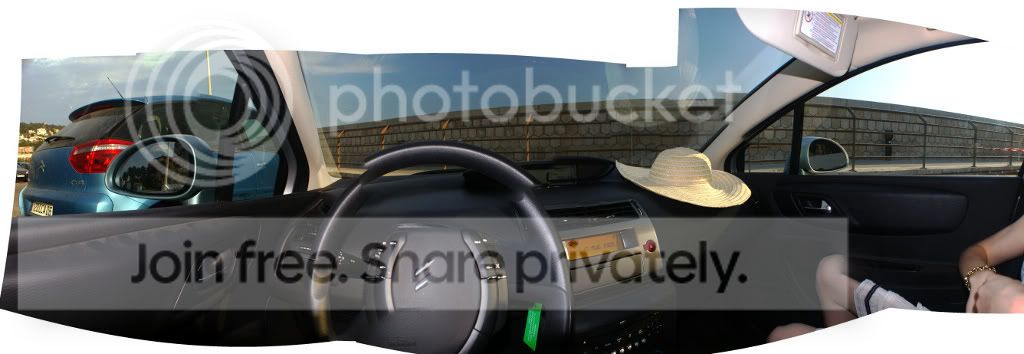
Resulting stitched panoramas give technically correct representations of the original scene but their suitability will depend on the whatever projection is chosen for the final result
On the taking side the information provided by David Clapp is excellent, though I would add that the bubble level should not be used to make corrections to individual shots as this always results in stitching problems.
For your pockets sake, I would advise looking at the Nodal Ninja Range of Pano brackets, they are excellent.
Useful links.
http://www.tawbaware.com/forum2/
http://www.nodalninja.com/index.html
http://www.nodalninja.com/forum/
http://www.tawbaware.com/maxlyons/
http://www.tawbaware.com/ptasmblr.htm
www.PTGui.com
In this weeks AP it is held up as if it were in some way difficult, ..
That sometimes pictures will not go together with out strange overlaps.
That stitching five landscape shots together is no easy feat;
That extreme wide angle lenses exaggerate and distort the whole scene;
That the image produced is not technically correct.;
That the implication is that straight and level horizons might be difficult to achieve.
On the processing side it was suggested that PTLens or such program was necessary before stitching.
Most of the better modern stitching software is base on the math of Professor Helmut Dursch and his work on Panorama Tools
PTLens is a front end Gui that uses this same software for lens corrections. It is totally unnecessary to use this as a preliminary step when using stitching software based on PT, Such as PTAssembler or PTGui as this function is an integral part of the process.
It makes no difference to such stitching software what focal length is used, from Extreme wide to extreme telephoto makes no difference at all to the geometry of the final result. They will be Identical.
However you will need more shots the longer the lens you use, also the detail achieved and file size will also become greater.
It is no more difficult, though takes more processing time, to stitch with any number of shots provided they are taken with a properly set up Pano bracket, or do not include widely different object distances.
Things such as vertical features and horizons are normally automatically dealt with by the software, but both the above mentioned stitching programs make any needed manual corrections simplicity itself.
More recent blending plugins like smart blend even deal with residual parallax problems and even up skies quite automatically.
Perhaps the most Problematic area in making stitches is the choice of control points when done automatically these are often clumped in close proximity, or even worse, placed in the sky or on trees, water or other moving objects. The recent plug in panomatic seems to give a far better spread of points than the older autopano
The primary function of the control points is to supply information about the orientation of the individual pictures and supply matamatical data of the physical lens distortions. Focal length and crop factor is normally provided by the exif data.
Bad control points provide incorrect data to the stitcher, which can then cause weird results.
In such cases or when the highest quality results are necessary, bad points should be removed and new one positioned manually.
Resulting stitched panoramas give technically correct representations of the original scene but their suitability will depend on the whatever projection is chosen for the final result
On the taking side the information provided by David Clapp is excellent, though I would add that the bubble level should not be used to make corrections to individual shots as this always results in stitching problems.
For your pockets sake, I would advise looking at the Nodal Ninja Range of Pano brackets, they are excellent.
Useful links.
http://www.tawbaware.com/forum2/
http://www.nodalninja.com/index.html
http://www.nodalninja.com/forum/
http://www.tawbaware.com/maxlyons/
http://www.tawbaware.com/ptasmblr.htm
www.PTGui.com