A good set up for bikes?

zerodeluxe

Suspended / Banned
Messages
262
Name
Ben
Edit My Images
No
Hi

Not been here for while now and have asked a similar question before, but what would anyone recommend as a good (but not overly expensive) studio lighting setup for bikes please?

We've got a bit of a budget and are comparing the cost with just sending to a studio, as ideally to do them in-house will give us much more flexibility. I did some earlier in the year with a three light set up (only continuous lighting) and they were "okay" but I knew the lighting needs to be improved considerably (the results weren't horrendous, but by no means a match to a equipped studio! Under the circumstances I think they turned out pretty well considering).

I'm assuming the very least I'll need is a five light setup to cope with the bike and the backdrop, but are brollies or softboxes better? (Thinking of reflections).

I may even look into a short lighting course of some sort, just to give me a bit more confidence, so any recommendations on that would be welcome too.

I know many will think if I'm not skilled in this already then we should send to a pro, but we want to start somewhere, and in today's climate, with the amount of bikes needed to shoot, we could potentially save £1,000's. If having our own set up doesn't end up being cost effective/time effective then we will most likely farm it out. We'd like to try though....

Thanks!

Ben
 
Quick question - are these motor bikes or Bicyles ?
 
Many years ago I was asked to photograph a custom motorcycle for a magazine 'show us your ride' section - the owner thought that rather than just take a snap if he could get some pictures taken with studio flash he stood more chance of getting them published.

So I did my best with the gear I had and the results were very good and the motorcycle was indeed featured, but the pictures used in the magazine were professionally done in a very well equipped studio & whereas mine were very good, theirs were magnificent.

The set-up they used basically consisted of a cyclorama with a huge overhead light-bank, this gave very even lighting. Then with the use of a selection of smaller flash heads highlights were added and the final element was to use black flags and reflectors to add contrast/subtract light. Overall I would imagine the same process should be used for pedal cycles, just a bit scaled down.

Or you could go to the other extreme:D

Paul
 
You mean static studio product shots of BMX bikes?

Sample of want you've done, and what you think is wrong with it. And why you think you'd need five lights.
 
You might be able to get away with 3 lights. My first try would be a strobe overhead with a large bounce umbrella...this would be the "general lighting" source. I would add a striplight/softbox for frontal directional lighting. And then a third as key (snoot/bare/shoot thru, whatever suits the need). If the lights are close enough/large enough, and the subject is close enough to the BG, the spill may be enough to blow out the BG (assuming white). If not, you'll need another 1-2 for the BG.

If some of the bikes are silver/white they can tend to "blend in" with the BG and black panels can be used to add "negative lighting" to define the edges (basically throws a black reflection on the edges).

A white vinyl seamless BG will be easier to work with/blow out than fabric/paper will (fabric being the worst). Of course, you could create your own "infinity wall" instead.
 
Planet X do their own product shots (or did), they are all very simply lit and are fit for purpose, have a look at at their photography, shouldn't be that difficult to replicate.
Background lighting doesn't really matter if you are doing a cutout.
 
a few years ago i did some to show a client, they liked them so much i got the job, it was a simple set up, perspex below the bike and two flash heads with softboxes directly over the bike - for the white background i used two more flash heads but for the black background i just used the bike lights. i didnt use a stand for the bike, i floated it. Its something we do regularly now so has become second nature. have a look on www.tomcookephotography.co.uk to see it. a video of the setup can be seen here - http://vimeo.com/22806298 its a terrible quality video,
 
Last edited:
I would not want to have to cut out a bicycle...between the spokes, levers, cables, etc. etc. Easier to just do it right in the first place. Maybe if it was a green screen shot...

+1, especially as it is a relatively easy set-up (as long as you have the gear) ;)

Paul
 
You might be able to get away with 3 lights. My first try would be a strobe overhead with a large bounce umbrella...this would be the "general lighting" source. I would add a striplight/softbox for frontal directional lighting. And then a third as key (snoot/bare/shoot thru, whatever suits the need). If the lights are close enough/large enough, and the subject is close enough to the BG, the spill may be enough to blow out the BG (assuming white). If not, you'll need another 1-2 for the BG.

If some of the bikes are silver/white they can tend to "blend in" with the BG and black panels can be used to add "negative lighting" to define the edges (basically throws a black reflection on the edges).

A white vinyl seamless BG will be easier to work with/blow out than fabric/paper will (fabric being the worst). Of course, you could create your own "infinity wall" instead.

More or less...
But don't use an umbrella overhead, use a large softbox instead, on a boom arm. This will create a diffused specular highlight along the saddle, along any horizontal bars etc, an umbrella will just produce a horrible reflection.

The name of the game here is to get it as close to 100% right in camera as possible. You can tweak in PS or LR but you need to avoid cutouts if at all possible, they are very expensive when it comes to bike spokes.

And you definitely will need at least one extra light on the background.
 
More or less...
But don't use an umbrella overhead, use a large softbox instead,

You really don't like umbrellas do you? IME, and IMO, the only significant difference between an umbrella and a softbox is the ability to control light falloff at the sides.
As you know, "diffused light" is controlled by size/distance...I don't know why you would say an umbrella "will just produce a horrible reflection."
 
You really don't like umbrellas do you? IME, and IMO, the only significant difference between an umbrella and a softbox is the ability to control light falloff at the sides.
As you know, "diffused light" is controlled by size/distance...I don't know why you would say an umbrella "will just produce a horrible reflection."

I like umbrellas a lot, mainly because the light is good and they're so cheap and easy, but the main difference between a brolly and a softbox is you can use the softbox much closer, if needs be. And certainly with a subject invloving specula reflections, umbrellas can look pretty ugly with spokes and the flash head clearly visible in the reflection instead of a nice clean highlight.
 
I like umbrellas a lot, mainly because the light is good and they're so cheap and easy, but the main difference between a brolly and a softbox is you can use the softbox much closer, if needs be. And certainly with a subject invloving specula reflections, umbrellas can look pretty ugly with spokes and the flash head clearly visible in the reflection instead of a nice clean highlight.

I like umbrellas a lot, mainly because the light is good and they're so cheap and easy, but the main difference between a brolly and a softbox is you can use the softbox much closer, if needs be. And certainly with a subject invloving specula reflections, umbrellas can look pretty ugly with spokes and the flash head clearly visible in the reflection instead of a nice clean highlight.

A bounce umbrella cannot be placed as close, this is true. A shoot thru umbrella can be placed as close, but will have a bit less wrap. But since the object to be lit is fairly large, no light source (unless huge) will be able to be placed "close." For a given distance/size of modifier a bounce umbrella will have the most wrap and the widest pattern which is good or bad depending on the goal. Since the idea was to use fewer lights/simpler setup I suggested the bounce for the extra spill onto the BG. Bounce umbrellas also require more power/ put out less light.

As for the "catchlight" showing the source of the light...that is also true as long as the angle is ~90* or less to the camera and there is a reflective surface to show it. Beyond 90* or greater (i.e. overhead) you will not see the source of the light, only the light being thrown by it. Yes, you will still see the "shape" of the light if the light falling on the object is narrower than the object being lit. And yes, areas not being lit due to "obstruction" (flash head) will still not be lit. But at greater distances the light coming from the umbrella will spread and "fill in" those areas.

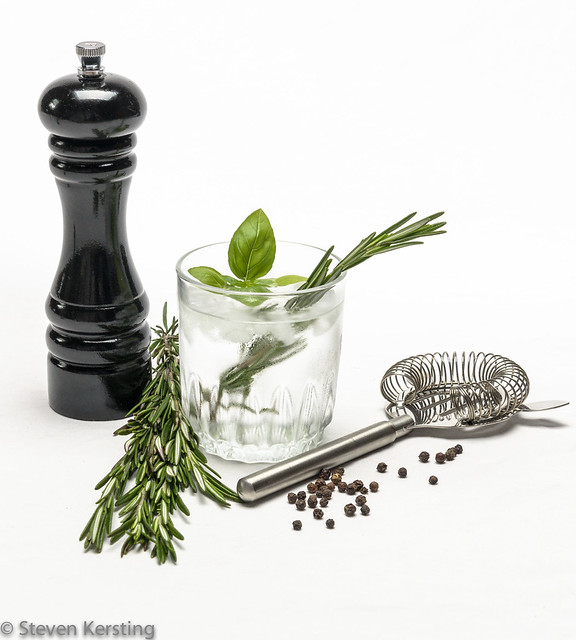
This was shot basically as I suggested. Umbrella above and fairly far (hard). Softbox also above, but frontal. Third light from the left. You can see the softbox, but not the umbrella. I should have used a flag/negative light on the right side.

5 o'clock somewhere by skersting66, on Flickr

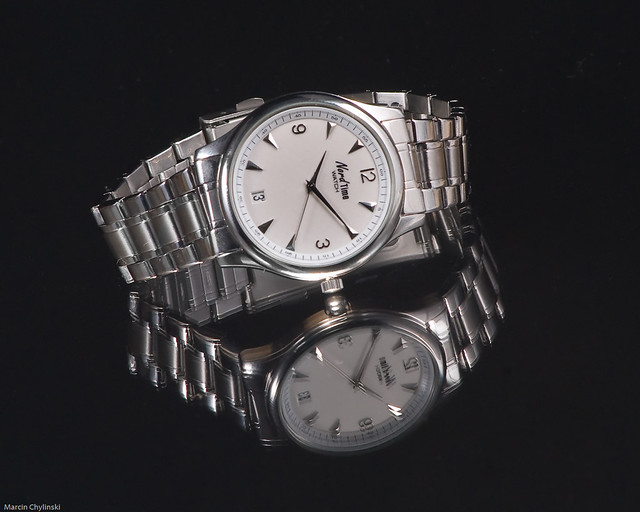
These next two were also shot using umbrellas, but they are not my work.

Product photo test by h4ndz, on Flickr

First attempt at product photography by Marcin Chylinski, on Flickr

It's certainly do-able...at least I believe it is. If I were going to do the bike shot "better," but also on the cheap/easy, I would stretch a sheet or shower curtain overhead and push two lights thru it.
 
Last edited:
It's about creating and controlling both light and shadow. It isn't, as many people seem to think, about having enough of it and about avoiding shadow.

Yes, as photographers we can often manage without the 'perfect' equipment for the job, either because we have to or because there's more than one way of approaching the shoot.
For example, if you're photographing a couple of mates having a drink then you'd it won't matter whether you use a softbox or an umbrella, or whether you use a studio flash head or a flashgun, or come to that why not just take the shot without any flash at all?

Product photography though is very different. Good shots sell the product.
Mediocre shots don't actually stop it selling
Bad ones do. So, it's worth doing a bit more to get a lot more.

With a subject like a bike, we need a diffused specular reflection on its top. That reflection needs to be smooth, so that people look at the bike, not at the lighting faults. That requires a large softbox, roughly in the shape of the bike - rectangular.

A reflective (bounce in American) umbrella can't do that for the reasons that Richard gave, and also because it's the wrong shape, putting light where it isn't wanted in the central area. It produces the type of hard, specular highlight seen in the pepper grinder and is far worse when used on a much larger subject.

And a shoot through umbrella will actually produce a lot more wrap, not less, because it can be placed much closer. but it has two major problems.
1. The light goes everywhere, destroying lighting control.
2. The centre is much closer than the edge, producing uneven lighting.

That's why I said that a softbox on an overhead boom arm is needed for this job.
 
As noted, in the image of the drink the specular highlight is from the softbox which was high front and not from the umbrella which was above and slightly behind. Interestingly, the softbox was much larger than the scene, and not that far away (maybe a few feet) and it's the type of box with an internal "spreader"... Of course, this is due to the surface being spherical and there was nothing I could do about it other than A)use a HUGE softbox B)use a light tent C) not use a light from that direction.

The umbrella created a lot of the highlights seen (top edges) and it is actually not specular... It also created the defined shadows due to it's distance.

I understand your reasoning, but I disagree that some fill light is necessarily bad. In fact, it's necessary. Just because it's coming from a light source with another primary function, rather than a separate "dedicated" light source, doesn't necessarily make it bad...if you don't like it you can flag it off.

"And a shoot through umbrella will actually produce a lot more wrap, not less, because it can be placed much closer. but it has two major problems.
1. The light goes everywhere, destroying lighting control.
2. The centre is much closer than the edge, producing uneven lighting."

Well yes, but you ignored my criteria of "similar size at the same distance." Used as bounce with the front edge of the modifier at the same distance it will have more wrap because the edges are much closer than the center, and the lighting will be "more even" due to the hotter portion being further away.
An umbrella is always less control due to the spill/uncontrolled reflected light. That's why I said *I* think control of spill is the main benefit of a softbox. But "less control" doesn't necessarily mean "insufficient control."

The fact is, a single light source overhead is probably not ideal for this situation...You probably could get a softbox/strip light big enough (~84" I'm thinking, an "average length" for the typical adult bicycle) but that would be expensive and heavy requiring additional support beyond your average light stand/boom and it might require a pretty powerful head to keep up with the other lights. A light bank would be even better and even more expensive.

Ideally, something like this would be done with an infinity wall, multi head light bank overhead, and probably 3-5 additional lights with modifiers...rather expensive...And if *I* were setting up such a studio for product photography of similar items (i.e. not people or food) I would probably choose constant lights, air conditioning, and a tripod.

But that was not the question. The question was how to do the job (could it be done) effectively with 3-5 lights and minimal investment.
I'm fairly certain I could produce results above "mediocre" with an umbrella overhead...possibly even with only 3 lights. I'm half tempted to do it "just because"....But I don't have a permanent studio setup, I have other things I should be doing, and I'm too lazy to go thru all of that effort just to prove a point.

now I have to quit debating this stuff and go do my business taxes....
 
It's about creating and controlling both light and shadow. It isn't, as many people seem to think, about having enough of it and about avoiding shadow.

Yes, as photographers we can often manage without the 'perfect' equipment for the job, either because we have to or because there's more than one way of approaching the shoot.
For example, if you're photographing a couple of mates having a drink then you'd it won't matter whether you use a softbox or an umbrella, or whether you use a studio flash head or a flashgun, or come to that why not just take the shot without any flash at all?

Product photography though is very different. Good shots sell the product.
Mediocre shots don't actually stop it selling
Bad ones do. So, it's worth doing a bit more to get a lot more.

With a subject like a bike, we need a diffused specular reflection on its top. That reflection needs to be smooth, so that people look at the bike, not at the lighting faults. That requires a large softbox, roughly in the shape of the bike - rectangular.

A reflective (bounce in American) umbrella can't do that for the reasons that Richard gave, and also because it's the wrong shape, putting light where it isn't wanted in the central area. It produces the type of hard, specular highlight seen in the pepper grinder and is far worse when used on a much larger subject.

And a shoot through umbrella will actually produce a lot more wrap, not less, because it can be placed much closer. but it has two major problems.
1. The light goes everywhere, destroying lighting control.
2. The centre is much closer than the edge, producing uneven lighting.

That's why I said that a softbox on an overhead boom arm is needed for this job.

+1 - Garry has hit the nail on the head here!
 
Cool - thanks for all the replies so far! Sorry - been a bit busy to check back on all this!

At the moment I have 3 continuous lights with soft boxes (2 floor, 1 boom) - the light isn't terribly good so I do need a a fair bit of post production. And yes, ideally to blow out the background so I don't need to clip out 30+ bikes! (I'll send to a clipping path service if it's necessary for print work...)

I'm hoping that maybe we can use these 3 lights *somehow* (or at least the stands) but I was suspecting I'd be better off with all new studio flashes to get the higher power.

We have a white vinyl backdrop, but it's only just wide enough. Again, we could do with a slightly wider one, but we could probably manage as I can paint in the gaps.

As an example of one of the previous images, here is one with PP:

Total-Pic-Sample-1.jpg


So yeah, okay, but certainly no "zing". (I think this was one of the "sample" PP's too which I did to show the bike co. the angles etc - not one of the final ones, but it was the only one I could find a link to quickly, so the white bg hasn't been done "properly")

I think the idea of the black sheets may work well - I think we could easily sort that to cut down on unwanted reflections. A larger overhead softbox would be great as well.

I think I'll need to start a thread in the other section about the actual shots too. I'd like to cut down on the "perspective"... ie, the back wheel is much smaller than the front. I've seen bikes on the same angle where this doesn't happen as much - does the camera need to be further back and use a longer lens? (I've got a 7D with a Tamron 17-50 which I used for those - If we don't buy in a new one I'll hire a 5DII and lenses for the job.)

The kind of shots we'd like to achieve are on this site:

http://thevandalsbmx.com/

A little better, non?! :)

I'd love to try and do all of this here under my own steam as it would be great to learn and get some lighting experience... but if we do have to get it done properly then so be it.

If anyone can recommend or provide links to lights/kits that might help that would be great. I've searched around and found one (http://www.lencarta.com/lighting-store/studio-lighting-kit/twin-head-mains-powered-starter-kit-506) which *might* be okay but not entirely sure. I'd just need a new head for the overhead boom.

A lot of this will be down to cost - if it's not going to save us very much (equipment and time/effort included) then again, we'll send to a studio.

Again, thanks everyone for the advice so far!
 
Last edited:
I think you've made a fair job of the example you've posted, but I bet it involved a LOT of PP work... Proper studio flash is definitely needed here, and the kit you linked to will be fine, although you will of course also need a larger softbox, to go on the overhead boom arm that you also need.

The white background will be OK as long as it's big enough for the bike, adding white "canvas" later isn't a problem.

Your lens is just unsuitable so yes, you need to be further back. Going further back will solve (or help with, depending on how back you can go) the perspective distortion problem, and of course the background size problem. Perspective in photography, as in life, depends on viewpoint - we tend to use longer lenses when we're further away, to fill the frame, but it's the viewpoint that affects perspective distortion, not the lens. If these shots are just for web use, using your existing lens from further back will probably produce all the image quality you need. But if it's for print, you will need a longer lens to get the image quality.

Actually those shots you link to are nothing special.You should be able to achieve that standard very easily, with the right equipment and some practice.
 
Thanks. Yeah there was some PP needed for sure, although the worst being the removal of the prop under the rear pedal... I've since got a better clear perspex tube which is now pretty much is unseen in the right conditions (we may even get a proper custom perspex prop). I'd like to reduce the loss in quality from having to adjust the exposure and brightening the whites in PP.

Just been looking for a larger softbox now. I'd hope we can use the book arm we already have.

With the kit I linked, can I reuse the soft boxes I have on the continuous light if the brollies weren't giving the correct reflections?

I'd also need an extra head for above - would it be more sensible to get the same make with a built in wireless trigger so it all works together, or not worry and use a third party trigger?

Thanks for confirming about the longer lens and camera position - I had suspected that was the case. We used a small room for that sample shot (camera about 6-7ft away) so had no choice but use that lens, but we can utilise the warehouse for the shoot, which will give us much more room (especially depth). I'd like to think a longer prime lens would be ideal (100/150mm?), but maybe a 70-200L might give more flexibility to experiment with distance?

Thanks again for the help!
 
It's highly unlikely that your existing softboxes will fit. They need to be S-fit, and most continuous lighting is physically far too big for that to be possible.

You can use a 3rd party trigger to fire any flash heads, it isn't a problem.
You don't need an especially high quality lens for this purpose. You'll typically be shooting at around f/8, and pretty well any lens will perform well at that aperture. I would say, with enough space, that 100 - 200mm would be ideal.
 
Just to add to what Garry said, a sheet of perspex for the reflections on the floor.

I'd guess a stripbox would be the most suitable shape for the keylight, and if it's a semi permanent solution I'd put up something more substantial than a boom arm on a stand, maybe ceiling mounted tracking or just a frame. But I'm not really an expert.
 
TBH, your shot isn't bad and I suspect the one in the link that you like perhaps started out not too different. But it's had a lot of post-processing done and the wheel reflection is a popular Photoshop trick. Your shot was taken at close distance with 23mm focal length, so just move back and shoot at the longer end of your zoom to fix the perspective.

You also don't necessarily need flash for this, as the subject is static and you can overcome the lack of brightness just by increasing shutter speed. However, a decent studio head will allow you fit better modifiers and that's the bit you need to work on, lighting technique, to minimise post-processing, but you will always need some with white backgrounds like this.
 
Thanks Hoppy. I know I wanna throw more light behind so I'm not trying to brighten it too much in PP - that's one hurdle I'd like to overcome! So even if I just get the flashes for behind and maybe one for overhead and keep two continuous lights that would be better than I have now!

I'd Imagine if we use reflections I'll add these in Photoshop afterwards if we think we need them. Easier to add than remove I'd have thought?!

Phil - It's going to be a one-off set up, so I think we'll have to use the boom for now. Maybe if one day we extend we might get a dedicated space for this and then we can look to have it ceiling mounted. Good point though.
 
Thanks Hoppy. I know I wanna throw more light behind so I'm not trying to brighten it too much in PP - that's one hurdle I'd like to overcome! So even if I just get the flashes for behind and maybe one for overhead and keep two continuous lights that would be better than I have now!

I'd Imagine if we use reflections I'll add these in Photoshop afterwards if we think we need them. Easier to add than remove I'd have thought?!

Phil - It's going to be a one-off set up, so I think we'll have to use the boom for now. Maybe if one day we extend we might get a dedicated space for this and then we can look to have it ceiling mounted. Good point though.

Mixing flash and continuous light will make life difficult. You can do it, but the flash will be so much brighter you'll have to mess about balancing exposures and may get colour problems.

White backgrounds are difficult. Lots of threads on this, but the main problem you have here is both the background and floor need to be slightly over-exposed* to blow to pure white. Not that hard for the background but if you over-expose the floor then the subject gets over-exposed with it.

Plenty of space (distance between subject and background) and controllable modifiers (eg big rectangular softbox with grid) help a lot. Then you can get the background over-exposed right up close to the bike, and contain the spill better. That should leave a minimal area to clean up in post processing, and you want a little bit of shadow around the wheels to give the image something to 'sit' on. The Photoshopped reflection thing is optional.

*Edit: Background/floor should be only just blown to white (aim for half a stop over-exposed) and that over-exposure must be even all over. If you over-do it, it will eat away at the subject outline and cause contrast-reducing flare. Screeen off all areas of white outside the actual image area with black paper/material/whatever to minimise flare. Moving back and using a longer lens will reduce the area of background needed.
 
Last edited:
Okay - in which case I will push to get ALL new flashes. If the budget it there, that shouldn't be a problem. That Lencarta set up isn't going to break the bank, but I will check out similar (although initially I've not seen a 4 light set up in that price range). I may just need triggers, extra head and softbox... black sheets... hire of the camera and lens...

Anything else that I might need that I've not thought of?
 
Okay - in which case I will push to get ALL new flashes. If the budget it there, that shouldn't be a problem. That Lencarta set up isn't going to break the bank, but I will check out similar (although initially I've not seen a 4 light set up in that price range). I may just need triggers, extra head and softbox... black sheets... hire of the camera and lens...

Anything else that I might need that I've not thought of?

Phone Garry Edwards and talk it through. There's plenty of flash kit about that will do the job but you won't get better value than Lencarta. From what you've now posted, he will have a good idea of what's needed in terms of kit for that specific task, but will need to know about how much space etc you've got.

TBH, the kit bit is easy. Setting everything up is rather more difficult. Modifiers, positioning, balance and so on will be critical to get a) the result you want with b) minimal post processing. It's a skilled job, and from what you've said re a permanent set-up then I would get a professional (skilled in studio lighting) to do that for you. Garry may be able to advise on that too.
 
IMO, your image is as good as the ones linked to. Personally, I think the highlights are a bit soft and the contrast a bit low (black point).
I like perspective in images like this..it adds another bit of "drama." On the product page you might want to add "other views" such as a flat profile to make things like tire diameter directly comparable... If you go with a longer lens it will reduce the perspective, but not eliminate it...it will also make your BG appear larger *if* there is much distance between the subject and the BG, which you'll need more of anyways if you add stronger lighting to the BG to blow it out more.

Also IMO, the advantage of strobes over constant lights is power. The advantage of constant lights is WYSIWYG. Constant lights just require longer exposures and a tripod.
 
IMO, your image is as good as the ones linked to. Personally, I think the highlights are a bit soft and the contrast a bit low (black point).
I like perspective in images like this..it adds another bit of "drama." On the product page you might want to add "other views" such as a flat profile to make things like tire diameter directly comparable... If you go with a longer lens it will reduce the perspective, but not eliminate it...it will also make your BG appear larger *if* there is much distance between the subject and the BG, which you'll need more of anyways if you add stronger lighting to the BG to blow it out more.

Also IMO, the advantage of strobes over constant lights is power. The advantage of constant lights is WYSIWYG. Constant lights just require longer exposures and a tripod.

To be clear, as you say, a longer lens will make the background relatively larger, and that means there will be less physical area of it in the frame, so it needs less studio space and will be easier to light.

Yes, flash has much greater brightness than continuous lights though that's not such a major consideration here. More importantly, continuous lights that have even the minimum workable brightness have multiple large bulbs meaning that there's a very limited range of modifiers available to fit them. You're pretty much stuck with whatever they come with.
 
Last edited:
Yes, flash has much greater brightness than continuous lights though that's not such a major consideration here. More importantly, continuous lights that have even the minimum workable brightness have multiple large bulbs meaning that there's a very limited range of modifiers available to fit them. You're pretty much stuck with whatever they come with.

Well, I'll have to concede that my experience with constant lights is relatively limited....I was not aware of a limitation as to modifiers.
 
How about going and looking at some studio flash equipment and discussing your needs face to face?

Just did a quick google and you have AJ's Studio & Cameras Supplies only 8 miles from Shepton Mallet. They sell Elinchrom, Bowens & Profoto - certainly not the cheapest, but they are virtually on your doorstep, never used them myself either (don't stock my preferred brand) but I'd have thought worth a chat.

Paul
 
To be clear, as you say, a longer lens will make the background relatively larger, and that means there will be less physical area of it in the frame, so it needs less studio space and will be easier to light.

Yes, flash has much greater brightness than continuous lights though that's not such a major consideration here. More importantly, continuous lights that have even the minimum workable brightness have multiple large bulbs meaning that there's a very limited range of modifiers available to fit them. You're pretty much stuck with whatever they come with.
Without wishing this thread to go off into yet another pointless discussion about the merits of continuous lighting -v- flash, this really is the whole point... It's all about the modifiers and how they are used. We're spoilt for choice with flash and although new continuous lighting products such as LED lights will happily take the same modifiers, these are expensive compared to flash, and the fluorescent continuous lights, as Richard says, have extremely limited modifier choices.

That's why it really needs to be studio flash, and especially with a modest budget.
 
Thanks for the advice guys! Much appreciated! I just need to price up all the equipment now and submit to the boss as to whether we go for it or not.

Thanks for the tip Paul - hadn't known about them so will check them out at least!
 
Garry - if I were to go for the SmartFlash 800 kit plus an Elite 300 for overhead, would the trigger in the kit work for the Elite?

Thanks!

Yes
 
Back
Top