35mm Camera Choice

paulkane1

Suspended / Banned
Messages
38
Name
Paul
Edit My Images
No
I'm interested in the old 35mm Cameras ,I think im getting sentimental,Don't know a lot about them,Could someone kindly provide a good choice of Camera ,to start of with? I've have a old Russian made lens ,Helios make , would it fit onto the old 35 mm Cameras? Where can you buy good 35mm Film,? I've watched a YouTube video,on how you can devolve your own 35 mm film,then print of the prints from your computer .If my lens ,doesn't suit,what lens ,would you recommended?All help appreciated.

Yours Kindly Paul
.
 
Hi Paul..if you want to use the Russian lens it's probably a screw M42 one and there are quite a few M42 screw cameras around OR you can choose a more modern camera with bayonet mount that can take a M42 screw adapter for the lens, so you get the benefit of both worlds i.e. bayonet lenses and screw although you would have to stop the lens down on the bayonet camera as it won't work on auto......if interested in this idea beware as some cameras like Olympus and Nikon won't work properly with this M42 adapter.
 
First off, welcome Paul! Second, have a read of https://www.talkphotography.co.uk/threads/first-film-camera-ever-or-for-many-years.481985/ ... there's quite a lot there that's useful.

Third, yes that lens is specifically designed for 35mm cameras, SLRs specifically. As Brian says, you'd need a camera with a M42 screw thread to use it. The classic, I believe would be a Pentax Spotmatic variant. However, there's a problem: the batteries for these cameras have been banned for years (mercury?), so there are various kludges to make them work, of varying effectiveness and cost. There may be camera families with the M42 mount and more modern batteries (Practika? Fujica?) but I don't know them. Bit of research needed.

The alternative is to buy a bayonet-mount camera that takes more modern batteries, eg the ubiquitous LR44 used in many cameras including the K-mount Pentax SLRs. You can mount the Helios with an adapter, and buy wonderful manual Pentax lenses. IMHO the sweet spot is the Pentax MX, fully manual with metering, one of the world's greatest viewfinders too. Others will probably try to hook you on Nikons, and Brian loves his Canons I believe. Plenty of choice! (Might be worth taking account of the digital cameras you use; some of the lenses might fit older cameras, particularly if the have aperture and focus rings.)

As you get newer cameras with autofocus, program modes, auto wind etc, you tend to get plastic bodies, full scale ugliness, and you might as well be digital as far as I can see. But some do have appeal!

So, plenty to go on with researching. Slow motion GAS with MUCH lower prices and very little depreciation!

To start with, for test purposes at least, why not buy some Agfa Vista 200 at Poundland (guess the price). You can also get film in Boots on a permanent buy one get one half price offer. Prices a little higher than you might get from t'internet, but you don't have to pay postage.

Most people here have a hybrid workflow where they process the film (or get it processed), scan it (or get it scanned), then edit on the computer and print from there. A few still have darkrooms and do the whole wet printng thing, but they are very much the minority.
 
I would go for a Pentax Spotmatic. Don't worry about the batteries. Although they were designed for mercury batteries (1.3 volts), they have a bridge circuit that means that the voltage only needs to be approximately correct. Modern 1.5 volt batteries will work fine.

Spotmatic are plentiful - just confirm with the seller that the meter works. They usually are, my three are fine. Something like a Practical MTL5B is also quite a good choice. Not as nicely designed or made as Spotmatic but still good workhorse cameras.

The Helios is an excellent lens - copied from the Carl Zeiss Biotar lens.
 
I would start by asking why 35mm?
I would then ask why 35mm SLR?

35mm film became the dominant format because it was 'cheap' and because it was 'small'. It was cheap, because it was the same stock, used in huge quantities by the movie industry, and from which economy of scale we got the widest range of different film types; which in the earlier days also made colour photography more viable. With all film now something of a specialist field, range of available stock is shrinking and getting more expensive; that 'advantage' no longer really exists.

The compact format, was the next advantage it had. A 35mm camera could be half the height width and depth and be an awful lot easier to lugg about than a 12 roll film camera; let alone a 1/4 plate field camera! They could be made compact enough to fit in your pocket.

SLR's offered the advantage you composed through the taking lens, rather than a separate view finder lens. this avoids any paralax error in composition, particularly at close focus distances, and offers advantage that if you have an interchangeable lens camera, you don't have to change viewfinder or view finder lenses with that lens. Disadvantages? actually quite numerous. complexity of a pentaprism and movable mirror system; also begs compromises to the shutter system. this all adds to the size and bulk of the camera, that rather diminishes the advantage the format offers to be 'compact'.. as well as a lot of potential 'cheapness'! interchangeable lens mounts also brought other design compromises, and quite often a significant one was in the depth of teh mirror housing that begged a 'retrofocus' lens rather than a true focal length one. Even in the heyday of 35mm SLR's, there was an awful lot of reasons for NOT buying one.

Now? 35mm is still a great format and a lot of fun. But, I shgot far more 35mm film with a compact range finder than I did with SLR's... they were a heck of a lot easier to lugg up hills, and convenient to stick in my pocket, and they delivered the same full frame 'quality' as the SLR's, and often had a better lens.

Getting 'in' to film now.. I would NOT choose an interchangeable lens SLR, simply because I already had an M42 screw fit lens for one! that Helios 44, is a cracking little lens for what it was, but what do they fetch on ebay? £1o? In a world where what were £1000 camera's when new, now command sub £100 prices, and lenses for them, especially those less favoured by the MFT adapter fans, are similarly 'cheap'; I would pick a system that maximised my options to get a good 'range' of VFM lenses, rather than utilise that one for the sake of.

Whilst if this was a toe in the water pocket money fun exercise, where I was only going to use that one 'prime' lens; I would seriously ponder whether to buy an SLR at all, and look instead at high end old 35mm compacts. THESE are so frequently over looked these days there are absolutely amazing bargains to be had out there.

EG: I have a Konikca C35; it is a 1970's range finder, with a fixed 'true' focal length 35mm lens. When launched I think they retailed for about £60, which was NOT a 'cheap' camera; it was a serious bit of kit, with a cracking quality lens, and a very well rated built in 'coupled' meter and automatic exposure system. Its a lovely little camera, and if you don't want or need to use other lenses, it's will probably do all you ever want a film camera to; in fact it will probably do 90% of what you are likely to ever want to do with an SLR. Yet, these things trade for reletive pennies; you could easily pick one up for under £10 in good working order. Other one i have, which doesn't have quite such a fantastic lens, but still pretty good, and even more compact, in fact one of the three smallest 35mm cameras ever made, is the renowned Olympus XA2 {actually I have 3, cos I'm greedy!} I have had that since 1980, when it cost ISR about £90, again NOT a 'cheap' camera. It was about as expensive as Olympus's 'entry' SLR the OM10, and 50mm lens, and that two or three times the price of a Russian Zenit or East German Praktica 'outfit' that probably came with a tripod and flight case for the price! Still very well regarded, and again, incredibly useful. Probably half of the 35mm film photo's I have ever taken were shot with my first one! It was just always 'there' and always did the job. A more well known camera these tend to be a bit more costly, and might stretch you to a whole £20! But, if you want to move up the game, there are things like the Minox 35, a 'pop out' lens camera as compact as the XA2 when folded, yet with a true focal length lens, better than the Konica, and possibly as good as a Rollie, or Leica. But either which way, for under £50 there is an AWFUL lot of non SLR 35mm film cameras out there for your money, that potentially offer far more of what the 35mm system can offer than a 35mm SLR.

Which would then chunk us out to consider why sticking with the compromised 'small format' 35mm film; and if not limiting ourself to 35mm just to make use of existing lens; then why not go Medium format, and get that big leap in what film has to offer.... only reason not to, given that so many MF cameras are still as 'cheap' is the cost and ease of developing and scanning/printing... but for a low use camera? could be worth the compromise to get that bit more of what film in general has to offer.

I have four 35mm film SLR's; most used is probably my favourite old Sigma MK1 M42 screw fit camera, Its just a lovely handling camera, with all metal construction that makes a noise like a german car door being closed when you press the shutter! I have a pair of Olympus OM's that used to be my 'front line' cameras; but they tend to sit on the shelf these days; zoom lenses and TTL coupled metering, they were best at easy shooting; which is not really what film is about any more; if I want easy, I shoot digital! The old meterless Zenith just doesn't get used at all! So I probably wouldn't buy another 35mm film SLR.

If I didn't have those? Well, for that 'Film feel' I would probably be avoiding any of the later Auto-focus Nikons & Cannons of the 90's, and certainly the Minoltas which I never liked even then! I would be looking at the earlier Manual focus cameras of the 70's and 80's, which mostly used dedicated to system bayonet mount lenses, and started to incorporate aperture links for through the lens metering and auto- exposure systems.

I shot the Olympus OM's through the 90's mostly because they were, at that time, they were an unsuported system; and less loved in the face of AF and higher end Nikons or Pentax; Hence they were CHEAP, and you got a lot of camera for your money. As a shout NOW, they still are, and the system support is rather mute given same pretty much applies to all in the face of Digital. The Olympus OM10, is a loverly handling little camera; it has a very good aperture priority TTL coupled metering system, and they are still as cheap as when I was at uni twenty five years ago and picked them up for a tenner a time to treat as 'disposable'!

Other wise, I would probably be trawling through whats on the shelves of the local second hand or charity shop; and seeing what takes my fancy; at that sort of level, there probably isn;t much to choose between them, and you could luck in on a real steel, or something that you just happen to fall in love with.

I WILL say that the Zenit that your M42 helios most likely came with is a blummin brick. Mine is meterless its an incredible faff to use, and I STILL manage to stab myself with the ruddy strap clips! they are NOT a nice handling camera. And they are decidedly unfreindly to use, and are particularly limited. Great for a film or two as a training tool to teach womeone to use manual and a seperate meter, but frustrating for much after that. Older Practika's take the same M42 screw lenses; they are a bit better; but not much. One of them I think I gave away about three times and kept coming 'back' like a bad penny! not a bad camera; more useful TTL metering on them, but strange control arrangement and not all that robust. Both are 'cheap', but they always were, and these days dont represent particularly great VFM

So question really is, IS 35mm SLR the 'best' place to start? 35mm range finders and high end compacts could offer a lot more of what 35mm has to offer. Medium format a lot more of what film has to offer. 35mm SLRS were always a hugely compromised package. If 35mm SLR, then dont buy to fit a lens you have, buy to fit the lenses you might want but DONT yet have.... and as they are ALL so cheap, buy as far up the market and get as good as you can for your money. actual system, brand and model, probably aren't all that important.
 
H'mm I'd rather use a digi compact than a film compact (after playing with at least 10)..but then I'm not a compact guy for digi or film, also zoom film compacts are not great IMO for a very sharp lens.... they are all right for snaps but for anything serious you have to have a camera with interchangeable lenses.
 
Thanks,A lot to take in with your response,I'm a novice,some of your terminology,honesty,I don't know,So,could you tell me exactly what Camera and lens I should go go?without breaking the bank.
I would start by asking why 35mm?
I would then ask why 35mm SLR?

35mm film became the dominant format because it was 'cheap' and because it was 'small'. It was cheap, because it was the same stock, used in huge quantities by the movie industry, and from which economy of scale we got the widest range of different film types; which in the earlier days also made colour photography more viable. With all film now something of a specialist field, range of available stock is shrinking and getting more expensive; that 'advantage' no longer really exists.

The compact format, was the next advantage it had. A 35mm camera could be half the height width and depth and be an awful lot easier to lugg about than a 12 roll film camera; let alone a 1/4 plate field camera! They could be made compact enough to fit in your pocket.

SLR's offered the advantage you composed through the taking lens, rather than a separate view finder lens. this avoids any paralax error in composition, particularly at close focus distances, and offers advantage that if you have an interchangeable lens camera, you don't have to change viewfinder or view finder lenses with that lens. Disadvantages? actually quite numerous. complexity of a pentaprism and movable mirror system; also begs compromises to the shutter system. this all adds to the size and bulk of the camera, that rather diminishes the advantage the format offers to be 'compact'.. as well as a lot of potential 'cheapness'! interchangeable lens mounts also brought other design compromises, and quite often a significant one was in the depth of teh mirror housing that begged a 'retrofocus' lens rather than a true focal length one. Even in the heyday of 35mm SLR's, there was an awful lot of reasons for NOT buying one.

Now? 35mm is still a great format and a lot of fun. But, I shgot far more 35mm film with a compact range finder than I did with SLR's... they were a heck of a lot easier to lugg up hills, and convenient to stick in my pocket, and they delivered the same full frame 'quality' as the SLR's, and often had a better lens.

Getting 'in' to film now.. I would NOT choose an interchangeable lens SLR, simply because I already had an M42 screw fit lens for one! that Helios 44, is a cracking little lens for what it was, but what do they fetch on ebay? £1o? In a world where what were £1000 camera's when new, now command sub £100 prices, and lenses for them, especially those less favoured by the MFT adapter fans, are similarly 'cheap'; I would pick a system that maximised my options to get a good 'range' of VFM lenses, rather than utilise that one for the sake of.

Whilst if this was a toe in the water pocket money fun exercise, where I was only going to use that one 'prime' lens; I would seriously ponder whether to buy an SLR at all, and look instead at high end old 35mm compacts. THESE are so frequently over looked these days there are absolutely amazing bargains to be had out there.

EG: I have a Konikca C35; it is a 1970's range finder, with a fixed 'true' focal length 35mm lens. When launched I think they retailed for about £60, which was NOT a 'cheap' camera; it was a serious bit of kit, with a cracking quality lens, and a very well rated built in 'coupled' meter and automatic exposure system. Its a lovely little camera, and if you don't want or need to use other lenses, it's will probably do all you ever want a film camera to; in fact it will probably do 90% of what you are likely to ever want to do with an SLR. Yet, these things trade for reletive pennies; you could easily pick one up for under £10 in good working order. Other one i have, which doesn't have quite such a fantastic lens, but still pretty good, and even more compact, in fact one of the three smallest 35mm cameras ever made, is the renowned Olympus XA2 {actually I have 3, cos I'm greedy!} I have had that since 1980, when it cost ISR about £90, again NOT a 'cheap' camera. It was about as expensive as Olympus's 'entry' SLR the OM10, and 50mm lens, and that two or three times the price of a Russian Zenit or East German Praktica 'outfit' that probably came with a tripod and flight case for the price! Still very well regarded, and again, incredibly useful. Probably half of the 35mm film photo's I have ever taken were shot with my first one! It was just always 'there' and always did the job. A more well known camera these tend to be a bit more costly, and might stretch you to a whole £20! But, if you want to move up the game, there are things like the Minox 35, a 'pop out' lens camera as compact as the XA2 when folded, yet with a true focal length lens, better than the Konica, and possibly as good as a Rollie, or Leica. But either which way, for under £50 there is an AWFUL lot of non SLR 35mm film cameras out there for your money, that potentially offer far more of what the 35mm system can offer than a 35mm SLR.

Which would then chunk us out to consider why sticking with the compromised 'small format' 35mm film; and if not limiting ourself to 35mm just to make use of existing lens; then why not go Medium format, and get that big leap in what film has to offer.... only reason not to, given that so many MF cameras are still as 'cheap' is the cost and ease of developing and scanning/printing... but for a low use camera? could be worth the compromise to get that bit more of what film in general has to offer.

I have four 35mm film SLR's; most used is probably my favourite old Sigma MK1 M42 screw fit camera, Its just a lovely handling camera, with all metal construction that makes a noise like a german car door being closed when you press the shutter! I have a pair of Olympus OM's that used to be my 'front line' cameras; but they tend to sit on the shelf these days; zoom lenses and TTL coupled metering, they were best at easy shooting; which is not really what film is about any more; if I want easy, I shoot digital! The old meterless Zenith just doesn't get used at all! So I probably wouldn't buy another 35mm film SLR.

If I didn't have those? Well, for that 'Film feel' I would probably be avoiding any of the later Auto-focus Nikons & Cannons of the 90's, and certainly the Minoltas which I never liked even then! I would be looking at the earlier Manual focus cameras of the 70's and 80's, which mostly used dedicated to system bayonet mount lenses, and started to incorporate aperture links for through the lens metering and auto- exposure systems.

I shot the Olympus OM's through the 90's mostly because they were, at that time, they were an unsuported system; and less loved in the face of AF and higher end Nikons or Pentax; Hence they were CHEAP, and you got a lot of camera for your money. As a shout NOW, they still are, and the system support is rather mute given same pretty much applies to all in the face of Digital. The Olympus OM10, is a loverly handling little camera; it has a very good aperture priority TTL coupled metering system, and they are still as cheap as when I was at uni twenty five years ago and picked them up for a tenner a time to treat as 'disposable'!

Other wise, I would probably be trawling through whats on the shelves of the local second hand or charity shop; and seeing what takes my fancy; at that sort of level, there probably isn;t much to choose between them, and you could luck in on a real steel, or something that you just happen to fall in love with.

I WILL say that the Zenit that your M42 helios most likely came with is a blummin brick. Mine is meterless its an incredible faff to use, and I STILL manage to stab myself with the ruddy strap clips! they are NOT a nice handling camera. And they are decidedly unfreindly to use, and are particularly limited. Great for a film or two as a training tool to teach womeone to use manual and a seperate meter, but frustrating for much after that. Older Practika's take the same M42 screw lenses; they are a bit better; but not much. One of them I think I gave away about three times and kept coming 'back' like a bad penny! not a bad camera; more useful TTL metering on them, but strange control arrangement and not all that robust. Both are 'cheap', but they always were, and these days dont represent particularly great VFM

So question really is, IS 35mm SLR the 'best' place to start? 35mm range finders and high end compacts could offer a lot more of what 35mm has to offer. Medium format a lot more of what film has to offer. 35mm SLRS were always a hugely compromised package. If 35mm SLR, then dont buy to fit a lens you have, buy to fit the lenses you might want but DONT yet have.... and as they are ALL so cheap, buy as far up the market and get as good as you can for your money. actual system, brand and model, probably aren't all that important.
hh
 
I'm interested in the old 35mm Cameras ,I think im getting sentimental,Don't know a lot about them,Could someone kindly provide a good choice of Camera ,to start of with? I've have a old Russian made lens ,Helios make , would it fit onto the old 35 mm Cameras? Where can you buy good 35mm Film,? I've watched a YouTube video,on how you can devolve your own 35 mm film,then print of the prints from your computer .If my lens ,doesn't suit,what lens ,would you recommended?All help appreciated.

Yours Kindly Paul
.

Hi Paul.

The problem is that there are so many choices. Having said that my suggestions would be as follows :

Olympus OM 10/20/30, small, light, very well made and with a good selection of excellent lenses. And cheap.

Nikon FG for the same reasons as above.

There are hundreds of other choices though, good luck and I hope you find something suitable.

Andy
 
I would start by asking why 35mm?
I would then ask why 35mm SLR?

35mm film became the dominant format because it was 'cheap' and because it was 'small'. It was cheap, because it was the same stock, used in huge quantities by the movie industry, and from which economy of scale we got the widest range of different film types; which in the earlier days also made colour photography more viable. With all film now something of a specialist field, range of available stock is shrinking and getting more expensive; that 'advantage' no longer really exists.

The compact format, was the next advantage it had. A 35mm camera could be half the height width and depth and be an awful lot easier to lugg about than a 12 roll film camera; let alone a 1/4 plate field camera! They could be made compact enough to fit in your pocket.

SLR's offered the advantage you composed through the taking lens, rather than a separate view finder lens. this avoids any paralax error in composition, particularly at close focus distances, and offers advantage that if you have an interchangeable lens camera, you don't have to change viewfinder or view finder lenses with that lens. Disadvantages? actually quite numerous. complexity of a pentaprism and movable mirror system; also begs compromises to the shutter system. this all adds to the size and bulk of the camera, that rather diminishes the advantage the format offers to be 'compact'.. as well as a lot of potential 'cheapness'! interchangeable lens mounts also brought other design compromises, and quite often a significant one was in the depth of teh mirror housing that begged a 'retrofocus' lens rather than a true focal length one. Even in the heyday of 35mm SLR's, there was an awful lot of reasons for NOT buying one.

Now? 35mm is still a great format and a lot of fun. But, I shgot far more 35mm film with a compact range finder than I did with SLR's... they were a heck of a lot easier to lugg up hills, and convenient to stick in my pocket, and they delivered the same full frame 'quality' as the SLR's, and often had a better lens.

Getting 'in' to film now.. I would NOT choose an interchangeable lens SLR, simply because I already had an M42 screw fit lens for one! that Helios 44, is a cracking little lens for what it was, but what do they fetch on ebay? £1o? In a world where what were £1000 camera's when new, now command sub £100 prices, and lenses for them, especially those less favoured by the MFT adapter fans, are similarly 'cheap'; I would pick a system that maximised my options to get a good 'range' of VFM lenses, rather than utilise that one for the sake of.

Whilst if this was a toe in the water pocket money fun exercise, where I was only going to use that one 'prime' lens; I would seriously ponder whether to buy an SLR at all, and look instead at high end old 35mm compacts. THESE are so frequently over looked these days there are absolutely amazing bargains to be had out there.

EG: I have a Konikca C35; it is a 1970's range finder, with a fixed 'true' focal length 35mm lens. When launched I think they retailed for about £60, which was NOT a 'cheap' camera; it was a serious bit of kit, with a cracking quality lens, and a very well rated built in 'coupled' meter and automatic exposure system. Its a lovely little camera, and if you don't want or need to use other lenses, it's will probably do all you ever want a film camera to; in fact it will probably do 90% of what you are likely to ever want to do with an SLR. Yet, these things trade for reletive pennies; you could easily pick one up for under £10 in good working order. Other one i have, which doesn't have quite such a fantastic lens, but still pretty good, and even more compact, in fact one of the three smallest 35mm cameras ever made, is the renowned Olympus XA2 {actually I have 3, cos I'm greedy!} I have had that since 1980, when it cost ISR about £90, again NOT a 'cheap' camera. It was about as expensive as Olympus's 'entry' SLR the OM10, and 50mm lens, and that two or three times the price of a Russian Zenit or East German Praktica 'outfit' that probably came with a tripod and flight case for the price! Still very well regarded, and again, incredibly useful. Probably half of the 35mm film photo's I have ever taken were shot with my first one! It was just always 'there' and always did the job. A more well known camera these tend to be a bit more costly, and might stretch you to a whole £20! But, if you want to move up the game, there are things like the Minox 35, a 'pop out' lens camera as compact as the XA2 when folded, yet with a true focal length lens, better than the Konica, and possibly as good as a Rollie, or Leica. But either which way, for under £50 there is an AWFUL lot of non SLR 35mm film cameras out there for your money, that potentially offer far more of what the 35mm system can offer than a 35mm SLR.

Which would then chunk us out to consider why sticking with the compromised 'small format' 35mm film; and if not limiting ourself to 35mm just to make use of existing lens; then why not go Medium format, and get that big leap in what film has to offer.... only reason not to, given that so many MF cameras are still as 'cheap' is the cost and ease of developing and scanning/printing... but for a low use camera? could be worth the compromise to get that bit more of what film in general has to offer.

I have four 35mm film SLR's; most used is probably my favourite old Sigma MK1 M42 screw fit camera, Its just a lovely handling camera, with all metal construction that makes a noise like a german car door being closed when you press the shutter! I have a pair of Olympus OM's that used to be my 'front line' cameras; but they tend to sit on the shelf these days; zoom lenses and TTL coupled metering, they were best at easy shooting; which is not really what film is about any more; if I want easy, I shoot digital! The old meterless Zenith just doesn't get used at all! So I probably wouldn't buy another 35mm film SLR.

If I didn't have those? Well, for that 'Film feel' I would probably be avoiding any of the later Auto-focus Nikons & Cannons of the 90's, and certainly the Minoltas which I never liked even then! I would be looking at the earlier Manual focus cameras of the 70's and 80's, which mostly used dedicated to system bayonet mount lenses, and started to incorporate aperture links for through the lens metering and auto- exposure systems.

I shot the Olympus OM's through the 90's mostly because they were, at that time, they were an unsuported system; and less loved in the face of AF and higher end Nikons or Pentax; Hence they were CHEAP, and you got a lot of camera for your money. As a shout NOW, they still are, and the system support is rather mute given same pretty much applies to all in the face of Digital. The Olympus OM10, is a loverly handling little camera; it has a very good aperture priority TTL coupled metering system, and they are still as cheap as when I was at uni twenty five years ago and picked them up for a tenner a time to treat as 'disposable'!

Other wise, I would probably be trawling through whats on the shelves of the local second hand or charity shop; and seeing what takes my fancy; at that sort of level, there probably isn;t much to choose between them, and you could luck in on a real steel, or something that you just happen to fall in love with.

I WILL say that the Zenit that your M42 helios most likely came with is a blummin brick. Mine is meterless its an incredible faff to use, and I STILL manage to stab myself with the ruddy strap clips! they are NOT a nice handling camera. And they are decidedly unfreindly to use, and are particularly limited. Great for a film or two as a training tool to teach womeone to use manual and a seperate meter, but frustrating for much after that. Older Practika's take the same M42 screw lenses; they are a bit better; but not much. One of them I think I gave away about three times and kept coming 'back' like a bad penny! not a bad camera; more useful TTL metering on them, but strange control arrangement and not all that robust. Both are 'cheap', but they always were, and these days dont represent particularly great VFM

So question really is, IS 35mm SLR the 'best' place to start? 35mm range finders and high end compacts could offer a lot more of what 35mm has to offer. Medium format a lot more of what film has to offer. 35mm SLRS were always a hugely compromised package. If 35mm SLR, then dont buy to fit a lens you have, buy to fit the lenses you might want but DONT yet have.... and as they are ALL so cheap, buy as far up the market and get as good as you can for your money. actual system, brand and model, probably aren't all that important.
great, great information! thanks :)
 
Hi Paul.

The problem is that there are so many choices. Having said that my suggestions would be as follows :

Olympus OM 10/20/30, small, light, very well made and with a good selection of excellent lenses. And cheap.

Nikon FG for the same reasons as above.

There are hundreds of other choices though, good luck and I hope you find something suitable.

Andy

...but Andy Olympus or Nikon will not take his Russian lens or any other screw lens.
 
...but Andy Olympus or Nikon will not take his Russian lens or any other screw lens.

Oh yes. Note to self..... read the post properly. :D
 
So question really is, IS 35mm SLR the 'best' place to start? 35mm range finders and high end compacts could offer a lot more of what 35mm has to offer. Medium format a lot more of what film has to offer. 35mm SLRS were always a hugely compromised package. If 35mm SLR, then dont buy to fit a lens you have, buy to fit the lenses you might want but DONT yet have.... and as they are ALL so cheap, buy as far up the market and get as good as you can for your money. actual system, brand and model, probably aren't all that important.

Hmmm. I spent 6 months exclusively with 35mm rangefinders, and went back to my small, light, ergonomic Pentax MX SLRs because they really worked for me, particularly with a variety of lenses. Rangefinders tend to fall apart at over 90mm (not literally, in terms of ease of use). I'm quite often out with a 100mm f/4 macro plus a 35 or 28mm lens (or wider). All work perfectly comfortably with a good SLR.

High end compacts? We've been struggling to find @Andysnap one that would suit him, the choice doesn't seem so great compared to the SLR market. And the good ones seem expensive. There are plenty of cheap zoom 35mm compacts, but do many have the lens quality and control needed to develop one's photography?

I say, go with the flow, get a small, light, ergonomic, high quality SLR. Pentax, of course, OM maybe, Nikon FG perhaps.

But as noted above, any existing lenses should sway the OP.
 
I think a list of 42mm screw mount cameras would help the OP, assuming the Helios is 42mm.

After that, point glass bit at subject and press clicky button thingy.

End of.
 
Last edited:
Good point. Wikipedia lists these notable camera systems with M42 mounts:

But they also mention

"M42 cameras with wide open metering facility include:

  • Praktica PLC2, PLC3, EE 2 and EE 3 (1975, 1977, 1979) (EE = Electric Eye) using Pentacon Electric lenses
  • Fujica ST705, ST801, ST901
  • Olympus FTL (1970)
  • Pentax Spotmatic F, Electro Spotmatic (Japan only), ES and ESII (1975, 1971-3)
  • Yashica Electro AX (1972)
  • Zenit 18 (with Zenitar ME1 lens only)
"or automated selection of aperture (shutter priority) for
  • Ricoh TLS-EE (1973)
  • Petri-designed Exakta FE 2000 (1978)"
I've seen plenty of Fujicas in charity shops. I think there's one of those in our local Oxfam right now (but I didn't note the number).
 
..and the m42 metal bodied Chinon CE memotron, very heavy but fairly advanced for a screw camera with 1/2000 top speed, semi auto exposure, memory lock......anyway I use it now and again even though it should have a service.
 
Some of the prakticas at least have a meter. My dad's one did.
 
If you are on a budget a Praktica MTL5 or 5B might take some beating. Working ones go for as little as £10 on ebay. Older ones are designed for banned mercury battery but also have a bridge circuit & work fine with a 1.5 volt battery.
 
The Praktica MTL5 was my first 35mm camera. Screw lens, easy metering, big viewfinder - I'd recommend it!
 
If you are on a budget a Praktica MTL5 or 5B might take some beating. Working ones go for as little as £10 on ebay. Older ones are designed for banned mercury battery but also have a bridge circuit & work fine with a 1.5 volt battery.
Thanks,So the older ones will work fine,without any modification?
 
The differences are minor. I have a 5 & it meters accurately with a 1.5v battery. All the battery is used for is the meter. Link below is for the MTL5 but there is a link off it for the 5B.
http://camerapedia.wikia.com/wiki/Praktica_MTL_5
 
Thanks,A lot to take in with your response,I'm a novice,some of your terminology,honesty,I don't know,So,could you tell me exactly what Camera and lens I should go go? without breaking the bank.
Not really! That's the point!

Film was around for a century, before digital came along, in which an enormous number of different film formats existed, and different designs of cameras to take them offered, of which the 35mm format, whilst the and more dominant format, was only one, and 35mm SLR only a small part of even that part of the film world. Which unhelpfully brings me back to the top, and why 35mm? and why 35mm SLR? What do you hope to get from 'film'? what do you think you are likely to do with film? and answers one question with SO many more!!! and that's the point; there's no 'prescription' solution to "I have an itch to get into film photo!"

You say some of my terminology, I presume things like TTL or Through The Lens metering, or meter coupled automatic exposure, are new to you; and I probably compounded your confusion talking of such as being 'transparent' on a camera like the OM10. But this is where your question leads. A modern DSLR with auto-focus lens, is very sophisticated, but it contains so much automation, it's almost as easy to use as 'point and press', all the 'operation' of the camera is transparent and automatic, and you don't need to do very much apart from point it at your subject. a trait inherited from the last of the line auto-focus film cameras; which is why they are less likely to feel much different or offer a 'different' photo making experience.

Moving back in time, to the 'Manual focus' film cameras; they still contained a lot of automation; usually in their metering systems; measuring the light level falling ;'through the lens' but making exposure settings for you based on that metering. Older still camera's, then begged more and more 'user involvement'; the automatic exposure systems reading TTL light levels, but only setting shutter speed or aperture setting for you, whilst you selected the other. Less sophisticated cameras still had TTL metering, but only offered you a hi/lo indication in the view finder and left you to make your own aperture and shutter settings on it. Older or less sophisticated cameras still, didn;t offer any metering at all; you had to use a hand held meter and transpose incident or reflected meter readings into settings from a calculator dial or chart; or you had to assess light levels by 'eye' or guess work!

So, how much of that sort of 'involvement' do you want to actually engage in? How much can you handle?... more and more questions, and ever less answers.

If you want to dodge all that and just suck it and see; then its a question of how far can you go with any particular choice; and what choices would offer best value; which without doing your shopping for you, we cant answer, and which when you get to it would probably still need some pretty specific research on any particular candidate, to check things like lens compatabilities; battery availability, as well as 'reliability' and 'useability', irrespective of any issues of potential image quality or camera durability.

If you want to push me to give you a 'I dont want to have to think about this, just give me an answer, tell me what camera to buy!" answer... then as they are still so 'cheap' and hence a lot less risk than suggested Pentax spotties, I will say OLYMPUS OM1O & 50, and be done. Its as good a place as any, for as little money as you can get away with.... BUT, it is ignoring so much of what film could offer, and leading you into the arena through a bottle neck to continue ignoring so much, whilst its as good a place to start as any, it is possibly not the 'best'... and with a little thought and considering the questions raised about what you hope to do, you could get a much better one, and get so much more from the whole experiment & experience...

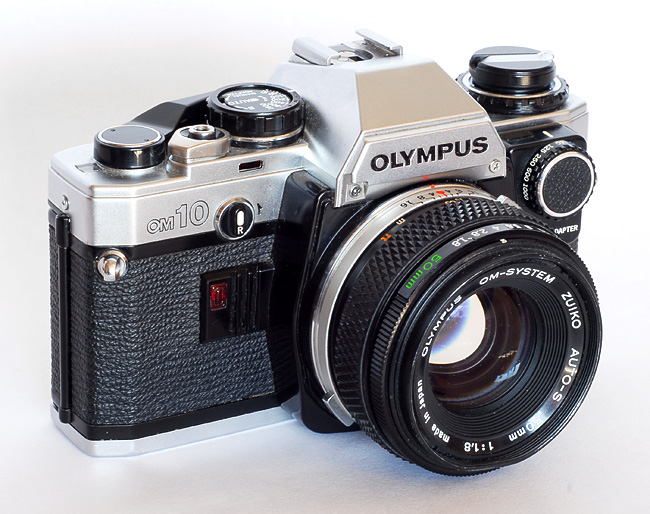
Olympus OM10 & Zuiko 50
OM10-1.jpg

This was my first 35mm SLR quarter of a century ago. They were a £100 'entry' level SLR when new, you can pick up a basic body and 50mm lens for about £30 these days, if you hunt a bit. £50 should get you something with the 'manual adapter' and maybe an extra lens or a flash gun. They have been criticized for being a little unreliable, compared to some rivals in the same price range, like the Pentax or Canon, though usually better featured. I have had about three over the years, and the only trouble I had with any was shear abuse! (One got drowned at a gig at the SU when I was at uni... another got dropped off the top of a castle battlement when I got bumped by one of the kids.. cant exactly blame the camera for not wanting to work after that!)

As compact as 35mm SLR's got, its a very easy handling camera, and very versatile. Zuico 50 is a cracking and still well regarded lens, and popularity with the digital Micro-four-Thirds users who like mounting old 35mm lenses has kept prices relatively 'strong'. OM's through the lens light metering system was sophisticated and almost transparent in use, and widely regarded as one of the 'best'.

As an 'Entry-Level' SLR, it was very very good, and did introduce many to SLR photography, being almost as point and shoot easy to use as a compact and encouraging people to worry about the photo rather than the settings, and that virtue remains, its still a very good entry camera for 35mm film SLR.... if used to digital, and its a fairly 'safe' system to go for, with plenty of scope to buy, reletively cheaply alternative extra lenses without having to get enormously clued up to assure comparability.

BUT, it 'isn't a very large step away from digital; and other than having to manually focus the lens, it could be somewhat underwhelming in not begging more 'involvement'; which could be said of a lot of 35mm SLR's of this generation. For similar or less money still, outside 35mm SLR, I offer:-

Olympus XA2
Olympus-XA2.jpg

That is the 'clam-shell' Olympus XA2, of which I own three! It's about the size of a packet of cigarettes, and is slightly smaller even than the Minox. It was the camera that basically 'invented' the 35mm 'compact', making a camera that was almost as compact and easy to use as a 110 cartridge 'Instamatic', yet delivered 35mm quality as good as SLR's without the bulk. As mentioned, probably half of all the film photo's I have ever taken were shot with one of these; they DO offer SLR rivaling quality, and are as or even more usable than an SLR & 50 combination. And if you are looking at an SLR and a single lens, so not exploiting the interchangeability of lenses, then why buy that unnecessary feature? The XA2 and similar non SLR 35mm film cameras are often cheaper than a 35mm lens for an SLR, so even if you want that alternate lens versatility, these can still be cheaper and 'more' useful than that extra lens in the bag.

Dismissed far too rapidly as a 'consumer compact' and inference it cant be much cop; just because of the trend it started to consumerise 35mm, ignoring it's iconic status as the camera that started that trends, and it's inherent virtues of being a standard setting camera, able to deliver image quality to rival SLR's. It has acquired something of a 'cult' status, and some are now using XA2's as I have always done, as a second body slipped in the gadget bag with the SLR, or tucked in a pocket as a very very versatile carry about.

And they were not a 'cheap' camera in their day, Mine cost about £90 new in 1981, as much as basic OM10 on the shelf next to it; but you can pick them up now in good working order and nice cosmetic condition for under £30. You can probably pick up something very usable for £10 or £15... and so represent a lot of camera for the money. But many many other non SLR 35mm range finders or compacts are out there, many that were very creditable cameras in their day for 'serious' photographers, that simply NOT being SLR's are even bigger bargains than SLR offerings.

Minox 35
latest

One such alternative is a Minox 35. Various versions were offered over the twenty years they made them from about 1980 until the millennia. Minox were best known for their sub-miniature 'spy' cameras (as featured in the James Bond movies), and were renowned for the 'precision engineering' of them that could capture 35mm rivaling image quality on a 6mm film! The C35, then was to show what they could do with 35mm. It was one of the smallest ever 35mm cameras, with in camera metering and coupled automatic exposure, as by then usual on SLR's, but an image quality from the lens quality and construction few but the highest end 35mm SLR's could match.

My father was wowed by his when he eventually bought one in the early '90's, and I have to say it was impressive, though I only ever used it a couple of times, and cant remember any 'foibles', which suggests it probably didn't have very many. When he bought his, then, it was ludicrously expensive, ISTR around £500, which then would have bought a brand new all singing all dancing Minolta AF SLR 'outfit' with a couple of lenses and a flash! Now? You can pick them up for 'around' £50, as much as an SLR & 50; that offers potentially 'better' image quality, but exploiting the advantage of the 35mm format to be compact enough to slip into a jeans pocket!

Its a heck of a lot of camera for an incredibly small amount of money; and mostly 'just' because it ISN'T an SLR, which is why this non SLR world is so attractive, so much of what were very serious enthusiast or professional grade cameras are over looked or ignored, simply because they aren't an SLR, so many have been lead to believe are what you 'have' to have to get into 'serious' photography... and delving into that arena, could take you as far as the interchangeable lens Leica rangefinders, which still for the same sort of cold cash as a DSLR, are far from 'cheap' but a bargain compared to what they cost new twenty years ago, there is far more in it, than the typically 'cheap' consumer compacts of the era.


Heading into the world of 'Medium format' then, I shall mention:

Lubitel 166
komsomolets.jpg

That's the soviet era Russian Lubitel 166, a 'Twin Lens Reflex' 120 roll film Medium format camera. If memory serves they retailed new for about £50 in the 80's & 90's, and you can still pick up good working examples for under £20! It was a common 'entry' into medium format film cameras back in the day; with the suggestion that it was 'cheap Russian crap', but it delivered image quality that would make you question why you put up with the even crapper quality of 35mm SLR! Like the Zenit or Praktika 35mm SLR's, as 'cheap' cameras when new, they don't represent much of a bargain now, compared to how much 'better' cameras, but they still offer that leap in grade and involvement from 35mm SLR they always have, and are still astoundingly cheap way to try it.

A fixed 'twin lens reflex', you don't have the versatility to change lenses; but, as with a 35mm range finder; that's no great disadvantage over a 35mm SLR with a single prime lens or even a single reletively short range zoom.

Moving up the arena, you get from this to things like the Mamiya or Bronica's that come in many shapes and forms that include range finder's like a big 35mm non SLR, to Twin Lens Reflex like the lubitel, or even full SLR's like the legendary Hassablad; all potentially in interchangeable lens 'systems'; which can still be bought for relatively un bank breaking prices in the sub £100 arena gaining ever greater 'bargain' status as you move up through the rankings to cameras that cost £1000's when new, and can now be bought for £100's.

Zeiss Ikon Ikonta folding camera.
A3CBC69281F04AB184B32EA17BDC0EED.jpg

To offer an alternative to the 'Cheap' lubitel though, this is a 'Medium format' 120 roll film camera; 12 to a roll. It has a very good 90 or 120mm Ziess lens, and makes huge negatives 6x10cm, This is the 'basic' model with scale focus and 'machine gun sight view finder; of which there are a few examples on e-bay, that could be procured for 'about' £25 or so. More sophisticated models with in body 'range finders' and shutter's with a wider range of speeds & apertures are more desirable, and more expensive, but few command more than £100.

NOW: I own an example of one shown, I inherited many years ago, and can say, as a folder, it's not particularly bulky, it slips into a coat pocket more easily than a 35mm SLR and it's a very pleasant handling camera, that delivers amazing quality pictures. Mine, actually belonged originally to my Grandad's brother-in-law, and I can recall as a child in the 1970's, him defending his 'antique' whilst my father and cousin argued for their 35mm SLR's. 'Uncle John' pointed out the virtues of the larger format, and the wonderful 'perspective', and image quality it offered, whilst pointing out that whilst the 'Boys' with their 35mm might be able to shoot cheaper 35mm film, and colour slides; but with that camera, and only 12 frames to a roll, he had to be somewhat more discerning and thoughtful about what he shot, but could home develop his film and make 'contact-prints' in the kitchen, that could go straight into the family album, without having to pay for 'expensive' processing or wait for slides to turn up in the post and set up a projector to look at them.
It is still a very usable camera; and as a step into the world of 'film photo', one that's as cheap and useful as a 35mm SLR & 50mm lens combo, that offers a very different type of more traditional film photography.

So, you don't have to go very far up the rankings or up the budget much if any to start finding very very useful Medium format cameras, and could procure one that is as useful and far more rewarding to use than a basic 35mm SLR & Prime. Back to 35mm SLR's....

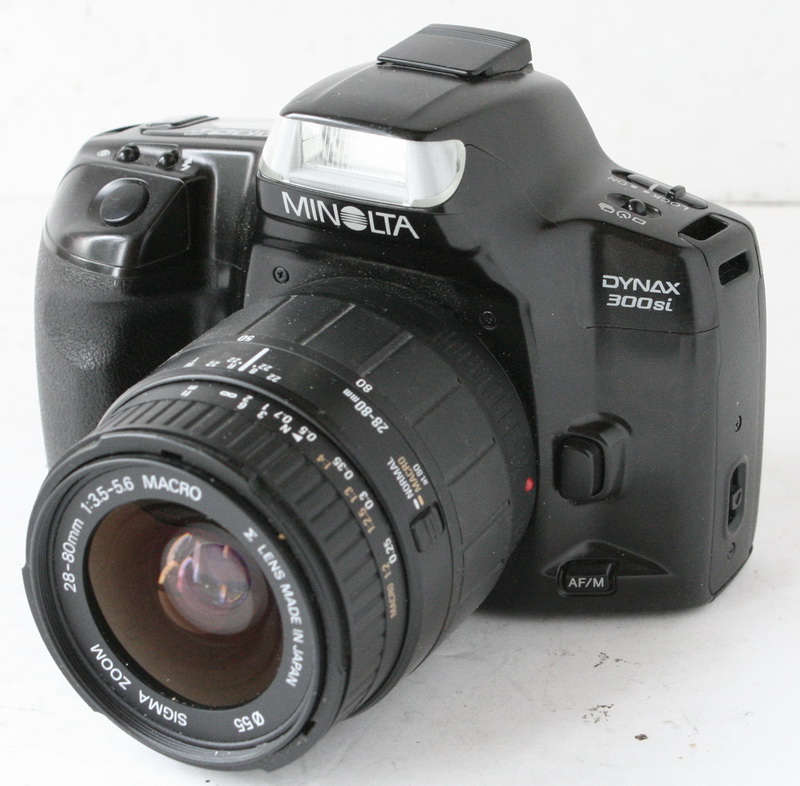
Minolta Dynax 3000
Minolta_300_Si.JPG


I include this as an example of something that's porobably NOT a very useful start. In the 90's Minolta pushed 'Auto-Focus' into the SLR world after pioneering it in 'compact' 35mm cameras in the 80's. This is an entry level Auto-Focus SLR from the '90's; ISTR that they eventually brought consumer 'kit' cameras with typically 35-70 zoom lenses down into the sub £500 price bracket. Now you can pick these up for under £50. I was always wary of them in their day; they didn't seem to have the durability of more traditional Manual Focus SLR's, and they usually took what were then very expensive, frequently 'special' disposable batteries, that driving the film transport and the lens focus were notoriously short lived making them very expensive to run! A 'niggle' that afflicted almost all of that generation of AF film camera, and almost all the ameteur grade offerings.

As an intro to film for a digital camera user, now, I would be very very wary of any of them; and for all they are often incredibly 'cheap'; they are almost as completely automated as modern DSLR's and not an awful lot different to shoot, other than having to fit film! they probably don't offer that 'film' experience, or involvement of earlier Manual focus cameras, whilst the battery issue, and whether you can still get the ones any particular camera needs, asides from lens availability & compatibility issues, I would be wary of recommending any of this generation of AF SLR to a film newbie.

And THIS is sort of the point, there is an awful lot out there, and SO much of it in the sub £100 price range, that includes so much that could be a very poor choice, from 'zoom' compacts from the late 90's, early entry level AF SLR's like the dynax, or the defunct Advanced Photo System, camera's, the SLR offerings being the basis of the now usual 'crop sensor' Digital SLR's; where you need to do your home work on anything to assess whether its a bargain or not, whether its even useable or not, and more importantly whether its in any way useful to YOU....

Which takes us back to the questions begged by your starting proposition; what do you hope to get out of your foray into film? Why 35mm, why 35mm SLR? How 'involved' do you want to be or can you tolerate? How much 'automation' do you need or want? And How much 'versatility' do you want or need? etc etc etc....

Most of us who started out when film was all there was, didn't start diving in with system SLR's and a bunch of lenses. We started out with compacts or range finders, or basic MF box cameras or folders we picked up in the 2nd hand shop. AND for most photo, it wasn't until we bumped into the buffers of what we were trying to do, and realized we needed long zoom lenses, or close focusing macro lenses or the like that we moved into the world of 35mm SLR's..... and made advantage of them.

Whilst; there were very very many, who were over sold in the shop on the virtues of SLR's who ended up with Practika's or OM's instead of more useable fixed lens range finders like the XA2, who were frustrated by the involvement of using them, and so didn't and got little or nothing from what they offered, even as much as they could have got from a compact. and THIS 'danger' still applies, and is 'worse' as film IS still a great place, it still has a lot to offer; BUT a bad start is not likely to let you discover what it has to offer and could put you off entirely.

So... answering the question asked... OM10... answering the one posed... what do you really hope to get from film?

 
H'mm well I'll just add with a semi or extra auto (select on the dial) film camera..you can ignore that setting and just use manual, but for me when in tricky light conditions or quick snaps or can't be bothered, just you the auto feature. So for the OP don't be put off for a more modern camera (before AF i.e. auto focus)
 
The Praktica MTL5 was my first 35mm camera. Screw lens, easy metering, big viewfinder - I'd recommend it!
I went and bought the Praktica MTL5, Would any 6 volt Camera Body be ok to buy?The are on eBay ,at prices with big differences.
 
I went and bought the Praktica MTL5, Would any 6 volt Camera Body be ok to buy?The are on eBay ,at prices with big differences.

Well the MTL5 is a good start to try film. But your comment "6 volt camera body" doesn't make sense.
There are two types of SLR cameras that either have older screw mounts or the later ones that have bayonet (mind you there could be a SLR with a fixed lens in place). And any camera could take a battery of 1.37 to 6v..the 1.37 battery was the old mercury one that has been banned.
 
I went and bought the Praktica MTL5, Would any 6 volt Camera Body be ok to buy?The are on eBay ,at prices with big differences.
It's a 625 battery, if I remember correctly. I bought a cheapy off eBay for mine and didn't have any problems.
 
Well the MTL5 is a good start to try film. But your comment "6 volt camera body" doesn't make sense.
There are two types of SLR cameras that either have older screw mounts or the later ones that have bayonet (mind you there could be a SLR with a fixed lens in place). And any camera could take a battery of 1.37 to 6v..the 1.37 battery was the old mercury one that has been banned.
I meant to say 6 v Battery,so,am I right in saying,any battery ( small round type) from 1.37v to 6v ,as long as it's not mercury,will do the job?
 
It's a 625 battery, if I remember correctly. I bought a cheapy off eBay for mine and didn't have any problems.
Thanks for your help.Can I ask ,how you develop your film?Ive been watching YouTube,and,I see there's a method of doing it yourself,uploading to your computer,and then print of what you like?Sorry if I sound naive,but,I thought ,if you opened your film roll,as,they did on YouTube,that was the film destroyed?Also,what ISO Film should I buy?I would love to photo my Grand-children?also,I love the Nature and Wildlife,maybe different films for different formats?Which leads onto another question?what M42 Screw on Long Focal Lens are there available,Lwhat he would you recommended?As I say ,I'm a complete learner,any help is greatly appreciated.

Yours Kindly Paul
 
First off, welcome Paul! Second, have a read of https://www.talkphotography.co.uk/threads/first-film-camera-ever-or-for-many-years.481985/ ... there's quite a lot there that's useful.

Third, yes that lens is specifically designed for 35mm cameras, SLRs specifically. As Brian says, you'd need a camera with a M42 screw thread to use it. The classic, I believe would be a Pentax Spotmatic variant. However, there's a problem: the batteries for these cameras have been banned for years (mercury?), so there are various kludges to make them work, of varying effectiveness and cost. There may be camera families with the M42 mount and more modern batteries (Practika? Fujica?) but I don't know them. Bit of research needed.

The alternative is to buy a bayonet-mount camera that takes more modern batteries, eg the ubiquitous LR44 used in many cameras including the K-mount Pentax SLRs. You can mount the Helios with an adapter, and buy wonderful manual Pentax lenses. IMHO the sweet spot is the Pentax MX, fully manual with metering, one of the world's greatest viewfinders too. Others will probably try to hook you on Nikons, and Brian loves his Canons I believe. Plenty of choice! (Might be worth taking account of the digital cameras you use; some of the lenses might fit older cameras, particularly if the have aperture and focus rings.)

As you get newer cameras with autofocus, program modes, auto wind etc, you tend to get plastic bodies, full scale ugliness, and you might as well be digital as far as I can see. But some do have appeal!

So, plenty to go on with researching. Slow motion GAS with MUCH lower prices and very little depreciation!

To start with, for test purposes at least, why not buy some Agfa Vista 200 at Poundland (guess the price). You can also get film in Boots on a permanent buy one get one half price offer. Prices a little higher than you might get from t'internet, but you don't have to pay postage.

Most people here have a hybrid workflow where they process the film (or get it processed), scan it (or get it scanned), then edit on the computer and print from there. A few still have darkrooms and do the whole wet printng thing, but they are very much the minority.
Thanks kindly for your help,Is it possible to find a M42 Screw Adapter that can be converted to take my Nikon DX Lens?
 
Thanks for your help.Can I ask ,how you develop your film?Ive been watching YouTube,and,I see there's a method of doing it yourself,uploading to your computer,and then print of what you like?Sorry if I sound naive,but,I thought ,if you opened your film roll,as,they did on YouTube,that was the film destroyed?Also,what ISO Film should I buy?I would love to photo my Grand-children?also,I love the Nature and Wildlife,maybe different films for different formats?Which leads onto another question?what M42 Screw on Long Focal Lens are there available,Lwhat he would you recommended?As I say ,I'm a complete learner,any help is greatly appreciated.

Yours Kindly Paul

Hi Paul - if you're a complete novice, I'd recommend getting your film developed by someone else to begin with! Asda, Tesco etc will develop your shots for you and put them on a DVD - that way you can have copies to email to people or print off at home. You can also post your film off to a few companies (a big list here: https://www.talkphotography.co.uk/tutorials/film-developing-in-the-uk.99/) and they will do the same. There are tons of M42 screw-on lenses available, I'd have a look on eBay and see what is going cheap to start with.
Regarding opening the back of your camera, just make sure that when you are finished with your shots, you wind the film back into the canister and wait until it's all in before you open the back :)
 
Hi Paul - if you're a complete novice, I'd recommend getting your film developed by someone else to begin with! Asda, Tesco etc will develop your shots for you and put them on a DVD - that way you can have copies to email to people or print off at home. You can also post your film off to a few companies (a big list here: https://www.talkphotography.co.uk/tutorials/film-developing-in-the-uk.99/) and they will do the same. There are tons of M42 screw-on lenses available, I'd have a look on eBay and see what is going cheap to start with.
Regarding opening the back of your camera, just make sure that when you are finished with your shots, you wind the film back into the canister and wait until it's all in before you open the back :)
Thanks
 

Charlotte is right, a commercial processing station will develop the film and scan it to disk for printing. The actual developing is very simple - I was doing this regularly when I was about 10 - but the negatives have to be scanned if you want to print them or get them printed digitally. That means buying a scanner, if you're going to do it yourself, and a decent film scanner costs a bit.
 
I meant to say 6 v Battery,so,am I right in saying,any battery ( small round type) from 1.37v to 6v ,as long as it's not mercury,will do the job?

NO....the battery must be for the camera make.
The MTL5 originally had a 1.37 battery but you can't get them anymore, so you will have to use a 1.5v cell battery (as Charlotte mentioned a 625 type) plenty of places sell them cheap on the net. As the battery is different, the exposure reading will be slightly out and if you have a digi camera can adjust the ASA (ISO) knob on the camera to roughtly get the same exposure reading looking at say green grass or grey pavement. Of course you can use the camera without a battery and use a seperate exposure meter or your digi or some mobiles or even the sunny 16 rule (used to be on old film boxes or instruction sheet yanno like f8 @ 1/250 sec for sunny days or f4 @ 1/125 for a bright cloudy day etc)
It is all basically simple using a film camera and once you know, will be telling other newbies what to do in the future (y) And the same problems you get using film would be the same as digi e.g. wrong exposure, or something like cut off heads in framing :eek: ;)
 
It's a 625 battery, if I remember correctly. I bought a cheapy off eBay for mine and didn't have any problems.
I'm looking on Ebay,and,the 625 battery is small,like hearing aid battery,How many do you need for the MTL5 Camera,or,is 1 battery sufficient?
 
The MTL5 has a bridge circuit so the higher voltage won't affect the meter accuracy. Seen quite a few forums online say that. Haven't noticed any metering problems running mine off a 1.5v battery. Exposures seem good.
 
Back
Top