


Harlequin565
Suspended / Banned
- Messages
- 8,684
- Name
- Ian
- Edit My Images
- No
So I've just finished developing my test roll of TMAX P3200 which I shot alongside a roll of HP5 Plus at 3200.
I know that P3200 works really well at 1600, but so does HP5. What is the difference?
To start with, P3200 is £10.50 a roll whilst HP5 is £5.75 (using AW as a reference as this is mainly to ge the price difference). Delta 3200 (not yet tested) is £9 a roll. So if you want a box speed 3200 film, you're paying significantly more.
Pushing film typically will increase contrast, which is why I'm guessing there are films out there that offer high ISO speeds. Recently I've started to experiment with Ilford DD-X which (I think) is a much gentler developer. It's expensive though. Price per 35mm film at 1+4 is about £1 vs the 30p of HC-110 or Rodinal.
My initial experience with P3200 was mainly kicked off because of wanting to take photos at indoor gigs and indoor evening events without a flash. My main developer was Rodinal which made HP5 look awful at anything over ISO 800, so I thought P3200 was the way to go.

This was my experience at 3200 ISO. Lots of grain, no real "Black", just grain spattered "gloom". It's ok I guess and atmospheric...
But with DD-X and how it makes HP5 look, I decided to see what happened at ISO 3200. I know NIge has shot this at 3200 but it was 120 which is much more forgiving of higher ISO.
The test was to load HP5 and P3200 into 2 cameras, then take the same photos with the same lens in the same lighting conditions. DD-X has times for both HP5 (20 minutes) and P3200 (11 minutes or 9. I went with 11) so I used the same developer. The HP5 was finished first and I was really surprised at how good it looked. Comparing it to the above, I was about to put all my P3200 on eBay. But then I developed the Kodak film...

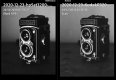
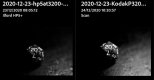
These are small screenies because of attachment size rules but at full size there is very little to tell them apart. So after every full size shot, I'll show a 100% crop.
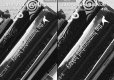
Now we can see some difference. Grain is clearly more pronounced on the Kodak film (right in all these images) and that lack of black shadows is visible.
Here it's also a bit more obvious, and in the low light, the grain is very visible on both films.
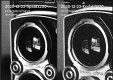
I know the Kodak looks sharper but it isn't. It's just a better focussed shot. But it certainly looks like there is more contrast to the HP5 film. I'd expect this because we're "Pushing" HP5 but we're not pushing P3200 (although some say this is an 800 or 1600 speed film that has been invisibly pushed through the use of box speed & dev times). In reality, I can see very little contrast difference at full size. It's definitely there though as it can be seen in the crop.
Another 100% crop
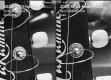
Overall - as with comparing HP5 to Tri-X, I think the Kodak film has a grittier feel and look to it. And to stress - at full size, there really is very little to tell them apart. I'm not convinced I've got the dev completely right on the P3200 as they look a little thin. With the scanner compensation though it's so hard to actually tell for sure.
So I won't sell off my P3200 but I think I shall keep it for when I want a gritty look. For my "there isn't enough light and I need 3200" I think I'll just shoot HP5. And when my stock of P3200 runs out, I'll probably just stick to HP5.
I guess the next test is HP5 vs Delta 3200 and then HP5 to 6400 for a giggle.
I know that P3200 works really well at 1600, but so does HP5. What is the difference?
To start with, P3200 is £10.50 a roll whilst HP5 is £5.75 (using AW as a reference as this is mainly to ge the price difference). Delta 3200 (not yet tested) is £9 a roll. So if you want a box speed 3200 film, you're paying significantly more.
Pushing film typically will increase contrast, which is why I'm guessing there are films out there that offer high ISO speeds. Recently I've started to experiment with Ilford DD-X which (I think) is a much gentler developer. It's expensive though. Price per 35mm film at 1+4 is about £1 vs the 30p of HC-110 or Rodinal.
My initial experience with P3200 was mainly kicked off because of wanting to take photos at indoor gigs and indoor evening events without a flash. My main developer was Rodinal which made HP5 look awful at anything over ISO 800, so I thought P3200 was the way to go.
This was my experience at 3200 ISO. Lots of grain, no real "Black", just grain spattered "gloom". It's ok I guess and atmospheric...
But with DD-X and how it makes HP5 look, I decided to see what happened at ISO 3200. I know NIge has shot this at 3200 but it was 120 which is much more forgiving of higher ISO.
The test was to load HP5 and P3200 into 2 cameras, then take the same photos with the same lens in the same lighting conditions. DD-X has times for both HP5 (20 minutes) and P3200 (11 minutes or 9. I went with 11) so I used the same developer. The HP5 was finished first and I was really surprised at how good it looked. Comparing it to the above, I was about to put all my P3200 on eBay. But then I developed the Kodak film...
These are small screenies because of attachment size rules but at full size there is very little to tell them apart. So after every full size shot, I'll show a 100% crop.
Now we can see some difference. Grain is clearly more pronounced on the Kodak film (right in all these images) and that lack of black shadows is visible.
Here it's also a bit more obvious, and in the low light, the grain is very visible on both films.
I know the Kodak looks sharper but it isn't. It's just a better focussed shot. But it certainly looks like there is more contrast to the HP5 film. I'd expect this because we're "Pushing" HP5 but we're not pushing P3200 (although some say this is an 800 or 1600 speed film that has been invisibly pushed through the use of box speed & dev times). In reality, I can see very little contrast difference at full size. It's definitely there though as it can be seen in the crop.
Another 100% crop
Overall - as with comparing HP5 to Tri-X, I think the Kodak film has a grittier feel and look to it. And to stress - at full size, there really is very little to tell them apart. I'm not convinced I've got the dev completely right on the P3200 as they look a little thin. With the scanner compensation though it's so hard to actually tell for sure.
So I won't sell off my P3200 but I think I shall keep it for when I want a gritty look. For my "there isn't enough light and I need 3200" I think I'll just shoot HP5. And when my stock of P3200 runs out, I'll probably just stick to HP5.
I guess the next test is HP5 vs Delta 3200 and then HP5 to 6400 for a giggle.
Last edited:


