100-400 OR 70-200

Mike, thanks for adding that. Your 70-200 II certainly looks impressive, it must be good knowing that if you need to go to 400mm with it, you can do and its just as good as the 100-400 in all reality!

This really is sounding more and more like a viable option.

Ive been thinking tonight about buying a cheaper crop camera for when I need reach! Would I be happy with the IQ from something like a 500D? It would mean I could use the 70-200 F4L IS + 1.4tc and get an effective range of 448mm @ f/5.6 Im guessing that a 15.5mp sensor would also stand upto some cropping quite well too?
But there are downsides to that too, in that I could pretty much guarantee Id be out with the 500D and wish I had the 5D2 in some situations!

Hard work all this!!!
 
Mike, thanks for adding that. Your 70-200 II certainly looks impressive, it must be good knowing that if you need to go to 400mm with it, you can do and its just as good as the 100-400 in all reality!

This really is sounding more and more like a viable option.

Ive been thinking tonight about buying a cheaper crop camera for when I need reach! Would I be happy with the IQ from something like a 500D? It would mean I could use the 70-200 F4L IS + 1.4tc and get an effective range of 448mm @ f/5.6 Im guessing that a 15.5mp sensor would also stand upto some cropping quite well too?
But there are downsides to that too, in that I could pretty much guarantee Id be out with the 500D and wish I had the 5D2 in some situations!

Hard work all this!!!

Don't fall into the trap of believing that crop format cameras inherantly deliver more reach. They don't, it's only the extra pixel density (that all croppers have) which has the potential for extra detail.

The problem is that unless you have an exceedingly sharp lens, typically one of the low f/number L-grade primes, then the dominant limiting factor is lens resolution. Simply, if you can't resolve the extra pixels, you won't see much benefit from having more of them (though the full explanation is complex, involving lens MTF characteristics, there should be a marginal theoretical upside).

For example, I know for a fact that a 70-200 L 4 IS with 1.4x extender, looks pretty much the same on a 7D with 18mp as it does on a 5D2 cropped down to the 1.6 format (when it still has 8.2mp). The 7D is better, but frankly it's barely noticeable. If on the other hand, the lens was swapped to a 300L 2.8 (though I've not tried that comparison) I'm sure the 7D would show what it can do.

First and foremost, you need a long lens and there's no getting away from that.
 
Don't fall into the trap of believing that crop format cameras inherantly deliver more reach. They don't, it's only the extra pixel density (that all croppers have) which has the potential for extra detail.

LOL, Richard you start this off by talking about reach and end up talking about extra detail which are two different things! If you don't mind the easiest thing for me to do is correct it to what it should say..

"Don't fall into the trap of believing that crop sensors inherently deliver more reach because of the reduced sensor size, what gives them the increased reach is the increased pixel density (which all croppers have).

Let's keep it simple ... a 500mm L lens and a 30 quid Acme cheapy of the same focal length will produce the same sized image on the sensor. They've both achieved identical extra reach by virtue of the crop sensor and pixel density. Of course one lens will produce a better image than the other but the fact is crop sensors do produce extra reach and when we're talking about IQ we're talking abut something entirely different.

The problem is that unless you have an exceedingly sharp lens, typically one of the low f/number L-grade primes, then the dominant limiting factor is lens resolution. Simply, if you can't resolve the extra pixels, you won't see much benefit from having more of them (though the full explanation is complex, involving lens MTF characteristics, there should be a marginal theoretical upside).

No argument here about any of that.

For example, I know for a fact that a 70-200 L 4 IS with 1.4x extender, looks pretty much the same on a 7D with 18mp as it does on a 5D2 cropped down to the 1.6 format (when it still has 8.2mp). The 7D is better, but frankly it's barely noticeable. If on the other hand, the lens was swapped to a 300L 2.8 (though I've not tried that comparison) I'm sure the 7D would show what it can do.

OK Richard you say you've done the tests and I don't doubt you. I can easily accept that a 5D2 image cropped down to the full frame size of a 7D and having 8.2 mp left would compare reasonably well against the 7D full frame image. The point is though that the 7D still has 18 mp but it's a pic of a sparrer and both images now need further substantial cropping for that bird to fill the frame reasonably. It doesn't need a lot of working out that the 5D2 is going to struggle very quickly to produce any sort of a usable image.

People who don't photograph birds just don't seem to get this at all - if they did they'd have the crop advantage rammed home very forcibly every time they uploaded their images to the PC.

First and foremost, you need a long lens and there's no getting away from that.

Well being a bit pedantic admittedly the effective reach advantage is there regardless of the focal length of the lens, but for wildlife generally, and small birds particularly, you need a long lens. Your results will be better with a higher quality lens - no argument but that's nothing at all to do with reach.
 
Cedric, I don't know why you keep picking me up on this, especially when you seem to end up agreeing.

What do you mean by 'reach'? I mean, the ability to resolve distant detail. That is different to mere focal length alone, and is unrelated to crop factor directly - it's a combination of image size (focal length, not format), lens resolution and pixel density.

Therefore, crop sensors don't automatically deliver greater reach simply by being smaller and having a narrower field of view, they do it by virtue of having greater pixel density, which is not necesarily the same thing.

That's an important distinction to make, but the real importance is it's no good having tons of pixels if the lens is incapable of resolving them - so in addition to pixel density you also need a damn sharp lens.

The point I was trying to make above was that I wondered if the OP was perhaps expecting to get more reach/detail simply by putting the same lens combo on a crop format camera, which with the case in point - the 70-200 zoom with 1.4x extender - he won't (not by any noticeable margin anyway) because the resolution capability of that excellent lens has been exhausted by the addition of the extender. The extender only magnifies the detail that is already there, it cannot magic up any more.

Put that another way, without an extender, you would reasonably expect to get more reach out of that 70-200 zoom, used on its own, if it was used on a 7D rather than simply cropping an equivalent field of view from the 5D2's frame - because it's able to resolve the extra pixels. The same would be true of your 300 2.8 or 500 4 because they also have the extra resolution capability 'in hand' (simply, without going into the complexities of MTF). However, the 70-200 plus 1.4x does not have any more to give, so the 7D would not be able to resolve detail that lens-plus-extender combo cannot deliver in the first place.

That is my point - basically repeating the bit after which you say "No argument here about any of that." Maybe it's the definition of 'reach' that is confusing things. TBH I'm not sure what you're getting at, it all seems quite straightforward to me ;)
 
Last edited:
Let's keep it simple ... a 500mm L lens and a 30 quid Acme cheapy of the same focal length will produce the same sized image on the sensor.
And what's more, they will produce the same sized image on the sensor whether it is a crop or full frame.

Have to say I'm with Richard here, it's the pixel density that gives the reach. If you had a full frame sensor with the same pixel density as the 7D, it would give the same images once you cropped the full frame to the same pixel dimensions. It's just more difficult to produce a lens that covers a full frame sensor AND gives the MTF to show that pixel density off to best advantage
 
Guys,

A bit over my head all this, but I too have seen the test of 7D vs a cropped image from a 5D2 - and that there was little to no difference (7D won, but it was marginal)

However I agree with CTs comment that once you've cropped down the 5D2 file to the same size as the 7Ds (and then presumably upscaled its image size in PS or similar) you are left with the same photo...albiet 18mp of the 7D vs whatever is left from the 5D. If you then require further cropping, ie to concentre intimately on the subject, the 7D has more resolution to play with, than an already hacked 5Ds image.

However, when waking up with a fresh mind this morning, having 2 cameras would probably be more trouble than it was worth to me, and I would rather keep the 5D2 and get a suitable lens that would enable to crop less than I currently am doing, but Im still happy cropping for now, as Im just a hobbyist and rarely even get my photos printed, I think Im being a bit over the top!!

I guess thats the good thing about the 5D2, the 22mpx can take a lot of cropping when you need it.

Ps - one thing I dont really get, if someone could explain further, is how the extender reduces the lens's resolution? Ive read tons of reviews now that state IQ isnt really affected by a 1.4X.
Are you suggesting that simply cropping an image taken without a 1.4x TC would result in the same/similar full frame image taken from one with a TC?
 
Ps - one thing I dont really get, if someone could explain further, is how the extender reduces the lens's resolution? Ive read tons of reviews now that state IQ isnt really affected by a 1.4X.

A converter is basically just a magnifying glass placed behind the lens. It doesn't alter the minimum focusing distance , it simply magnifies the image by a given amount before it reaches the sensor. It follows that no matter how good the converter is and how well it's matched to the particular lens it will magnify any shortcomings in the lens which were there anyway, as well as adding it's own optical shortcomings into the mix.

Generally speaking 1.4X converters used behind a quality lens have little or no impact on image quality that bother most users although the difference- however slight- will be there.

2X converters just magnify the image even more so there will inevitably be a more noticeable drop in IQ. Conventional wisdom has always been that converters are best used behind a prime lens rather than a zoom which is already compromised to some extent simply by virtue of the fact that it's a zoom, but zooms have improved considerably in recent years to the extent that with quality zooms the differences often aren't so great and lenses like the latest Canon 70-200 matched with the new converter are claimed to narrow the difference even more.
 
Last edited:
Cedric, I don't know why you keep picking me up on this, especially when you seem to end up agreeing.
Morning Richard. :wave:

I'll have to catch you later mate - stuff to do.
 
And what's more, they will produce the same sized image on the sensor whether it is a crop or full frame.

Have to say I'm with Richard here, it's the pixel density that gives the reach. If you had a full frame sensor with the same pixel density as the 7D, it would give the same images once you cropped the full frame to the same pixel dimensions. It's just more difficult to produce a lens that covers a full frame sensor AND gives the MTF to show that pixel density off to best advantage

You missed the bit a few posts back then where I typed exactly that - and in bold ?

It's still not the complete answer. What gives the crop sensor it's reach advantage is it's smaller sensor, it's pixel density, and how much of the frame your main subject occupies.

A factor we haven't even touchéd on here is the size of the 1:1 full sized image which is a huge contributing factor, but I'll come to that later.

I just don't know why this has be so difficult because it isn't, and some of the stuff posted here must leave people looking for advice needing a strait jacket trying to get any useful guidance from it all
 
There's something I've always wondered about that's related to this, and it's because I've not really done BIF that I don't know.

If you're tracking a small bird on a 7d and it's already fairly small in the frame, it's going to be really small in the frame of a 5d2. Surely then (ignoring the whole debate about if you can crop down the 5d2 pic to 7d size and still maintain good IQ), there is a far more practical consideration here, and that's autofocus. I always assumed that the camera is going to find it much harder to accurately lock focus, then track the bird, if it's a small dark dot in the frame. Plus, it must be harder as the camera operator to keep a focus point over a tiny subject that's moving fast.

I guess I always assumed this was one of the major reason why BIF togs used crop cameras - get the birds as large in the frame as possible to make it easier to focus on the little blighters. Can anyone confirm this?

So even if "reach" is a function of various things (incl pixel density) surely the dominating factor, from a practical not theoretical stand point, is the subject size in the frame, hence croppers and longer lenses are preferable in these situations.
 
Richard,

It' s just this sentence which is very misleading (probably unintentionally) for anyone looking for advice on the advantage of crop sensors.

Don't fall into the trap of believing that crop format cameras inherently deliver more reach. They don't, it's only the extra pixel density (that all croppers have) which has the potential for extra detail

The conventional advice given here for people asking about extra reach from a crop sensor goes along the lines of ….

" Yes, you'll get more reach from the crop sensor and it's increased pixel density. You may well find yourself disappointed with the performance from your present lens though, and needing to invest in better glass to see the full benefit"

Now - that is really all that needs to be said on the subject because it's factual and doesn't confuse effective reach with image quality. leaving seekers of enlightenment totally confused.

This is for the benefit of everyone else and I don't think Richard will disagree with it.

The 'reach' of crop sensors is a real benefit because of the reduced sensor size , the large pixel density and the fact that your main subject occupies a larger part of the image than it would with a larger sensor which would produce the same sized wren on the sensor but with a wider field of view showing more surrounding real estate which is inevitably just going to be be cropped away.

The other thing we haven't even touched on is that with the increasing pixel density the outputted files inevitably get larger with each new model while image aspect ratio doesn't, so with each increase in pixel density that wren in your full sized 1:1 file gets bigger proportionally with the pixel increase.

I did this comparison yonks ago - it's been posted here a few times before but we probably have lots of people people now who won't have seen it.


sensors and crops by tonky8203, on Flickr

Each picture represents a tight crop from the open full sized image from each camera. The overall size has been proportionally reduced for obvious reasons, but each example represents the largest image of this bird you can get from each of these cameras at the same distance and using the same lens. This isn't some pie in the sky theoretical advantage - it's a very real improvement in effective reach each time you move to the left of this chart.

I own, or have owned, each of the cameras shown with the exception of the 30D and 1DMK3 and I Iv'e seen the improvement in reach and real world gains each time I've upgraded. The only way the smaller images can be enlarged is by interpolation - which inevitably leads to loss of IQ, but the shown images from each camera still represent the bird in the shot at 1:1 with no loss in IQ in each case, but considerable gains as you move from left to right.

I'm not being pedantic, I'm just trying to show that crop sensors give you more reach - not just by virtue of their size, but all the other reasons covered. If we can just get that message across without having to keep returning to the subject, I for one will be a happy bunny.

 
There's something I've always wondered about that's related to this, and it's because I've not really done BIF that I don't know.

If you're tracking a small bird on a 7d and it's already fairly small in the frame, it's going to be really small in the frame of a 5d2. Surely then (ignoring the whole debate about if you can crop down the 5d2 pic to 7d size and still maintain good IQ), there is a far more practical consideration here, and that's autofocus. I always assumed that the camera is going to find it much harder to accurately lock focus, then track the bird, if it's a small dark dot in the frame. Plus, it must be harder as the camera operator to keep a focus point over a tiny subject that's moving fast.

I guess I always assumed this was one of the major reason why BIF togs used crop cameras - get the birds as large in the frame as possible to make it easier to focus on the little blighters. Can anyone confirm this?

So even if "reach" is a function of various things (incl pixel density) surely the dominating factor, from a practical not theoretical stand point, is the subject size in the frame, hence croppers and longer lenses are preferable in these situations.

There's so many possible variables at work here I don't think there's really a black and white answer. It would depend on lots of things such as number of AF points , density of AF points , whether they're cross type AF points etc. and of course, the size of the bird , colour of the bird and what sort of feather pattern or contrast areas it's presenting for the AF system to lock onto. The quality of the AF system also is markedly different between various models

The only thing I'd confidently say is that at any given distance the cropper will produce the larger image in the full sized file, but other than that apart from the above considerations BIF photography always benefits from a good dollop of luck! :D

It's about now that someone usually asks why some wildlife pros - Andy Rouse being an oft quoted example - use full frame cameras if crop cameras are so great. Andy Rouse travels all over the world photographing Grizzly Bears, Tigers etc, and for the bulk of his work he doesn't have a lot of trouble filling the frame to get the benefit of the larger sensor. When he does photograph birds they tend to be larger exotic foreign species for the most part.
 
Last edited:
CT said:
The only thing I'd confidently say is that at any given distance the cropper will produce the larger image on the sensor, but other than that apart from the above considerations BIF photography always benefits from a good dollop of luck! :D

I'm a bit confused by that first bit, my understanding was that the image on the sensor would be the same size, but on a cropped sensor the image would fill a larger proportion of the sensor (all other variables, lens etc being constant).
 
I'm a bit confused by that first bit, my understanding was that the image on the sensor would be the same size, but on a cropped sensor the image would fill a larger proportion of the sensor (all other variables, lens etc being constant).
Sorry - that was a typo which I've corrected. :thumbs:
 
There's something I've always wondered about that's related to this, and it's because I've not really done BIF that I don't know.

If you're tracking a small bird on a 7d and it's already fairly small in the frame, it's going to be really small in the frame of a 5d2. Surely then (ignoring the whole debate about if you can crop down the 5d2 pic to 7d size and still maintain good IQ), there is a far more practical consideration here, and that's autofocus. I always assumed that the camera is going to find it much harder to accurately lock focus, then track the bird, if it's a small dark dot in the frame. Plus, it must be harder as the camera operator to keep a focus point over a tiny subject that's moving fast.

I guess I always assumed this was one of the major reason why BIF togs used crop cameras - get the birds as large in the frame as possible to make it easier to focus on the little blighters. Can anyone confirm this?

So even if "reach" is a function of various things (incl pixel density) surely the dominating factor, from a practical not theoretical stand point, is the subject size in the frame, hence croppers and longer lenses are preferable in these situations.

A 7D has no more inherant ability to AF better than say a 5D2 by virtue of the sensor or the size the image appears in the viewfinder. For a lens of the same focal length, the image the AF system has to work with is the same, same limitations and problems.

It's rather more that the 7D is optimised to work from a smaller image in the first place, and also has a better AF system, but the advantage is not inherant to the smaller format.*

For example, the camera with the best AF system of all (certainly in the Canon range) is the 1D4, which has a bigger 1.3x crop sensor than the 7D's 1.6x.

* If you wanted to be picky about it, you could actually argue the opposite, because of the dimensonal element in phase-detect AF systems, which is potentially larger with the longer focal lengths required by larger formats in order to restore framing equivalence.
 
Richard,

It' s just this sentence which is very misleading (probably unintentionally) for anyone looking for advice on the advantage of crop sensors.

Don't fall into the trap of believing that crop format cameras inherently deliver more reach. They don't, it's only the extra pixel density (that all croppers have) which has the potential for extra detail

The conventional advice given here for people asking about extra reach from a crop sensor goes along the lines of ….

" Yes, you'll get more reach from the crop sensor and it's increased pixel density. You may well find yourself disappointed with the performance from your present lens though, and needing to invest in better glass to see the full benefit"

Now - that is really all that needs to be said on the subject because it's factual and doesn't confuse effective reach with image quality. leaving seekers of enlightenment totally confused.

<snip>

We seem to be saying exactly the same thing Cedric :thinking:

In terms of semantics, I would only take issue with your continued reference to format as being a key factor, when it's not - it's the pixel density (and lens resolution). Sure, smaller formats almost always have higher pixel density, but not always, and I personally think it's misleading not to point out this vital difference.

Without the extra pixels, and a lens capable of resolving them, crop sensors have no inherant reach advantage simply by virtue of their size.

Moving on, your later comment about Andy Rouse using full frame for wildlife is an interesting one. As you say, he tends to shoot larger subjects and so he can get all the reach he needs optically, and then also reap all the image quality benefits of the bigger format.

To put that another way, the appeal of cameras like the 7D and say a good quality 400mm lens, is that you can get decent reach in terms of pixels and lens sharpness that would otherwise require a 600mm lens on full frame, which is neither affordable nor practical for most folks. However, if you can do it, then the bigger lens/camera combo will win hands down on IQ.
 
Ok, so I think I understand, correct me if I'm wrong....

Success focusing on birds is flight is more down to the AF module of the camera, the skill of the photographer and/or luck, rather than the size of the sensor, even though the subject will appear larger in the frame of crop cameras. However, some cameras are designed to have crop sensors AND good AF modules, making them particularly well suited to the task.

So, that's focusing, para-phrasing the rest of this discussion, again correct me if I'm wrong....

The newer crop cameras tend to have higher pixel densities then their full frame cousins, which means that, assuming a sufficiently capable lens is used, they can resolve more detail. This, along with the fact that the subject will occupy a larger proportion of the frame means that current crop sensors effectively have more "reach". Essentially, the subject is larger in the frame with more detail making it appear closer. However, this only holds if the image in not enlarged (ie interpolated), and the physical dimensions of the image will be smaller than from a full frame camera because the sensor is smaller, so it all depends on the eventual output (eg small web image vs very large print).

I thought I had this right in my head, and it won't change me decision to buy a x1.4 for my 70-200 f4 IS (because I don't usually need 300mm+), but everytime I think about the best way to get more reach, I seem to confuse myself again :bang:

W
 
Guys, feel we are getting a little sidetracked here :)

Ok, how about this for a can of worms opening question

70-200 F4L IS + 1.4xTC (kenko Pro 300 DG) = 280mm f/5.6. Image then cropped to 400mm equivalent, then sharpened accordingly.

VS

100-400L IS


Which has the better IQ?

Both on the same camera? Then 100-400L. Easily.

The 70-200 starts out the sharper lens, but then you've stuck an extender on it and further compromised sharpness by cropping.

There is just no easy way around getting serious reach. First and foremost you need a big, expensive lens. If you still need more, then what you can get away with in terms of extenders, cropping, pixel density, f/number, AF perfromance etc etc etc - well, that depends and not everybody's idea of what works and what's best is the same.
 
Last edited:
Rich,
Thanks for the help (yet again :))
Do you use a 1.4x on your 70-200 F4L IS?

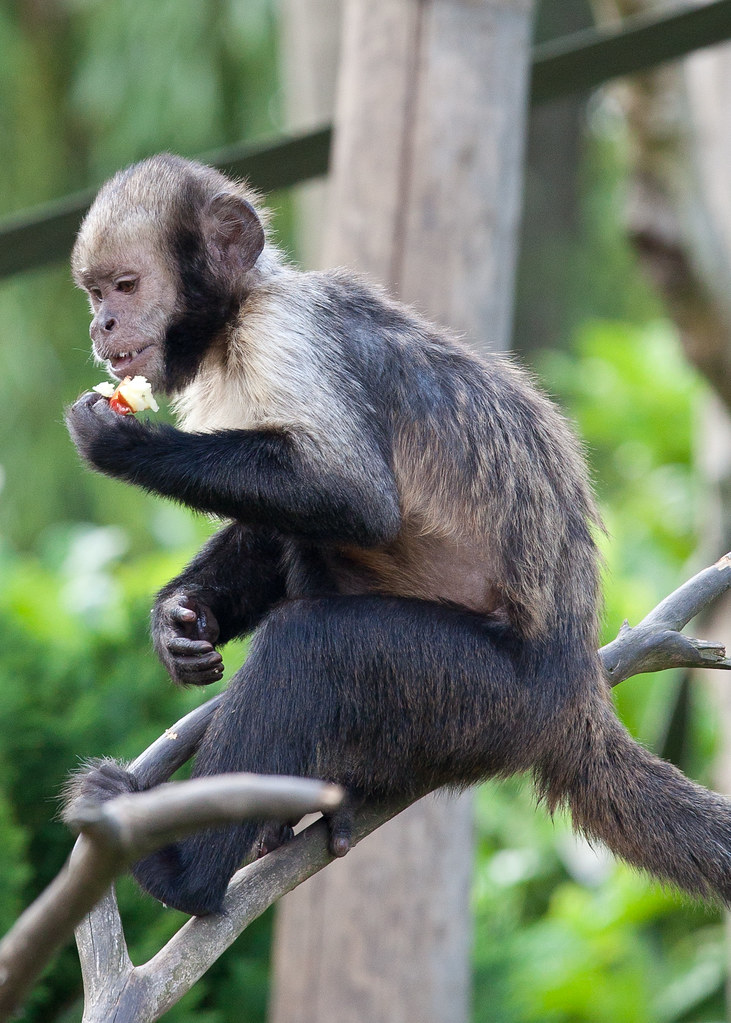
This was a massive crop from a recent zoo visit with my 70-200 F4L IS.
I dont know the technical details related to the crop - but in lightroom when you click the "Crop" icon - the image is split into 9 boxes (3x3), at which point you get the choice to crop it to a specific size, or custom size..
For this crop, I cropped it to the size of one of the 9 boxes (the central one to be particular) and then sharpened it by 30pts.
The boxes split the photo up into 3rds - so going off basic maths, I assume this is equivalent to around a 90% crop?

Im happy with the sharpness, in fact, Im very happy with the sharpness.

Do you think with a 1.4X I would have been able to crop less, and retain more detail?


Capuchin Monkey Eating Red Apple by futureal33, on Flickr
 
Last edited:
Ok, so I think I understand, correct me if I'm wrong....

Success focusing on birds is flight is more down to the AF module of the camera, the skill of the photographer and/or luck, rather than the size of the sensor, even though the subject will appear larger in the frame of crop cameras. However, some cameras are designed to have crop sensors AND good AF modules, making them particularly well suited to the task.

Yes :)

So, that's focusing, para-phrasing the rest of this discussion, again correct me if I'm wrong....

The newer crop cameras tend to have higher pixel densities then their full frame cousins, which means that, assuming a sufficiently capable lens is used, they can resolve more detail. This, along with the fact that the subject will occupy a larger proportion of the frame means that current crop sensors effectively have more "reach". Essentially, the subject is larger in the frame with more detail making it appear closer. However, this only holds if the image in not enlarged (ie interpolated), and the physical dimensions of the image will be smaller than from a full frame camera because the sensor is smaller, so it all depends on the eventual output (eg small web image vs very large print).

Just the bit in bold needs clarifying - if "larger in the fame" simply means because the sensor is smaller, then no. But if it means more pixels over the subject (which it usually does on a cropper) and a lens capable of resolving them, then yes LOL.

Very simply, in terms of sharpness, it's down to pixel density and lens resolution. The format is irrelevant.

I thought I had this right in my head, and it won't change me decision to buy a x1.4 for my 70-200 f4 IS (because I don't usually need 300mm+), but everytime I think about the best way to get more reach, I seem to confuse myself again :bang:

W

Sounds like a plan :)

This stuff is difficult because the ultimate answer is very often "it depends". Differenent camera/lens/extender/cropping options give different final outputs, they cost very different sums and are quite different to use.

There is no simple answer, there's a multitude of choices and things are changing all the time, but I guess it was always thus.
 
Rich,
Thanks for the help (yet again :))
Do you use a 1.4x on your 70-200 F4L IS?

This was a massive crop from a recent zoo visit with my 70-200 F4L IS.
I dont know the technical details related to the crop - but in lightroom when you click the "Crop" icon - the image is split into 9 boxes (3x3), at which point you get the choice to crop it to a specific size, or custom size..
For this crop, I cropped it to the size of one of the 9 boxes (the central one to be particular) and then sharpened it by 30pts.
The boxes split the photo up into 3rds - so going off basic maths, I assume this is equivalent to around a 90% crop?

Im happy with the sharpness, in fact, Im very happy with the sharpness.

Do you think with a 1.4X I would have been able to crop less, and retain more detail?


Capuchin Monkey Eating Red Apple by futureal33, on Flickr

LOL The sentence in bold is key I think ;)

Yes, in this case you would get better ultimate IQ with the extender and less cropping, but I find there's not much in it (5D2, 70-200L 4 IS, Kenko 1.4x).

I'm interested in this stuff from a technical point of view but at the end of the day, as we all know pixel peeping usually ends in tears. The difference between 'what is best' and 'what is practical/affordable and perfectly good enough for what I want to do' is the question to apply.
 
Rich,
Good point(s) made there. I dont take a lot of photos where I need 300mm+ to be honest. Its just zoo trips, and very occasional bird photos in the back garden, but the day I learn that a photo of a sparrow in my back garden isnt worthy of a £1000 lens purchase will be a good day lol!
I think, for my use, 280mm F/5.6 + IS + some cropping will be enough tbh.

Nice to know that if I still need more, the 300mm F4 IS is out there - and will work fairly well with the 1.4x if I need it, giving me 400mm (which will feel like 250mm to me because my brain still works in crop format - doh!)

Thanks for all the help - hopefully you'll see some photos soon from my 70-200 F4L IS + 1.4x Kenko TC which I am winning on eBay currently ;)
 
Back
Top