


Clive K
Suspended / Banned
- Messages
- 1,496
- Name
- Clive
- Edit My Images
- No
3. The Beginning And The End
The Contarex Bullseye was produced in two models from 1959 until 1967. The serial numbers on early cameras was stamped inside and commenced with a T prefix followed by Y & Z. There were two distinct Bullseye cameras, the later model having D, E & G prefixes also had several differences to the original. The light meter baffle was changed to accept a locking tab to stop it falling off and getting lost. The match needle meter was changed from a circle to inverted ‘V’s and it became possible to change the focus screens and include a data strip in the exposure. The later cameras had their serial numbers stamped on the tripod mount outside the camera back and had a smoother finish to the metal of the body. There was no guillotine like change to the two models. It is possible to find early ones with one or more of the improvements, but by the time the D prefix models arrived all the changes had been made including slightly extending the iso range by two points at the lower end.
There were other variants of Contax including two models the Professional and Electronic, both having battery operated light meters and the latter an electrical shutter mechanism. These cameras sold in even smaller numbers and at best were test beds for the later Voigtlander inspired Icarex cameras.
Sales of Contarex cameras never matched the expectations of the company. The production run of the two Bullseye models totalled 32000 cameras. In the same period Leica sold seven times that number of rangefinders. When the Nikon F was superseded in 1972 they had made over 800,00 of them. The reasons were many; the Japanese made cameras of an increasingly good quality and were far less expensive. Zeiss had over egged the pudding with the quality of their product. For example they opted for the helical lens mount to be entirely ground by hand and the tolerances of manufacture were 0.001mm. The rewind mechanism contained two gear trains and three axles. It took over 40 parts to be removed before any access could be made to the top of the mechanism. Also, the complexity of build; 1100+ individual parts, 4000 operations required to assemble it and the misplaced arrogance of cementing screws that were never thought were going to be removed. The repairs mounted up to the point when photographic and second hand dealers would not accept a Contarex at any price and eventually Zeiss went into tactical bankruptcy to distance the parent company from the financial demands of replacing faulty cameras that could not be feasibly repaired. It was a right mess and marked the end of Zeiss as a camera manufacturer. They sold the rights to make Contax cameras to the Japanese ceramics company Kyocera in the 1970’s.
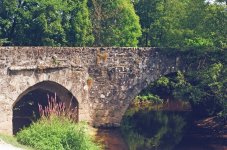
Pont Sainte-Elisabeth, Saint-Junien, France. 50mm Tessar and Kodak Pro Image 100
Zeiss purchased Voigtlander and with the purchase came a partially developed camera that eventually became adopted by Zeiss and called the Icarex. The Icarex was very similar to the later Zeiss Contarex Electronic and Professional cameras, but for reasons of cost and time retained the bayonet mount they had been given by Voigtlander in the early stages of production. Later Zeiss added an M42 option denoted as TM to distinguish it from the BM bayonet mount. This left Zeiss with two camera systems, two of which had bayonet mounts unique to the particular range and one available with a M42 mount common to much less expensive Japanese lenses. The opposition in Germany and Japan retained their respective mounts for decades and were in some cases backward compatible with more modern lenses.
Any Zeiss camera produced after the Icarex was effectively a Japanese camera albeit in some cases with German design courtesy of Porsche in the RTS series.
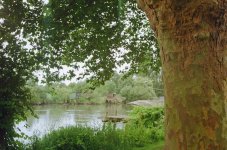
Fishing Cabins at Saint-Savinien, France. 135mm Sonar and Kodak Pro Image 100.

50mm Tessar with Proxar close-up filter. Kodak Pro Image 100.
The Contarex Bullseye was produced in two models from 1959 until 1967. The serial numbers on early cameras was stamped inside and commenced with a T prefix followed by Y & Z. There were two distinct Bullseye cameras, the later model having D, E & G prefixes also had several differences to the original. The light meter baffle was changed to accept a locking tab to stop it falling off and getting lost. The match needle meter was changed from a circle to inverted ‘V’s and it became possible to change the focus screens and include a data strip in the exposure. The later cameras had their serial numbers stamped on the tripod mount outside the camera back and had a smoother finish to the metal of the body. There was no guillotine like change to the two models. It is possible to find early ones with one or more of the improvements, but by the time the D prefix models arrived all the changes had been made including slightly extending the iso range by two points at the lower end.
There were other variants of Contax including two models the Professional and Electronic, both having battery operated light meters and the latter an electrical shutter mechanism. These cameras sold in even smaller numbers and at best were test beds for the later Voigtlander inspired Icarex cameras.
Sales of Contarex cameras never matched the expectations of the company. The production run of the two Bullseye models totalled 32000 cameras. In the same period Leica sold seven times that number of rangefinders. When the Nikon F was superseded in 1972 they had made over 800,00 of them. The reasons were many; the Japanese made cameras of an increasingly good quality and were far less expensive. Zeiss had over egged the pudding with the quality of their product. For example they opted for the helical lens mount to be entirely ground by hand and the tolerances of manufacture were 0.001mm. The rewind mechanism contained two gear trains and three axles. It took over 40 parts to be removed before any access could be made to the top of the mechanism. Also, the complexity of build; 1100+ individual parts, 4000 operations required to assemble it and the misplaced arrogance of cementing screws that were never thought were going to be removed. The repairs mounted up to the point when photographic and second hand dealers would not accept a Contarex at any price and eventually Zeiss went into tactical bankruptcy to distance the parent company from the financial demands of replacing faulty cameras that could not be feasibly repaired. It was a right mess and marked the end of Zeiss as a camera manufacturer. They sold the rights to make Contax cameras to the Japanese ceramics company Kyocera in the 1970’s.
Pont Sainte-Elisabeth, Saint-Junien, France. 50mm Tessar and Kodak Pro Image 100
Zeiss purchased Voigtlander and with the purchase came a partially developed camera that eventually became adopted by Zeiss and called the Icarex. The Icarex was very similar to the later Zeiss Contarex Electronic and Professional cameras, but for reasons of cost and time retained the bayonet mount they had been given by Voigtlander in the early stages of production. Later Zeiss added an M42 option denoted as TM to distinguish it from the BM bayonet mount. This left Zeiss with two camera systems, two of which had bayonet mounts unique to the particular range and one available with a M42 mount common to much less expensive Japanese lenses. The opposition in Germany and Japan retained their respective mounts for decades and were in some cases backward compatible with more modern lenses.
Any Zeiss camera produced after the Icarex was effectively a Japanese camera albeit in some cases with German design courtesy of Porsche in the RTS series.
Fishing Cabins at Saint-Savinien, France. 135mm Sonar and Kodak Pro Image 100.
50mm Tessar with Proxar close-up filter. Kodak Pro Image 100.

