


Clive K
Suspended / Banned
- Messages
- 1,496
- Name
- Clive
- Edit My Images
- No
2. The Contarex Laid Bare
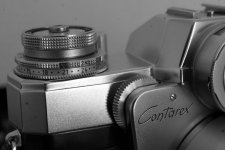
Nothing like the Contarex has been made before or since. It was designed to be the most luxurious 35mm camera ever and capture the lucrative professional and high end amateur market from the Leica rangefinders. Leica were reluctant to move into SLR production despite the limitations of their M range of cameras. The Contarex dwarfed anything Leitz had made. The body alone weighed 910g and 1260g with its ‘kit’ 50mm Planar lens. Every blogger mentions the weight. Strangely they don’t mention that it is around 100g lighter than the Nikon F. The dimensions of the beast are 153mm wide by 63mm deep and 99mm tall and had a very prominent circular light meter that gave it the enduring nickname ‘Bullseye’ or if you are posh ‘Cyclops’. Again, the Nikon F is no midget at 146mm x 101mm x 95mm. Nobody mentions that either.
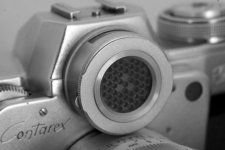
The design that inspired the Bullseye name is a selenium cell behind a removable baffle that has a honeycomb pattern. The baffle can be removed and by altering the film speed marker the meter can be used as an incidence meter giving four extra stops of sensitivity. On the original model film speeds of 8 to 1600 iso can be selected by turning a spring loaded dial underneath the combined shutter speed dial and shutter button arrangement on the right of the top cover. To the left of the viewfinder is a milled wheel that operates the step-less aperture selection. Also on the top cover is a small window with a match needle indicator that connects to the triangle of iso / shutter speed / aperture. There is also another match needle indicator visible through the viewfinder. One of the oddities of the Contarex is that in some instances the camera blocks access to the slower shutter speeds. This was designed to prevent photographers from selecting shutter speeds that might result in camera shake. A strange restriction given that the camera was aimed to be used by professionals and high end amateurs who should have the competency to deal with such matters. In the event you can work around the block by adjusting the iso setting and selecting a suitable aperture that the light meter might not approve of.
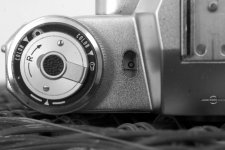
Film is loaded by the removal of the camera back in the customary Zeiss manner by turning two catches on the base of the film back, one of which also acts as the film rewind release. Once the film has been secured and advanced by the short, curved film advance lever that is not additive or cumulative and as to travel the whole distance to advance the film and cock the shutter. With the film secured and the film back locked it can be advanced two or three more times. Another Zeiss quirk is that the frame counter works backwards. The photographer should turn the wheel until the number of frames available 24 or 36 for example is opposite the small indicator. As each frame is advanced the number indicated reduces by one. In effect it indicates frames remaining and not frames exposed.
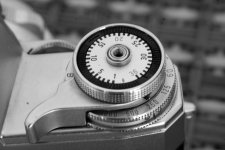
Everything on the Contarex is deliciously smooth and feels high quality. Except apparently the shutter button. That seems to be universally disliked by reviewers and can be soft and squishy or hard and lumpy depending on what review you read. Fortunately on my cameras I don’t have any issues with the shutter button. But then I don’t have a blog to fill every month with opinions. Before you press the shutter however there remains the shutter speed selection that is completed by rotating the large dial that surrounds the shutter until the required speed from 1s to 1/1000 is indicated. Then by using one or the other of the exposure meters the correct aperture will be indicated by rotating the small milled dial that falls conveniently to the photographer’s right index finger. There is no aperture selection possible on the lens itself. It has to be connected to the camera. Then we come to the viewfinder This has a conventional for the period split circle and ground glass focus aid. It also has a very bright view unmatched on any SLR of the period or later. Focus is obtained by turning the lens barrel. On the right of the view is a vertical black border with a match meter needle that should be aligned to the notches in the middle of the black border.. With a little practice everything can be done with the camera ‘to eye’.
The Contarex system includes the very high quality optics that Zeiss is famous for. The 50mm Planar is still highly regarded 50 years later and in demand for those who use heritage lenses on modern digital cameras. The available optics increased through the camera’s production run and are unique to the CRX mount. Lenses fit to the breach of the camera in the conventional manner. There is also a unique bayonet type mount on the front of many of the lenses to accept Zeiss filters and other accessories. A single Zeiss polarising filter or Proxar magnifying close-up filter will fit each of the Distagon 35mm, Planar or Tessar 50mm and the Sonar 135mm lenses amongst others. Each Contarex has facility to connect with three types of flash ensuring that the flash will fire in the period that the shutter is open. There was a special leather case designed to hold a Contarex, various lenses and accessories that in 1960 cost at today’s prices $14000 and you would probably have to pay a similar amount to buy one today.

Dandelion 'Clock' taken using 135mm Sonar and Kodak Pro Image 100.
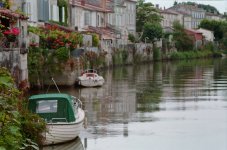
River Charente at Saint-Savinien, France. 135mm Sonar and Kodak Pro Image 100
Nothing like the Contarex has been made before or since. It was designed to be the most luxurious 35mm camera ever and capture the lucrative professional and high end amateur market from the Leica rangefinders. Leica were reluctant to move into SLR production despite the limitations of their M range of cameras. The Contarex dwarfed anything Leitz had made. The body alone weighed 910g and 1260g with its ‘kit’ 50mm Planar lens. Every blogger mentions the weight. Strangely they don’t mention that it is around 100g lighter than the Nikon F. The dimensions of the beast are 153mm wide by 63mm deep and 99mm tall and had a very prominent circular light meter that gave it the enduring nickname ‘Bullseye’ or if you are posh ‘Cyclops’. Again, the Nikon F is no midget at 146mm x 101mm x 95mm. Nobody mentions that either.
The design that inspired the Bullseye name is a selenium cell behind a removable baffle that has a honeycomb pattern. The baffle can be removed and by altering the film speed marker the meter can be used as an incidence meter giving four extra stops of sensitivity. On the original model film speeds of 8 to 1600 iso can be selected by turning a spring loaded dial underneath the combined shutter speed dial and shutter button arrangement on the right of the top cover. To the left of the viewfinder is a milled wheel that operates the step-less aperture selection. Also on the top cover is a small window with a match needle indicator that connects to the triangle of iso / shutter speed / aperture. There is also another match needle indicator visible through the viewfinder. One of the oddities of the Contarex is that in some instances the camera blocks access to the slower shutter speeds. This was designed to prevent photographers from selecting shutter speeds that might result in camera shake. A strange restriction given that the camera was aimed to be used by professionals and high end amateurs who should have the competency to deal with such matters. In the event you can work around the block by adjusting the iso setting and selecting a suitable aperture that the light meter might not approve of.
Film is loaded by the removal of the camera back in the customary Zeiss manner by turning two catches on the base of the film back, one of which also acts as the film rewind release. Once the film has been secured and advanced by the short, curved film advance lever that is not additive or cumulative and as to travel the whole distance to advance the film and cock the shutter. With the film secured and the film back locked it can be advanced two or three more times. Another Zeiss quirk is that the frame counter works backwards. The photographer should turn the wheel until the number of frames available 24 or 36 for example is opposite the small indicator. As each frame is advanced the number indicated reduces by one. In effect it indicates frames remaining and not frames exposed.
Everything on the Contarex is deliciously smooth and feels high quality. Except apparently the shutter button. That seems to be universally disliked by reviewers and can be soft and squishy or hard and lumpy depending on what review you read. Fortunately on my cameras I don’t have any issues with the shutter button. But then I don’t have a blog to fill every month with opinions. Before you press the shutter however there remains the shutter speed selection that is completed by rotating the large dial that surrounds the shutter until the required speed from 1s to 1/1000 is indicated. Then by using one or the other of the exposure meters the correct aperture will be indicated by rotating the small milled dial that falls conveniently to the photographer’s right index finger. There is no aperture selection possible on the lens itself. It has to be connected to the camera. Then we come to the viewfinder This has a conventional for the period split circle and ground glass focus aid. It also has a very bright view unmatched on any SLR of the period or later. Focus is obtained by turning the lens barrel. On the right of the view is a vertical black border with a match meter needle that should be aligned to the notches in the middle of the black border.. With a little practice everything can be done with the camera ‘to eye’.
The Contarex system includes the very high quality optics that Zeiss is famous for. The 50mm Planar is still highly regarded 50 years later and in demand for those who use heritage lenses on modern digital cameras. The available optics increased through the camera’s production run and are unique to the CRX mount. Lenses fit to the breach of the camera in the conventional manner. There is also a unique bayonet type mount on the front of many of the lenses to accept Zeiss filters and other accessories. A single Zeiss polarising filter or Proxar magnifying close-up filter will fit each of the Distagon 35mm, Planar or Tessar 50mm and the Sonar 135mm lenses amongst others. Each Contarex has facility to connect with three types of flash ensuring that the flash will fire in the period that the shutter is open. There was a special leather case designed to hold a Contarex, various lenses and accessories that in 1960 cost at today’s prices $14000 and you would probably have to pay a similar amount to buy one today.
Dandelion 'Clock' taken using 135mm Sonar and Kodak Pro Image 100.
River Charente at Saint-Savinien, France. 135mm Sonar and Kodak Pro Image 100
Last edited: