


Clive K
Suspended / Banned
- Messages
- 1,496
- Name
- Clive
- Edit My Images
- No
1. The Contarex Concept
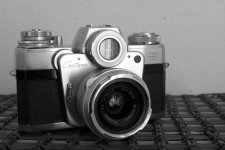
The Zeiss Contarex was the first and last professional quality SLR camera from the German company. Carl Zeiss is a long established optical company that was split into several arms covering lenses for spectacles, binoculars and microscopes and of course cameras and lenses. The company was founded by Carl Zeiss in 1846 and originally based in Jena. Carl Zeiss was similar to the English philanthropists Cadbury and Salt in that the company provided housing, education and medical care to their workers. One of their employees was Oskar Barnack who unfortunately suffered from a chronic complaint that excluded him from the company’s medical insurance. Barnack left Zeiss and took up employment in a smaller company that became Leitz and the rest as they say is history.
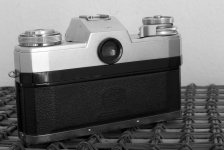
Carl Zeiss started the company soon after leaving university. He employed his tutor Ernst Abbe to design lenses. Abbe invented the method of mathematically calculating how light passes through curved lenses. Prior to that lens production was empirical and took much longer. Later Otto Schott became associated with the company. Schott was responsible for introducing methods of excluding air bubbles from molten glass making it denser and more pure.
The Zeiss company entered the photography market with a series of medium format folding cameras and Contax rangefinders based on the Barnack inspired 35mm format. They also acquired controlling rights in companies making shutters including Compur.
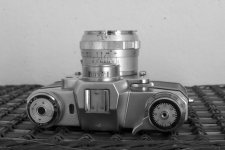
During WW2 the Zeiss factory was commandeered by the German Reich and used for military purposes making optics for the German war effort. Towards the latter end their factory at Dresden suffered total destruction and with it all the Zeiss development plans and prototypes. It is reported by a former employee that the prototype SLR camera locked in a steel cabinet was rendered to molten metal during the Thousand Bomber raid on Dresden. Germany was split in two as was Zeiss. The eastern factories and their development plans and prototypes fell into Russian hands spawning Zeiss clones including the first 35mm SLR, the Contax D and variants of the pre-war Contax II & III rangefinders.
The western part of the company became centred in Stuttgart and it was here in 1954 that Zeiss commissioned the Contarex development to sit above the leaf shutter Contaflex in their new SLR range alongside their revised rangefinders the Contax IIA & IIA and medium format folding cameras. The Contarex was to have a bayonet mount, horizontal curtain shutter and a light meter connected to the film sensitivity, aperture and shutter speed.The camera was introduced by means of press and publicity broadcasts in 1958 but did actually arrive on the shelves until very late 1959 due to the unforeseen complexity of production. The Contarex was designed to be the very best 35mm camera that money could buy and you needed a lot of money to buy one. At today’s prices the launch price was over a thousand US Dollars for a camera and 50mm Planar lens. That was half as much again as a Leica M3 and lens. If the price alone was to make it hard to sell events in Japan had an even more disastrous affect. Between the Contarex being announced and delivered the Nikon F had entered the market and was taking the high end amateur and professional markets the much more expensive Contarex was designed to dominate.
Reviews of the Contarex were somewhat mixed. Whilst many enthused at the sheer quality of manufacture others derided the style, size and weight of the camera. Even today online bloggers always harp on about the weight of the Contarex despite it being no more than several Leica and Japanese 35mm SLRs including the fabled Nikon F.
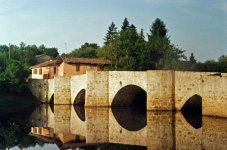
River Gartemp. Saint-Ouen sur Gartempe, France with Tessar 50mm and Kodak Pro Image 100

Apple Blossom with Tessar 50mm plus Proxar close-up filter. Kodak Pro Image 100.
The Zeiss Contarex was the first and last professional quality SLR camera from the German company. Carl Zeiss is a long established optical company that was split into several arms covering lenses for spectacles, binoculars and microscopes and of course cameras and lenses. The company was founded by Carl Zeiss in 1846 and originally based in Jena. Carl Zeiss was similar to the English philanthropists Cadbury and Salt in that the company provided housing, education and medical care to their workers. One of their employees was Oskar Barnack who unfortunately suffered from a chronic complaint that excluded him from the company’s medical insurance. Barnack left Zeiss and took up employment in a smaller company that became Leitz and the rest as they say is history.
Carl Zeiss started the company soon after leaving university. He employed his tutor Ernst Abbe to design lenses. Abbe invented the method of mathematically calculating how light passes through curved lenses. Prior to that lens production was empirical and took much longer. Later Otto Schott became associated with the company. Schott was responsible for introducing methods of excluding air bubbles from molten glass making it denser and more pure.
The Zeiss company entered the photography market with a series of medium format folding cameras and Contax rangefinders based on the Barnack inspired 35mm format. They also acquired controlling rights in companies making shutters including Compur.
During WW2 the Zeiss factory was commandeered by the German Reich and used for military purposes making optics for the German war effort. Towards the latter end their factory at Dresden suffered total destruction and with it all the Zeiss development plans and prototypes. It is reported by a former employee that the prototype SLR camera locked in a steel cabinet was rendered to molten metal during the Thousand Bomber raid on Dresden. Germany was split in two as was Zeiss. The eastern factories and their development plans and prototypes fell into Russian hands spawning Zeiss clones including the first 35mm SLR, the Contax D and variants of the pre-war Contax II & III rangefinders.
The western part of the company became centred in Stuttgart and it was here in 1954 that Zeiss commissioned the Contarex development to sit above the leaf shutter Contaflex in their new SLR range alongside their revised rangefinders the Contax IIA & IIA and medium format folding cameras. The Contarex was to have a bayonet mount, horizontal curtain shutter and a light meter connected to the film sensitivity, aperture and shutter speed.The camera was introduced by means of press and publicity broadcasts in 1958 but did actually arrive on the shelves until very late 1959 due to the unforeseen complexity of production. The Contarex was designed to be the very best 35mm camera that money could buy and you needed a lot of money to buy one. At today’s prices the launch price was over a thousand US Dollars for a camera and 50mm Planar lens. That was half as much again as a Leica M3 and lens. If the price alone was to make it hard to sell events in Japan had an even more disastrous affect. Between the Contarex being announced and delivered the Nikon F had entered the market and was taking the high end amateur and professional markets the much more expensive Contarex was designed to dominate.
Reviews of the Contarex were somewhat mixed. Whilst many enthused at the sheer quality of manufacture others derided the style, size and weight of the camera. Even today online bloggers always harp on about the weight of the Contarex despite it being no more than several Leica and Japanese 35mm SLRs including the fabled Nikon F.
River Gartemp. Saint-Ouen sur Gartempe, France with Tessar 50mm and Kodak Pro Image 100
Apple Blossom with Tessar 50mm plus Proxar close-up filter. Kodak Pro Image 100.
Last edited: