Wire Wool, is there a certain type?

wilt

Suspended / Banned
Messages
1,698
Name
Steven
Edit My Images
No
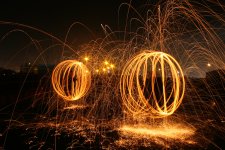
A few friends tried lighting wire wool and spinning it last night, for some creative photographs. Unfortunately is wouldn't seem to light.
I had a gas burner blow torch type thing to light it, so plenty of heat and fire.
We tried it tightly packed and loosely, but no joy.
I joked that it was fire retardant, as it wasn't lighting like we'd expected.
It just seemed to be the wrong type of wire wool. Does anyone have any recommendations on which type and where best to get it?
 
Has to be steel, not stainless steel (scourers are normally stainless).

Any good DIY shop should stock it.
 
Last edited:
Use regular steel wool, not stainless, and not with soap imbedded (in the US the embedded soap version is called a Brillo Pad). Experiment with different grades. The 0000 grade is the finest (smallest strand) version and will burn the easiest. A sleeve of steel wool is not expensive and readily available in hardware stores, Amazon, and home centers, so buy a sleeve of each of the smaller sizes and experiment. The number of zeros indicates the different sizes, so 000 will be the next larger (coarser) size. I will doubt that the 0 and 00 sizes will burn well, unless you combine fine with coarse (never tried). In this case, the smaller will burn readily and be hot enough to get the larger to burn - maybe. I haven't tried this.

You will need a relatively brave person to spin this. The sparks coming off are melted steel, so they are very hot. Be Careful. For spinning around a person, attaching a spring clip (heavy duty paper clamp) on a strong cord about 8 ft long works well. Add a large knot to the loose end and smaller knots every 6" or so, for the person doing the spinning to sense how much cord has been let out during the spinning and not let go when at full length. They should wear 100% cotton, smooth surfaced, with long sleeves, cotton gloves, and a smooth cotton hat or thick cotton bandana to cover their hair. Avoid synthetic garments to prevent the burning fabric from melting to the skin. These garments will likely be trashed afterwards, or saved for the next burning if still good enough. Cotton will burn, but quite slowly, and it doesn't melt to the skin like plastics can, so it's relatively safe. If flameproof treated these cotton garments will be even safer.

It's best to do this in a wide open area and over wet bare ground, wet grass after a rain, or pavement that can't burn. Sparks go everywhere, so be prepared with a pail or two of water and a few spray bottles of water. The spray bottles are to put the spinner's clothing out if he catches fire, but you have the pails of water in case he or the ground surface should have a more serious fire. If you want to stop the burning steel wool, dipping it into the pail of water will be the quickest way.

Spinning a burning piece of steel wool at 3-8' length around rapidly and at different angles in the dark, with your camera set on an extended time exposure will be very impressive. Experiment with different settings. If they start spinning with the cord short, and then they let out to the next knot or two while spinning, the shoot can be even more spectacular. It would be best to have several assistants ready with the spray bottles and water pails for fire watch/protection just in case they are needed.

Charley

 
Use regular steel wool, not stainless, and not with soap imbedded (in the US the embedded soap version is called a Brillo Pad). Experiment with different grades. The 0000 grade is the finest (smallest strand) version and will burn the easiest. A sleeve of steel wool is not expensive and readily available in hardware stores, Amazon, and home centers, so buy a sleeve of each of the smaller sizes and experiment. The number of zeros indicates the different sizes, so 000 will be the next larger (coarser) size. I will doubt that the 0 and 00 sizes will burn well, unless you combine fine with coarse (never tried). In this case, the smaller will burn readily and be hot enough to get the larger to burn - maybe. I haven't tried this.

You will need a relatively brave person to spin this. The sparks coming off are melted steel, so they are very hot. Be Careful. For spinning around a person, attaching a spring clip (heavy duty paper clamp) on a strong cord about 8 ft long works well. Add a large knot to the loose end and smaller knots every 6" or so, for the person doing the spinning to sense how much cord has been let out during the spinning and not let go when at full length. They should wear 100% cotton, smooth surfaced, with long sleeves, cotton gloves, and a smooth cotton hat or thick cotton bandana to cover their hair. Avoid synthetic garments to prevent the burning fabric from melting to the skin. These garments will likely be trashed afterwards, or saved for the next burning if still good enough. Cotton will burn, but quite slowly, and it doesn't melt to the skin like plastics can, so it's relatively safe. If flameproof treated these cotton garments will be even safer.

It's best to do this in a wide open area and over wet bare ground, wet grass after a rain, or pavement that can't burn. Sparks go everywhere, so be prepared with a pail or two of water and a few spray bottles of water. The spray bottles are to put the spinner's clothing out if he catches fire, but you have the pails of water in case he or the ground surface should have a more serious fire. If you want to stop the burning steel wool, dipping it into the pail of water will be the quickest way.

Spinning a burning piece of steel wool at 3-8' length around rapidly and at different angles in the dark, with your camera set on an extended time exposure will be very impressive. Experiment with different settings. If they start spinning with the cord short, and then they let out to the next knot or two while spinning, the shoot can be even more spectacular. It would be best to have several assistants ready with the spray bottles and water pails for fire watch/protection just in case they are needed.

Charley

Leather is even better than cotton (though we've only had it available as jacket, gloves & hat)

We've used a dog lead for spinning which set the maximum total length to something suitable for vertical spinning & and with the wool in a kitchen whisk (replacements were needed).
As well as open areas places with fire proof walls/ceilings or other surfaces for sparks to bounce off can add to the effect.
We've done it on beaches, by rocks/water & under a stone bridge all with nothing flammable nearby.

IMGP9854 by Mike Kanssen, on Flickr

Here's one of the bridge shots
IMGP9821_cr by Mike Kanssen, on Flickr

Even after half a dozen workshop sessions, We're still coming up with new variants to try.
 
Last edited:
Use regular steel wool, not stainless, and not with soap imbedded (in the US the embedded soap version is called a Brillo Pad). Experiment with different grades. The 0000 grade is the finest (smallest strand) version and will burn the easiest. A sleeve of steel wool is not expensive and readily available in hardware stores, Amazon, and home centers, so buy a sleeve of each of the smaller sizes and experiment. The number of zeros indicates the different sizes, so 000 will be the next larger (coarser) size. I will doubt that the 0 and 00 sizes will burn well, unless you combine fine with coarse (never tried). In this case, the smaller will burn readily and be hot enough to get the larger to burn - maybe. I haven't tried this.

You will need a relatively brave person to spin this. The sparks coming off are melted steel, so they are very hot. Be Careful. For spinning around a person, attaching a spring clip (heavy duty paper clamp) on a strong cord about 8 ft long works well. Add a large knot to the loose end and smaller knots every 6" or so, for the person doing the spinning to sense how much cord has been let out during the spinning and not let go when at full length. They should wear 100% cotton, smooth surfaced, with long sleeves, cotton gloves, and a smooth cotton hat or thick cotton bandana to cover their hair. Avoid synthetic garments to prevent the burning fabric from melting to the skin. These garments will likely be trashed afterwards, or saved for the next burning if still good enough. Cotton will burn, but quite slowly, and it doesn't melt to the skin like plastics can, so it's relatively safe. If flameproof treated these cotton garments will be even safer.

It's best to do this in a wide open area and over wet bare ground, wet grass after a rain, or pavement that can't burn. Sparks go everywhere, so be prepared with a pail or two of water and a few spray bottles of water. The spray bottles are to put the spinner's clothing out if he catches fire, but you have the pails of water in case he or the ground surface should have a more serious fire. If you want to stop the burning steel wool, dipping it into the pail of water will be the quickest way.

Spinning a burning piece of steel wool at 3-8' length around rapidly and at different angles in the dark, with your camera set on an extended time exposure will be very impressive. Experiment with different settings. If they start spinning with the cord short, and then they let out to the next knot or two while spinning, the shoot can be even more spectacular. It would be best to have several assistants ready with the spray bottles and water pails for fire watch/protection just in case they are needed.

Charley
Great information, thanks.
 
Also, just use a small 9v battery to light the wool. Easier than carrying around your blow torch!
 
When we did it we were wearing some of my welding clothes, blue jeans, thick cotton shirt, treated cotton welders hat, welding gloves and safety glasses. My son and I buy our welding clothes at the local thrift shops whenever possible, because they don't last very long. I still got a few burns doing this steel wool spinning, one on my neck and two on my wrist (the wrist involved in doing the spinning). I think my shirt sleeve and glove separated and left a gap). I have many burn scars from welding, so these little ones kind-of disappeared amongst the rest rather quickly. When welding, a seasoned welder never wants to stop a weld bead mid way, unless the burning becomes severe. It's more a "quality of weld thing", and we won't stop making a good bead unless it's absolutely necessary. A funny statement made once by a welder friend "You're not a welder, unless you can tell what part of you is burning by the smell."

Avoid any clothing that is synthetic or partially synthetic. Plastic (any form of plastic textile) burns and melts to the skin, leaving very severe burns. Fire retardant treated cotton is best, but untreated cotton (like blue Jeans) burns slowly, giving you or a close friend the chance to put the fire out before it starts burning you.

Charley
 
I don't think fire blanket ponchos existed when I tried this, but knowing what I do about ponchos, it might help, but not cover you well enough to be completely safe. If I had one, it would likely make a good top protection layer, but I would want thick cotton under it as one wouldn't be complete head to toe protection. High boots with pant legs overlapping them is needed too. Welders know this, and it's a bit of fun to watch a new welder when they don't do this and get a hot blob down inside their boot. The dance is quite spectacular to watch.

Charley
 
Back
Top