Wildlife Photographer of the Year 2025

Messages
44,805
Name
'Gramps'
Edit My Images
No
and a lot of photo shop.

I think rarity of the hyena played a big part, but i do rather like the juxtaposition of the white ruff on the neck and the white front of the building. The hyena looks just as wrecked as the building.

Just shows they are looking for something a bit more unusual than the heron/kingfisher/eagle catching a fish or deer in the mist.

The junior winner is a nice photo also.

Urban/nature combination seems to appeal - sod the romance. :)

Two unique images not easily reproduced.
 
Last edited:
Some interesting captures.


The winning photo is another camera-trap photo - thoughts?

If you look through all the images, "runner ups and highly Commended, etc.," some almost 1700 images, I was surprised how many were taken with the "older" DSLR's - even, D3's, D300's, D700's, D90 etc., etc.


I'm still trying to "figure out" the Shadow Hunter
 
Last edited:
If you look through all the images, "runner ups and highly Commended, etc.," some almost 1700 images, I was surprised how many were taken with the "older" DSLR's - even, D3's, D300's, D700's, D90 etc., etc.


I'm still trying to "figure out" the Shadow Hunter
I haven't looked through them all Bill, no.
There are some (IMO) really good photos and some meh! - 'Shadow Hunter' leaves me cold tbh.
If camera-traps are the thing then maybe it ought to be 'Wildlife Photograph of the Year' and not 'photographer'?
It's an old 'chestnut' but for me, if it's not the photographer taking the shot ... well :rolleyes:
 
I haven't looked through them all Bill, no.
There are some (IMO) really good photos and some meh! - 'Shadow Hunter' leaves me cold tbh.
If camera-traps are the thing then maybe it ought to be 'Wildlife Photograph of the Year' and not 'photographer'?
It's an old 'chestnut' but for me, if it's not the photographer taking the shot ... well :rolleyes:
I have to agree with your last couple of sentences there :)
 
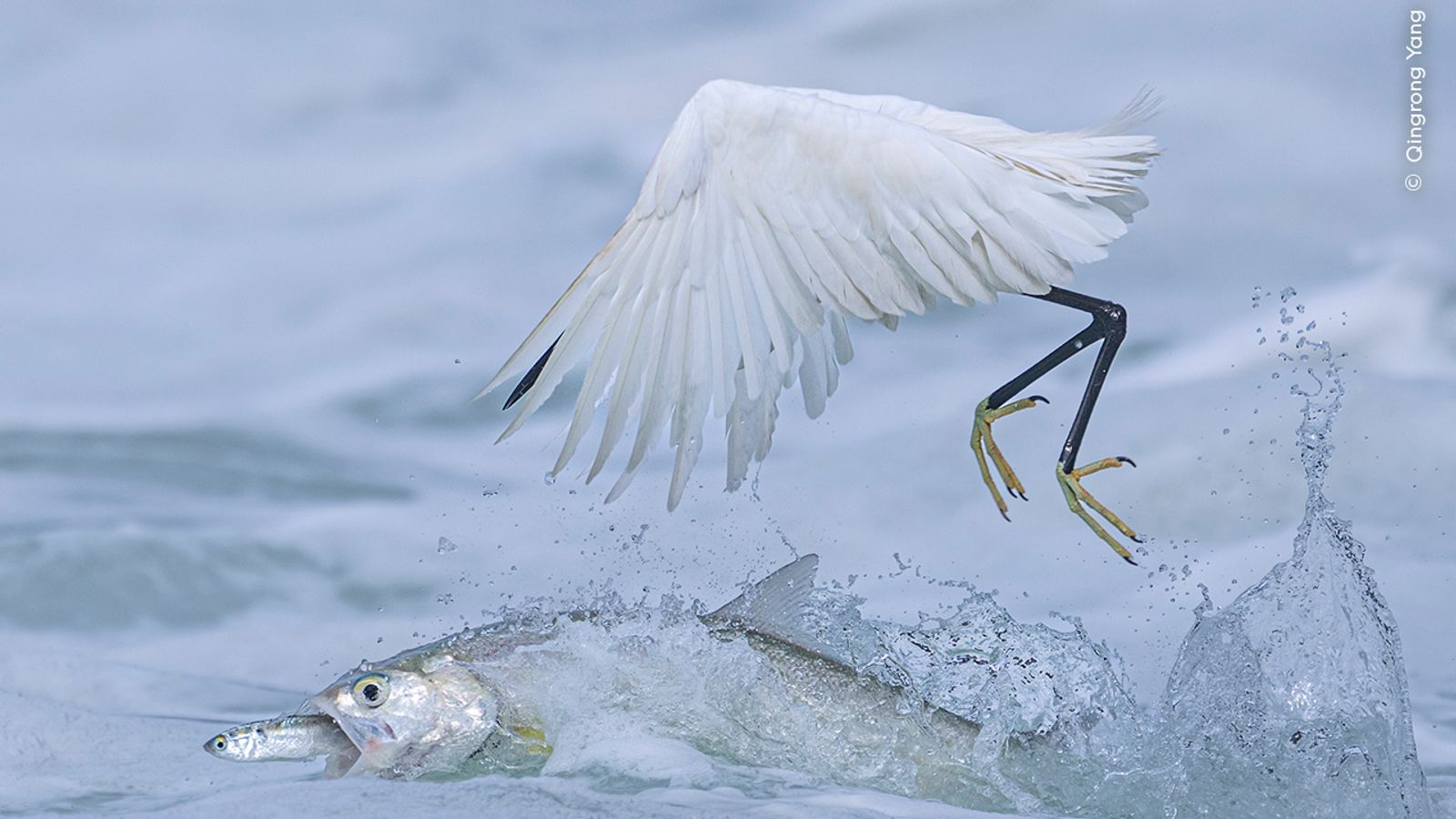
Some outstanding work there, the one that stands out for me (of the ones I've seen so far) is 'Synchronised Fishing', it's a belter. It has a problem for me though, if only the Little Egret's eye could be seen, or even the whole of it's face/head, that image would've been on another planet. At least he was there to take it though.


If camera-traps are the thing then maybe it ought to be 'Wildlife Photograph of the Year' and not 'photographer'?

:plus1:
 
Last edited:
Some interesting captures.


The winning photo is another camera-trap photo - thoughts?
I'm not sure what thoughts you think people might have, but I have no problem with animal triggered photographs.

Whether it's mammals, as in this case or other animals such as insects. I've spent a fair bit of time using camera traps, and there is no way I could put the time and effort required to lift my "research" driven record shots into competition-level "photographs"

Making high quality remote triggered animal photographs requires high levels of photographic, ecological and animal behaviour skills. Along with lots of time and effort.

I can well believe this photograph took ten years of hard work to pull off, even if it wasn't working on this project only.

Finding a good location for the photograph is difficult. You then need to compose and set up the lighting without the subject being present, along with working out the best camera position and position for the triggers. I knew of someone who used a stuffed badger to set up his camera position, composition and lighting.

If you are lucky and get more than one chance at a picture, refining camera position, trigger placement and lighting can be a risky business, as the next time the animal comes around, it may not do the same as it did the last time. I also know someone who was researching bat flight, and once a bat had flown through the trigger beam once, and fired the flashes, it continued to feed, but hopped over the invisible trigger beam, every time it circled the pond. After only a few photographs, none of the bats were flying through the trigger beam.

Finally, how an animal uses its home range may vary annually and seasonally, so even though you have researched your camera location (s) in advance, they may well prove useless once you get around to setting up the camera and lights. The window of time to capture the desired composition might be very small.

Of course, there is an element of luck in getting an animal to play along with your carefully structured setup, but I think this applies to all photography.

 
I'm not sure what thoughts you think people might have, but I have no problem with animal triggered photographs.

Whether it's mammals, as in this case or other animals such as insects. I've spent a fair bit of time using camera traps, and there is no way I could put the time and effort required to lift my "research" driven record shots into competition-level "photographs"

Making high quality remote triggered animal photographs requires high levels of photographic, ecological and animal behaviour skills. Along with lots of time and effort.

I can well believe this photograph took ten years of hard work to pull off, even if it wasn't working on this project only.

Finding a good location for the photograph is difficult. You then need to compose and set up the lighting without the subject being present, along with working out the best camera position and position for the triggers. I knew of someone who used a stuffed badger to set up his camera position, composition and lighting.

If you are lucky and get more than one chance at a picture, refining camera position, trigger placement and lighting can be a risky business, as the next time the animal comes around, it may not do the same as it did the last time. I also know someone who was researching bat flight, and once a bat had flown through the trigger beam once, and fired the flashes, it continued to feed, but hopped over the invisible trigger beam, every time it circled the pond. After only a few photographs, none of the bats were flying through the trigger beam.

Finally, how an animal uses its home range may vary annually and seasonally, so even though you have researched your camera location (s) in advance, they may well prove useless once you get around to setting up the camera and lights. The window of time to capture the desired composition might be very small.

Of course, there is an element of luck in getting an animal to play along with your carefully structured setup, but I think this applies to all photography.

I get your point Graham but I'm not convinced.
I had some lovely video of Foxes & Badgers visiting my garden a few years ago - I was asleep at the time, although I did setup the electronics!
 
There are some marvellous images in the "runner up" and "highly commended" categories ............ many I would have chosen over the winners ........... but the judges are the "experts" so they must know what they are doing as most of the worlds "experts" "judges" and senior members of Government do.
 
I get your point Graham but I'm not convinced.
I had some lovely video of Foxes & Badgers visiting my garden a few years ago - I was asleep at the time, although I did setup the electronics!
I don't think being asleep is relevant, the relevant bit is that you set it up. Remote "video" tends to be easier to produce something "lovely" because the animals are doing things to make it interesting; it doesn't need a lot of input from the photographer up to make it photographically interesting.

The shot we are discussing relies on it being graphically interesting, and that doesn't come without a lot of work from the photographer. This isn't just a picture of a hyena walking past a remote camera, it's clearly been constructed by the photographer

I don't think the photographer needs to physically press the shutter as long as they are responsible for what has been produced.
 
I don't think being asleep is relevant, the relevant bit is that you set it up. Remote "video" tends to be easier to produce something "lovely" because the animals are doing things to make it interesting; it doesn't need a lot of input from the photographer up to make it photographically interesting.

The shot we are discussing relies on it being graphically interesting, and that doesn't come without a lot of work from the photographer. This isn't just a picture of a hyena walking past a remote camera, it's clearly been constructed by the photographer

I don't think the photographer needs to physically press the shutter as long as they are responsible for what has been produced.
Well just have to disagree I’m afraid. :)
 
I don't think being asleep is relevant, the relevant bit is that you set it up. Remote "video" tends to be easier to produce something "lovely" because the animals are doing things to make it interesting; it doesn't need a lot of input from the photographer up to make it photographically interesting.

The shot we are discussing relies on it being graphically interesting, and that doesn't come without a lot of work from the photographer. This isn't just a picture of a hyena walking past a remote camera, it's clearly been constructed by the photographer

I don't think the photographer needs to physically press the shutter as long as they are responsible for what has been produced.
For the image in question the photographer clearly had a composition in mind - but having decided on that, and positioned the camera trap, it was then a case of periodically collecting the shots, and picking the one that came out best.
There's undoubtedly skill in finding/recognising the right spot for the camera, but I'd be happier if such photography was in a separate category (much as Underwater has a category).
 
For the image in question the photographer clearly had a composition in mind - but having decided on that, and positioned the camera trap, it was then a case of periodically collecting the shots, and picking the one that came out best.

As per my original post, I think you underestimate how much work goes into getting to a stage of picking the best one, along with ongoing tweaking of the set up.

But how far do you take this idea of just picking the best one. Should we be concerned with continuous shooting: 5fps, 10fps .... 120fps, and then just picking the best one, Or pre-capture where we don't have to judge when a bird leaves a perch, just pick the best one.
There's undoubtedly skill in finding/recognising the right spot for the camera, but I'd be happier if such photography was in a separate category (much as Underwater has a category).
That sounds like a good idea.
 
As per my original post, I think you underestimate how much work goes into getting to a stage of picking the best one, along with ongoing tweaking of the set up.

But how far do you take this idea of just picking the best one. Should we be concerned with continuous shooting: 5fps, 10fps .... 120fps, and then just picking the best one, Or pre-capture where we don't have to judge when a bird leaves a perch, just pick the best one.

...
I agree there's skill in setting up a successful camera trap - but it's about creating a scene which an animal will subsequently enter, rather than photographing an animal in the location you find it - hence the suggestion that it should be in a separate category.
There's also a degree of truth about use of high FPS in modern cameras - how do you differentiate between a 'spray and pray' approach, and using a short controlled high fps burst to get that 'perfect' shot where the photographer has used years of skill and practice to predict when a particular behaviour will occur but the behaviour is brief / high speed so that relying on single shot and reaction time is a lottery?
 
I agree there's skill in setting up a successful camera trap - but it's about creating a scene which an animal will subsequently enter, rather than photographing an animal in the location you find it - hence the suggestion that it should be in a separate category.
As I said, I agree with the separate category, but you are still creating a scene in a location where your research has shown you will find the animal, so I'm not sure about the distinction

And once you start thinking about what is actually being assessed (and I'm not sure what that is), it seems to get complicated. hence my question on fps.

For example, should there be a distinction between photographs taken while sitting in a hide on an RSPB reserve and photographs taken in the "wild".
There's also a degree of truth about use of high FPS in modern cameras - how do you differentiate between a 'spray and pray' approach, and using a short controlled high fps burst to get that 'perfect' shot where the photographer has used years of skill and practice to predict when a particular behaviour will occur but the behaviour is brief / high speed so that relying on single shot and reaction time is a lottery?
I’ve discussed this before, and it's one of the reasons, I think it should be Wildlife "Photograph" of the year, and that Wildlife "Photographer" of the year should be something different, and based on a portfolio of work.

"Consistent" results come from carefully timed short bursts, but you still need a bit of luck, and a spray and pray approach with a lot of luck can still produce. winning photograph. Equally, setting out intending to photograph a particular behaviour with expertise in that animal's behaviour will dramatically increase your "luck" in catching it. Just as it does with animal triggered photography.

I think that a title of Photographer of the year, should be about the skills of the photographer, and not, potentially, about a lucky shot.
 
Some of these photos leave me cold. 'Wildlife' implies to me something other than set up shots, studio images and, camera traps. I realise the techniques of setting camera traps isn't easy, but the 'trap' can be left out for ever and be part of a large campaign involving multiple cameras. Sooner or later they will record a good image.
 
Back
Top