Wide Angle with Cropped Sensor

gman

Suspended / Banned
Messages
11,100
Name
Graham
Edit My Images
Yes
Following on from This thread, I've been doing a bit more reading and could someone help me out a bit with this.

Last thread basically concluded that all lenses on my 400D would be subject to crop factor, therefore I'd never get what the lens is capable of on the wideangle end of things. But I've read that the EF-S lenses are closer to the image sensor to allow for the proper wideangle. This would explain why I'm sure my kit lens goes far more wide than my Sigma 20mm prime.

So would a 20mm EF-S lens actually be 20mm and not be 32mm due to the crop factor? :shrug:
 
Nope sorry, it's still got the crop factor to deal with.
20mm is 20mm so you'd have 35mm equiv = 32mm.
If you took the mirror out of a full frame EF body you could use it on one, but it would still be 20mm.
The EF-S bit is just the mount type - it only fits EF-S bodies whereas EF lenses fit both.
 
are EF-S lenses designed for cropped bodies (like the DX Nikon lenses)? If so, then it will be a true 20mm on your 400D, otherwise it will be 32mm.
 
are EF-S lenses designed for cropped bodies (like the DX Nikon lenses)? If so, then it will be a true 20mm on your 400D, otherwise it will be 32mm.

This is what I'm thinking. I came across this http://en.wikipedia.org/wiki/EF-S which says that the EF-S lenses have the rear element closer to the sensor presumably to accomodate the restriction of the cropped sensor?

Kinda like the "less expensive" part also :D
 
read this

EF-S lenses ARE for cropped bodies (well according to the link they are, i'm a darksider so don't know much about those things) so a 20mm EF-S lens will be 20mm.
 
Using the EF-S lens will still be subject to magnification factor e.g.

17-85mm that I have is including magnification factor about the same as a 28-135mm on a 35mm film camera. If I stick a 28-135mm on the 40D it will fit but will be subject to magnification factor again so would be pretty useless.

Just because it says 17mm it does not make it super wide, for that you will need a 10-22mm or similar which at the wide end will be equivilent to about 16mm.

Either way whether it be EF-S or the equivilent full frame lens what you see in the viewfinder is the same.

We have got used to lenses being quoted in 35mm full frame terms. You just need to remember that we still use this system and if using an EF-S lens take the magnification factor into consideration i.e. take the quoted lens and multiply by 1.6x.
 
Where is that useful picture with the circles and squares that explains this perfectly?
 
whether a lens is EF or EF-S it will still be subject to the 1.6 crop factor of the body. The only way you will get the stated range of the lens (eg. 17-85mm) is if you buy a full frame body.

bit more here:
crop factor explained/
 
What's the difference between EF and EF-S lenses?
 
EF-S lens' are designed for crop body sensors and as such have their rear elements closer to the sensor...this reduces vignetting in some instances (by them being designed to better focus the light on the sensor), makes the lens' lighter and therefore cheaper to manufacture.
 
makes the lens' lighter and therefore cheaper to manufacture.

Just came across this in severl other places. Damn, I was hoping for the superwide answer! lol

Cheers for all the advice
Graham
 
Agree with all the above regarding the EF-S (S stands for small I believe). The rear element on an EF-S lens is closer to the sensor which can only be fitted to a body with a smaller sensor ie 400D.
I use the 400D with a EF 17-40, and I get a wider angle than with the EF-S 18-55.
I too thought the 17-40 wouldn't be as wide as my kit lens, but was pleasantly surprised!

Jamie
 
What's the difference between EF and EF-S lenses?
Where is that useful picture with the circles and squares that explains this perfectly?
Here.

On the left is the image projected by a "traditional" lens (like a Canon EF or a Sigma DG): the image circle is large enough to cover a full-frame sensor or a frame of 35mm film. On the right is the same view through a designed-for-digital lens (such as a Canon EF-S or a Sigma DC) with the same focal length. It's simply a smaller piece of glass, which is why it's cheaper, and you can see why they only work on crop-factor cameras.

Crop-factor-demo-3.jpg


Now can we please cut out all the "20mm is really 32mm" nonsense?
 
:clap:i'm glad thats sorted :lol:
 
That's an interesting diagram and explanation. However the fact remains if you compose the scene using a cropped sensor camera e.g. EOS40D with say a 17-85mm and the same scene with a 28-135mm strapped to a full frame camera such as the 5D the picture and view available to you would be roughly the same. Or have I missed the point somewhere?

The field of view is the important bit rather than the mm of the lens surely?
 
That's an interesting diagram and explanation. However the fact remains if you compose the scene using a cropped sensor camera e.g. EOS40D with say a 17-85mm and the same scene with a 28-135mm strapped to a full frame camera such as the 5D the picture and view available to you would be roughly the same. Or have I missed the point somewhere?

The field of view is the important bit rather than the mm of the lens surely?
Yes, in the scenario you describe, the view would be roughly the same.

Yes, for virtually all applications, the field of view is the important bit.

But I think the best argument for trying to maintain a bit of clarity is this. Most people - especially beginners who are going to be most easily confused about this - don't have a 40D and a 5D and aren't going to be particularly interested in the kind of comparison you described. However, they are going to be interested in the difference between, say, an EF 17-40mm and an EF-S 18-55mm on a 400D. It's all to easy for them to conclude that 17mm on the EF lens is "really" 28mm and that 18mm on the EF-S lens will be wider, which of course isn't the case.
 
The focal length is what is quoted in the lens. 35mm equivalent is a standard guide. Medium and large format camera may have a standard lens as 90mm or 110mm which is equivalent to a 50mm on in 35mm frame size. The larger area that records the image needs a higher focal length to fill the frame. If you put a 50mm on a medium format is would be a wide angle lens, but the frame size in the middle which is the same size as the 35mm frame, will have recorded the same area of the image as the 35mm frame, but the larger area that has recorded the picture (6x7 or whatever) records the outside edge. Of course the med and large format glass has a larger circle or coverage, so using a 35mm or ef-s lens would no record on the whole frame (similar to the example above). In conclusion 20mm, 50mm or whatever will ALWAYS be that, you just think about the image in 35mm terms to get a comparison and benchmark to judge how wide or telephoto the lens will cover of the scene you are trying to photograph.

Hmm, I wonder if I explained that well or not.
 
The crop factor just gives you a narrower angle of view than the same lens on a 35mm camera.

LINK

But doesnt that give magnification in a way?

Dave
 
The crop factor just gives you a narrower angle of view than the same lens on a 35mm camera.

LINK

But doesnt that give magnification in a way?

Dave

I think the area of the image seen woud look the same size but you wouldn't get the same compression effect like telephoto lenses produce.
So you can't just crop the centre of a shot taken with a normal lens and get the same compression effect.

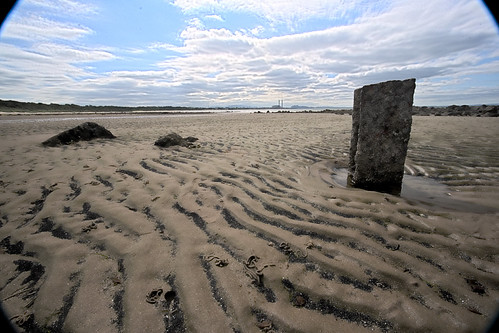
An extreme example (excuse the crap HDR, vignetting (forgot to take off UV filter when I put CPL on) and dust bunnies by the way)
You can make out the power station in the distance in the centre of this shot taken at 10mm


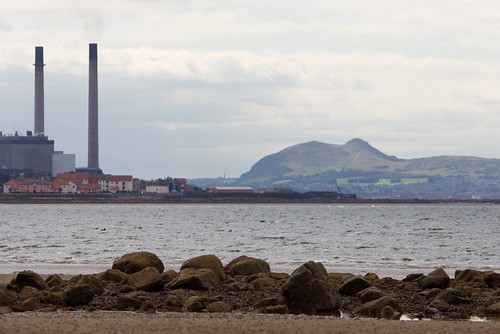
Now you could crop the area around the power station, but you wouldn't get the same image compression than if you took it at 200mm, eg:-


I could be talking nonense of course! It's probably a question for a physicist!
 
The crop factor just gives you a narrower angle of view than the same lens on a 35mm camera.

LINK

But doesnt that give magnification in a way?

Dave

He makes some good points in that article, but also contradicts himself a few times, which doesn't help on what can be a confusing topic at the best of times.
 
159 sir, you have it exactly.

Field of view is just one thing that changes with focal length. Compression/distortion and depth of field are also dependent on focal length but don't appear any different on a crop of full frame camera.

Which is why a 10mm lens DOES NOT BECOME AND WILL NEVER BE a 16mm on a crop camera. :)
 
I think the area of the image seen woud look the same size but you wouldn't get the same compression effect like telephoto lenses produce.
So you can't just crop the centre of a shot taken with a normal lens and get the same compression effect.

An extreme example (excuse the crap HDR, vignetting (forgot to take off UV filter when I put CPL on) and dust bunnies by the way)
You can make out the power station in the distance in the centre of this shot taken at 10mm


Now you could crop the area around the power station, but you wouldn't get the same image compression than if you took it at 200mm, eg:-


I could be talking nonense of course! It's probably a question for a physicist!
Sorry 159, you are talking complete and utter rubbish.

If you cropped out the centre of the 10mm image it would look identical to the 200mm image.

So-called compression is nothing to do with focal length or any other property of the lens. It arises from the spatial relationship between the objects in the image and the camera, not from the lens.
 
159 sir, you have it exactly.
Exactly wrong, you mean.

But 159 did at least have the good sense to indicate that he wasn't entirely sure of his facts. It would have helped if you'd done that too, dazza, so that people who are looking for information and guidance could apply an appropriate degree of scepticism to your remarks. I think it is slightly irresponsible to convey such an air of certainty when what you say is actually untrue.
 
I think it is slightly irresponsible to convey such an air of certainty when what you say is actually untrue.

If you were right, I would agree. You're not.

Trust me, I do know what I'm talking about here. It's my job to know and frankly, it should be yours too.

If you cropped out the centre of the 10mm image it would look identical to the 200mm image.
No, it wouldn't. You've got the kit there, go and check it for yourself if you don't believe me.

Don't make me drive all the way over there so you can buy me a pint whilst we discuss nerdy physics down the pub. :p;)

159, YOU ARE RIGHT. end of!
 
I think the phrase "Field of view equivelent" would therefore be a better way of describing what happens on a cropped sensor camera. OK I know it's not 100% technicaly accurate but it's near enough to explain what is happening
 
I think the phrase "Field of view equivelent" would therefore be a better way of describing what happens on a cropped sensor camera. OK I know it's not 100% technicaly accurate but it's near enough to explain what is happening

It would work for me. :D

OK, I've managed to stir the grey cells into thinking of a good example of this. Top Gear use it lots, far too much really but there you go.

Have you ever seen leading tracking shots of a car on the telly. Then the shape of the car changes and you either get more or less of the background through the transformation.

Well that's adjusting the focal length of the lens while adjusting the camera to subject distance to maintain the same magnification. The optical charateristics change with the focal length of the lens. Mainly these would be the compression or distortion and depth of field.
 
Now can we please cut out all the "20mm is really 32mm" nonsense?

Granted a 20mm lens is a 20mm lens regardless of what format camera its on

But why nonsense? a 20mm lens on a dslr x (1.6 factor) has the same view as a 32mm lens on a 35mm camera and in my opinion i think that it can be said it magnifies the image
 
It doesn't magnify it - you are 'viewing' a smaller portion of the field of view.

If we play with different numbers it might make more sense.

Pretend the crop factor is 20x (as opposed to 1.6x).

If you had a 10mm lens on a 20x crop sensor that would be the same field of view as a 200mm lens on a full frame.

It's not magnified though because the image is still from a 10mm lens. You're just seeing a very small portion of it, one twentieth in fact.
 
So, if its a bird on a twig which would be better...a dlsr x1.6 or a full frame?
 
I would agree in that a crop factor of 1.6 makes it APPEAR to be magnified to the operator even though it would obviously seem that technically it's not magnified.

What a thread. Me and my questions! hehe :D
 
So, if its a bird on a twig which would be better...a dlsr x1.6 or a full frame?

Well, that leads to a whole lot more questions!

Taking the same lens and comparing full frame v 1.6x crop...

You'd be more likely to have to crop the final image if it was full frame, whereas the crop body's image would cover a smaller area and perhaps be tighter around the subject.

Another consideration is that the depth of field for any given aperture will be more shallow on the full frame body. Some might see this as a bonus, and some may see it as a hindrance.

That is perhaps a topic for another thread! ;)
 
the depth of field for any given aperture will be more shallow on the full frame body

At the risk of making more friends in this thread ;) ......

That's not right. Depth of Field is purely an affect of the lens and not changed by using a FF, crop, large format camera or whatever. :)
 
Back
Top