Why do things bend and distort on my photos ?

Crotal Bell

Suspended / Banned
Messages
3,470
Name
Keith
Edit My Images
Yes
Why is it that things bend out or in when you take photos from certain angles. I took a photo of a long alleyway and the fences are bent outwards like a banana.
Take this church photo, the left side of the church leans-in as if the tower is bent?

Is this the case with photos/cameras in general? Are some lenses worse than others?

Taken with Panasonic G80 and 12-60mm lens.

P1310570.JPG
 
And you also get distortion (progressively greater) as you move further from the lens axis. This is normally only noticeable with wide angle lenses (people at the edges become wider in group photos). Unless you're using a shift lens, when even long focal lengths can be shifted far from the axis.

This isn't a lens fault - it's simple to demonstrate on paper that it's inevitable.
 
Converging verticals - If you want to avoid them, I have found that there are basically two options,

1) Move further away from the subject on the same line of sight with the view that you wish to obtain and then use a longer focal length lens.

Of course this is not alway practiable due to trees, obnoxious street furniture etc.

2) Buy a PC, perspective control, Lens

Not all camera systems have them available.
 
Last edited:
Barrel (and other types of) distortion tend to be more prevalent with cheaper lenses, it isn't really an obvious problem with most "normal" subjects.

Perpective distortion, which is your issue, is, as pointed out by others, unavoidable unless we use very specialised lenses and/or cameras (and an understanding of physiscs), it's caused by one part of the subject being closer to the lens than another. In theory, the camera should be straight and if we can't get everything in then we should move further back until we can, but we don't do that and point the camera up or down instead, which causes the problem.

And yes, we can correct it, to some extent, in software, and both product and architectural photographers may do that routinely, but for most photos we just accept this distortion as normal and unavoidable. It's all about lens to subject distance, so shows up more with wideangle lenses, because they allow us to be closer to the subject.
 
You can correct, but you would need quite a bit more space around the subject to allow for cropping as part of the process, otherwise you end up with something that is straighter but doesn't appear quite right


P1310570a.jpg
 
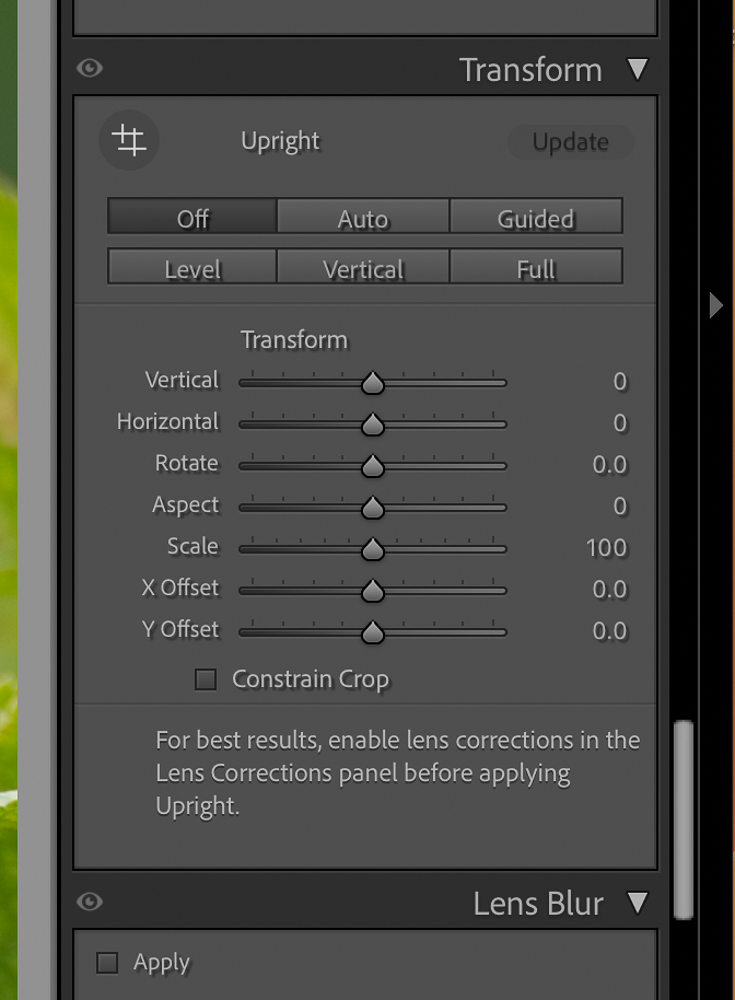
if you use LR, this helps - sometimes it's effective but you loose some of your image

TP_Transform.jpg
 
Umpteen years ago, I read an article in, if I remember correctly, "Photography" magazine.

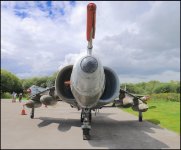
The premise of the article was "lens distortion is a fact of life; learn to use it". I won't claim I always succeed but it's more fun trying to turn it to my advantage than moaning about it.

Harrier Jump Jet at Yorkshire Air Museum GM5 P1220783.JPG
 
I don't think you should see significant optical distortion as such with most MFT cameras because most of them have inbuilt corrections. After that you're into perspective distortion and all lenses show that but it will be more obvious with wide angle lenses.

You don'need a camera and lens to visualise this. All you need to do is to form a picture frame with you fingers, tilt it, look through it and look at the verticals in the scene relative to the sides of your finger picture frame.

One way to never see perspective distortion as in the above picture in the op is... Stop tilting the camera, but if you do that you're not going to get a lot of compositions you want and you'll still see it show in another way when some things in the scene are close to the camera and others aren't.
 
Last edited:
Are some lenses worse than others?

Yes - or possibly more correctly, some are better corrected than others (for the distortions - the perspective [converging verticals] is down to physics and can only really be sorted by using a tilt/shift lens of software) with the Sigma 12-24 standing out.

Some zooms show both barrel and pincushion distortion, with bulging sides at the wide end and squeezed edges at the long end...
 
I might be wrong but I think with many modern lenses even those relying on in camera or post capture corrections optical distortion probably isn't as bad as with some lenses of the past. Even with near perfect lenses perspective distortion is still going to be easily visible when you tilt the lens or get too close to someone's nose.

I think it's important to know what is happening and why and depending on the type of camera and lens you are using perspective distortion may well be easily visible before you take the picture if you look at the scene you are about to capture and note the position of things relative to the edges of the frame.
 
I agree, most modern lenses are pretty good, obviously the more we pay the better they should be, and fixed focal length lenses tend to be better than zooms, especially when it's a big zoom range, and standard and telephoto lenses tend to be better than wide-angle lenses.

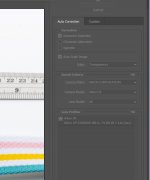
Also, some editing software can do a pretty good job of correcting - or at least dramatically improving - lens faults, just tell the software which lens you're using.
Screenshot 2025-08-08 123557.jpg
So, there's a lot that we can do.

But, my advice is that unless you're a specialist (think product or architectural photography) that requires dead straight lines etc, it's best not to worry too much, just concentrate on the subject.
 
I prefer that to my original.
I took literally a few seconds with Affinity, but with more room and more time, good results can be had.


Were you using a Panasonic lens (I'm guessing you were using the G9)?

Panasonic lenses on Panasonic cameras do mostly correct for optical inaccuracies, but of course they do not correct for distortions that depend on angles / heights etc that are under user control or just physics associated with a short focal length etc.
 
Distortion is a feature of every long focus lens, because of the "flattening" of the perspective but it's often considered beneficial and even attractive.

I remember numerous magazine articles on that effect in the 1960s and 1970s, when relatively inexpensive lenses in the 300mm to 1000mm range became available. Like all such matters of taste, there were (and still are) conflicting opinions on the subject...

NIKON F AUSTRIA 1991 21.jpg
 
I hate to be pedantic but I'll do it anyway just so that everyone is clear on this.

There is no "flattening" with longer focal length lenses. It's all down to the camera to subject distance and if for example you took two shots from the same position and distance one at 20mm and the other at 200mm and you then cropped the 20mm shot for the same framing as the 200mm shot the "flattening" would look exactly the same.

Same is true of perspective distortion causing converging verticals and noses looking way too big etc. It's not the focal length it's the angle of the camera and the camera to subject distance.

Whilst I'm on about flattening and big noses and that sort of thing, go for whatever works for you and sometimes perspective distortion can IMO make a picture but if going for realism and avoiding both big noses and flat faces I think the happy medium is depending upon framing somewhere between 50 and 85mm in FF money. Having said all that. An ex GF of mine with great legs loved a 28mm picture of her I took from a low angle pointing upwards because it made her legs look great. So whatever works for you and the subject is best :D
 
I hate to be pedantic but I'll do it anyway just so that everyone is clear on this.

There is no "flattening" with longer focal length lenses. It's all down to the camera to subject distance and if for example you took two shots from the same position and distance one at 20mm and the other at 200mm and you then cropped the 20mm shot for the same framing as the 200mm shot the "flattening" would look exactly the same.

Same is true of perspective distortion causing converging verticals and noses looking way too big etc. It's not the focal length it's the angle of the camera and the camera to subject distance.

Whilst I'm on about flattening and big noses and that sort of thing, go for whatever works for you and sometimes perspective distortion can IMO make a picture but if going for realism and avoiding both big noses and flat faces I think the happy medium is depending upon framing somewhere between 50 and 85mm in FF money. Having said all that. An ex GF of mine with great legs loved a 28mm picture of her I took from a low angle pointing upwards because it made her legs look great. So whatever works for you and the subject is best :D
I'm glad you mentioned that, it's something that a lot of people simply don't understand.

There was a thread on here a few years ago, where a press photographer had taken a shot of people on a beach, from a long way away. Because it was taken from so far away, it looked like the beach was crowded with people, all very close together, ignoring the Coronavirus regulations that were in force at that time.

Sadly, despite this being a photography forum where we should all know better, quite a few people were sure that the compression effect was caused by the use of a telephone lens, when it was of course caused by the distance.
 
I took literally a few seconds with Affinity, but with more room and more time, good results can be had.


Were you using a Panasonic lens (I'm guessing you were using the G9)?

Panasonic lenses on Panasonic cameras do mostly correct for optical inaccuracies, but of course they do not correct for distortions that depend on angles / heights etc that are under user control or just physics associated with a short focal length etc.
Pana G80 and 12-60mm bussy
 
I'm glad you mentioned that, it's something that a lot of people simply don't understand.

There was a thread on here a few years ago, where a press photographer had taken a shot of people on a beach, from a long way away. Because it was taken from so far away, it looked like the beach was crowded with people, all very close together, ignoring the Coronavirus regulations that were in force at that time.

Sadly, despite this being a photography forum where we should all know better, quite a few people were sure that the compression effect was caused by the use of a telephone lens, when it was of course caused by the distance.

I remember that. It was IMO deliberately and maliciously done but I suppose it is possible that he just had no clue. Unlikely but I suppose possible.

On understanding. You don't even need a camera to see the effect for yourself. All you need to do is try and recognise and understand what you are seeing as you walk down a street preferably with something big visible in the distance such as a hill, large building or tree. As you set off things in the distance look small relative to the hill, building or tree but as you get closer the once distant but now foreground things look bigger relative to the hill, building or tree. With each step you take you should see the changes in perspective.
 
Last edited:
Saying compression is all about the viewpoint only serves to confuse IMO. While it is a consequence of viewpoint relative to subject, a flattened image is the result of using a telephoto lens.

If someone asks how to get an appearance of compressed space in a photograph the answer is to use a telephoto lens AND stand further away from the subject. One doesn't work without the other.
 
Saying compression is all about the viewpoint only serves to confuse IMO. While it is a consequence of viewpoint relative to subject, a flattened image is the result of using a telephoto lens.

If someone asks how to get an appearance of compressed space in a photograph the answer is to use a telephoto lens AND stand further away from the subject. One doesn't work without the other.
Of course one works without the other, the focal length of the lens is totally irrelevant, perspective distortion is entirely dependent on viewpoint.

I can of course see why you say that one doesn't work without the other, we use long lenses at long distances to avoid unnecessary loss of image quality due to avoidable levels of cropping, but the focal length of the lens still has nothing to do with the effect, so it's probably best to avoid causing confusion by saying that they're related.
 
Saying compression is all about the viewpoint only serves to confuse IMO. While it is a consequence of viewpoint relative to subject, a flattened image is the result of using a telephoto lens.

If someone asks how to get an appearance of compressed space in a photograph the answer is to use a telephoto lens AND stand further away from the subject. One doesn't work without the other.

I think it's best to arm people with the info and hope it makes them think and sorry but I do thing that saying that a flattened image is the result of using a telephoto is misleading but maybe it's just the way my mind works. I personally think it's better to say that it's down to distance and framing. Framing being the zoom bit.

I think explaining that compression or rather perspective is down to distance can lead people doing more than standing in one spot and zooming in and out or conversely believing that you can zoom with your feet, yes you can "zoom" with your feet but you should understand that in doing so you change the perspective. OK, sometimes you can't change position and the only option you have is to zoom but if people do understand what's going on and that it involves distance and perspective perhaps that gives them more creative options when they can change position and thus change perspective. I think understanding helps people and gives more creative options when we can move and use different focal lengths to create quite different looks.

Perhaps I should say sorry again for being pedantic and raising this :D but hopefully all this back and forth does help people to understand what's going on with distance, perspective and focal lengths.
 
Of course one works without the other, the focal length of the lens is totally irrelevant, perspective distortion is entirely dependent on viewpoint.

I can of course see why you say that one doesn't work without the other, we use long lenses at long distances to avoid unnecessary loss of image quality due to avoidable levels of cropping, but the focal length of the lens still has nothing to do with the effect, so it's probably best to avoid causing confusion by saying that they're related.
But they ARE related. :D

I think the optical pedants are looking at this from the other end to me - the camera end. My starting point is the final photo.

If someone asks how to get the compressed look in an UNCROPPED photo they ain't going to get it with a fisheye. Ergo what they need to get the look is a telephoto. Then they need to stand in the right place to get the required perspective.

....hopefully all this back and forth does help people to understand what's going on with distance, perspective and focal lengths.
I doubt it. Perspective is all about looking. Really looking. I know Ken Rockwell gets slated on here but his advice (tucked away in the bowels of his website) that taking drawing lessons is the best thing a budding photographer can do, is spot on. Drawing teaches you to look see what things really look like rather than what we think they look like. How a slight movement of the head can completely alter the view - using perspective. Photographers can use that knowledge to hide distracting objects behind ones closer to the lens instead of relying on shallow depth of field for example.

Having poked the hornet's nest I'll leave this lesson in perspective for you all...

View: https://www.youtube.com/watch?v=MMiKyfd6hA0
 
But they ARE related. :D
In theory, they are not related, in practice they are.

You'd need a very long enlarger column to get the appearance of the "nun" picture from a 28mm lens on a 35mm SLR. Hence, in the real world, if you want that sort of image, you stick on a long lens, in this case a 400mm on a Nikon F.

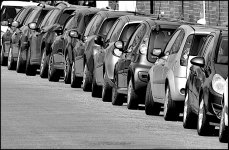
This "compressed perspective" picture could have been made with a standard zoom on the Panasonic G9 by selecting a tiny section out of the image in editing. However, the 100~400mm at maximum focal length made it a lot easier and kept it reasonably sharp...

Cars parked in Exmouth G9 P1012154.JPG
 
Back
Top