

Beginner Which light - studio items.

Gary Rawlins

Suspended / Banned
Messages
368
Name
Gary
Edit My Images
No
Hi all,

I know absolutely nothing about lighting and am looking to get a light which is constant, dimmable, zoomable (if this is a possibility), and has an adjustable colour temperature. I'll also need a stand/tripod for it to mount onto.

I'll be using the light in a small home studio setup.

I will also need a boom (possibly 2) to hold various items from above and a stand/tripod for them to mount to.

Is there anywhere that sells cheap used studio equipment?


The image I took here is the kind of thing I'm aiming at. As you can see, I struggled to get light in the foreground. I had a bicycle light strapped to a chair on top of the sofa and aimed the light at the FG and added a mirror on the opposite side to help reflect back to the FG. It worked, but wasn't powerful enough.

The coloured fairy lights were dangled from a string line, stretched across my lounge tied to a ladder and clothes rack.
The BG is a roll of black cordura material, which I think works very well and the reflective base is a roll of window blackout film. It has a texture, which you can see in the coloured reflections.

This is a homework shot for a night class I'm attending. We're currently working on DOF.
1/20
f/2.8
iso 100
70mm
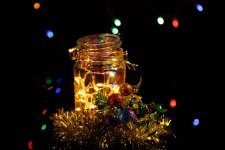
Festive bokeh f-2.8.jpg
 
The trouble you’ll have with this question is that your example here is a very untypical ‘studio’ image, because your subject is emitting a very small amount of light.
The answer to getting more light into that image would be a focussable torch. And that would work great for exposures of 1/20 sec.

The problem is then what happens if you want to photograph a human, or a dog, or a wine bottle, or a watch?

A torch isn’t going to work for those, neither is a 1/20 exposure

As for your more general question, there’s loads of studio lighting and kit on eBay, and there are bargains to be had, but importantly there is kit available you should give a wide berth to. And flash is always the better option (except for your niche example above).
 
The gear you have (or propose to get) will be hopeless for any "normal" lighting needs but, for what you're doing right now, I can't see any need for change.

AFAIK, nobody really bothers to sell cheap used studio equipment, but it may get sold on preloved, facebook and similar. As far as your boom arm is concerned, maybe a microphone boom stand will be perfect? https://www.ebay.co.uk/sch/i.html?_from=R40&_nkw=microphone+stand+boom&_sacat=0&rt=nc&_udhi=10

As for lack of power, you can set any ISO you like, for your purpose even if the image quality is poor, it shouldn't matter much.

The image I took here is the kind of thing I'm aiming at. As you can see, I struggled to get light in the foreground. I had a bicycle light strapped to a chair on top of the sofa and aimed the light at the FG and added a mirror on the opposite side to help reflect back to the FG. It worked, but wasn't powerful enough.
What wasn't powerful enough - the reflected light? Do you understand how the Inverse Square law works? it applies to all light, including reflected light, and in fact applies to all forms of radiated energy. In short, every time the light is moved twice as far from the subject, 3/4 of the light is lost. So, if the light is say 1 metre from the subject but then needs to travel another meter to the mirror, and then another metre back to the foreground, then the reflected light has travelled 3 meters and has lost nearly all of its power. The simple answer is to move the mirror much closer to the subject.

This is all a bit rough and ready, based largely on my guesswork, but if you give us more detail we may be able to give more detailed advice.
 
The trouble you’ll have with this question is that your example here is a very untypical ‘studio’ image, because your subject is emitting a very small amount of light.
The answer to getting more light into that image would be a focussable torch. And that would work great for exposures of 1/20 sec.

The problem is then what happens if you want to photograph a human, or a dog, or a wine bottle, or a watch?

A torch isn’t going to work for those, neither is a 1/20 exposure

As for your more general question, there’s loads of studio lighting and kit on eBay, and there are bargains to be had, but importantly there is kit available you should give a wide berth to. And flash is always the better option (except for your niche example above).
Thank you for your reply Phil.

Skipping the torch idea, would something like a Godox Litemons LA150Bi be useful for my festive shot above and the foreground lighting. Just to help brighten the shadows of the gold tinsel, and then if I wanted to progress to shooting humans, wine bottles, watches etc?

I realise the exposure would be different, though.

Flash is on the list. I currently own a Godox V1 (canon fit). Again, flash photography is something I know nothing about. Although, I'm currently looking into it.

I was hoping to try water splash shots using the V1, but I'm not sure if it would be the best solution, perhaps getting something more powerful and having the ability to use it in other situations may be a better idea, something like a Godox AD200.

Regarding eBay, I'll give it a wide berth, until I'm more familiar with studio kit in that case.
 
The gear you have (or propose to get) will be hopeless for any "normal" lighting needs but, for what you're doing right now, I can't see any need for change.

AFAIK, nobody really bothers to sell cheap used studio equipment, but it may get sold on preloved, facebook and similar. As far as your boom arm is concerned, maybe a microphone boom stand will be perfect? https://www.ebay.co.uk/sch/i.html?_from=R40&_nkw=microphone+stand+boom&_sacat=0&rt=nc&_udhi=10

As for lack of power, you can set any ISO you like, for your purpose even if the image quality is poor, it shouldn't matter much.


What wasn't powerful enough - the reflected light? Do you understand how the Inverse Square law works? it applies to all light, including reflected light, and in fact applies to all forms of radiated energy. In short, every time the light is moved twice as far from the subject, 3/4 of the light is lost. So, if the light is say 1 metre from the subject but then needs to travel another meter to the mirror, and then another metre back to the foreground, then the reflected light has travelled 3 meters and has lost nearly all of its power. The simple answer is to move the mirror much closer to the subject.

This is all a bit rough and ready, based largely on my guesswork, but if you give us more detail we may be able to give more detailed advice.
Thank you for your reply Garry.

Boom stands. I have been looking at various options... Where do you start ;)

I didn't want to get any of the coloured fairy light cables or noise in the shot. I'm yet to come back to this particular setup and try various things. What I really wanted to achieve was getting more light into the FG gold tinsel. My little torch and mirror did help slightly, but something more powerful may have done this job better and created more flexibility with the shot.

Inverse square law, thank you for mentioning it. I hadn't heard of it, but I'll certainly be reading about it now (y)
 
Thank you for your reply Garry.

Boom stands. I have been looking at various options... Where do you start ;)

I didn't want to get any of the coloured fairy light cables or noise in the shot. I'm yet to come back to this particular setup and try various things. What I really wanted to achieve was getting more light into the FG gold tinsel. My little torch and mirror did help slightly, but something more powerful may have done this job better and created more flexibility with the shot.

Inverse square law, thank you for mentioning it. I hadn't heard of it, but I'll certainly be reading about it now (y)
Well, having at least a basic understanding of the ISL is crucial, everything to do with artificial lighting is controlled by it. That's also true of natural light, but as the sun is 93 million miles away and our artificial lights are much closer, the percentage of light fall-off is much greater with artificial lights. As it happens, I've started on a tutorial about the ISL because much of the online stuff is either too technical or is simply wrong, but it won't be finished for a few weeks.

Meanwhile, just accept that you can't use one small light to equally illuminate your foreground tinsel. But you could add another, similar light on the opposite side.

As for the boom arm, the ones that are designed for photographic lights are very large, and are also heavy and expensive. many years ago I had a few old boom mike stands to hold very lightweight items, which were perfect for the job.

Except for the gearheads who always find a need for the best and most expensive gear, we tend to make do and mend.

I get it that you don't want to introduce noise, but 100 ISO simply won't work for these shots with very low-powered lighting. You're managing with 100 ISO for this particular shot at f/2.8, but you won't manage at the smaller apertures which will also be needed for these DOF exercises.
ISO:
100 = f/2.8
200 = f4
400 = f/5.6
800 = f/8
1600 = f/11
3200 = f/16
6400 = f/22
12800 = f/32

EDIT:
The Godox Litemons LA150Bi is just an overpriced LED light, usable for some subjects but horrible for humans, which is why we use flash unless we hate people:)
And adding more power won't affect the ISL, so it won't help you anyway.
 
Last edited:
Well, having at least a basic understanding of the ISL is crucial, everything to do with artificial lighting is controlled by it. That's also true of natural light, but as the sun is 93 million miles away and our artificial lights are much closer, the percentage of light fall-off is much greater with artificial lights. As it happens, I've started on a tutorial about the ISL because much of the online stuff is either too technical or is simply wrong, but it won't be finished for a few weeks.

Meanwhile, just accept that you can't use one small light to equally illuminate your foreground tinsel. But you could add another, similar light on the opposite side.

As for the boom arm, the ones that are designed for photographic lights are very large, and are also heavy and expensive. many years ago I had a few old boom mike stands to hold very lightweight items, which were perfect for the job.

Except for the gearheads who always find a need for the best and most expensive gear, we tend to make do and mend.

I get it that you don't want to introduce noise, but 100 ISO simply won't work for these shots with very low-powered lighting. You're managing with 100 ISO for this particular shot at f/2.8, but you won't manage at the smaller apertures which will also be needed for these DOF exercises.
ISO:
100 = f/2.8
200 = f4
400 = f/5.6
800 = f/8
1600 = f/11
3200 = f/16
6400 = f/22
12800 = f/32
What format will your tutorial be in? If it becomes available I'd be very interested.

I think that mic boom stands will work perfectly and are quite cheap, used. This seems like the best solution (y)

I'll re shoot the festive setup again soon and try different ISO's and hopefully by that time I'll have a better light/s source for the FG. It's a whole new learning curve and quite exciting to be learning something new. In fact, I'm glad I posted this up, your replies are very helpful and informative. I really appreciate your time.
 
What format will your tutorial be in? If it becomes available I'd be very interested.
I'll just publish it online, in the "Resources" section here.

I'm going to include some real-world photos for illustration, the problem with that is that it will need space that I simply don't have at home, so I'll need to use space in the Lencarta warehouse, which means waiting until some space has become available, right now there isn't enough space because of a large new delivery of stock.

2 - 3 weeks hopefully.
 
I'll just publish it online, in the "Resources" section here.

I'm going to include some real-world photos for illustration, the problem with that is that it will need space that I simply don't have at home, so I'll need to use space in the Lencarta warehouse, which means waiting until some space has become available, right now there isn't enough space because of a large new delivery of stock.

2 - 3 weeks hopefully.
I look forward to it and I hope things work out with the warehouse.

It would seem that space is an issue for me, too. I think my front room is perfectly useable as a studio, but apparently, having everything (non-photography related) shoved into a corner isn't normal :(
 
Skipping the torch idea, would something like a Godox Litemons LA150Bi be useful for my festive shot above and the foreground lighting. Just to help brighten the shadows of the gold tinsel,
The key thing, that I tried to point out first time, is that your subject is some led lights that aren’t very bright. So whilst your previous torch and mirror wasn’t bright enough to light the foreground, that Godox light would almost certainly be too bright even at lowest power. So by the time you’d got the foreground exposed correctly, the led lights would be invisible.
What I really wanted to achieve was getting more light into the FG gold tinsel. My little torch and mirror did help slightly, but something more powerful may have done this job better and created more flexibility with the shot.
 
I look forward to it and I hope things work out with the warehouse.
There won't be any kind of a problem, it's just that with today's very low profit margins and high turnover, stock comes and goes quickly and I just need to synchronise my time availability with their space availability - the old days of my 4000 sq ft studio have gone:(
The key thing, that I tried to point out first time, is that your subject is some led lights that aren’t very bright. So whilst your previous torch and mirror wasn’t bright enough to light the foreground, that Godox light would almost certainly be too bright even at lowest power. So by the time you’d got the foreground exposed correctly, the led lights would be invisible.
And it isn't even about the power, it's about the fall-off of light over distance, ISL.

Not to worry about the techo issues for now, given that you're new to this and have equipment limitations, I think that you've done well, and practice and understanding will move you forward.

But my personal approach would have been to set a much higher ISO, and get all of the shots at all of the different f/numbers done in one shoot.

As for your thanks, that's what we do on TP:)
 
The key thing, that I tried to point out first time, is that your subject is some led lights that aren’t very bright. So whilst your previous torch and mirror wasn’t bright enough to light the foreground, that Godox light would almost certainly be too bright even at lowest power. So by the time you’d got the foreground exposed correctly, the led lights would be invisible.

Of course, that makes perfect sense. Thank you.
 
Back
Top