What's wrong with my camera (Nikon F-301) ? Opinions ....

Naboo32

Suspended / Banned
Messages
3,278
Name
Andy
Edit My Images
Yes
Hello all :) !

It's been years since I've posted here, but as I have recently decided to give 35mm film another go, it was only a matter of time before I came back :giggle: . Sadly though, it's not to share a 'wealth of wonderful captures' (I wish) with you, but to pose the question; What's wrong with my camera :( ?

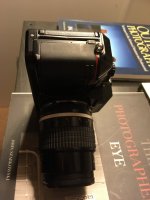
The camera in question is a Nikon F-301 (Wikipedia link ...).

I bought it on eBay, from a charity shop, so it was untested (risky, or what?). After I'd cleaned it up and checked it over, it appeared that everything was working as it should and so I went out and shot my first roll of film with it. When the negatives came back, I discovered that nearly all of them had a curved, white 'swish' of light across the left hand side of the frame (or the bottom, if I was shooting in portrait orientation). Oddly, the very first exposure didn't have it, but all of the next dozen or so did. After that, it seemed to be intermittent and only showed up on one of the last four frames.

Here are some examples.


Confusingly (to me), these next two frames were taken 5 seconds apart using exactly the same settings (I think) - one frame is marred, the other isn't.


So, what do you think is causing this effect?

Just to rule out some variables:
  • The affected exposures were not all shot with the same lens.
  • The film was new (Ilford HP5) stock and was processed professionally (by Ag Photographic, in Birmingham).
  • Although most of these were shot a high(ish) shutter speeds, there are still marks (albeit fainter) on some of those that used slower (1/30 sec) shutter speeds.

Over to you, folks ;) ...
 
That is a light leak. You have decayed light seals. The particular seal causing this is the foam strip by the hinge connecting the back to the body. I can tell this because the flare is on the left - the image in the camera is reversed vertically and horizontally so that part of the image was on the right in the camera which is where the hinge (and light seal) is.

The effect will appear to be intermittent as the extent of the flare depends on the time between shots. If you take several shots in quick succession the film will be moved before there is enough light to be visible. If you delay between shots, the film is stationary in front of the film gate for longer giving the flare a longer exposure.

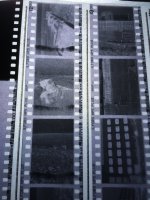
When asking for help with film problems, it is better to provide a photo of the negatives including the edges around the holes rather than a scan of the image as the state of the rebates can be important.
 
Last edited:
Thanks John, that makes sense.

There is a dent in the film door on the hinge side and although the seals looked OK at first, it could be that the dent is causing a leak.

I don't have a photo of the negatives, but the (black) mark only extends as far as the the edge of the frame where the sprocket holes begin.
 

Attachments

  • IMG_0788.JPG
    IMG_0788.JPG
    84.8 KB · Views: 10
Thanks for your added input, Trevor.

I do actually have a spare door on another F-301 that I bought for parts, so I could use that. Also, I do have a 'universal' light seal kit that I used on some other SLRs years ago, which I could use on the new door.

I thought that the problem was maybe something to do with the shutter, which is something that I couldn't tackle, but from what you both say it isn't.

Again, thank you both for your help ;) .

Andy
 
  • Like
Reactions: Sky
A spare? Result. (y)

I'd recommend replacing the seals if you already have some foam then Andy. It's always easier to get older ones off before they start to crumble. :)
 
That model is so cheap these days (compared to the FE, FE2, FM, FA etc.) that I actually bought three of them last month so that I could carry them all round with different lenses on. The first one I bought turned out to have a broken speed dial mechanism, so I bought a faulty one for a tenner and swapped over the parts that I needed to fix it. Now it looks as though I will be pulling more spare parts off that camera - it was a useful purchase :) .

When I've used up the rolls of film that are in the other two F-301s, I will take the film doors off (they are held in with sliding pins) and re-do all of the light seals, as per your suggestion.

It's funny, I've never seen the effects of faulty light seals in any of my previous SLRs and I've had a few that were older and had very little of the original foam left. I guess that the dent in the hinge on this one is playing a major part. At least it's not the shutter though, thankfully.
 
I wouldn't be absolutely certain of pinning the blame on the foam at the hinge end of the door. I have several 35mm cameras, including an F-301 and can't help noticing the quite clearly defined bands in the arc on that image.

I've had several light leaks over the years, some due to crumbling seals, other due to a hole in a cloth shutter curtain on a FED. I've never has a hinge-end seal leak that didn't extend on to the sprocket holes. The arc-shaped streak also puzzles me, making me think of maybe the shutter, I know that the shutter is a vertical one, but I can't see how it operates on my F-301, as with the back open it always does the 3 frame automatic wind on, without operating the shutter.

I'm more inclined to think of light entering the cassette or the scanner during processing. Where do the hairs on the images come from? The processing may not have been that 'professional'.

The obvious test is to shoot another roll with wide black tape over the hinge end for half the roll and half the roll without it. I wish you luck with your endeavours.
 
Hi Nick! Thanks for your input and for raising an interesting point. As the mark only extends to the very beginning of the sprocket holes (and gets thicker towards the outside edges), it does rather suggest that the light leak is coming through the shutter curtain itself and not from the back. Now I see why John was strongly advocating the inclusion of a photo like the one below with any (public) investigation into such a fault :giggle: . Sorry it took me so long, John.


IMG_0804.JPG

As for how to proceed, I have decided that I am going to sell the camera as 'faulty' and let someone else worry about it. Like I said, I bought three of these things and I really only need two (or less).

Regarding the hairs and dust spots on the images, that would be down to me. Ag Photographic only processed the negatives. I took them out of the protective sleeve and scanned them myself. Unfortunately, the negative scanner that I use is a very old Minolta DiMage (Dual Scan MkIII) and whilst it is far sharper than any flatbed scanner I have tried in the past, it is unbelievably slow to scan a strip of 6 exposures (like, 30 minutes) because of the knackered old Windows (Vista) laptop that I need to run it. What happens is, the slide holder sits outside the scanner for most of that scanning time and is only 'sucked in' a frame at a time. During that time, bits of airborne dust and fluff can settle on the exposed (pardon the pun) negatives. I have tried giving them a periodic blow-over with the rubber bulb blower during scanning, but even that doesn't eliminate it completely.

This will be my third attempt in life to shoot film, but based on my experiences with these test rolls (and the underwhelming results), I can't see it working for me this time either :( . Never mind, at least it kept me busy for a while :) .

Thanks again to everyone who has given their time to replying.

Andy
 
Last edited:
Back
Top