
What is my central heating system doing?

StewartR

Suspended / Banned
Messages
11,513
Name
Stewart
Edit My Images
Yes
Our smart meter records and displays usage minute-by-minute. And this level of detail is making me very confused about what the heating system is actually doing. Can anyone help me understand?

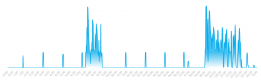
The graphic below is a display of our gas usage on New Year's Day. We'd been out at a New Year do the night before and had stayed over for lunch, so there was nobody in at home until about 17:30. It's clear that the central heating was on from 07:00 until 09:00, and from 19:00 to 22:30. But what I don't understand is:
(a) Why are there regular little spikes every couple of hours throughout the day? (They're not exactly regular though; for example the first few are at 01:29, 03:24, 05:17, 07:08.)
(b) When the heating is on, why does it have that pattern of increased activity every half hour or so?

I see the same sorts of patterns every day; I've just shown the one from January 1st because with nobody at home for most of the day it's easier to rule out human intervention.

Can anyone explain?
upload_2017-1-4_1-19-7.png
 
Hi Stewart,

What type of boiler do you have?

If it is a combi, then I know our one has a quick warm option or some thing similar where you can hear it kick in for a bit (less than a minute) and stop to keep the water hot.
 
It's kicking in to keep the low temperature up, when the heating is 'off' it'll either have a frost protection or a min temp, I think mines about 10deg.
 
It's a combi boiler. I read in the manual that it has a 'Pre-heat' mode where it produces hot water at the tap more quickly and an 'Eco' mode where it doesn't. The default mode, which I checked is the one that's operative, is 'Pre-heat'.

I reckon that's it, exactly. Logically it must work by having a little reservoir of water which it heats up, and then re-heats when it's cooled down by a certain amount. The little spikes in gas usage get slightly closer together as the night wears on, slightly further apart during the day, and furthest apart immediately after the heating has been on. That's exactly consistent with the rate of cooling being driven by the temperature of the house.

Great, thanks, one mystery solved.

Now can anybody work out why there's that half-hourly cycle when the heating is on?
 
Yep sounds like that to me to ,it's called the "eco" button ,it tops up the water in a small tank .simple answer find it and turn it off

Your other question re spikes is either the thermostat kicking in and out or human activity doors opening and shutting etc altering the temp around the thermostat
 
Last edited:
Yep sounds like that to me to ,it's called the "eco" button ,it tops up the water in a small tank .simple answer find it and turn it off

If it's a Vaillant, it is turned on by temporarily putting the hot water temperature to maximum and off by holding it temporarily at minimum.


Steve.
 
Now can anybody work out why there's that half-hourly cycle when the heating is on?
Thermostat lag. There has to be a difference between the temperature that triggers the heating to come on (say 20C) and the temperature it goes off at (say 21C) and it's got to drop from the higher to the lower before the boiler comes on again.

Heating systems have always worked like this, you're just seeing it for the first time with your new app.
 
If it's a Vaillant, it is turned on by temporarily putting the hot water temperature to maximum and off by holding it temporarily at minimum.


Steve.
Yes, this is what I had to do on my Valiant Turboxmax, as I could here it kicking in at night and did not want it to.
 
Your other question re spikes is either the thermostat kicking in and out or human activity doors opening and shutting etc altering the temp around the thermostat
Thermostat lag. There has to be a difference between the temperature that triggers the heating to come on (say 20C) and the temperature it goes off at (say 21C) and it's got to drop from the higher to the lower before the boiler comes on again.

Heating systems have always worked like this, you're just seeing it for the first time with your new app.

That makes sense, thanks. It happens even when nobody is moving around, and it's very regular, so I agree it's the thermostat lag. And it's a testable hypothesis, because it implies that the spikes should be closer together when the temperature is lower (eg tonight, which is forecast to be very cold).

But there's still one more aspect that's interesting. We have three separate central heating circuits with three separate thermostats, but the spikes in the usage graph imply that they're all switching on and off more or less simultaneously. I guess there's going to be some correlation, because the different areas of the house are not perfectly insulated from one another. Still, I think I would have expected to see a pattern which was less synchronised, less regular. I sense some experimentation coming on...
 
Last edited:
But there's still one more aspect that's interesting. We have three separate central heating circuits with three separate thermostats, but the spikes in the usage graph imply that they're all switching on and off more or less simultaneously
You've only got one boiler, and the boiler thermostat is only looking at the temperature of the water passing through it. The circuit thermostats control the pumps. At least that's how I understand it.
 
You've only got one boiler, and the boiler thermostat is only looking at the temperature of the water passing through it. The circuit thermostats control the pumps. At least that's how I understand it.
Yeah, but no, but ...

The way I see it is that each of the three room thermostats is independently deciding whether or not its particular room is warm enough, and if not it will call for heat. So the boiler will run if and when any non-zero number of thermostats are calling for heat. Won't it? I don't see where the boiler thermostat comes into it?
 
Yeah, but no, but ...

The way I see it is that each of the three room thermostats is independently deciding whether or not its particular room is warm enough, and if not it will call for heat. So the boiler will run if and when any non-zero number of thermostats are calling for heat. Won't it? I don't see where the boiler thermostat comes into it?
It doesn't. The boiler thermostat controls how much the burner heats the water passing through it. The roomstats in your setup will be controlling motorised valves which will open/close depending on whether each zone is calling for heat.
 
Yeah, but no, but ...

The way I see it is that each of the three room thermostats is independently deciding whether or not its particular room is warm enough, and if not it will call for heat. So the boiler will run if and when any non-zero number of thermostats are calling for heat. Won't it? I don't see where the boiler thermostat comes into it?
when the room calls for heat, the water in the system may already be warm enough to pass along to that room so the boiler does not need to fire up straight away to heat any water. Only when the addtional room coming online has lowered the overall water temperature will the boiler then be asked to warm the water up again.

I think.
Probably.
 
Room and radiator thermostatic valves measure air temperature and the boiler thermostat controls primary water temperature.
Are you certain you have turned off the eco/comfort setting on the boiler?
 
He did say he had 3 separate circuits.
But it sounds like we're not talking about three separate pumped circuits. We're talking about one circuit with three room thermostats effectively acting as remote radiator thermovalves . I suppose the end result is the same, the room thermostats are only diverting water around the house in response to the room temperature and the boiler is only responding to the temperature of the water in the circuit.
 
But it sounds like we're not talking about three separate pumped circuits. We're talking about one circuit with three room thermostats...
No we aren't.
We have three separate central heating circuits with three separate thermostats...
What we specified was that the radiators upstairs, the radiators downstairs, and the underfloor heating in the extension should all be controllable independently. I think that's what we've got. There are certainly three thermostats and there appear to be three valves in the jumble of pipework around the boiler.

But it seems the three of you all agree how it works....
The boiler thermostat controls how much the burner heats the water passing through it. The roomstats in your setup will be controlling motorised valves which will open/close depending on whether each zone is calling for heat.
when the room calls for heat, the water in the system may already be warm enough to pass along to that room so the boiler does not need to fire up straight away to heat any water. Only when the addtional room coming online has lowered the overall water temperature will the boiler then be asked to warm the water up again.
I suppose the end result is the same, the room thermostats are only diverting water around the house in response to the room temperature and the boiler is only responding to the temperature of the water in the circuit.
...and that makes sense to me.

I've learned something today. Thanks.
 
Back
Top