What flash brackets for 2 flash set up?

Bridges

Yep I live under my name
Suspended / Banned
Messages
145
Edit My Images
No
I'm planning to use 2 flashguns to create a dual colour effect to use at an event, shooting pics of people in the crowd etc. so a gun either side of the camera, using two different coloured gels on each. I thought this might be 'fun, and a bit more interesting than straight white flash. Nightclub so very dark; normal flash kills any atmosphere and no flah is near impossible because it's so dark; would necessitate a very high ISO which degrades the image even with FF. So I'd appreciate suggestions for a sturdy yet lightweight twin bracket set up that can be attached easily. One flash will have a TTL extension lead, the other will use wireless triggering, but both attaching via a normal tripod screw fitting.

Any ideas?

EDIT: I should add that macro type brackets aren't great because the flash heads will be too close to the lens. So something that can extend at least a foot or so from the lens, preferably further. Ideally, two assistants each holding remote triggered flashes would be great, but that's not really feasible. This will be quite experimental, so I expect things to not be perfect.
 
Last edited:
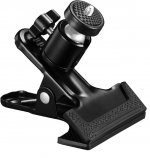
I'd use a carbon fibre section through-bolted to the tripod mount of the camera and then these clampy things to fix the flash guns to the ends of the section.

Spring clamp tripod thing.jpg
 
Hmm. That looks like it could easily get knocked off; I'll be in the midst of people dancing away, and many won't be too aware of what's around them. I don't fancy an expensive flashgun being smashed. Needs to be properly secured to whatever bracket I use.
 
Hmm. That looks like it could easily get knocked off; I'll be in the midst of people dancing away, and many won't be too aware of what's around them. I don't fancy an expensive flashgun being smashed. Needs to be properly secured to whatever bracket I use.
A Manfroto Fig Rig then ? Mount the flash guns inside.
 
I would tend not to use a flash cable at all but use a flash controller ( like the Godox X Pro) to easily adjust the flashes.
I would look at the use of a camera cage to attach the flashes securely as it will give many options for holding the flashes on fixtures via rods etc Have a look at the small rig range.. alternatively You cold look at any 15mm rod fixtures or long Arca Swiss type rails fixed to the camera screw.
 
I've mounted a beauty dish on a double beam arm (manfrotto 396B), which is attached to a monopod with a superclamp. The camera was mounted on a small ballhead in portrait orientation using an L-bracket. I padded the arm with foam plumbing insulation to rest on my shoulder when moving around.

I initially mounted a godox AD360 with a metal BD on it. But I quickly switched to a collapsible BD with an AD200 remote head. In both cases the flash was controlled wirelessly and the battery pack/body was carried in a small shoulder bag along with spares.

The 396B allows placing the flash/modifier at ~ 3ft from camera, ~45˚. Using the ballhead allows swinging/tilting the monopod to change placement of the lighting somewhat. And using the L-bracket placed portrait orientation correctly on top of the monopod, with landscape flopped to the right (much more comfortable/natural than w/o the L-bracket IMO). You want the beam with spigots at both ends, not the one with a camera bracket at one end. Because you are wanting to just use gelled speedlights, you could probably use cheaper/lighter arms/clamps/brackets; but even something like a V860II might be pushing the limits of some generic arms.

Or, just use one flash handheld (direct or bounced) if you don't need the extension distance/modifier; use/choose available light as your "second color"... it's far simpler in every aspect. Consider setting the camera's WB to turn the ambient to a more desired color (say 10K for red) and then select your complementary gel color (e.g. blue for shadow side). Yes, it's a compromise of the dual color idea, but anything else is going to be a waste of effort IMO (too small/too close/etc). And two arms/flashes is going to be very awkward/limited no matter how you go about it, unless you mount one somewhere off-camera... I've done it with one, IDT I would want to try it with two.
 
Last edited:
Easiest and cheapest is a length of alu bar with a 1/4 screw in the middle and each end, bung a cold shoe on the end ones and a camera in the middle.
I've seen long arms with a cold shoe, but I cant find them on google now. Nearest I can find is this.

link
 
Last edited:
Easiest and cheapest is a length of alu bar with a 1/4 screw in the middle and each end, bung a cold shoe on the end ones and a camera in the middle.
I've seen long arms with a cold shoe, but I cant find them on google now. Nearest I can find is this.
Yes, I'm now thinking this is the best route. A simply DIY job. Although I'm now thinking that a macro flash set up would probably be ideal because the subjects will be pretty close, and lighting will be more easily controllable. I've been messing about with a SC-17 cord and a 'slave' flash, but that's proving to be a little fiddly. The macro flash units are small and light, and although I already have a little Meike MK320 flash unit, it's not a proper TTL unit off camera. The Godox wireless units look pretty good as well I have to say, but they do of course add extra weight.

The one issue I do have with photo gear is the use of the ancient 1/4" screw. M6/7, and I can easily use lots of existing nuts and bolts I have lying around, plus I can also tap a thread to suit. 1/4" is a bit of a pita in that respect.
 
One of these brackets might be what you need. I don't know if they are available in your Amazon though. You could also consider making one from a piece of aluminum with cold shoes bolted on, and a 1/4-20 bolt in the center to attach to the tripod mount of your camera. It could be whatever length you desire this way.

When using speedlites very close to the flash transmitter, sometimes they will fail to operate. There is a range selection in the menu of some flash transmitters that might help, or you can resort to an old standby - PC Sync cables.

www.amazon.com/Neewer-Extension-Compatible-Camcorder-Microphone/dp/B09F31QPV3/ref=sr_1_3?crid=5TAIXPKQO2WJ&keywords=dual+cold+shoe+mount&qid=1695134625&sprefix=Dual+cold+shoe+%2Caps%2C97&sr=8-3

There are others, made by different sources listed too. This is only one of them, searched for by using " two speedlite flash bracket ".

Charley
 
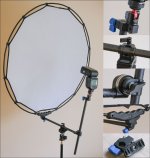
I have made up an arm to be able to flash into a Lastolite/Manfrotto Halo reflector. I tried to use a magic arm for this but I could not stop it spinning around on the screw.
I found all the bits on Ebay and AliExpress including the carbon fibre 15mm rods.
I moulded the handle attachment out of Pollymorph.

I am sure that you could make up something suitable easy enough this way.
T30X4688-copy-3.jpg
 
One of these brackets might be what you need. I don't know if they are available in your Amazon though. You could also consider making one from a piece of aluminum with cold shoes bolted on, and a 1/4-20 bolt in the center to attach to the tripod mount of your camera. It could be whatever length you desire this way.

When using speedlites very close to the flash transmitter, sometimes they will fail to operate. There is a range selection in the menu of some flash transmitters that might help, or you can resort to an old standby - PC Sync cables.

www.amazon.com/Neewer-Extension-Compatible-Camcorder-Microphone/dp/B09F31QPV3/ref=sr_1_3?crid=5TAIXPKQO2WJ&keywords=dual+cold+shoe+mount&qid=1695134625&sprefix=Dual+cold+shoe+%2Caps%2C97&sr=8-3

There are others, made by different sources listed too. This is only one of them, searched for by using " two speedlite flash bracket ".

Charley


The Problem with that is that it is not very wide, also attaching to the Hot shoe is a weak point

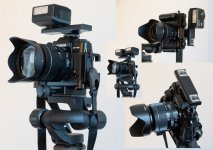
I have used a similar small bar ( but fully wired in) to fire two ef.x20 Fuji flashes from the hot shoe.comb-shoe.jpg
 
Last edited:
The Problem with that is that it is not very wide, also attaching to the Hot shoe is a weak point
IMO, anything that places the two flashes w/in ~ 3ft of each other is going to be garbage for dual color/split type lighting... even 3ft is extremely tight for a person.
 
Last edited:
This is actually much closer to what I want.


I think something like that, and a Nikon SC-24 TTL cord, will enable me to connect both flash units to the camera for full TTL control. And a little cheaper than buying another Speedlight, or a wireless trigger system. And perhaps a little more reliable. A little messy, but it'll work and not cost a fortune. And be useful for other things, such as macro photography.
 
MO, anything that places the two flashes w/in ~ 3ft of each other is going to be garbage for dual color/split type lighting... even 3ft is way tight for a person.
Yes, this is my thought. Although I will probably be up quite close to people, so it might work. Anything wider will just be unfeasibly huge and daft. This is just an idea anyway, so may never actually be realised. Would be fun to try it out though.
 
I'm planning to use 2 flashguns to create a dual colour effect to use at an event, shooting pics of people in the crowd etc. so a gun either side of the camera, using two different coloured gels on each. I thought this might be 'fun, and a bit more interesting than straight white flash. Nightclub so very dark; normal flash kills any atmosphere and no flah is near impossible because it's so dark; would necessitate a very high ISO which degrades the image even with FF. So I'd appreciate suggestions for a sturdy yet lightweight twin bracket set up that can be attached easily. One flash will have a TTL extension lead, the other will use wireless triggering, but both attaching via a normal tripod screw fitting.

Any ideas?

EDIT: I should add that macro type brackets aren't great because the flash heads will be too close to the lens. So something that can extend at least a foot or so from the lens, preferably further. Ideally, two assistants each holding remote triggered flashes would be great, but that's not really feasible. This will be quite experimental, so I expect things to not be perfect.
my normal approach in a dark club situation is:
- to slow the shutter speed (e.g. 1/60th) to pick up the colours and background without sending the ISO crazy
- use a minimum amount fill flash to capture the people and freeze motion, using 2nd curtain in case there is some motion
- the amount of flash is always less than metered TTL, usually by around 2 stops. At this level it is just fill and the people don't look like they have been blasted by the flash
- shoot a short burst in case of motion and people blinking
In my experience in clubs, people tend to pose with their friends when they see you with the camera so freezing motion is not a major problem.
 
Surely the easiest thing is to keep one of the gelled flashes on camera and put the other one at arms length or on a small boom.

It’s easy to hold a camera (with flash attached) and one other flash, than it is to hold a camera and two flashes.
 
my normal approach in a dark club situation is:
- to slow the shutter speed (e.g. 1/60th) to pick up the colours and background without sending the ISO crazy
- use a minimum amount fill flash to capture the people and freeze motion, using 2nd curtain in case there is some motion
- the amount of flash is always less than metered TTL, usually by around 2 stops. At this level it is just fill and the people don't look like they have been blasted by the flash
- shoot a short burst in case of motion and people blinking
In my experience in clubs, people tend to pose with their friends when they see you with the camera so freezing motion is not a major problem.
This but I never use 2nd curtain, I always want to pick my moment
 
Surely the easiest thing is to keep one of the gelled flashes on camera and put the other one at arms length or on a small boom.

It’s easy to hold a camera (with flash attached) and one other flash, than it is to hold a camera and two flashes.
great idea
 
So; a quick preliminary test with coloured gels suggests the technique might actually work, even quite close up. I'm going to have to conduct more tests, as there is a difference in the way the different colours are rendered by the sensor, so this needs a fair bit of careful thought. Obvs white balance set to 'daylight' to ensure the flash colours are more or less accurate. Might have to dial one flash down a bit more than the other, for instance. Encouraging so far though.
 
So; a quick preliminary test with coloured gels suggests the technique might actually work, even quite close up. I'm going to have to conduct more tests, as there is a difference in the way the different colours are rendered by the sensor, so this needs a fair bit of careful thought. Obvs white balance set to 'daylight' to ensure the flash colours are more or less accurate. Might have to dial one flash down a bit more than the other, for instance. Encouraging so far though.
I would guess daylight or flash WB as not only keeps the flash colors good but also any ambient light in the background. Usually the ambient is warm and matching to that may loose that warm effect.
 
Surely the easiest thing is to keep one of the gelled flashes on camera and put the other one at arms length or on a small boom.

It’s easy to hold a camera (with flash attached) and one other flash, than it is to hold a camera and two flashes.
This wont work for what I've intended. Because one colour will dominate, as it'll be straight on. I know this from experience.
my normal approach in a dark club situation is:
- to slow the shutter speed (e.g. 1/60th) to pick up the colours and background without sending the ISO crazy
- use a minimum amount fill flash to capture the people and freeze motion, using 2nd curtain in case there is some motion
- the amount of flash is always less than metered TTL, usually by around 2 stops. At this level it is just fill and the people don't look like they have been blasted by the flash
- shoot a short burst in case of motion and people blinking
In my experience in clubs, people tend to pose with their friends when they see you with the camera so freezing motion is not a major problem.
All good, and pretty much my experience of previous similar shoots. In many ways, it's one of the most challenging environments to take pictures in, not just for technical reasons, but also because it's extremely crowded and people are literally dancing about everywhere. Fortunately I know the organisers and quite a number of those going, pretty well, so I won't be annoying people that much. The kind of effect I'm going for is sort of like when you view 3-D images or films without the glasses; you get the opposing coloured 'halos' in different places. Add in a little bit of motion blur with 2nd curtain flash, and this will hopefully convey movement and atmosphere without that characteristic flash type look.

I'm considering a Nikon SC-24 TTL cord, which has the same tripod screw mountable hotshoe unit at one end, but a connector at the other, which I intend to plug into a port on the SC-17. This will then give two TTL hotshoes. I am considering a second Meike MK320 flash unit, as these are very small yet still powerful enough for the job, whilst being pretty cheap. These would then work well in a macro flash set up. Yes, it does mean a couple of coiled leads flapping about, but at this stage a full wireless setup is very expensive just to try something out. I could look around for a cheap macro set up as an option, but they don't seem to be that cheap so far. The Nikon set is very nice, but also very expensive. The cheapo solution will guarantee TTL operation with no fuss.
 
Not what your after but there was a thing (cant remember what it was called) but you have one colour filter on the lens and the opposite colour on the flash. The idea is your subject "should" come out normal looking but the background had the camera filter colour.
 
Please do share the results, I’d love to see how it works out!
 
What about mounting both flashes near the camera, each pointing forward of sideways, then you could used bounced flash from whatever was around, OR mount a couple of reflectors on extensions either side. The reflectors would not need to be big, and could be on telescopic extensions. (couple of cheap selfie sticks)

Would be lighter and easire to handle, though the results are not likely to be consistent or predictable, but may be even more interesting.
 
Last edited:
Just remembered I saw a guy at comicon a few years back. He had a flash and very small softbox on a monopod mounted on a rucksack frame above his head and I think one off to the side he swing out on about a 2 foot bar. No idea how well it worked but the seperation was a good few feet.
 
What about mounting both flashes near the camera, each pointing forward of sideways, then you could used bounced flash from whatever was around, OR mount a couple of reflectors on extensions either side. The reflectors would not need to be big, and could be on telescopic extensions. (couple of cheap selfie sticks)

Would be lighter and easire to handle, though the results are not likely to be consistent or predictable, but may be even more interesting.
I think for this I'd need very powerful flashguns, as the light won't be bouncing off a flat white wall. I don\t think this would work, based on my experience.

I'm now considering buying a couple of s/h Nikon SB-400 flash units, as they are very small and light, and do full iTTL. I think these are essentially what's in the SB-R200 sets, but without the wireless tech. This would be a far cheaper way of achieving my goal, albeit not as neat. The SB-R200 units aren't simple hot shoe mountable units, you need the mounting adapter things. I can always add a wireless trigger system later if Iso choose.
 
I think for this I'd need very powerful flashguns, as the light won't be bouncing off a flat white wall. I don\t think this would work, based on my experience.

I'm now considering buying a couple of s/h Nikon SB-400 flash units, as they are very small and light, and do full iTTL. I think these are essentially what's in the SB-R200 sets, but without the wireless tech. This would be a far cheaper way of achieving my goal, albeit not as neat. The SB-R200 units aren't simple hot shoe mountable units, you need the mounting adapter things. I can always add a wireless trigger system later if Iso choose.
If you are loking for a smaller / lighter flash, have look at the Godox V350 (or TT350, if you prefer using AA's).
 
UPDATE: 2x Nikon SB-400 units purchased, along with a SC-24 cord, plus 2 SmallRig ball and socket heads and some1/4" thumbscrews. I intend to get some 4mm or so alu sheet and make some 'arms' and a central baseplate. These will then attach via simple screws and nuts. I could also thread the alu plate. Will be a simple, but effective and adjustable set up I think. So far spent less than £200 all in, so quite pleased. All the above will come in handy for other projects too anyway. And will be far more flexible than a Nikon R1-C1 macro flash set up or similar.
 
Last edited:
Just remembered I saw a guy at comicon a few years back. He had a flash and very small softbox on a monopod mounted on a rucksack frame above his head and I think one off to the side he swing out on about a 2 foot bar. No idea how well it worked but the seperation was a good few feet.
I regularly use a small plastic 1 pint milk bottle with the end cut off, which slides over my SB-700 and fits snugly using a couple of rubber wrist bands. The translucent plastic is perfect at diffusing light, and works with bouncing flash too. No issues with colour cast at all; it's slightly warm if anything, but very pleasing results. Like those £40 diffuser dome things, but free. I once forgot it at an event, but was able to improvise using a white plastic ice cream tub the caterers kindly gave me. That acted like a mini soft box, worked really well. The original milk bottle I still have; I didn't expect it to last long, but I've actually had it for several years now. Easily and cheaply replaceable. I also have an old Nikon pistol grip; this was used with a cable release to trigger the shutter, useful with long lenses etc. This works very well as an off-camera flash grip with the SC-17 TTL cord. You can't beat a bit of bodging.
 
My setup for multi-flash:

Pair of Godox TT685II Flash guns, each on a hotshoe/tripod adaptor then mounted on those otherwise hopeless mini tabletop tripods (one of mine is a Manfrotto, the other a Benro I think - wrecks my OCD, but my tightness overrides for now) triggered by a Godox X2 trigger.
 
those otherwise hopeless mini tabletop tripods
They're only good for flashes. I saw someone use one once, to put a video set up on a table; the legs actually just collapsed under the weight. What's even more useless are those little stands that come with flash guns. What's the point of those, other than for display purposes? Although some have a tripod socket so perhaps useful in so
me instances.
 
I regularly use a small plastic 1 pint milk bottle with the end cut off, which slides over my SB-700 and fits snugly using a couple of rubber wrist bands. The translucent plastic is perfect at diffusing light, and works with bouncing flash too. No issues with colour cast at all; it's slightly warm if anything, but very pleasing results. Like those £40 diffuser dome things, but free. I once forgot it at an event, but was able to improvise using a white plastic ice cream tub the caterers kindly gave me. That acted like a mini soft box, worked really well. The original milk bottle I still have; I didn't expect it to last long, but I've actually had it for several years now. Easily and cheaply replaceable. I also have an old Nikon pistol grip; this was used with a cable release to trigger the shutter, useful with long lenses etc. This works very well as an off-camera flash grip with the SC-17 TTL cord. You can't beat a bit of bodging.
For a few years I used the bottom half of Carex bottles which were white back then, like your milk tube ever so slightly warm colour but gave a lovely light.
 
They're only good for flashes. I saw someone use one once, to put a video set up on a table; the legs actually just collapsed under the weight. What's even more useless are those little stands that come with flash guns. What's the point of those, other than for display purposes? Although some have a tripod socket so perhaps useful in so
me instances.
The problem with the 'tabletop tripods' is that if used with anything other than a fairly short lens, it's easy to get them to tip over if you are not very careful on placement.
They do work OK for use with my A6000 + 16-50 for travel.
I've never had any problems with the plastic 'feet' for my flash - but I've never tried to use them in anything other than an indoor setting, where they have been on a flat, solid surface (side table, shelf, etc).
 
The 1/4" thread on a flashgun foot is a perfect piece of engineering until you need to use it in my experience, but then what do I know.
 
The 1/4" thread on a flashgun foot is a perfect piece of engineering until you need to use it in my experience, but then what do I know.


I can't understand why the photo industry has not standardised on the Arri 1/4 20 screw with sprung register pin system.
It is so simple yet so secure.
They do a 1/4 and a 3/8 version. Both with sprung or solid pin specifications.
 
Just remembered I saw a guy at comicon a few years back. He had a flash and very small softbox on a monopod mounted on a rucksack frame above his head and I think one off to the side he swing out on about a 2 foot bar. No idea how well it worked but the seperation was a good few feet.
I have seen a white plastic tubing frame like plumbing plastic pipe sticking out of a rucksack with a Insta 360 on. I had chat with chap and he also mounts GoPro's and Speedlites.
Basically it is frame inside the rucksack with pipe sticking up sky wards with a mount / bracket on it.
 
For a few years I used the bottom half of Carex bottles which were white back then, like your milk tube ever so slightly warm colour but gave a lovely light.
I think any white, translucent plastic will do the job really. Milk bottles are semi-translucent, so work a lot better than the less translucent plastic of other containers. The flash needs to work at much higher power to achieve the same result, of course. My SB-700 never struggles in that regard though. When using the milk bottle diffuser, I have the flash head angled straight up at the ceiling/wall, depending on camera orientation, and most of the light goes up and bounces, with some being diffused sideways. This gives such a nice even, natural looking light. I'v etested this alongside no diffuser, and the SB-700's built in flip down wide angle diffuser and the slip-on plastic diffuser, and the milk bottle gives the best results. I tried it against one of those expensive £40 dome things once, that another photographer let me try. It worked just as well, and the other photographer was annoyed he'd spent so much when he could have achieved the same results for free!

My thoughts now are about what type of filters to use; gels are easy to get in sheets, although I've found it's better to use darker shades than you'd think, as what you might think of as ok, may well look too pale in the finish. I have done tests dialling down the flash exposure level to -1 stop, and this works well. Another consideration is balancing the level of light from each gun, because different colours require more/less power for similar coverage. The old Lee gels I tried worked pretty well together though. This is just to try to retain the atmosphere of a club tohugh; the efect I want is as if the subject has been lit by the coloured lighting. The problem is that it's generally way too low to work well for freezing action or keeping the ISO down. Bright points of light come out ok, but they don't sufficiently illuminate people. Using very high ISOs and fast lenses compensates, but you then end up with those nice coloured highlights being too washed out. I also want to retain the 'harsh' nature of the flash itself, rather than have soft diffused lighting.

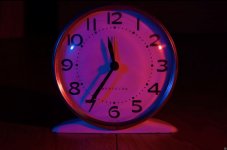
Initial tests taught me a lot; using mismatched flash units was an issue as they not only give slightly different quality of light, I struggled to get a good balance in terms of output. I don't have a flash meter to measure this, that would actually be quite helpful. I'm not a flash/studio lighting person anyway tbh. But tests with a static subject worked well I think, I just need to keep working on technique and try it out on live subjects. RedBlueTest.jpg
 
You do realize that you could get exactly the same result with a single flash, right?

If the light from the right is the available ambient, and you set the camera's WB (or gelled the lens) so that it recorded as red(er). Then you would only need to add the secondary blue light from the left; for the same effect.

In order to get this result with dual flashes you will have to kill the ambient... which means the flashes will have to run much harder, which will tend to wash the gels out. If you do not kill the ambient the effect will be greatly reduced and only/primarily show in the shadows (resulting in tri-color WB).
 
You do realize that you could get exactly the same result with a single flash, right?

If the light from the right is the available ambient, and you set the camera's WB (or gelled the lens) so that it recorded as red(er). Then you would only need to add the secondary blue light from the left; for the same effect.

In order to get this result with dual flashes you will have to kill the ambient... which means the flashes will have to run much harder, which will tend to wash the gels out. If you do not kill the ambient the effect will be greatly reduced and only/primarily show in the shadows (resulting in tri-color WB).
I’m not sure you’ve been to any nightclub type venues. The ‘ambient’ light is invariably just strobes/coloured disco light type things. It’s generally very dark. There isn’t really enough light to capture much without raising the ISO to stupid levels, which impacts on image quality. I’m hoping to capture the event with atmosphere; lighting that looks like ‘disco’ lighting. Rather than blast daylight balanced white light at everything. Using a coloured filter over the lens or just one flashgun will render everything in that colour pretty much. Could be ok, but not what I’m going for. Hence the desire to use two different colours on the flashes.
 
I think any white, translucent plastic will do the job really. Milk bottles are semi-translucent, so work a lot better than the less translucent plastic of other containers. The flash needs to work at much higher power to achieve the same result, of course. My SB-700 never struggles in that regard though. When using the milk bottle diffuser, I have the flash head angled straight up at the ceiling/wall, depending on camera orientation, and most of the light goes up and bounces, with some being diffused sideways. This gives such a nice even, natural looking light. I'v etested this alongside no diffuser, and the SB-700's built in flip down wide angle diffuser and the slip-on plastic diffuser, and the milk bottle gives the best results. I tried it against one of those expensive £40 dome things once, that another photographer let me try. It worked just as well, and the other photographer was annoyed he'd spent so much when he could have achieved the same results for free!

My thoughts now are about what type of filters to use; gels are easy to get in sheets, although I've found it's better to use darker shades than you'd think, as what you might think of as ok, may well look too pale in the finish. I have done tests dialling down the flash exposure level to -1 stop, and this works well. Another consideration is balancing the level of light from each gun, because different colours require more/less power for similar coverage. The old Lee gels I tried worked pretty well together though. This is just to try to retain the atmosphere of a club tohugh; the efect I want is as if the subject has been lit by the coloured lighting. The problem is that it's generally way too low to work well for freezing action or keeping the ISO down. Bright points of light come out ok, but they don't sufficiently illuminate people. Using very high ISOs and fast lenses compensates, but you then end up with those nice coloured highlights being too washed out. I also want to retain the 'harsh' nature of the flash itself, rather than have soft diffused lighting.

Initial tests taught me a lot; using mismatched flash units was an issue as they not only give slightly different quality of light, I struggled to get a good balance in terms of output. I don't have a flash meter to measure this, that would actually be quite helpful. I'm not a flash/studio lighting person anyway tbh. But tests with a static subject worked well I think, I just need to keep working on technique and try it out on live subjects. View attachment 401813
This isn’t a human face.
This is what happens when you chase an ‘idea’ without considering the market.

‘Ooh that’s quirky’ is interesting, but not a substitute for ‘ooh thats a good picture of me looking gorgeous’.

But as others have said, I’d be interested in the results. Not just what the images look like, but what effect it has on sales.
 
Last edited:
Back
Top