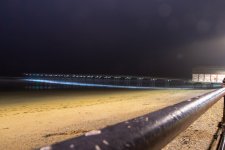
What are these?

AndyG123

Suspended / Banned
Messages
398
Name
Andy
Edit My Images
Yes
Please excuse the poor photo. I was out last night for a walk looking for potential compositions. I wanted to see how this shot looked with a longish exposure)

When i took the photo I noticed these marks... Was wondering if anyone could advise what these are? Top right hand corner - I've got a clean sensor, a clean lens... are these just lens flares? or is it possible I do have something on my lens/sensor which i'm missing?
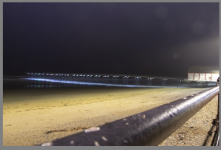
1630568224390.png
 
difficult to tell from a thumbnail sized (383x261 px) png file frankly, but looking at the shape of the dots, they're all vaguely a rounded septagon - usually this implies lens flare or lens induced issues (the 7 sides rounded off nature comes from the 7 curved blades of the shutter, and varies from lens to lens depending on how many blades are fitted...) It does look like you've a very strong (relatively) light source just out of frame right.

2 questions

1 were you using the factory provided lens hood

2 did you have any filters on the lens (uv or "protection" filters) as this can definitely increase risk of lens flare

supplimentary question

was there any reason why you posted such a terribly small picture in PNG format ?
 
This looks like it could be tiny dust particles on or inside the lens picking up the light which appears to be originating just out of frame to the right - if bright enough they might render as iris-shaped ghosts.... I had a similar drama about 35 years ago and finally realised that the annoying ghost images I was getting (similar to these) were caused by point light sources in the image reflecting forward off the front element onto the rear side of the UV filter I had fitted to the lens. Once the filter was removed, no more ghosts...
This could be as simple as that.
 
Last edited:
They look far to large to be something on the sensor. Far more likely to be flare.
 
difficult to tell from a thumbnail sized (383x261 px) png file frankly, but looking at the shape of the dots, they're all vaguely a rounded septagon - usually this implies lens flare or lens induced issues (the 7 sides rounded off nature comes from the 7 curved blades of the shutter, and varies from lens to lens depending on how many blades are fitted...) It does look like you've a very strong (relatively) light source just out of frame right.

2 questions

1 were you using the factory provided lens hood

2 did you have any filters on the lens (uv or "protection" filters) as this can definitely increase risk of lens flare

supplimentary question

was there any reason why you posted such a terribly small picture in PNG format ?

1) Factory provided lens hood on a 17-50 sigma f2.8 shot at 17mm.
2) no filter on the lens at all
3) the image hasn't been exported from lightroom, it was a screengrab copied from clipboard. Larger image sizes said that it was too large.

I've attached half size image. hopefully this will help identify.

Thanks

Andy
 

Attachments

  • DSC_1994.jpg
    DSC_1994.jpg
    89.3 KB · Views: 23
1) Factory provided lens hood on a 17-50 sigma f2.8 shot at 17mm.
2) no filter on the lens at all
3) the image hasn't been exported from lightroom, it was a screengrab copied from clipboard. Larger image sizes said that it was too large.

I've attached half size image. hopefully this will help identify.

Thanks

Andy
Yeah, I think it's just crap on the lens catching the sidelight...
 
Dirty lens surfaces do tend to induce flare. best to keep them very clean, it is not enough just to remove dust they need to be sparkly clean, especially free from any form of grease. best to use lens cleaning solution.
Even small amounts of flare shows up worse against dark areas, as in your image.
 
You are by the sea? Water droplets?
 
Last edited by a moderator:
I might treat all of my lenses to a splash of lens cleaner later on! Hopefully will resolve the issue;

I was by the sea but the tide was right out so hadn't been close enough to effect it.

Thanks all
 
flarering.jpg The image circle from your lens is bigger than your sensor. Light striking in any of the areas outside the image but contained with in the image circle can contribute
to flare. hoods that conform closely to the image size help a great deal. however manufacturers give a great deal of leeway so hoods are rarely as efficient as one might hope for.

Holding your hand ( or object) to cast a shadow, from any bright light, so shading the lens can be a great help.

In your image the light causing the flare probably was in the area of concern to the right of the image. but would have been striking the rest of the lens circle..
 
Last edited:
View attachment 328854 The image circle from your lens is bigger than your sensor. Light striking in any of the areas outside the image but contained with in the image circle can contribute
to flare. hoods that conform closely to the image size help a great deal. however manufacturers give a great deal of leeway so hoods are rarely as efficient as one might hope for.

Holding your hand ( or object) to cast a shadow, from any bright light, so shading the lens can be a great help.

In your image the light causing the flare probably was in the area of concern to the right of the image. but would have been striking the rest of the lens circle..

Thanks, never actually understood how lens flare worked.

I guess when you do have a zoom lens such as the 17-50mm the lens hood always has to have a compromise between varying focal length... too long and you'll see vignette, too short and you'll get the lens flares. (I'm guessing the reason for tulip style hoods is to do with this, or to do with the shape of the sensor not been square?)

On a side note; The more I look at this image, the more I question is it a wonky pier or lens distortion. I'm sure I applied profile corrections!
 
Looks like dust to me!
It does indeed look just like illuminated airborne dust some little way in front of the lens.
However he said he used a long exposure. dust in the air is in constant motion and would not produce such a defined image.
Had he fired his flash during the exposure that is exactly how it might have looked.. and is a common problem in enclosed areas.
Though this is rare by the sea side as there is usually very little, or no, floating dust in the air. except on breezy long hot sandy beaches.
Dust on the lens almost never causes visible problems as it is totally out of focus, but when extreme can soften images.

If you look carefully at the brighter orbs you can clearly see the telltale signs of the shape of the aperture. This would not be caused by dust but only an optical phenomenon such as some form of flare .
 
Last edited:
Back
Top