

You are using an out of date browser. It may not display this or other websites correctly.
You should upgrade or use an alternative browser.
You should upgrade or use an alternative browser.
Well I took the leap of faith and came home with.........
- Thread starter Crtm
- Start date


OP

Crtm
Suspended / Banned
- Messages
- 1,406
- Name
- Carol
- Edit My Images
- Yes
? Some Film ??
Yes plenty of that too 3 black and whites and 3 colour!!!!

- Messages
- 4,158
- Name
- Rob
- Edit My Images
- Yes
I have one of them, nice little lens 
OP
Crtm
Suspended / Banned
- Messages
- 1,406
- Name
- Carol
- Edit My Images
- Yes
Hi Mark it's the FD version.

RaglanSurf
Suspended / Banned
- Messages
- 11,477
- Name
- Nick
- Edit My Images
- Yes
We were only joking...film is dead only a loon would spend money on an old film camera

OP
Crtm
Suspended / Banned
- Messages
- 1,406
- Name
- Carol
- Edit My Images
- Yes
We were only joking...film is dead only a loon would spend money on an old film camera
I know he's a funny b****r!


Jao
Suspended / Banned
- Messages
- 3,936
- Name
- Adrian
- Edit My Images
- Yes
Can anyone tell me anything about the lens please?
This might be useful Carol
http://www.mir.SPAM/rb/photography/companies/canon/fdresources/fdlenses/28mm.htm

- Messages
- 12,294
- Name
- Brian
- Edit My Images
- Yes
The Canon 28mm lenses are very good...I had this shot blown up to about 12" X 16" print and it looks great:-
Canon T70 + 28mm + Superia 200

Canon T70 + 28mm + Superia 200

Last edited:


VirtualAdept
Suspended / Banned
- Messages
- 2,169
- Name
- Mads
- Edit My Images
- Yes
I was just thinking exactly what freecom2 said... I've got those 2 very lenses and I absolutely adore them.
OP
Crtm
Suspended / Banned
- Messages
- 1,406
- Name
- Carol
- Edit My Images
- Yes
Thanks for all your comments I was planning a 50mm lens but thought I would see how I got on with this set up for the time being. Film loaded manual read from cover to cover now just wanting to get out and use her, can't today weather most unpleasant and too many other things to do.
Question what telephoto lens would you recommend for this camera?
Carol
Question what telephoto lens would you recommend for this camera?
Carol

Strapps
Suspended / Banned
- Messages
- 3,064
- Name
- Dean
- Edit My Images
- Yes
... the question is now what?
Get out and use it! Sticking with only one lens means you're forced into thinking about your composition rather than seeing how the scene looks through other lenses. And you've already responded to that while I was typing so now it looks as though I'm suggesting you do what you're already going to do. I think.
Anyways, moving on. I quite like medium telephotos, 85mm, 100mm and especially 135mm. Which you get comes down to how much you want to spend - a lot of Canon FD kit holds its value very well following a resurgence in interest for use with mirrorless digital cameras. Some of the Vivitar lenses on an FD mount are cracking bits of kit for the money, for example.
If you fancy a zoom, here's a Kiron 80-200mm on ebay for reasonable money (I have no connection to that sale). Kiron was a company formed by ex-Nikon engineers and they made some fantastic lenses - that lens was also sold by Vivitar under their Series 1 branding and in the latter form it's quite sought after

OP
Crtm
Suspended / Banned
- Messages
- 1,406
- Name
- Carol
- Edit My Images
- Yes
Thanks Dean for the info and the link, I wont be purchasing one right now but if one came up that I felt was right and at the right money I would get it.
The one in your link for £25.00 seems like really good value for money and in todays market it is nothing to be spending on a piece of kit.
The one in your link for £25.00 seems like really good value for money and in todays market it is nothing to be spending on a piece of kit.
Last edited:

MatBin
Suspended / Banned
- Messages
- 5,334
- Name
- matt
- Edit My Images
- Yes
the Canon 70-210 became an EF lens then became the basis for the 70/200f3.5/4.5 non L series, damn fine lens it was too. If possible try and get hold of breech-lock lenses.Thanks for all your comments I was planning a 50mm lens but thought I would see how I got on with this set up for the time being. Film loaded manual read from cover to cover now just wanting to get out and use her, can't today weather most unpleasant and too many other things to do.
Question what telephoto lens would you recommend for this camera?
Carol
OP
Crtm
Suspended / Banned
- Messages
- 1,406
- Name
- Carol
- Edit My Images
- Yes
the Canon 70-210 became an EF lens then became the basis for the 70/200f3.5/4.5 non L series, damn fine lens it was too. If possible try and get hold of breech-lock lenses.
Sorry going to show my ignorance here but what is or why breech-lock lenses?
Edit - Just been on ebay and there is quite a few for sale is there anything I should look for if I were to purchase one?
Ta Carol
Last edited:
- Messages
- 12,294
- Name
- Brian
- Edit My Images
- Yes
As mentioned the Kiron 80-200 f4 is a good zoom (mine is non zoom lock and use it a lot), also the Vivitar 135mm f2.8 is good. Just check on ebay that the lens is not covered in fungus or scratches and focusing is smooth with no play.....I bought a lens once that you couldn't focus because the grease had dried solid. 
Strapps
Suspended / Banned
- Messages
- 3,064
- Name
- Dean
- Edit My Images
- Yes
Breech-lock (or you might sometimes see them called barrel-lock) lenses have a ring that you tighten to fix the lens on the camera, the newer lenses are the ones you fit into the bayonet and turn the lens to lock in place. For example, this is a picture of my 100mm f/4 macro with its extension tube.

The extension tube has a silver ring at the bottom - this is the lock. You put the tube on the camera and then rotate the ring to lock it in place. With the lens, you line up the red dot with the red mark on the camera and then rotate the lens to lock it into place. That's the newer type of FD mount (introduced c.1980), hence new FD or FDn.
I'm a little surprised that Matt's recommended you look for B/L lenses because I was never as impressed with the results as with the newer lenses. I ran some side-by-side comparisons between my FDn 50mm f/1.4 and a 50mm f/1.4 SSC* B/L years ago and if it's any indication, I only own the FDn version now.*
Incidentally, if you decide to buy a non-Canon FD lens, chances are that it'll have a breech-lock as it seems third-party manufacturers stuck with the older mount, probably to avoid the costs of updating their manufacturing. There's no difference in operation once the lens is on the camera, it's purely how they mount. FDn lenses tend to be a little shorter than their B/L counterparts because they don't have to incorporate the ring and I find them easier to fit and remove when out and about.
* SSC is a designation you'll see on some B/L FD lenses and stands for Super Spectra Coating, i.e. the lens is multi-coated. The FDn versions have this coating as standard.
** If you want to spend a bit more money, the FDn 50mm f/1.4 is an absolute belter and is described on mir.com thus: The 50mm f/1.4 lens was used for optical measurements at various public institutions and is also the standard which determines color balance for the rest of the nearly 60 lenses in the FD series. I absolutely love mine
The extension tube has a silver ring at the bottom - this is the lock. You put the tube on the camera and then rotate the ring to lock it in place. With the lens, you line up the red dot with the red mark on the camera and then rotate the lens to lock it into place. That's the newer type of FD mount (introduced c.1980), hence new FD or FDn.
I'm a little surprised that Matt's recommended you look for B/L lenses because I was never as impressed with the results as with the newer lenses. I ran some side-by-side comparisons between my FDn 50mm f/1.4 and a 50mm f/1.4 SSC* B/L years ago and if it's any indication, I only own the FDn version now.*
Incidentally, if you decide to buy a non-Canon FD lens, chances are that it'll have a breech-lock as it seems third-party manufacturers stuck with the older mount, probably to avoid the costs of updating their manufacturing. There's no difference in operation once the lens is on the camera, it's purely how they mount. FDn lenses tend to be a little shorter than their B/L counterparts because they don't have to incorporate the ring and I find them easier to fit and remove when out and about.
* SSC is a designation you'll see on some B/L FD lenses and stands for Super Spectra Coating, i.e. the lens is multi-coated. The FDn versions have this coating as standard.
** If you want to spend a bit more money, the FDn 50mm f/1.4 is an absolute belter and is described on mir.com thus: The 50mm f/1.4 lens was used for optical measurements at various public institutions and is also the standard which determines color balance for the rest of the nearly 60 lenses in the FD series. I absolutely love mine
MatBin
Suspended / Banned
- Messages
- 5,334
- Name
- matt
- Edit My Images
- Yes
I prefer b/l because its a better mechanical joint. Neither the lens nor the camera turn against each other, any/all the play is taken by the clamping ring. On older bodies or lens their could be more play than they were designed to accommodate if either had been heavily used.
Correctly placed the breach lock ting self rotated to a degree, oddly I preferred them in the field each to their own I guess.
Matt
Correctly placed the breach lock ting self rotated to a degree, oddly I preferred them in the field each to their own I guess.
Matt
Strapps
Suspended / Banned
- Messages
- 3,064
- Name
- Dean
- Edit My Images
- Yes
I find it odd that the B/L ring has a soft 'lock' in the open position but doesn't click into place when you're mounting it on the camera. I was always checking it was done up properly and found that lenses with a bit of wear tended to loosen off a little - didn't fill me with confidence. I also found that with the ring in the open position, if you don't line the lens up with the camera mount properly it's possible to release the ring and you have to put the camera down to reset it. Finally, I think the results from the FDn mount lenses are better and for me it's the glass that really counts.
As you say, each to their own
As you say, each to their own

Musicman
Suspended / Banned
- Messages
- 9,866
- Name
- Rob Telford
- Edit My Images
- No
I certainly prefer the FDn 50mm f/1.4 over its 1.8 sibling. It's a great lens that is the most often found on any of my cameras.
If you are after a very cheap telephoto, the FDn 135/3.5 can still be had for peanuts. The 2.8 is much better optically, though.
If you are after a very cheap telephoto, the FDn 135/3.5 can still be had for peanuts. The 2.8 is much better optically, though.
Last edited:

Musicman
Suspended / Banned
- Messages
- 9,866
- Name
- Rob Telford
- Edit My Images
- No
I have been sort-of rediscovering my FDn 28/2.0 with the Sony A7 over the last couple of weeks.
Stopped down a little, it is amazingly sharp right across the frame, even when subjected to the scrutiny if 24 Mpx, and it's only a little larger than the f/2.8.
Stopped down a little, it is amazingly sharp right across the frame, even when subjected to the scrutiny if 24 Mpx, and it's only a little larger than the f/2.8.
OP
Crtm
Suspended / Banned
- Messages
- 1,406
- Name
- Carol
- Edit My Images
- Yes
I have been using it but not developed the film yet, out tomorrow so hope to finish one and start a new one. Will post some of the results when developed.Some thing I like about the 28 f/2.8 is that infinity is so close that you can walk around with it set at infinity and be ready to shoot any time.
OP
Crtm
Suspended / Banned
- Messages
- 1,406
- Name
- Carol
- Edit My Images
- Yes
Hi Musicman what would be the best general walk about settings for this lens or should I say sweet spot? I have to say I am looking forward to getting the film developed.I have been sort-of rediscovering my FDn 28/2.0 with the Sony A7 over the last couple of weeks.
Stopped down a little, it is amazingly sharp right across the frame, even when subjected to the scrutiny if 24 Mpx, and it's only a little larger than the f/2.8.
Musicman
Suspended / Banned
- Messages
- 9,866
- Name
- Rob Telford
- Edit My Images
- No
For general daylight walk around use, f/5.6 or f/8 as a default works well for me. Focus set around 3.0m covers you from 1.5m to infinity at f/8.
With aperture priority, in reasonable light, it's ready to shoot almost anything in an instant if needed. On digital, the A7's auto ISO and good dynamic range gives you a lot of leeway.
Edit: looking back on some of my film shots with the 28/2.8, it handles itself pretty well too.
A-1, FDn 28/2.8, Boots 200 slide film
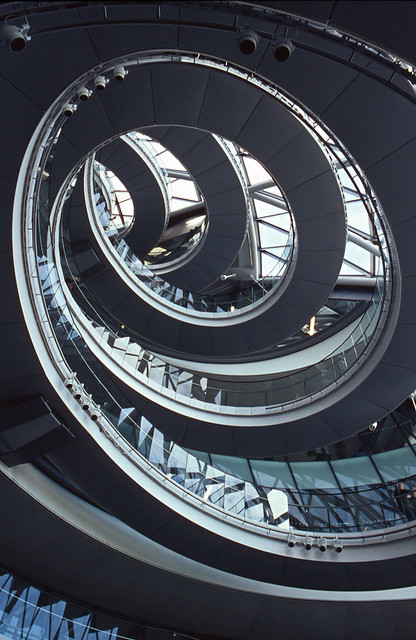 GLA Building Open House by -cybertect-
With aperture priority, in reasonable light, it's ready to shoot almost anything in an instant if needed. On digital, the A7's auto ISO and good dynamic range gives you a lot of leeway.
Edit: looking back on some of my film shots with the 28/2.8, it handles itself pretty well too.
A-1, FDn 28/2.8, Boots 200 slide film
GLA Building Open House by -cybertect-
Last edited: