Want to increase the value of your home if you have a drive? Install an EV charger !

Mr Bump

From under the bridge
Suspended / Banned
Messages
10,944
Name
Sophia aka Paul
Edit My Images
Yes
According to research, 76% of UK homes with an EV charger have a higher price tag when compared to properties with no charging port,
with EV-friendly houses in Swindon and Walsall witnessing the most significant increase in value.
 
If you could evidence similar houses in the same location showing a price difference with only that as the differentiator, it might be believable. TBH I don't buy that argument as it's not exactly an expensive thing to get - providing you already have a house with a non-shared driveway.
 
According to research, 76% of UK homes with an EV charger have a higher price tag when compared to properties with no charging port,
with EV-friendly houses in Swindon and Walsall witnessing the most significant increase in value.
It might be helpful if you could cite the study. "Research shows" could be a study conducted over multiple years with 10's of thousands of data sets, or I asked 3 blokes down my local
 
So, houses that have their own private driveway sell for more than those that don't?
Makes sense:)
 
So, houses that have their own private driveway sell for more than those that don't?
Makes sense:)
no houses that have drives and EV charge point sell for even more.
basically what is being said is if you want more for your house install an EV point and advertise it with it.
they cost about £1k to have a good one fitted and can add way more than that to its value and it is a big selling plus
 
It might be helpful if you could cite the study. "Research shows" could be a study conducted over multiple years with 10's of thousands of data sets, or I asked 3 blokes down my local

One study in 2021 by Rivervale Leasing compared 1,000 house prices across 50 UK areas and found that homes with an electric charge point installed sell for 13% more than the local average.

Of the 1,000 houses, 76% of UK homes with an EV charger showed an increase in value, when compared to the local average. For the 38 out of 50 areas which saw a positive link between value and home charge points, their analysis showed an increase of £50,595 on average.
 
the way the EV market for cars is on the decline I wouldn't even bother, they are selling them at a loss just to reach the targets.
Give me an ice car any day.
 
the way the EV market for cars is on the decline I wouldn't even bother, they are selling them at a loss just to reach the targets.
Give me an ice car any day.

sorry to burst your bubble but umm nope.......

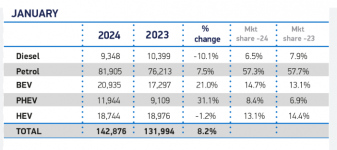
More fully electric cars have now been sold this year than the whole of last year. In 2023, the last full year, there were 314,684 electric cars sold, as compared to 267,203 in 2022; a growth of 18%. The proportion of new cars that are electric has grown from 6.6% in 2020, to 18.7% in 2024.

1734186862984.png
 
One study in 2021 by Rivervale Leasing compared 1,000 house prices across 50 UK areas and found that homes with an electric charge point installed sell for 13% more than the local average.

Of the 1,000 houses, 76% of UK homes with an EV charger showed an increase in value, when compared to the local average. For the 38 out of 50 areas which saw a positive link between value and home charge points, their analysis showed an increase of £50,595 on average.
One study in 2021 by Rivervale Leasing compared 1,000 house prices across 50 UK areas and found that homes with an electric charge point installed sell for 13% more than the local average.

Of the 1,000 houses, 76% of UK homes with an EV charger showed an increase in value, when compared to the local average. For the 38 out of 50 areas which saw a positive link between value and home charge points, their analysis showed an increase of £50,595 on average.
I think that might be stretching the data in support of an argument !!
1) It's 3 years old
2) It uses a local average - which as we all know can vary enormously rather than same postcode, which whilst not perfect is probably a better like with like comparison.
3) 38 out of fifty areas they cherry picked showed an increase, which means 12 or roughly 25% showed a reduction or no increase so potentially installing a charger could reduce the value of your home according to the survey
4) In those 38 areas installing a charger for say £1000 added £50k to the house....I think whoever reviewed the data needs to look at cause and effect !!
 
@taxboy here is a more recent article from JCT600


in which they agree..

How Will an EV Chargepoint Influence The Cost of Your Home?​

Installing a home EV chargepoint is not just for convenience, it is also a strategic move ahead of time.
The UK has announced a ban on the sale of new petrol and diesel cars starting in 2035. This ban aims to make a shift towards a cleaner environment making electric vehicles the new ‘normal’. Installing an EV chargepoint ahead of time ensures you’re ready for this change.
Ahead of the change, the UK government announced in June 2022 that all new homes and buildings are legally required to come equipped with EV chargepoints. Homes already equipped with an EV chargepoint are becoming extremely attractive to buyers as more people make that move. Selling a property with an EV chargepoint will be a significant selling point, potentially increasing your property’s value.
When you make the switch to an electric vehicle and having an EV chargepoint at your home you're supporting global and national efforts to reduce carbon emissions and combat climate change.
When charging your electric vehicle at home the costs typically average around 8p per mile depending on your selected energy tariff. This means a typical full charge for an EV with a 60 kWh battery costs around £17 giving you 200 miles of range. On average annually it costs £528 less to run an electric car compared to a petrol car.
EVs are significantly quieter than a standard vehicle. The reduction in engine noise means if a full street of houses were to have EV vehicles the overall noise levels would be significantly less. The reduction in noise leads to a more peaceful residential environment. Not forgetting, quieter streets can be a big factor as part of a property's valuation.

 
@taxboy here is a more recent article from JCT600


in which they agree..

How Will an EV Chargepoint Influence The Cost of Your Home?​

Installing a home EV chargepoint is not just for convenience, it is also a strategic move ahead of time.
The UK has announced a ban on the sale of new petrol and diesel cars starting in 2035. This ban aims to make a shift towards a cleaner environment making electric vehicles the new ‘normal’. Installing an EV chargepoint ahead of time ensures you’re ready for this change.
Ahead of the change, the UK government announced in June 2022 that all new homes and buildings are legally required to come equipped with EV chargepoints. Homes already equipped with an EV chargepoint are becoming extremely attractive to buyers as more people make that move. Selling a property with an EV chargepoint will be a significant selling point, potentially increasing your property’s value.
When you make the switch to an electric vehicle and having an EV chargepoint at your home you're supporting global and national efforts to reduce carbon emissions and combat climate change.
When charging your electric vehicle at home the costs typically average around 8p per mile depending on your selected energy tariff. This means a typical full charge for an EV with a 60 kWh battery costs around £17 giving you 200 miles of range. On average annually it costs £528 less to run an electric car compared to a petrol car.
EVs are significantly quieter than a standard vehicle. The reduction in engine noise means if a full street of houses were to have EV vehicles the overall noise levels would be significantly less. The reduction in noise leads to a more peaceful residential environment. Not forgetting, quieter streets can be a big factor as part of a property's valuation.
But it's an article from a car retailer. There is no evidence supplied in support of the assertion - in fact all it says is installing an EV charger POTENTIALLY increases your property value. It's no different to me saying if I have my house redecorated in my favourite colours that could also potentially increase its value.
I'm not being closed minded but would like to see some proper data / evidence to support these contentions
 
It's interesting that the figures quoted my the motor industry are a hell of a lot higher than the figures quoted by the property market. According to ZOOPLA installing an EV charger at home will add about £5000 the the value of a property.

I had a quick look but couldn't find any supporting data. As far as I could tell the statement quoted doesn't even come from a recognised trade body but a loose association of estate agents. However logic says a house without an EV charger, which costs approx £1000 to install is not going to be worth £5000 less than an identical house next door with one...unless I'm missing something?
 
Fitting an EV charger takes (somebody else) an afternoon and about £1200.

There's a small complication because technically the dno could deny you permission if the total house load exceeds some number but in practice it's pretty unlikely.

I can see it adding £1k to your house value. I can see it adding £2-3k because it saves the new owner hassle. But more than that is surely nonsense. I could fit one to a house I bought about as fast as I could get Sky installed.
 
sorry to burst your bubble but umm nope.......

More fully electric cars have now been sold this year than the whole of last year. In 2023, the last full year, there were 314,684 electric cars sold, as compared to 267,203 in 2022; a growth of 18%. The proportion of new cars that are electric has grown from 6.6% in 2020, to 18.7% in 2024.

View attachment 440955
simple reason is that dealers cannot get hold of new ice cars so they can make the targets set out by the government for EV's.

Failure to meet the 22 per cent target can result in fines of £15,000 per vehicle short of the required threshold

see here
 
So an EV will save you £500 a year and restrict you to a 100 mile distance (200 miles round trip) if you want to avoid public network charging. Then after 5-10 years it will cost you many thousands for a new battery, unless you sell it and take the massive depreciation hit.

Google says the average on-street charging cost is 56p a kwh, or £33.60 for a 60KWh battery, or 16.8p a mile for 200 miles. So if I do a 600 mile round trip that will be £17 for the first 200 miles then £67 for the remaining 400 miles on public charging points. £84 in total. This is more than my petrol car, which I can refuel in minutes instead of hours.

Electric cars are great for granny who only goes to the shops and is after a low maintenance vehicle. Also great as a second car for the kids run (a second vehicle needs a double drive). Particularly good for anyone with solar panels on their roof. Not good for anyone who travels long distances or runs a business where they might have to travel more than the vehicle range in a day.

I expect to see long queues at the motorway charging points this coming weekend.
 
So an EV will save you £500 a year and restrict you to a 100 mile distance (200 miles round trip) if you want to avoid public network charging. Then after 5-10 years it will cost you many thousands for a new battery, unless you sell it and take the massive depreciation hit.

Google says the average on-street charging cost is 56p a kwh, or £33.60 for a 60KWh battery, or 16.8p a mile for 200 miles. So if I do a 600 mile round trip that will be £17 for the first 200 miles then £67 for the remaining 400 miles on public charging points. £84 in total. This is more than my petrol car, which I can refuel in minutes instead of hours.

Electric cars are great for granny who only goes to the shops and is after a low maintenance vehicle. Also great as a second car for the kids run (a second vehicle needs a double drive). Particularly good for anyone with solar panels on their roof. Not good for anyone who travels long distances or runs a business where they might have to travel more than the vehicle range in a day.

I expect to see long queues at the motorway charging points this coming weekend.

wow so you are getting all your facts from where?

200 miles ? the Tesla 3 standard battery is good for 270 miles

firstly the JCT600 report only mentions charging at full rates , everyone that has an EV has a compatible tariff for cheap overnight charging JCT work on 8p per mile its actually closer to about 2p per mile so the savings about are closer to £2000/saving per year.

New battery in 5-10 years? most modern EVs are guaranteed for close to 10 years on there battery life.

there is a reason EVs are becoming more popular than ever and sales are going up so much its actually just not what you want it to be?

People love them !
 
simple reason is that dealers cannot get hold of new ice cars so they can make the targets set out by the government for EV's.

Failure to meet the 22 per cent target can result in fines of £15,000 per vehicle short of the required threshold

see here

nope so in your world standard family go to buy a small petrol car to be told there is a waiting list so they buy an EV?

drivel
 
I quoted the facts from your post #11 earlier in the thread. Where did you get them from?
 
So an EV will save you £500 a year
Tee-hee.

I think we've done this to death.

I've just checked - I've done a little over 500 miles this week. Total fuel has been a bit under a tenner. I do have solar panels but never use them to charge the car bc I can sell their output at 15p and buy it back at 7p.

I did have a journey to do that my EV couldn't manage (there are some things that don't fit in the boot of even a Model S) so I rented a diesel van. I'd forgotten all about hill starts.....
 
Fitting an EV charger is just like fitting double glazing, it's an improvement and will add to the value whether or not you personally use it.
 
We compared 1,000 sold house prices on Right Move to the average local area price over 50 UK areas. House prices were recorded where there is an EV charger installed at that postcode’s address, using Zap-Map, chosen by the properties most recently sold. When recording areas with no charge point installed or any nearby, locations were selected within 10 miles of the houses with a charge point for a fair representation. The findings shown are from our study only and may not represent other experiences.
Yeah - that methodology is lazy and silly.

Average house price in my area is £291k and most properties don't have chargers, Within three miles of me (not 10 as they used) there are flats selling for £2 million with EV chargers. So I could make a chart showing that having an EV charger makes your property worth more than 5X as much.

The average house that has a charger is going to be bigger than the average house that doesn't - so I can get some AI to write an article that adding a charger make your house 20% bigger.
 
The average house that has a charger is going to be bigger than the average house that doesn't - so I can get some AI to write an article that adding a charger make your house 20% bigger.

And there's you complaining about lazy methodology...
 
Back
Top