

As most will probably be aware, early photographic processes were predominantly sensitive to UV light. In the hope of understanding UV better, with a view to being able to determine exposures by taking a reading with a UV meter, I recently took a series of readings over a period of a few weeks. On each outing, I took four measurements, where the meter's sensor was oriented in a particular way...
Horizontal - directly up towards the sky.
Direct - directly towards the sun.
Oblique - towards my face, about 30cm away, and ensuring the sensor is in shade.
Reflected - towards a predominantly green landscape, meter tilted down a little, sensor shaded.
The readings are all in miiliwatts per square centimeter (mW/cm2). Most readings were taken in the mid afternoon, with some at other times. All were taken in the same general area (local park and local country park), and at a latitude of about 56N. The times have been adjusted from BST to local noon (sun at zenith at midday) on the basis that the strongest readings are likely to occur when the sun is highest in the sky.
The lighting conditions were noted for each set of readings, and were simplified to...
Sunny - Clear sun. Maybe some clouds, but not obscuring the sun.
Bright - Light, thin cloud obscuring the sun, but still bright.
Cloudy - Cloudy overall, but still moderately bright.
Overcast - Complete cloud cover, dull to various degrees.
The phrase 'no hat' often appears in the notes. I normally wear a wide-brimmed hat which could shade part of my face during the oblique readings, where the sun is to the side and usually fairly high in the sky. Readings where I didn't wear a hat are noted in case the lack of shading resulted in a stronger reflection.
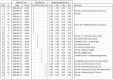
In the table below, the data has been sorted by conditions (sunny to overcast), and then direct reading (highest to lowest). The idea is to be able to compare readings taken in similar conditions and use the direct readings as a reference against which to compare the other readings. The direct reading was chosen as the reference because the sun is the source of the UV being measured.
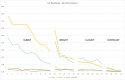
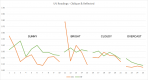
The following two graphs show the differences in the various sets of readings. The first has all four, and the second expands the oblique and reflected to allow for easier comparison between these two. The four types of lighting conditions are separated from each other with white space to make them easier to distinguish.
A few things of interest can be noted...
This was a somewhat unexpected result. When I started taking the readings, it was from the perspective that the UV meter would be used like a conventional light meter to take a reading and then convert it to an exposure. As noted, once the particular process is understood and a baseline exposure known, it should be a case of needing to do little more than look at the lighting conditions and deciding on the adjustment.
Horizontal - directly up towards the sky.
Direct - directly towards the sun.
Oblique - towards my face, about 30cm away, and ensuring the sensor is in shade.
Reflected - towards a predominantly green landscape, meter tilted down a little, sensor shaded.
The readings are all in miiliwatts per square centimeter (mW/cm2). Most readings were taken in the mid afternoon, with some at other times. All were taken in the same general area (local park and local country park), and at a latitude of about 56N. The times have been adjusted from BST to local noon (sun at zenith at midday) on the basis that the strongest readings are likely to occur when the sun is highest in the sky.
The lighting conditions were noted for each set of readings, and were simplified to...
Sunny - Clear sun. Maybe some clouds, but not obscuring the sun.
Bright - Light, thin cloud obscuring the sun, but still bright.
Cloudy - Cloudy overall, but still moderately bright.
Overcast - Complete cloud cover, dull to various degrees.
The phrase 'no hat' often appears in the notes. I normally wear a wide-brimmed hat which could shade part of my face during the oblique readings, where the sun is to the side and usually fairly high in the sky. Readings where I didn't wear a hat are noted in case the lack of shading resulted in a stronger reflection.
In the table below, the data has been sorted by conditions (sunny to overcast), and then direct reading (highest to lowest). The idea is to be able to compare readings taken in similar conditions and use the direct readings as a reference against which to compare the other readings. The direct reading was chosen as the reference because the sun is the source of the UV being measured.
The following two graphs show the differences in the various sets of readings. The first has all four, and the second expands the oblique and reflected to allow for easier comparison between these two. The four types of lighting conditions are separated from each other with white space to make them easier to distinguish.
A few things of interest can be noted...
- When the sun is clear, the direct readings are strongly affected by time of day, but less so if there is cloud cover.
- The horizontal readings generally follow the direct readings. There's a notable offset in sunny conditions, but very little difference when there is cloud in the way. This suggests that the clouds act as a diffuser or secondary emitter, while clear sky doesn't.
- The oblique and reflected readings don't vary much, even if the direct and horizontal readings do.
- There is no particular offset between the oblique and reflected readings. In general, oblique tends to be a bit lower (in visible light, I generally read about 1 stop brighter than green vegetation, but this is often reversed with UV, and the difference is inconsistent).
This was a somewhat unexpected result. When I started taking the readings, it was from the perspective that the UV meter would be used like a conventional light meter to take a reading and then convert it to an exposure. As noted, once the particular process is understood and a baseline exposure known, it should be a case of needing to do little more than look at the lighting conditions and deciding on the adjustment.