

You are using an out of date browser. It may not display this or other websites correctly.
You should upgrade or use an alternative browser.
You should upgrade or use an alternative browser.
Using a Circular Polarizer for Long (daytime) exposures
- Thread starter DropDead
- Start date

mrtoad
Suspended / Banned
- Messages
- 18,182
- Name
- Geof
- Edit My Images
- Yes
i await more comment but my first is...you would get longer exposures..and polarised effects where possible...ie light direction and polarity
edit..i am thinking the old type pola..aint i?..
i thought ND's were the way to go
or a welders glass...
edit..i am thinking the old type pola..aint i?..
i thought ND's were the way to go
or a welders glass...

candlestick
Suspended / Banned
- Messages
- 1,461
- Name
- The King Of Prestwich
- Edit My Images
- Yes
You should see the 'colours change', and the image get darker as you rotate it. That said you'd be better off with a ND filter of some form, which you could always stack the CP onto if you want a longer exposure time/reduced reflections from what you are photographing??
OP

DropDead
Suspended / Banned
- Messages
- 549
- Name
- Jake Lewis
- Edit My Images
- Yes
Well i'm doing a thing for college called contrasting images, basically opposites, i've done the ol' fashioned car trail and now want to do a long exposure in the day.
And I asked someone breifly about doing one in the day and he said circ polarizer
And I asked someone breifly about doing one in the day and he said circ polarizer
candlestick
Suspended / Banned
- Messages
- 1,461
- Name
- The King Of Prestwich
- Edit My Images
- Yes
ND filter will give you more stops, depending on the type you buy. Like I said though, you could by a cheap ND and use the CP in conjunction with it to gain a couple more stops??

Chappers
Suspended / Banned
- Messages
- 5,386
- Name
- John
- Edit My Images
- No
A Polarising filter has a certain amount of ND built in due to the way it works. You'll probably find that it will be the equivalent of about 1-2 stops. This will help in increasing exposure but to be honest it won't give you the type of exposure increase that you are looking for.
ND filters are available in several strengths. These can be signified by the actual density of the ND, its exposure multiplier or sometimes the number of stops increase required.
You may want to check out the B+W web site for more info.
They do a range of ND filters, the 501 model increases exposure by 1 stop. The 502 by 2 stops etc, the 510 is a 10 stop filter. A bit dark to say the least.
A cheaper option may be to go for a Cokin, but I'm not sure they do ones that will be dense enough. You could always put two together to get the effect you want.
ND filters are available in several strengths. These can be signified by the actual density of the ND, its exposure multiplier or sometimes the number of stops increase required.
You may want to check out the B+W web site for more info.
They do a range of ND filters, the 501 model increases exposure by 1 stop. The 502 by 2 stops etc, the 510 is a 10 stop filter. A bit dark to say the least.
A cheaper option may be to go for a Cokin, but I'm not sure they do ones that will be dense enough. You could always put two together to get the effect you want.

dinorock
Suspended / Banned
- Messages
- 4,581
- Name
- Mike
- Edit My Images
- No
hi jake, a polariser will only reduce your exposure by about one f stop, so not exactly long exposure. i,m with every one else, you need a nd filter .hth mike also the old polarisers had a line on them which you turned in the direction of the sun for maximum effect, the new ones dont, so you just have to look through it and see what your getting .best way to do this is on a reflection in a window or on water when at maximum effect you will see the reflection disappear

coldpenguin
Suspended / Banned
- Messages
- 2,196
- Edit My Images
- Yes
Hi DD,
If you /have to/ use the polarisers to create the long exposure, and the short exposure, then you will need (preferably) two linear polarisers, [or, 1 linear one circular, but the order is IMPORTANT in this case]
A circular polariser is a linear polarizer, with a second face which then unpolarises the light.
You would put the circular [or first linear] on the camera first, and adjust so that you have good contrast. Then, you put the linear polarisre on the end of the camera. Adjust this one to increase or decrease the amount of light, hence exposure time. Be careful, at almost infinite stops, polarisers will tend to cause colour casts (if you are shooting B&W, no probs).
If however, you can take the filters off, and put them on, then ND filters (1, 2, 3 = 1 stop , 4 stop, 9 stop) are your best bet.
HTH
If you /have to/ use the polarisers to create the long exposure, and the short exposure, then you will need (preferably) two linear polarisers, [or, 1 linear one circular, but the order is IMPORTANT in this case]
A circular polariser is a linear polarizer, with a second face which then unpolarises the light.
You would put the circular [or first linear] on the camera first, and adjust so that you have good contrast. Then, you put the linear polarisre on the end of the camera. Adjust this one to increase or decrease the amount of light, hence exposure time. Be careful, at almost infinite stops, polarisers will tend to cause colour casts (if you are shooting B&W, no probs).
If however, you can take the filters off, and put them on, then ND filters (1, 2, 3 = 1 stop , 4 stop, 9 stop) are your best bet.
HTH
mrtoad
Suspended / Banned
- Messages
- 18,182
- Name
- Geof
- Edit My Images
- Yes
hi jake, a polariser will only reduce your exposure by about one f stop, so not exactly long exposure. i,m with every one else, you need a nd filter .hth mike also the old polarisers had a line on them which you turned in the direction of the sun for maximum effect, the new ones dont, so you just have to look through it and see what your getting .best way to do this is on a reflection in a window or on water when at maximum effect you will see the reflection disappear
do polalisers cut exposure even if you are shooting them but not polarising

coldpenguin
Suspended / Banned
- Messages
- 2,196
- Edit My Images
- Yes
Yes, exposure amount depends on the angle + quality of polariser.
Mine here are 0.4 and 0.6, think HoppyUK had one which was 1+
Mine here are 0.4 and 0.6, think HoppyUK had one which was 1+
mrtoad
Suspended / Banned
- Messages
- 18,182
- Name
- Geof
- Edit My Images
- Yes
Yes, exposure amount depends on the angle + quality of polariser.
Mine here are 0.4 and 0.6, think HoppyUK had one which was 1+
thanks CP..i only used one on a 35mm film camera lens..permanently..28mm wa
and it did cut the speed but i never knew how much or if all the time
cheers

HoppyUK
Suspended / Banned
- Messages
- 23,200
- Name
- Richard
- Edit My Images
- No
do polalisers cut exposure even if you are shooting them but not polarising
Yes they do cut the exposure. Most are around 1.7 to 2 stops. I have a Hoya HD which is 1.1 stops. Of course that is in addition to the polarising effect which can be almost nothing to several stops more depending on the polarised element of the light. A perfect clear blue sky can go black.
But I don't think that is any help to the OP, who needs a strong ND filter to do what I think he's wanting. The two B+W filters are the only good ones available, six or ten stops, but expensive.
Assuming budget is tight, I think the welding glass is a good option. I bought mine for £3 from Machine Mart (cheaper on ebay) stuck it to an old filter ring and sealed it with Blu Tac, and with custom white balance have got some very good results considering. I'm going to get it cut circular to fit straight into the filter ring which will save so much messing about.
DD, search the forum for threads about ND filters and welding glass (as used in welding masks). There has been a lot about very recently.

boyfalldown
Suspended / Banned
- Messages
- 17,486
- Name
- Hugh
- Edit My Images
- No
A cheaper option may be to go for a Cokin, but I'm not sure they do ones that will be dense enough. You could always put two together to get the effect you want.
Cokin has a reputation for adding a colour cast if you stack them, and don't do anything that deep.
Hitech are a better option on a P holder, but they also don't do anything as deep as a 10 stop( I *think* they do a 6 stop) so you would need to stack with them
Hugh
HoppyUK
Suspended / Banned
- Messages
- 23,200
- Name
- Richard
- Edit My Images
- No
Cokin has a reputation for adding a colour cast if you stack them, and don't do anything that deep.
Hitech are a better option on a P holder, but they also don't do anything as deep as a 10 stop( I *think* they do a 6 stop) so you would need to stack with them
Hugh
HiTech do a ten stopper, but it is notorious for red colour casts. Sealing slot- in filters against light leaking around the back is a big problem, but easily solved with a screw-in filter.
OP
DropDead
Suspended / Banned
- Messages
- 549
- Name
- Jake Lewis
- Edit My Images
- Yes
If it helps i'm attempting to achieve a photo like this
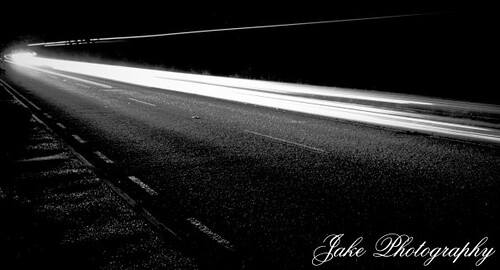
But a daytime version, so they are like "Contrasting" each other.
Does that make it easier? And when i get home from college i can tell you what Circ Polarisor I have. All I know on the top of my head is that it's a Hoya
But a daytime version, so they are like "Contrasting" each other.
Does that make it easier? And when i get home from college i can tell you what Circ Polarisor I have. All I know on the top of my head is that it's a Hoya
coldpenguin
Suspended / Banned
- Messages
- 2,196
- Edit My Images
- Yes
Are those cars?
Thinking of the practicalities of this, daytime I don't think will be of any use to you.
They won't have any lights on.
Thinking of the practicalities of this, daytime I don't think will be of any use to you.
They won't have any lights on.

HoppyUK
Suspended / Banned
- Messages
- 23,200
- Name
- Richard
- Edit My Images
- No
I don't want to do the lights
I just want an exposre during the day of the same place.
Just because they are opposits. that's what im doing for college.
If you shoot a daylight scene with a heavy ND filter to give you an exposure of 30secs or so, the cars will just disappear. If that's what you want, you will get exactly the same effect by waiting for a gap in the traffic and shooting normally.

- Messages
- 18,695
- Name
- LongLensPhotography
- Edit My Images
- No
If you shoot a daylight scene with a heavy ND filter to give you an exposure of 30secs or so, the cars will just disappear. If that's what you want, you will get exactly the same effect by waiting for a gap in the traffic and shooting normally.
At best you will get slightly grey blobs if anything. Now in some countries there is a law to have the lights on at any time of the day so you may want to look into it if you are desperate.
OP
DropDead
Suspended / Banned
- Messages
- 549
- Name
- Jake Lewis
- Edit My Images
- Yes
If you shoot a daylight scene with a heavy ND filter to give you an exposure of 30secs or so, the cars will just disappear. If that's what you want, you will get exactly the same effect by waiting for a gap in the traffic and shooting normally.
Oh ok, I see what you say.
So what would you advise to get somthing remotley intresting?
Like what exposure speed, etc etc?
Or would you suggest re-thinking my initial idea?
if you want the blur of the traffic and a vehicle at the head of the shot frozen , shot the traffic coming towards you with a slow shutter speed 1/4 sec finished with a second curtain flash exposure at the end will require a lot of test shots to match the distance of travel for the vehicles all so a wide angle lens will help
bit more try standing at a large traffic junction with a stop watch to see how long it takes them to cross this should give you the time for the length of the exposure the flash put on second curtain sink will look after its self [in day light the flash should not interfer with the traffic or get a friend to drive through a quiet junction