Beginner to capture fast action shots - dog catching treats

Wolf100

Suspended / Banned
Messages
20
Name
Jane
Edit My Images
Yes
Hi everyone, im very new to photography and id really like to take the following photograph. My dogs/family dogs catching a treat (you know the ones, dogs eyes bulging, funny mouth etc).
The shots will be taken outdoor, in the living room and in a shed type building. Time is of the essence as I want to do these for birthdays and christmas. (I completley understand Im requesting to sprint before I can walk, but I hope someone can help me.
I will be using black backdrops and coloured backdrops. In the shed type building (which I want to turn into a little studio eventually) I will need additional flashes etc that will work remotely.
Ive a Nikon D5300 with the lens that came with it, 18-55mm AF-P DX. I also have a second hand speedlite YN568EX to get me started.
Will my D5300 plus current lens (and speedlite) capture this fast action shot? If this gear wont give me that sharp shot I require, i am open to selling this gear and buying second hand, to get me the shot I need.

Also may i ask these questions:
1. I want x2 light umbrellas but dont know how they work (these will be for when I shoot in a shed building). What is compatible with my D5300 and current lens, please?
2. the second hand YN568EX can this act as a master and slave as well? Im hoping it could be a slave and I get a newer/better condition speedlite. (I could stick the YN568EX on a stand?)

Thank you for reading and sorry I sound stupid. Im super excited, i just need to ensure my current gear will give me what i need, if not, i am simply wasting more and more time practising something I will never achieve.

Im also needed the shot to give me bursts of course, so fingers crossed 1-2 of the shots are what Im after. I use the best batteries in the speedlite too, so Ive been told.
 
Last edited:
The good news is yes, you can use the kit you have to achieve this. (y)

I'd suggest you start outdoors as it's easiest to get you started. Providing it's not wet or windy, you can still use your backdrops.

Use a fast shutter speed to freeze the action and shoot at f.56 or f8 to get a depth of field deep enough to focus the dog's ears and nose - just experiment with both to get the best results.

I'm not familiar with your flashgun, but it looks like it should get you started with some experimentation. As you only have the one flash, get yourself a nice big white reflector to fill in the shadow side a little.

A pair of cheap umbrellas and a second flash gun along with the means to trigger them both off-camera, and a couple of lightweight stands will get you started without having to spend too much money. This can be a slippery slope, but my advice would be don't rush into spending lots until you know how the various light modifiers that are available will work to your advantage.

You'll find plenty of tutorials on YouTube to help and once you have some pictures to show, put them on here and people will offer you help and guidance with how to improve.

Welcome to the forum BTW. :welcome:
 
Last edited:
I do a fair bit of dog/pet photography for friends and family although I didn't really start doing it frequently until I was a technically proficient photographer.

Now, technically proficient doesn't always equal 'good' and I found that I'd underestimated the other half of the equation which is the behaviour of the pet. To give yourself the best chance of success, I'd ensure you've got your relationship with the camera and lighting set up absolutely locked down so you can concentrate almost fully on managing your canine subjects as I've found trying to predict what they do and then relating that to my technical choices is a layer of complication that most don't expect.
 
The good news is yes, you can use the kit you have to achieve this. (y)

I'd suggest you start outdoors as it's easiest to get you started. Providing it's not wet or windy, you can still use your backdrops.

Use a fast shutter speed to freeze the action and shoot at f.56 or f8 to get a depth of field deep enough to focus the dog's ears and nose - just experiment with both to get the best results.

I'm not familiar with your flashgun, but it looks like it should get you started with some experimentation. As you only have the one flash, get yourself a nice big white reflector to fill in the shadow side a little.

A pair of cheap umbrellas and a second flash gun along with the means to trigger them both off-camera, and a couple of lightweight stands will get you started without having to spend too much money. This can be a slippery slope, but my advice would be don't rush into spending lots until you know how the various light modifiers that are available will work to your advantage.

You'll find plenty of tutorials on YouTube to help and once you have some pictures to show, put them on here and people will offer you help and guidance with how to improve.

Welcome to the forum BTW. :welcome:
Hi Sky, thanks a million for your time and patience with me. Im SUPER happy to read your reply. Yeah I will also post some pics on here too. Im googling umbrellas now and softboxes, I have a budget so its not like im cashless. Outdoors in Autumn Winter can be problematic, but i will try, its rained here for almost a week. Thank you again :) .
 
  • Like
Reactions: Sky
I do a fair bit of dog/pet photography for friends and family although I didn't really start doing it frequently until I was a technically proficient photographer.

Now, technically proficient doesn't always equal 'good' and I found that I'd underestimated the other half of the equation which is the behaviour of the pet. To give yourself the best chance of success, I'd ensure you've got your relationship with the camera and lighting set up absolutely locked down so you can concentrate almost fully on managing your canine subjects as I've found trying to predict what they do and then relating that to my technical choices is a layer of complication that most don't expect.
Hi Adam-G thank you for your time and helping me. The handler will look after their dog to a degree. Firstly I wanted to ensure my current gear (which is brand new although I bought it all 5+ years ago) will get me that important freeze shot. Thank you for the insight thought, I really do appreciate it. :-)
 
Am I wrong in saying this? Don't you need an editing program like Photoshop to "bulge" the eyes and the mouth? It has less to do with using the right flash. A flash would make the cornea's of the eye grow smaller not larger. Maybe I'm thinking of another funny image of a big eyed dog.
 
Hi Adam-G thank you for your time and helping me. The handler will look after their dog to a degree. Firstly I wanted to ensure my current gear (which is brand new although I bought it all 5+ years ago) will get me that important freeze shot. Thank you for the insight thought, I really do appreciate it. :)
All you really need for the vital freeze is a fast enough shutter speed which with the right lighting won't be an issue. As Sky mentioned above, stopping the lens to a tighter aperture will help keep the dog's nose in focus to an extent but all of these factors are going to also be reliant on your focal length, your proximity to the subject and of course your aperture. You may need to experiment to get the results you want.

You may also want to turn Autofocus off and work on the focal plane manual focus gives you. You'll be surprised just how quickly the dog moves in and out of frame so you don't really want to give the camera any additional workload with subject tracking. Just give yourself as much focal plane as possible and sort of hope for the best. This advice would of course be different for other types of pet photography but for the very specific result you want, that would be my advice.
Am I wrong in saying this? Don't you need an editing program like Photoshop to "bulge" the eyes and the mouth? It has less to do with using the right flash. A flash would make the cornea's of the eye grow smaller not larger. Maybe I'm thinking of another funny image of a big eyed dog.
A lot of this style of photographer use wider angle lenses to add distortion to the dog's features with the dog being generally photographed pretty close to the lens.
 
For action type shots you could try outdoors in good lighting and shutter speed mode (think it's S on Nikon) set the shutter to 1/500 or faster and maybe auto ISO. I wouldnt worry about the flash for now, to freeze motion with flash yoou need to be able to control the lighting, as you sound as if your inexperienced, this might complicate things at this stage.
 
I agree, forget about indoor shots for now, they add a level of complication that you don't need, but I'll come back to that.

Your camera is perfectly capable. You have a maximum shutter speed of 1/4000th of a second, that will freeze almost all action if you want to freeze it, and you also have the choice of using a much longer shutter speed if you want to deliberately blur the action.

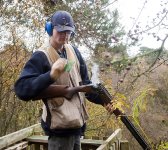
In the shot below, on a dull day, I shot at just 1/80th sec, to deliberately blur the movement of the ejected cartridges (the gun is opened after firing and the spent cartridges are then automatically ejected at pretty high speed) Different people handle them in different ways, this young man is fast and actually catches them mid-air, I knew that so his hand etc is also blurred. This is very similar to a dog catching a treat, the movement is very predictable.
bill gun.jpg

This was shot at f/8, but on a full-frame camera. Your camera, with its cropped sensor, will produce greater depth of field.
The only real limitation of your camera is that you can only shoot at a maximum of 5 shots per second, and that isn't fast enough to fire a burst of shots and expect the timing of one of them to be perfect - but again, the movement is predictable so, with practice, you will be able to get it right with just one shot. The shot above was just a single shot.

In bright sun your flash won't have anywhere near enough power to be useful, so don't bother with flash. You can use flash if the natural light is poor, but it will be a fairly sharp learning curve. Making the light source larger and softer by using an umbrella probably won't be necessary outdoors, but if you do go down that route then get a reflective umbrella like this one https://www.lencarta.com/silver-reflective-deep-parabolic-umbrella-lencarta-130cm because it makes very efficient use of the light - don't get the other design, a shoot-through, because they are pretty useless outdoors.

If you want to shoot indoors in the future, just come back to us and post again, preferably in the lighting forum, and we'll take it from there.
 
For action type shots you could try outdoors in good lighting and shutter speed mode (think it's S on Nikon) set the shutter to 1/500 or faster and maybe auto ISO. I wouldnt worry about the flash for now, to freeze motion with flash yoou need to be able to control the lighting, as you sound as if your inexperienced, this might complicate things at this stage.
Hello thank you for your advice. I will be shooting in a barn, that does have a couple of bulb lights hanging down, a few clear roof sheets here and there, and a huge roller shutter door lifted to max, which is approx 5 metres high (to get lots of light in). I’m having the barn prepped for my homemade studio. The type of shots I wil be taking are a) dogs running towards me (the shot will be taken with me being laid on the floor and a max of 5-6-7 metres away from me). b) dogs running towards me but jumping over a jump. c) close up of dogs catching a treat (with different backgrounds etc). The barn will be set up with 3-4 background stands, so I can seamlessly move form one to another. Since posting in here; I have come to the conclusion that my d5300 and 18-55mm lens will
Not give me the freeze shot I need, not only because the d5300 has low FPS when shooting in raw, but also it’s AF modes aren’t what I need.

I’m considering part-ex my d5300 or selling on ebay, it’s 5 years old but literally has been out of the box 8/9 times only.

I know I don’t know much at all about photography, but if I can get the right gear/fast lens, and a one2one with someone at my studio, Im in a better place than I currently am. I will only be shooting close action shots like catching a treat, and dogs running towards me (between 1-7 metres from
Me).

I’m considering the d500 because of its outstanding AF system, and its tracking abilities, and its fast shutter speed 1/8000, 14 FPS and buffer size should work for me. I’ve read it’s designed for speed; so I’m kind of falling in love with this . I also understand it’s DX format so I will get more out of the lens focal length (even though I am only shooting very close on dogs).

Question: what fast lens would you pair with the d500 to get the right mix? Remember I’m shooting at between 1-7 metres….. and should I get a lens with image stabilisation ? As the d500 doesn’t have this feature.

I also need some additional lights to run off the d500, maybe two, anyone any suggestions?

Those of you that do close action shots like I’m wanting to do? Should I stick with d500 or suggest another Nikon.

I know I’m wanting to run before I can crawl, but I do believe investing in the right equipment that will help me, will get me the result quicker. I am very prepared to work hard with the camera/lens but the right tools will help me faster.

Thank you everyone.
 
I also need some additional lights to run off the d500, maybe two, anyone any suggestions?
You have a quandary here, you want to shoot bursts so that you can pick a shot from a selection, and for that a fast lens and natural light is the key.

But you also want to add light, and that is a whole other ballgame. Because good lighting is all about precision, suitable for static (or at least predictable) rather than moving targets, and it’s also (unless you pay a fortune) not really up to bursts.

So you could shoot the static shots or dogs catching using flash. But the dogs running towards you won’t work in the way you’d hope.
 
Last edited:
You have a quandary here, you want to shoot bursts so that you can pick a shot from a selection, and for that a fast lens and natural light is the key.

But you also want to add light, and that is a whole other ballgame. Because good lighting is all about precision, suitable for static (or at least predictable) rather than moving targets, and it’s also (unless you pay a fortune) not really up to bursts.

So you could shoot the static shots or dogs catching using flash. But the dogs running towards you won’t work in the way you’d hope.
Hi Phil thank you so much for advising me. I’ve seen other peoples photographs of dogs running toward them, it’s only running approx 5-6-7 metres so it’s not a run, more of a galloping trott haha. The studio I’m making will have light that’s already in it: clear sky velux window type things and I will also add umbrellas or whatever. I’ve seen people set it up like this, I just need to know what they are using as in equipment - to get that shot.
 
As @Phil V says, what you need is natural light.

Your Nikon D5300 has a max flash sync speed of 1/200th second, which means that when you use flash, the shutter speed cannot be faster than 1/200th. In fairly dark conditions, with a fairly small lens aperture and a fairly low ISO setting that won't matter at all, because the very short flash duration will freeze the action.
But if you have a fairly high level of ambient light and / or have to use a fairly high ISO setting, the ambient light will make a significant (unwanted) contribution and will create image blur.

You mentioned possibly getting a d500. T'internet says that the max sync speed of that is 1/250th, of 1/320th, or maybe faster with some setting or other, but will have the same basic limitation.

There are some mirrorless cameras that have a different type of shutter that should allow much faster shutter speeds, other people can advise on that but personally I can't, as I have no experience of them.

You could use flash for dogs running towards you, and if they're basically doing agility then you could set up a modern flashgun (Think one of the Godox ones) that can recycle very quickly at very low power settings and which should be able to keep up with reasonably fast camera bursts. You'd have a transmitter in your camera hotshoe and the flashes would be in the right place, to light the dog as it came over the jump, and if there are several jumps at different distances you could have a flashgun to light each one. You'd have to do this, because the effect of the inverse square law means that the light loses a lot of power as the distance increases.

As for the need to shoot your camera in machine-gun mode, and the need for really fast autofocus, I'm not sure about that. If you know your subject, which I'm sure you do, you should be able to time your shots perfectly, which means that a single shot will do just as well or nearly as well as a burst of shots. And the same applies to autofocus, you can set the focus manually to the right distance and won't need autofocus at all, as long as you can use a fairly small lens aperture to get the amount of depth of field you need.

Forget about the hanging light bulbs, they will make virtually no difference, you say that you have light coming through the roof panels and can open the big door. This natural light, combined with a high ISO setting, should make it possible to use 1/8000th second and forget about flash.

All of this is just an educated guess based on my experience, you just need to try it for yourself, but I'd be surprised if I'm wrong about my guesses.
 
As @Phil V says, what you need is natural light.

Your Nikon D5300 has a max flash sync speed of 1/200th second, which means that when you use flash, the shutter speed cannot be faster than 1/200th. In fairly dark conditions, with a fairly small lens aperture and a fairly low ISO setting that won't matter at all, because the very short flash duration will freeze the action.
But if you have a fairly high level of ambient light and / or have to use a fairly high ISO setting, the ambient light will make a significant (unwanted) contribution and will create image blur.

You mentioned possibly getting a d500. T'internet says that the max sync speed of that is 1/250th, of 1/320th, or maybe faster with some setting or other, but will have the same basic limitation.

There are some mirrorless cameras that have a different type of shutter that should allow much faster shutter speeds, other people can advise on that but personally I can't, as I have no experience of them.

You could use flash for dogs running towards you, and if they're basically doing agility then you could set up a modern flashgun (Think one of the Godox ones) that can recycle very quickly at very low power settings and which should be able to keep up with reasonably fast camera bursts. You'd have a transmitter in your camera hotshoe and the flashes would be in the right place, to light the dog as it came over the jump, and if there are several jumps at different distances you could have a flashgun to light each one. You'd have to do this, because the effect of the inverse square law means that the light loses a lot of power as the distance increases.

As for the need to shoot your camera in machine-gun mode, and the need for really fast autofocus, I'm not sure about that. If you know your subject, which I'm sure you do, you should be able to time your shots perfectly, which means that a single shot will do just as well or nearly as well as a burst of shots. And the same applies to autofocus, you can set the focus manually to the right distance and won't need autofocus at all, as long as you can use a fairly small lens aperture to get the amount of depth of field you need.

Forget about the hanging light bulbs, they will make virtually no difference, you say that you have light coming through the roof panels and can open the big door. This natural light, combined with a high ISO setting, should make it possible to use 1/8000th second and forget about flash.

All of this is just an educated guess based on my experience, you just need to try it for yourself, but I'd be surprised if I'm wrong about my guesses.
Hiya I can’t thank you enough for helping me, all you say makes sense to me, and it’s so kind of you to spend time with me. I’m going to go away and re-read your message again and then really think about my next steps. Have a super weekend
 
I've spent a lot of time with dogs, I have one now and often have others "staying over" I' also lived at a kennels for several months and lived on a farm with a dog rescue and boarding kennels.
A dog running towards you over 5 -7 metres is not going to give you much time to shoot, my pug can run that in 2 seconds no bother, and a bigger faster dog will be on you in no time. I'd prefocus manually on a spot saythe jump and shoot anticipating the time. It might take a few shots, but you'll have to do that anway I'd guess.
With the door open whats going to stop the dog doing a runner after? I'm guessing from what youve said they are well trained so that might not be an issue.
 
I've spent a lot of time with dogs, I have one now and often have others "staying over" I' also lived at a kennels for several months and lived on a farm with a dog rescue and boarding kennels.
A dog running towards you over 5 -7 metres is not going to give you much time to shoot, my pug can run that in 2 seconds no bother, and a bigger faster dog will be on you in no time. I'd prefocus manually on a spot saythe jump and shoot anticipating the time. It might take a few shots, but you'll have to do that anway I'd guess.
With the door open whats going to stop the dog doing a runner after? I'm guessing from what youve said they are well trained so that might not be an issue.
I agree (my bold)
A long time ago I shot some agility, mainly Border Wallies, which really shift . . .
Max shutter speed back then was 1/1000th and autofocus simply didn't exist, but I used to have a pretty high success rate. New technology is great, but isn't always the best solution.
 
I agree (my bold)
A long time ago I shot some agility, mainly Border Wallies, which really shift . . .
Max shutter speed back then was 1/1000th and autofocus simply didn't exist, but I used to have a pretty high success rate. New technology is great, but isn't always the best solution.
Hi guys, that’s exactly what I will be doing. Taking the shot when the dogs “jumps” over the jump. My measurements of 5-7 metres was to share the short distance I’m working within. Dog jumping will be approx 5 metre mark.

When I’m doing dogs siting and treat catching, I will be less that 1 metre from the dogs head.

This is why I want to part ex my current d5300 and get the D500 with a super fast DX lens. I’ve got money for the new kit, just need to make the right choice.
Some people are pointing me towards the tamron f2.8 24-70 g2 lens and d750. Some people are saying Nikon lenses but again suggesting I stick with f2.8 as I’m working at such short distance.

As I’ve said it’s the gear I want to invest in.

Thank you
 
Hi guys, that’s exactly what I will be doing. Taking the shot when the dogs “jumps” over the jump. My measurements of 5-7 metres was to share the short distance I’m working within. Dog jumping will be approx 5 metre mark.

When I’m doing dogs siting and treat catching, I will be less that 1 metre from the dogs head.

This is why I want to part ex my current d5300 and get the D500 with a super fast DX lens. I’ve got money for the new kit, just need to make the right choice.
Some people are pointing me towards the tamron f2.8 24-70 g2 lens and d750. Some people are saying Nikon lenses but again suggesting I stick with f2.8 as I’m working at such short distance.

As I’ve said it’s the gear I want to invest in.

Thank you

Has anyone suggested a 70-200 lens for the running shots? The 24-70 will be better for the close up treat catching but you'd have more versatility around distance and you're more likely to get a nice frame filling shot with a longer focal length.

Both of these shots are at the 200mm end of a 70-200mm 2.8 lens if it helps you to visualise at all.

 
Last edited:
Adam you are so so helpful, really, this is wonderful. I
Am going to read about both lenses. The closer shot lens and 200mm one. Your pics are fabulous.
Are they both Nikon you mention? What camera body do you have? Hope you don’t mind me asking.
 
Adam you are so so helpful, really, this is wonderful. I
Am going to read about both lenses. The closer shot lens and 200mm one. Your pics are fabulous.
Are they both Nikon you mention? What camera body do you have? Hope you don’t mind me asking.

These were shot on a Lumix S5ii with the Sigma 70-200mm f2.8 DG DN OS Sport lens I wouldn't worry about the system, it was more a demonstration of how different focal lengths produce a different look to the image and have very different use cases.

Some knowledge about the "why" when it comes to lens selection will be a great help in predicting the outcome of a shot.

Like I mentioned earlier in the thread, the treat catching photos with the bulging eyes/face effect come out like they do because the photographer is aware that a subject close to a wide angle lens will have their features distorted, giving an exaggerated, comical look to the photo of the dog.

With the running dog shots, I choose the telephoto lens because it gives me that nice compressed look and makes the dog stand out.

Don't get too hung up on brands and systems. Any system that has a decent 70-200mm option can take those shots and as far as I'm aware, that's all of them.
 
These were shot on a Lumix S5ii with the Sigma 70-200mm f2.8 DG DN OS Sport lens I wouldn't worry about the system, it was more a demonstration of how different focal lengths produce a different look to the image and have very different use cases.

Some knowledge about the "why" when it comes to lens selection will be a great help in predicting the outcome of a shot.

Like I mentioned earlier in the thread, the treat catching photos with the bulging eyes/face effect come out like they do because the photographer is aware that a subject close to a wide angle lens will have their features distorted, giving an exaggerated, comical look to the photo of the dog.

With the running dog shots, I choose the telephoto lens because it gives me that nice compressed look and makes the dog stand out.


Don't get too hung up on brands and systems. Any system that has a decent 70-200mm option can take those shots and as far as I'm aware, that's all of them.

(My bold) The different perspective effects are of course due to the different shooting distances, not by the difference in focal lengths.
 
(My bold) The different perspective effects are of course due to the different shooting distances, not by the difference in focal lengths.

Would a wider 16mm lens not have a more exaggerated look than a 50mm lens at the same distance all things being equal?

I already understand that the distance to the lens is a factor as I mentioned "close" but maybe I'm misunderstanding the other part?
 
Would a wider 16mm lens not have a more exaggerated look than a 50mm lens at the same distance all things being equal?

I already understand that the distance to the lens is a factor as I mentioned "close" but maybe I'm misunderstanding the other part?
No.
 
I've always misunderstood that, thanks for clearing it up!
 
These were shot on a Lumix S5ii with the Sigma 70-200mm f2.8 DG DN OS Sport lens I wouldn't worry about the system, it was more a demonstration of how different focal lengths produce a different look to the image and have very different use cases.

Some knowledge about the "why" when it comes to lens selection will be a great help in predicting the outcome of a shot.

Like I mentioned earlier in the thread, the treat catching photos with the bulging eyes/face effect come out like they do because the photographer is aware that a subject close to a wide angle lens will have their features distorted, giving an exaggerated, comical look to the photo of the dog.

With the running dog shots, I choose the telephoto lens because it gives me that nice compressed look and makes the dog stand out.

Don't get too hung up on brands and systems. Any system that has a decent 70-200mm option can take those shots and as far as I'm aware, that's all of them.
Adam, you know when I’m looking for a second hand D500 on these websites, how many shutter counts should I accept as a maximum. Lowest I’ve seen is 79,000 ish. I know lower the better but thought I’d ask you. Hope this is ok.
 
If it's any help, my thoughts are that a lens of something around 80-200mm (or cropped frame equivalent) is probably ideal for your jumping shots.
It may be that with your own setup, you can be dead in line with the dog, but if you need to be a bit out of the way then shooting at the longer distance that a longer lens would allow/force would help to minimise the "angle of attack" and make the dog look as if it's coming straight towards you.

I also feel that the distance required to shoot with about a 70mm lens is about right in terms of "natural" perspective. A lot of people feel that 50mm or (more technically) 43.5mm is best, but I don't agree - which doesn't make me right:)
 
If it's any help, my thoughts are that a lens of something around 80-200mm (or cropped frame equivalent) is probably ideal for your jumping shots.
It may be that with your own setup, you can be dead in line with the dog, but if you need to be a bit out of the way then shooting at the longer distance that a longer lens would allow/force would help to minimise the "angle of attack" and make the dog look as if it's coming straight towards you.

I also feel that the distance required to shoot with about a 70mm lens is about right in terms of "natural" perspective. A lot of people feel that 50mm or (more technically) 43.5mm is best, but I don't agree - which doesn't make me right:)
Garry thank you so so much. That’s really useful to me. You have all been so kind on here I delighted to have joined the forum. And yes I will be dead in line with the dog.
 
Last edited:
Adam, you know when I’m looking for a second hand D500 on these websites, how many shutter counts should I accept as a maximum. Lowest I’ve seen is 79,000 ish. I know lower the better but thought I’d ask you. Hope this is ok.

I don't have any experience unfortunately. I believe manufacturers publish how many actuations their shutters should last in theory so if I were in your shoes I'd find that information and see what's viable.
 
Thank you. I’ve found a good few with 500-1000 which so hellish low, and with warranty.
Wish I could find a new one haha
 
I've always misunderstood that, thanks for clearing it up!
The reason we jump to believe it’s about focal length is because for any given framing of a shot, the focal length determines subject distance.

So as photographers we tend to actually see subject distance in FL terms. Which becomes a ‘truism’ but it’s not correct.
 
Last edited:
Regarding flash sync speeds, a used Nikon D40, only 6MP but under £50, can sync at 1/4000 using a non dedicated flash or by taping over some of the contacts as it uses shutter switching at faster speeds.
Probably not what you want but may be useful to others reading this thread.
 
The reason we jump to believe it’s about focal length is because for any given framing of a shot, the focal length determines subject distance.

So as photographers we tend to actually see subject distance in FL terms. Which becomes a ‘truism’ but it’s not correct.
Makes perfect sense now after Garry linked me to the thread explaining it. A concurrent relationship of two factors created a false positive in my head.
 
Makes perfect sense now after Garry linked me to the thread explaining it. A concurrent relationship of two factors created a false positive in my head.
Not just you. If you go anywhere that photographers gather, you’ll read / hear the same thing you posted repeated regularly. :D
 
Back
Top