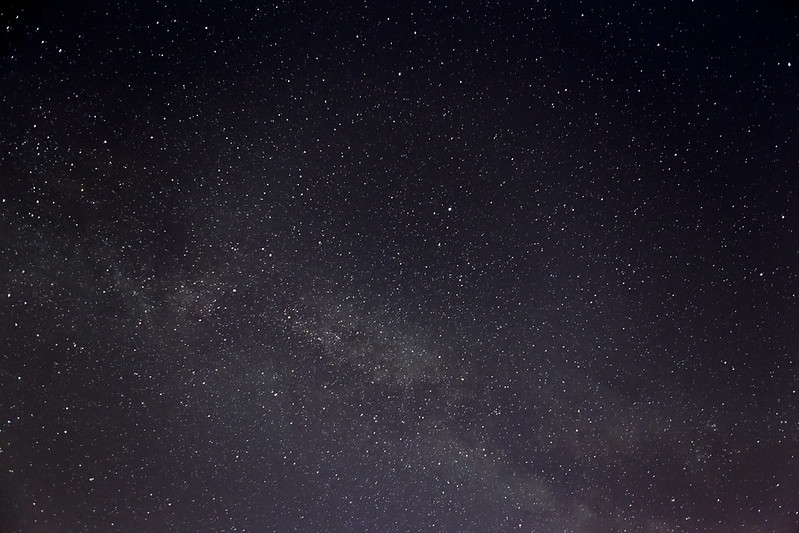
Tips on shooting The Milky Way

cokecan72

Suspended / Banned
Messages
22
Name
Martin
Edit My Images
Yes
Hi Guys

Just wondering if anyone could offer suggestions on snapping some decent pictures of The Milky Way?

A wide lens and a shutter speed quick enough not to show trails while slow enough (or high enough iso/low enough F stop) to show more stars in the photo?

Unfortunately my widest lens is 28mm, which on a crop sensor isn't actually as wide as it could be. Would a stitched panoramic type shot work here too? I guess it would be difficult to gauge the overlap of images?

Any help would be useful :)
 
Hi Martin

Not my area of expertise at all (in fact i havent got any real expertise areas:thinking:) but I reckon (you dont show your location) that if you are UK based you've effectively had it. Too much light pollution.
So the recomendation would be: move to Wyoming :)

Maybe someone else will drop in and prove me wrong!
 
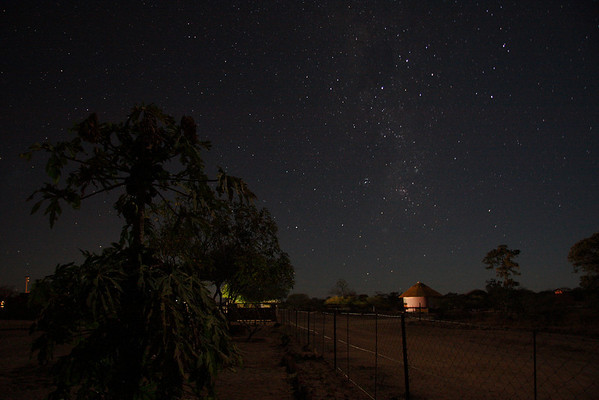
I have only done one once.

It was in our village in Botswana. The nearest mains electricity was 10km away, and that is a village of about 1000 houses, the nearest town is actually about 45km away, both of these are on the left (the south) of the image. However, my in-laws have a generator (it is the only one in the village used at night) and were running about 4 light bulbs off it (somewhere between 60W and 100W, so normal light bulbs not industrial / search light types!), I seem to remember there being a half moon too - there was certainly enough moonlight to see with (I didn't need a torch to set up with) and to cast shadows on the ground, but it wasn't as bright as when it is a full moon.

My settings were: ISO 1000, f4.5, 56 seconds at 17mm on my 40D, and I had to process it to make the most out of it. I did find my 10-22mm too wide for the location (had to get too close to the prickly pear tree for the composition to work) and I found my 50 f1.8 too long to get a workable composition due to plot boundaries and fences. But those are problems unique to that location, so there is no real reason why you couldn't use 28mm happily.

988529206_HwfxC-M.jpg

Larger: http://gembobs.smugmug.com/Travel/Bots-2010/MG5640/988529206_HwfxC-XL.jpg

As DorsetDude says, if you are planning on doing it in the UK, then you will need to get a decent distance away from any urban areas to minimize light pollution.

ETA: if you look closely, you can see that the stars are starting to trail a bit on the shot
 
Last edited:
It's hard but not impossible:

Gimblet%20Rock%20014.jpg


This was my first Milky Way shoot so I was experimenting with the settings, not sure of the EXIF (I'll check later) but it was a wide angle, I think 17mm on full frame which would be equivalent to around 11mm on a crop sensor. High ISO and long-ish exposure, but not long enough to register significant star trails.

Most important part is location - this was near Pwllheli looking out towards the Irish sea so not much light pollution at all, however facing the other direction it was virtually impossible to pick anything up. Your eyes can see the Milky Way easily enough, but the sensor is overloaded by all the city lights and it just disappears into the glow. I think it would be very hard to get a good Milky Way shot inland unless you are in the middle of nowhere, and even then it's hard to avoid the horizon glow.
 
Thanks for the replies guys :)

I am in the UK, headed up to Surprise View in The Peak District recently on a clear night and it was very visible with little to no glow on the horizon and a new moon that was casting hardly any light (actually the first time I've ever seen The Milky Way with the naked eye!). Its supposed to be around 15 times darker than Sheffield city center?

What kind of processing did you guys have to do on your images?

So the verdict is high iso (I will be limited to 800 on my Canon 450D), long-ish exposure but not too long to avoid noticeable trails and a wide angle lens. Well if my 28mm isn't going to be wide enough, does anyone have any recommendations on a very cheap wide lens for my Canon 450D? Don't even mind if it's old/needs a converter ring with manual focus as for this and even star trails I generally focus on infinity anyway
 
Can't help on the lens front, best I could suggest would be a Tokina 11-16 2.8 for a crop but they're not cheap and I have no idea what other wide/fast options there are for Canon crops. Actually, the Samyang 14mm is supposed to be pretty good and not expensive, I'd like to try one myself at some point as 17mm isn't really wide enough for my liking, even on full frame.

As regards processing, I set a tungsten WB and fine tune to taste, and then adjust the blues (luminosity up, saturation down) which brings more stars out of the darkness. Could probably do more to enhance them but that's just a 10 second tweak in Lightroom.
 
read somewhere that you should shoot wiiiiide open? Like below 4-5?

Have read other posts about the samyangs, do ther work on D90s?
 
Shot from my back garden in a residential area in Devon a few weeks ago.

Canon 5D MKII
24-70 @ 24mm
F2.8
25 seconds
ISO 1600


Perseids-2 by Richard_Cole, on Flickr

Given the light pollution it turned out okay!

I would get a faster lens than f4 before worrying about a wider lens.
 
Last edited:
As you've seen Martin a dark sky is a great help.

The 600 rule is a good starting point to prevent stars becoming trails (unless you have some means of guiding the camera to counter the rotation of the Earth).

The maximum exposure in seconds = 600/the FF effective focal length of the lens.

On my camera using the kit lens at 18mm and a crop factor of 1.5 the maximum exposure is about 22s (600/(18*1.5)).

This is more a guide than a rule as it varies with latitude, but its a reasonable place to start.

You could also take a number of shorter exposures and stack them with something like http://deepskystacker.free.fr/english/index.html

Dave
 
slightly off topic Ive just come back from Egypt where We did a trip into the Sinai desert at night to watch the sunset and stargaze and the milky way is incredible from there,just a bit expensive to go all that way just for a shot.wish I had taken my 50D and a small tripod now.
 
DorsetDude said:
Hi Martin

Not my area of expertise at all (in fact i havent got any real expertise areas:thinking:) but I reckon (you dont show your location) that if you are UK based you've effectively had it. Too much light pollution.

So the recomendation would be: move to Wyoming :)

Maybe someone else will drop in and prove me wrong!

You don't need to travel far at all in the uk for dark skies. I just need to drive for 40 minutes to have pitch black skies from the city I'm in.

There are lots of specialist web sites that can help you, I suggest you try the potn and look at the section for all things in space ;)
 
We're only 30 miles from the Galloway Forest Park - the only dark skies park in the UK - and don't get much light pollution in our village either - but we do get a lot of overcast/cloudy weather which isn't great for this sort of thing!

I've had more success in the Drakensberg and northern Kwa Zulu Natal, far from any major development, where the skies are often clear and the Milky Way sometimes looks like a shining pathway across the sky. My photographs are on another computer in SA, and I can't remember exactly what settings I used, but I tried a range of combinations.
 
DorsetDude said:
Hi Martin

Not my area of expertise at all (in fact i havent got any real expertise areas:thinking:) but I reckon (you dont show your location) that if you are UK based you've effectively had it. Too much light pollution.

So the recomendation would be: move to Wyoming :)

Maybe someone else will drop in and prove me wrong!

Not true. I could see it clear as day Wednesday, would have been perfect!
 
This timelapse video [click] of the Milky Way rising is pretty awesome.

But it's also very helpful because the author explained how he took it. The short version is ISO 1600, f/2.8, 20 seconds exposure per frame. Pretty similar to the settings Rico above used.
 
As well as being a favourable location, the other key thing is visibility.
I live in Mendip and a few nights a year the Milky Way is so clear it looks like someone whapped a white paintbrush over the sky. I'm only 30 mins drive from Bristol!
A number of the weather websites include visibility in their forecast.
Being high up obviously helps. Mendip is 800ft above most of Somerset.

Here's one of mine from a couple of weeks ago.
The visibility was OK, but not brilliant. At sunset I could see I was on the upper edge of the haze, but still in it. And there was a sliver of moon reducing contrast.
I could make the Milky Way out with the naked eye; but no where near as clearly as on a properly clear night.
The milky way rising over Pen y Fan - 30s, 24mm, full frame.
20120909-010117-I39A2272-L.jpg
 
Last edited:
Back
Top