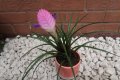
Tillandsia plant

jonbeeza

Suspended / Banned
Messages
9,388
Name
Jon
Edit My Images
Yes
IMG_0050.JPG

I bought this plant the other week and the two purple flowers came up over the last day or two. An interesting little plant, and I was thinking of re potting it for better growth.
I bought it potted in soil, but reading up on wiki suggests soils is not a correct growing environment.

Wiki
Due to their epiphytic way of life, these plants will not grow in soil but live on the branches of trees, in deserts and on other substrates that will not be saturated with water for very long.

Any ideas how to best re pot it, in a stone filled pot maybe? :thinking:
 
Tillandsia
Also known as air plants.
wedge it into a piece of rock or drift wood and "mist" regularly.
Unfortunately many die once they have flowered, but in the mean time they should have shot out a little clone which then can be started all over again
 
It can be grown in pots, unlikely other air-plants, but make sure the compost you use is very free draining. Leaf mold mixed with moss maybe? You may find there are specific pre-mixed composts for them.
 
As above. Mist with a suitable feed according to the feed's instructions. If it has to be in a pot, the rooting medium should be as free draining as possible and shouldn't be used to water the plant.
 
Tillandsia
Also known as air plants.
wedge it into a piece of rock or drift wood and "mist" regularly.
Unfortunately many die once they have flowered, but in the mean time they should have shot out a little clone which then can be started all over again

I did read something like, once they die new life appears. I wonder what part starts the life cycle again? I did read up on it, could not make head nor tail of the article.
I will have to do more reading up possibly.
 
It can be grown in pots, unlikely other air-plants, but make sure the compost you use is very free draining. Leaf mold mixed with moss maybe? You may find there are specific pre-mixed composts for them.
As above. Mist with a suitable feed according to the feed's instructions. If it has to be in a pot, the rooting medium should be as free draining as possible and shouldn't be used to water the plant.

I was thinking of re potting it for better growth, but doing so may damage the plant possibly.
 
I wonder what part starts the life cycle again?
After flowering Tillandsia produce the next generation of airplants as offsets (also known as ‘offshoots’ or ‘pups’). With most species these baby plants appear at the base of the parent plant....

I guess its very much like the house leeks (sempervivums)
that send out "pups" but they don't normally die after

I was thinking of re potting it for better growth, but doing so may damage the plant possibly.
Yes its possible, I never tried "soil based" none of mine were ever potted, just wedged into rocks or drift wood.
The roots are just there for anchorage they "feed" from the rain or dew in the air.
 
After flowering Tillandsia produce the next generation of airplants as offsets (also known as ‘offshoots’ or ‘pups’). With most species these baby plants appear at the base of the parent plant....

I guess its very much like the house leeks (sempervivums)
that send out "pups" but they don't normally die after


Yes its possible, I never tried "soil based" none of mine were ever potted, just wedged into rocks or drift wood.
The roots are just there for anchorage they "feed" from the rain or dew in the air.

Thanks Chris. ;) (y)
 
This particular Tillandsia is part of the Bromeliad type and different from air plants. Airplants are usually stuck to a log or rock and require misting frequently. This type will be grown in compost in a house and does not like compost drying out but also not wringing wet. They dont particularly like water with chlorine in it so rain water is best or boiled and cooled water if not.
 
This particular Tillandsia is part of the Bromeliad type and different from air plants. Airplants are usually stuck to a log or rock and require misting frequently. This type will be grown in compost in a house and does not like compost drying out but also not wringing wet. They dont particularly like water with chlorine in it so rain water is best or boiled and cooled water if not.

Thanks for that bit of info. :) (y)
 
Back
Top