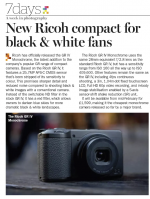
This makes as much sense to me as a 1/2 frame digital camera

flashp

Suspended / Banned
Messages
392
Edit My Images
No
1769379464190.png
From Amateur Photographer, 27th Jan 2026

Or am I missing the point of such cameras? Why would you buy this with all the software options available? If it had switchable IR capability I'd understand.
Also, the notion of the original 1/2 frame 35mm camera was to eek out film I thought, what's the point of that in digital form? Genuinely, I don't get it. Happy to be educated :confused:
 
Last edited:
There is a theory that a sensor designed to record only monochrome will produce sharper monochrome images. I've never tried that sort of camera so I don't know if there is any proof of that claim.

There are no "half frame" digital cameras. The M43 sensor is simply one of several widely used sensor formats. Basically, sensor yields were originally so poor that it made economic sense to design cameras around the smallest practical sensor. As sensor yields improved, the sensor chips became physically larger to allow for more and/or larger photo sites. Much more here...

 
Thanks for your repy Andrew. No such thing as a half frame is kind of my point. You could double the number of shots on film but on a digital platform it's a misnomer. It seems to be a thing of compromises and bizarre that Fuji can market an inferior sensor in terms of resolution for ~£600 in the X Half model.
 
Last edited:
In theory, monochrome sensors are sharper and have a better dynamic range. And if like me, most of your output is monochrome then it provides a simpler workflow.

I know a couple of people who have monochrome cameras in the monochrome group I’m a member of. The output from the Leica Q2 was mind bogglingly sharp, although I’m not sure if that was a function of using a prime lens, monochrome sensor, excellent post-processing, or all the above.
The other camera in question was the Pentax K something or other, which I think is the same sensor as the Ricoh. I’ve had a look at a raw file from it in Lightroom and I felt that it needed a lot of work doing on it compared to a file off my Nikon’s, and I wasn’t sure about the claims of an improved dynamic range. Maybe it was just a different workflow that was required but I wasn’t overly impressed and decided not to buy one.
 
There is a theory that a sensor designed to record only monochrome will produce sharper monochrome images. I've never tried that sort of camera so I don't know if there is any proof of that claim.

In theory, monochrome sensors are sharper and have a better dynamic range. And if like me, most of your output is monochrome then it provides a simpler workflow.

The above is true, without a Bayer (or X-Trans) filter in the way, a monochrome sensor has no pixel intepolation, so it will produce more spatially accurate images (sharper) and have a dynamic range improvement.

I work in industrial machine vision and we always use monochrome sensors for measurement applications for the above reasons.
 
Interesting replies, I've learnt something new.
 
It seems to be a thing of compromises and bizarre that Fuji can market an inferior sensor in terms of resolution for ~£600 in the X Half model.
At the end of the day, everything in photography is a compromise between conflicting demands.

In the case of Fuji's X-Half, they've chosen the "1 inch" sensor format, which has been used by several manufacturers, in an attempt to balance the physical size of the camera against a better result from the sensor.
 
I have the Pentax K3iiiMono which I think is an excellent camera. I can't comment on @viewfromthenorth 's observation as I'm probably not enough of a pixel-peeper (really, I'm not having a dig), but as I also have a Nikon D850 I think I have enough skin in the game to observe that I think the mono images of the Pentax are excellent. Other more techie photographers have done detailed reviews and struggled to see a difference in sharpness etc, but for me it's not really about that. I am an avowed Pentax fanboi so I'm biased. However I wanted the K3iiiM because I like the idea of a dedicated mono camera, to make me think in B&W when shooting. I could use the D850 with a higher Mp count and have raws that I can cut the colour out of, or could set the camera to show B&W jpegs probably, but that wouldn't set my brain into the right mode.

I'm not surprised by the Ricoh GRiv mono version coming out, they produce a special version every year anyway, but I was shocked at the price. There is a zeitgeist at present I think that is moving niche photography areas into the mainstream for certain groups of people, and this includes new analogue cameras and B&W shooting, and the combination of the two with new film coming out. Anything that grows or encourages the market is probably good.
 
What interests me about these debates on sharpness, etc. is what is the end product and is it relevant? If you are shoooting for a professional purpose; commercial or scientific, then I can see the worth. Or if you have hand made wet large prints from the digital images. But, if you are just posting on forums, etc then will the indisputable quality render differently on a phone or tablet at 72ppi jpg?

I am guilty of this in as much as I like to use Zeiss glass as I believe that it gives an undefined 'quality' of image that I only see with some Zeiss and Leitz optics. But, my s/h lenses cost in the low hundreds of £s at most are are fairly bomb proof for future value. I struggle to see how these expensive luxury monochrome only compact digital cameras can be justified especially in small image formats. A bit like the Contax T range: fashion over sense perhaps?
 
I agree Clive, there's no commonsense justification for them probably. As I said, in my case I'm a Pentax fanboi and get bad doses of GAS sometimes. The K3iii is probably peak-Pentax at present, moreso than the FF K1ii perhaps, so it was my preferred route into Pentax digital, and the Mono version was a differentiator that appealed to me. A purely emotional decision therefore.
 
A monochrome camera can't change the white balance to make the picture look different and digital filters (available in most cameras monochrome settings) don't work. It is a bit like having a film camera with only one type of film (2 with the built in red filter).
 
Certainly for the monochrome group I’m in, our output is prints (A2 and A3) so there are different variables in that compared to shooting for screen.

Not sure what it was about the Pentax, the files just seemed to need more work than my Nikon ones. Maybe I needed to spend more time with the one I had and maybe get a few more, but there was nothing about the camera or its outputs that made me want to invest in a parallel system to what I already have.
 
Back
Top