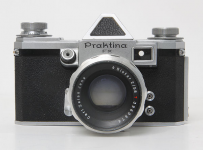
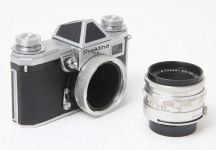
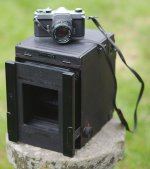
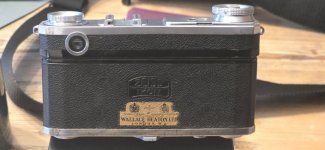
Yes, I'd completely forgotten about the Praktina, and back then (around 1960) there were loads of manufacturers who had quite quirky designs. The reality is that none of them really had much chance here in the UK, before the internet, simply because retailers simply couldn't stock them all and so the public didn't really know about them - advertising at the time basically consisted of retailers taking up several pages in the photography magazines, listing their stock and prices.
At about that time I worked at Wallace Heatons, New Bond Street, the biggest by far I believe, but even we had limited stock. We had just one showcase, stuck almost out of sight, with Japanese cameras, and I especially remember the Asahi Pentax, great cameras for the money, and very up to date, but a combination of snobbery and anti-Japanese sentiment (which is still extremely strong in China) stopped them from being popular. I mentioned earlier that the TLR cameras had the massive advantage of not needing to be stopped down manually to take the shot, this of course also applied to all rangefinder cameras, which is probably why Rollie and Leica dominated the market at that time.
There were alway the oddities, there were the Vito cameras, which were excellent value for money and well-built, competing with the Ilford film tearing machine (The Sportsman) there was then excellent Mamiya TLR cameras with interchangeable lenses, there were the awful Reid and Wray Leica copies, some Ukranian Leica copies, and the dreadful Irish Corfield 66, then there was the Werra camera, where we wound on the film by twisting the lens mount, which was noisy and unreliable, there was the Robot, which had a mechanical motor drive, The Edixa, with a cloth FP shutter that was guaranteed to fail, and the Exacta series, which looked like Frankenstein and which was just as badly made

Aout the only advantage of working for Wallace Heaton was that, if we paid a few pence for insurance, we could take home and borrow any stock.