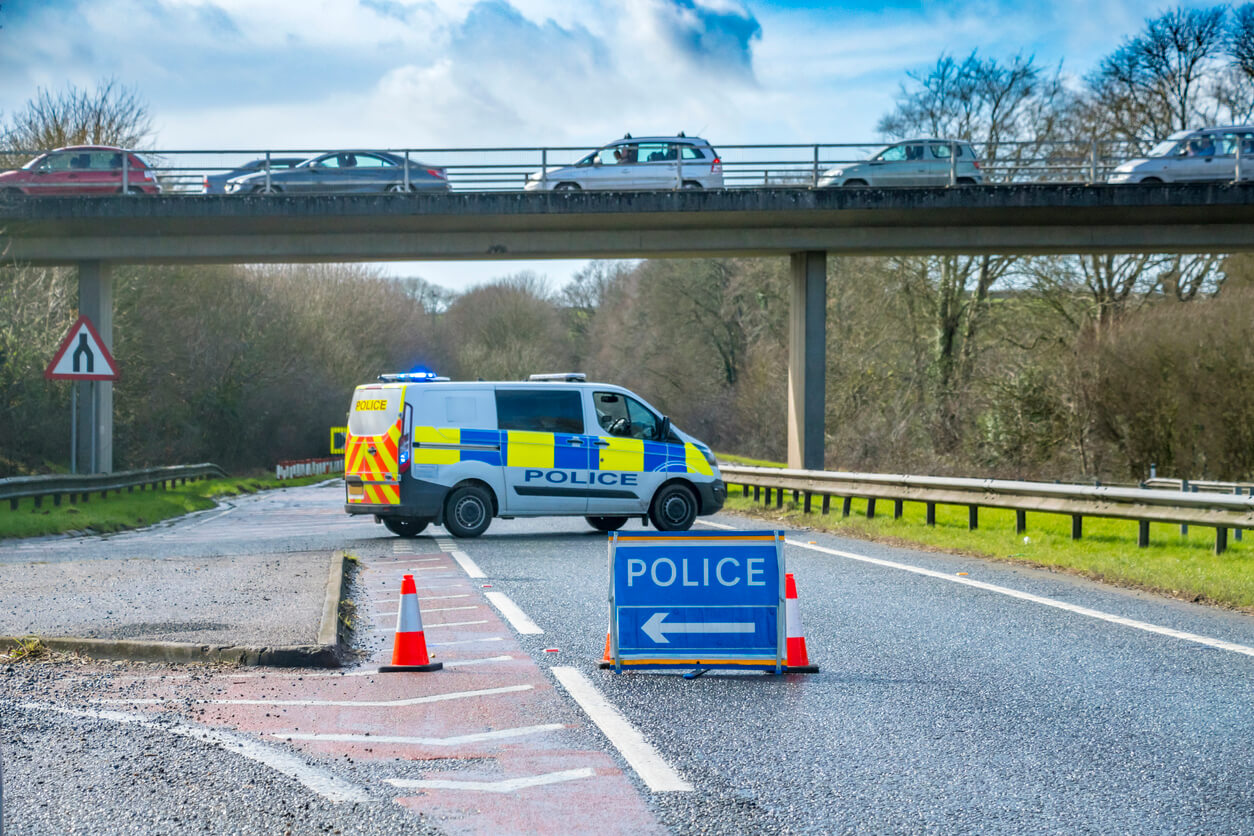
THE RUNAWAY CAR CAME OVER THE HILL ............... etc

Well done the police for stopping him without causing damage. Al least they got there 3 hours before the RAC . . .

But, he seemed to have had plenty of time for other options, for example switching it off and coming to a halt, using the central barrier to slow him down. Maybe he's just a poor driver.
 
It happened a month ago?
 
Well done the police for stopping him without causing damage. Al least they got there 3 hours before the RAC . . .

But, he seemed to have had plenty of time for other options, for example switching it off and coming to a halt, using the central barrier to slow him down. Maybe he's just a poor driver.


EVs don't have the option to turn off the engine when running. Come to think of it, I'm not sure I can turn mine off when in D and moving. He was lucky that plod were able to get there and bring him to a safe, non damaging halt (and were willing to do so!)
 
EVs don't have the option to turn off the engine when running. Come to think of it, I'm not sure I can turn mine off when in D and moving. He was lucky that plod were able to get there and bring him to a safe, non damaging halt (and were willing to do so!)
I didn't know that. Who would have thought that I have to share the roads with machines that can't be switched off?
Yet another reason to stick with my diesel:)
 
I didn’t know that , I did read that electric vehicles can’t be towed if the battery is completely flat , don’t know if that’s true
 
Everything concerning safety that happens now with vehicles has come about from previous incidents.

A key factor in everything like this is how quickly you react. I would imagine that EV manufactures are looking closely at this incident and what it means for their vehicles.

(I went off looking for a Ford that caught fire. Now I remember it was the Pinto. However before I remembered that, the first 10 search engine responses were all about 100,000s of Ford vehicles recalled because of fire risk. Very recent ones)

Ford Pinto. Google it.
 
An extremely high number of vehicle accidents are down to the driver...................................... nowadays, sensors get all the blame! I recently hired a car with "lane control". It may be able to read lines but it can't read the road. It didn't allow for potholes, cars parked half on pavements, adverse camber etc., etc. I did not like the machine being in control!
 
I didn't know that. Who would have thought that I have to share the roads with machines that can't be switched off?
Yet another reason to stick with my diesel:)


Just had a look and eventually found out that I CAN turn my (Diesel) car's engine off when moving but then lose all assistance with steering, braking etc..

Years ago, a friend had a van which shed a rear wheel but not completely - the half shaft kept the corner up. The problems were that it was an old van so had a single circuit braking system so with one set of shoes flapping in the wind, he had no brakes and the lack of drive to the errant wheel meant no engine braking either. He managed to bring it to a full stop by reversing it into the Armco when it drifted to a halt on a slight uphill.
 
I didn’t know that , I did read that electric vehicles can’t be towed if the battery is completely flat , don’t know if that’s true
Some can, some can't - like pretty much everything :) Also, on many EVs the 12 v battery is surprisingly important. It should never go flat since it can be charged from the HV system but if it fails then lots of things don't work. But then, when one failed on my Saab I couldn't move it off the drive.

My mother had a Daf 44 in the 70s (#spoiler a good candidate for the worst car I've ever been in) and that couldn't be towed because of its "innovative gearbox".
EVs don't have the option to turn off the engine when running. Come to think of it, I'm not sure I can turn mine off when in D and moving. He was lucky that plod were able to get there and bring him to a safe, non damaging halt (and were willing to do so!)
He was lucky they were around and helpful. The story is quite odd though - he describes a "runaway" speed of 30mph but the police describe it as "a low speed". It's a curious case of role reversal :)
 
EVs don't have the option to turn off the engine when running. Come to think of it, I'm not sure I can turn mine off when in D and moving. He was lucky that plod were able to get there and bring him to a safe, non damaging halt (and were willing to do so!)

Is because they don't have an engine to turn off :) I've never had to try but I'm sure you can cut the power via the ignition/power switch if you need to.
 
EVs with a power switch you can push and hold power button in to force it off.
Usually you can pop them into neutral.
There's also option of holding EPB button on to force braking.

You can also usually hold P button in to force braking too.

Policeman got in and stopped it so driver was likely a muppet somehow.
 
To be fair I've had a diesel automatic where the ignition was stuck on & the gear selector was stuck in drive. Ok I could stop it but couldn't apply the parking brake nor leave the car because as with most automatics they creep when you take your foot off the footbrake.

Full tank of fuel. Eventually called a neighbour to clamp the fuel hose to stop it.
 
Crumbs, setting aside any Muppetry by the driver it surely is important that buyers of EVs (all unfamiliar types) get instructions and shown how to control things

At a tangent and IIRC my dad's old FX3 (might have the FX2) diesel taxi needed 30 seconds of heater plugs every day in the winter. But of relevance to the stopping.......you could turn off the ignition and the engine still ran but to stop the engine IIRC there was a switch/control to flood the engine and stopped it. NB thinking back, surely not flooding the engine with fuel.....but perhaps a (mechanical?) fuel 'stop' ???
 
My old S 2a Diesel LandRover had a mechanical fuel stop. Probably a similar system to the FX taxi (IIRC, they shared an engine).
 
Is because they don't have an engine to turn off :) I've never had to try but I'm sure you can cut the power via the ignition/power switch if you need to.

Gave it a try today, will not switch off with a short press of the power button if the car is moving.
 
Gave it a try today, will not switch off with a short press of the power button if the car is moving.
I mean, you'd really hope not.....if it did you'd immediately lose drive, power steering, brake assist and regen braking at least.

Many cars don't even have an off switch - my ancient Tesla has one buried somewhere in the menus and it turns "on" when I sit in the car and press the accelerator or brake. I drove a Polestar the other day and it doesn't have any sort of switch - get in, drive, get out. I didn't ask how to switch it off because, why would I?

It's interesting that many of the side effects (I'd almost call them drawbacks) of an ICE car have morphed over the last 100 years into "can't love without benefits"
  1. They make a lot of noise which wastes power
    We LOVE noise! Louder = better. Also, noise = safe.
  2. They generate a lot of heat which is basically a waste of fuel
    Look at EV drivers shivering! Glad my car is toasty without having to run the heater - in the summer I can run cooling!
  3. They have complex engines that in many cases can't easily be stopped and started*
    Check out my new Greentech stop start technology. I won't kill pedestrians in traffic jams any more.
  4. You can't fuel them at home
    I love petrol stations! They are so convenient.....
* obviously they can but it takes a little fuel and a lot of battery power so even the newest have a limited number of times they can turn the engine back on. And to be clear, it's a *really* good idea to be able to turn the engine off if one of the things that engine does is pump volatile fuel around a system made of hot metal.

 
Everything concerning safety that happens now with vehicles has come about from previous incidents.

A key factor in everything like this is how quickly you react. I would imagine that EV manufactures are looking closely at this incident and what it means for their vehicles.

(I went off looking for a Ford that caught fire. Now I remember it was the Pinto. However before I remembered that, the first 10 search engine responses were all about 100,000s of Ford vehicles recalled because of fire risk. Very recent ones)

Ford Pinto. Google it.
I don't need to Google it, I'm old enough to remember it!
The Pinto used to either explode or catch fire if someone hit it in the back, because they put the petrol tank in the wrong place. The manufacturers decided that it made commercial sense not to modify it, and to pay compensation when sued instead, because it would cost them less.

Ralph Nader wrote his famous book "Unsafe at any speed" about the general lack of safety interest by various US car manufacturers. From memory, he was shot at, bombed, had cars driven at him and similar, but the car manufacturers couldn't even murder him . . .
I mean, you'd really hope not.....if it did you'd immediately lose drive, power steering, brake assist and regen braking at least.

Many cars don't even have an off switch - my ancient Tesla has one buried somewhere in the menus and it turns "on" when I sit in the car and press the accelerator or brake. I drove a Polestar the other day and it doesn't have any sort of switch - get in, drive, get out. I didn't ask how to switch it off because, why would I?

It's interesting that many of the side effects (I'd almost call them drawbacks) of an ICE car have morphed over the last 100 years into "can't love without benefits"
  1. They make a lot of noise which wastes power
    We LOVE noise! Louder = better. Also, noise = safe.
  2. They generate a lot of heat which is basically a waste of fuel
    Look at EV drivers shivering! Glad my car is toasty without having to run the heater - in the summer I can run cooling!
  3. They have complex engines that in many cases can't easily be stopped and started*
    Check out my new Greentech stop start technology. I won't kill pedestrians in traffic jams any more.
  4. You can't fuel them at home
    I love petrol stations! They are so convenient.....
* obviously they can but it takes a little fuel and a lot of battery power so even the newest have a limited number of times they can turn the engine back on. And to be clear, it's a *really* good idea to be able to turn the engine off if one of the things that engine does is pump volatile fuel around a system made of hot metal.
All very interesting, you obviously know a lot about it.
But any ICE car can be switched off in an emergency, and when left in gear not only will engine braking stop it (slowly), but servo brakes and power steering will still work. Not perhaps a complete answer, but far better than an electric car that cannot be overridden at all by the driver.

Even if there is, buried deep within a sub-menu, some way of switching off an electric car, there will be no time to read the instruction book and then try to find the well-hidden control in an emergency - nothing can beat turning off a key and leaving it in place!
 
Key? My car doesn't have an ignition keyhole! There is a key which unlocks the boot or the passenger door but no ignition keyhole.
 
Key? My car doesn't have an ignition keyhole! There is a key which unlocks the boot or the passenger door but no ignition keyhole.
I've often been puzzled by the various noises ice cars make when they are "off". The engine may not be running but many of their systems are certainly live.

I'm wondering if one of these stop start cars could malfunction and restart itself.

ETA: just googled it. Apparently they do. A lot. Yikes.
 
Last edited:
Key? My car doesn't have an ignition keyhole! There is a key which unlocks the boot or the passenger door but no ignition keyhole.
But presumably there's a way of switching the ignition off?
I've often been puzzled by the various noises ice cars make when they are "off". The engine may not be running but many of their systems are certainly live.

I'm wondering if one of these stop start cars could malfunction and restart itself.

ETA: just googled it. Apparently they do. A lot. Yikes.
Mine never has. It will re-start itself if rolling downhill, for example if I stop in traffic pointing downhill it will restart the engine if I release the brake and allow it to roll forwards, removing the need to depress the clutch to re-start the engine, but it's designed to do that.

Personally I'm not convinced about the efficacy of stop start - it produces lower emission figures and does produce some fuel saving but it requires a much more expensive battery and also wears the starter motor, and - in theory at least - can discharge the battery.
 
But presumably there's a way of switching the ignition off?

Mine never has. It will re-start itself if rolling downhill, for example if I stop in traffic pointing downhill it will restart the engine if I release the brake and allow it to roll forwards, removing the need to depress the clutch to re-start the engine, but it's designed to do that.

Personally I'm not convinced about the efficacy of stop start - it produces lower emission figures and does produce some fuel saving but it requires a much more expensive battery and also wears the starter motor, and - in theory at least - can discharge the battery.
If the engine didn't restart there would be no power assistance for the brakes or steering, likewise an engine stop fault can make it very difficult to steer to the side of the road!

IMHO stop start is very unsafe when emerging from busy junctions in an automatic

There would be more chance of saving the planet if we gained efficiency by going back to smaller lighter cars, although there's little chance of the world saving CO2 while losing the energy already locked in the concrete being destroyed daily
 
If the engine didn't restart there would be no power assistance for the brakes or steering, likewise an engine stop fault can make it very difficult to steer to the side of the road!

IMHO stop start is very unsafe when emerging from busy junctions in an automatic

There would be more chance of saving the planet if we gained efficiency by going back to smaller lighter cars, although there's little chance of the world saving CO2 while losing the energy already locked in the concrete being destroyed daily
Why do you say this? If the car is in gear then both brakes and steering power assistance is maintained, regardless of whether or not the ignition is switched on. This applies with both petrol engines, which get the power from inlet manifold depression, and with diesel, which has a separate but linked pump.
 
I was highlighting a situation where the car was coasting out of gear with the engine not running. Many years ago when we had traffic police, the night shifts would have competitions to see who could coast the furthest down a local hill.
 
There would be more chance of saving the planet if we gained efficiency by going back to smaller lighter cars, although there's little chance of the world saving CO2 while losing the energy already locked in the concrete being destroyed daily
This.

Just been to a city centre car park, parked up with loads of space. When I came back there was a tank on each side, with squeezing room to get into my car ( and theirs). Having another look at them, they were actually quite 'small' models, not outrageous Chelsea tractors.
 
I was highlighting a situation where the car was coasting out of gear with the engine not running. Many years ago when we had traffic police, the night shifts would have competitions to see who could coast the furthest down a local hill.
And if a member of the public was to do that they would be prosecuted . . .
 
If the engine didn't restart there would be no power assistance for the brakes or steering, likewise an engine stop fault can make it very difficult to steer to the side of the road!

IMHO stop start is very unsafe when emerging from busy junctions in an automatic

There would be more chance of saving the planet if we gained efficiency by going back to smaller lighter cars, although there's little chance of the world saving CO2 while losing the energy already locked in the concrete being destroyed daily
Smaller, lighter, older cars aren’t automatically better for emissions. I get 50% more mpg (and lower emissions) from my 3 litre diesel than I got from my old petrol mini and the difference in comfort and performance is massive.
 
Smaller, lighter, older cars aren’t automatically better for emissions. I get 50% more mpg (and lower emissions) from my 3 litre diesel than I got from my old petrol mini and the difference in comfort and performance is massive.
How does it stack up when compared with resources use for manufacture, damage to road surfaces, creation of tyre and brake residue, the need for more space for parking and manouvering?

Also, if the efficiencies in the big car were put into the small one, how much more efficient would it be?
 
Back
Top