The logic of high MP and cropping photos?

LancsMak

Suspended / Banned
Messages
170
Edit My Images
Yes
Ok, so looking to test my thinking with the collective knowledge and experience on here. To say I've become infatuated with photography over the last year would be a gross understatement, and I'm giving serious consideration to having a two-camera setup for sports events. The question is whether my reasoning is sound....

- Currently a Canon M50 Mk2 with a f2.8 70-200 Mk2
- Debating getting a Canon R5 and adding a 24-70 to the mix. I'd swap the lenses over though and run the 70-200 on this mostly.

What's my logic?

Hopefully the split between the 24-70 and 70-200 is self explanatory in terms of being able to just switch as I need. The rationale for larger MP and cropping is that I often shoot down at f2.8 (or 3.2 if I can to minimise softness / still keep a fast aperture) due to indoor lighting. At best I'm after shutter speeds of 1/800 panning or 1/1600 headshots. So rather than a close-zoomed shot at 20MP with a very very shallow DoF (I manage this maybe 50% of the time, the rest are binned) my thinking is a wider shot at 45MP with a deeper DoF and then cropping down.

Smart thinking, or utter rubbish?

Thanks in advance.
 
Ok, so looking to test my thinking with the collective knowledge and experience on here. To say I've become infatuated with photography over the last year would be a gross understatement, and I'm giving serious consideration to having a two-camera setup for sports events. The question is whether my reasoning is sound....

- Currently a Canon M50 Mk2 with a f2.8 70-200 Mk2
- Debating getting a Canon R5 and adding a 24-70 to the mix. I'd swap the lenses over though and run the 70-200 on this mostly.

What's my logic?

Hopefully the split between the 24-70 and 70-200 is self explanatory in terms of being able to just switch as I need. The rationale for larger MP and cropping is that I often shoot down at f2.8 (or 3.2 if I can to minimise softness / still keep a fast aperture) due to indoor lighting. At best I'm after shutter speeds of 1/800 panning or 1/1600 headshots. So rather than a close-zoomed shot at 20MP with a very very shallow DoF (I manage this maybe 50% of the time, the rest are binned) my thinking is a wider shot at 45MP with a deeper DoF and then cropping down.

Smart thinking, or utter rubbish?

Thanks in advance.
Personally I would use the lens on the body that gave me the framing that I wanted. I don't use megapixels as a form of zoom.
 
my thinking is a wider shot at 45MP with a deeper DoF and then cropping down
It doesn't work that way.
Depth of field is how sharp an image appears to be... and a very significant factor in that is magnification; more-so than the aperture chosen. The greater the magnification, the more apparent flaws are, and the less DoF there is.

It does not matter what causes the increased magnification; it can be due to using a longer lens, having a shorter subject distance, using a crop sensor, cropping the image in post, or viewing the output image from a shorter distance... they all cause the same reduction in DoF, and to the same degree.

Likewise, image noise/light is really only about light per image area (total/remaining)... pixels/MP (magnification) really only determines how well you can see it. So collecting more light by using a wide aperture w/ a larger sensor will do you no good if you discard the additional light in post (crop away extra image area/light).


There are two areas where the larger sensor/higher resolution w/ a wider lens may help some. The first is depth of focus; which is the sensor side factor of depth of field... basically, more details will be presented as more in-focus to the sensor which can make AF faster and more accurate at a coarser level (but smaller details may be too small to focus on).

And more sensor resolution IS more image resolution; just like using a sharper lens can be (that's assuming the lens can resolve to the higher level and the lower resolution sensor wasn't utilizing it fully). But since the APS camera in this comparison actually has greater pixel density, this isn't a factor. And both cameras in this comparison have pixel densities great enough to demand the very best lenses and technique to take full advantage of it... in most situations and with most lenses you won't be able to.
 
Last edited:
If you have room to move further back from the subject then your dof will increase and you can keep the longer focal length (although the spatial relationship between objects will change).

Alternatively, decrease the aperture and increase the ISO accordingly, if the noise can be controlled?
 
R5 is a very good mirrorless camera with a fast read out sensor and combine with a one of the best Eye AF systems ( i think mayby the Sony A9ii my be better ) ideal for sports, inside or out !
Very expensive compared to M50ii, R*, R7 though !

Not sure what you mean by Eye AF here so just to clarify for the OP, the R5 focus system has eye tracking (Can track a subjects eye) but not Eye control AF (Camera focuses where you look)
 
Smart thinking, or utter rubbish?
I think it's an approach that might work but it will depend on what the pictures are for and who will decide on their "goodness".

Be wary of anyone making proscriptive claims on "image quality". Remember that one of the most used pictures of World War Two is Robert Capa's image of soldiers coming ashore at Normandy. It's grainy, smeary and probably out of focus but still one of the classics... https://www.standard.co.uk/futurelo...y-at-imperial-war-museum-london-a4160851.html
...it's been published thousands of times and continues to earn fees.

So the very first question to ask yourself is "why am I taking these pictures?" Once you have an answer to that you can then decide what approach will be most appropriate.
 
So the very first question to ask yourself is "why am I taking these pictures?" Once you have an answer to that you can then decide what approach will be most appropriate.

Nice question, I like that, thank you.

These are memories and trophies for owners racing their animals, for teams remembering competitions together, for heartfelt mementos and proud pictures on walls at home. Alongside that of course is the fact that the majority of consumption will be phones and tablets, then computer screens/wallpapers, and a relative minority going to print.

Personally, I'm doing it for the challenge, the enjoyment of photography, and the buzz I get when a picture I've taken makes somebody smile or laugh.
 
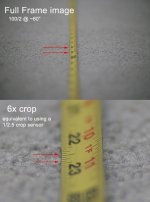
I have this image in a post about this topic on may facebook page; I don't know how to link directly to the post: https://www.facebook.com/ThePhotographicAcademy

It shows how cropping reduces the DoF in the viewed image...the linear depth of what appears acceptably sharp. But if you notice, the percentage/area of the viewed image that appears acceptably sharp remains the same... that's because the depth of focus recorded does not change (what is being magnified).

If you understand/accept that in this respect there is no difference between cropping in post vs using a crop sensor, then any DOF calculator will give you the same results numerically.

DoFcrop.jpg
 
Not quite so technical as the above but I find it better to have some overlap on my zooms' ranges.
I normally carry an 18-105 and a 70-300 so that I reduce the number of times that need to swap lenses.
With a 24-70 and a 70-200 you will need one lens for say 85 and the other lens for say 65.
 
Not sure what you mean by Eye AF here so just to clarify for the OP, the R5 focus system has eye tracking (Can track a subjects eye) but not Eye control AF (Camera focuses where you look)
Yes, I do mean Eye AF tracking.

I believe only the canon R3 has eye recognition to focus on to a subject to start in camera object tracking.
 
I have this image in a post about this topic on may facebook page; I don't know how to link directly to the post: https://www.facebook.com/ThePhotographicAcademy

It shows how cropping reduces the DoF in the viewed image...the linear depth of what appears acceptably sharp. But if you notice, the percentage/area of the viewed image that appears acceptably sharp remains the same... that's because the depth of focus recorded does not change (what is being magnified).

If you understand/accept that in this respect there is no difference between cropping in post vs using a crop sensor, then any DOF calculator will give you the same results numerically.

View attachment 394568

Interesting. So purely because you're looking more closely at the image you're now able to see some small elements that looked in focus are actually not adequately in focus to be acceptable when enlarged.

Destroys my thinking of shooting at shorter focal length and cropping... Just be the benefit of zoom lens and full frame light transmission then.
 
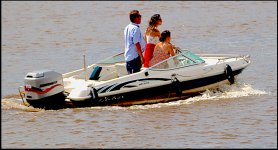
If it's of any help in forming your opinions, this is roughly a quarter of the frame from a Nikon D600 (so roughly 6MP) through the Tamron 28~300mm at 300mm...

Small power boat passing Topsham Quay D600 210714_4853.JPG

...to me it looks acceptably sharp but others may not find it so. The question you need to consider here is: do you find it sharp enough for what you want to achieve or would you want more detail?
 
If it's of any help in forming your opinions, this is roughly a quarter of the frame from a Nikon D600 (so roughly 6MP) through the Tamron 28~300mm at 300mm...
If that is 1/4 of a D600 sensor it would be ~ 1.5 MP (.25hx.25w); and as posted here it is just under 0.4 MP.

The question is not whether cropping from a larger high resolution sensor is viable... it certainly can be. The question is whether it provides any benefit compared to using a smaller high resolution sensor (and it does not).
 
Interesting. So purely because you're looking more closely at the image you're now able to see some small elements that looked in focus are actually not adequately in focus to be acceptable when enlarged.

Destroys my thinking of shooting at shorter focal length and cropping... Just be the benefit of zoom lens and full frame light transmission then.
Correct, no image is perfectly in focus... there is always a level of detail at where an image is not sharp/resolved. DoF is just a matter of whether or not that is apparent to you in the way the image is being viewed.

Also note that a deeper DoF gives you a larger depth/area with a larger qtty of larger details considered acceptably in focus. But the smaller details that are actually in focus at the focal plane are lost (too small to see).
In contrast, a shallower DoF (greater magnification) gives you a smaller depth/area with a smaller qtty of smaller details considered acceptably in focus. More of the smaller details at the focal plane become visible, and the larger details away from the focal plane become unacceptably sharp.
 
Last edited:
If that is 1/4 of a D600 sensor it would be ~ 1.5 MP (.25hx.25w); and as posted here it is just under 0.4 MP.
The original file records the output from 24 million pixels. I cut out roughly one quarter of the area, hence 6 million pixels. I then reduced it to fit within the constraints of the site with a long side of 850 pixels and as you say, that reduced the displayed pixels to 850 x 459 for a total of 390,150 pixels.

However, the reduced file still gives him some idea as to the effect of cropping on the observed image, which is what I think he's attempting to understand.

The question is not whether cropping from a larger high resolution sensor is viable... it certainly can be. The question is whether it provides any benefit compared to using a smaller high resolution sensor (and it does not).
From what LancsMac has written, I think he's trying to decide on the practicality of cropping versus a longer lens. It seems to me that showing an example is called for in this sort of discussion, a picture being worth the proverbial 1,000 words.

Only he can decide whether, in terms of his needs, this shows any benefit from one of the alternatives.
 
For sport I use a combination of a full frame camera and a crop sensor camera.

Also given the option of cropping an image further or using a teleconverter, I tend to crop the image - sometimes the compromises that a teleconverter brings with focus speed / accuracy and image quality is not worth it.

When a DSLR was producing images of 8 - 10Mp, I didn't have that luxury, but now cameras are in the 20-30+ Mp, there is a lot more leeway in being able to crop and still have an image that could be blown up to an enormous print if required.
 
Last edited:
@LancsMak Let’s forget the bit where you’re overthinking DoF etc.
as soon as you pick up the R5 the M50 will be a major disappointment you’re never going to use again.

Two R6’s are definitely a better bang for your buck than 1 R5 if you have a need for 2 bodies. And a 1.4 TC will give you close enough to the crop factor from the M 50. There’s nothing you need from the R5 that the R6 can’t deliver (except megapixels that you were planning to throw away)

Not the question you asked or the answer you were looking for but a better solution to your needs than your proposition.

Or indeed a couple of R7’s and you wouldn’t need the 1.4x
 
Last edited:
@LancsMak Let’s forget the bit where you’re overthinking DoF etc.
as soon as you pick up the R5 the M50 will be a major disappointment you’re never going to use again.

Two R6’s are definitely a better bang for your buck than 1 R5 if you have a need for 2 bodies. And a 1.4 TC will give you close enough to the crop factor from the M 50. There’s nothing you need from the R5 that the R6 can’t deliver (except megapixels that you were planning to throw away)

Not the question you asked or the answer you were looking for but a better solution to your needs than your proposition.

Or indeed a couple of R7’s and you wouldn’t need the 1.4x
If you're going to be using two cameras I'd always recomend two of the same, set up identically...you're always going to have your favourite and end up swapping lenses anyway (Don't ask me how I know!).
I currently use two Fuji XH1's for my gig stuff (Just bought a third! :) ). I know there are now "Better" options but I would have to replace at least two.
 
Thanks all. The M50 was a gift so as it's both a great camera in its own right and also of sentimental significance to me it's definitely staying in my lineup!
 
Thanks all. The M50 was a gift so as it's both a great camera in its own right and also of sentimental significance to me it's definitely staying in my lineup!
Even if you’re certain you’re keeping the M50, two R6’s still make more sense.

As Graham alluded, if you are ‘working’ with cameras, muscle memory plays a big part in how enjoyable or frustrating your working day becomes.

I used to use 2 similar bodies, I was at great pains to set them up in the same way, but there was always a bit of frustration. I went on to buy an M5 for travel and again really tried to set it up to behave like my DSLR’s, but it was never ‘right’, in fact it was ‘terrible’ (a great little camera, but just not snappy enough).

Which leads me to your assumption that you’ll keep the M50. I completely understand the emotional attachment. But once you’ve used an R5, 6 or 7? Genuinely the M50 will frustrate you every time you try to use it.

If you’re wondering how I can be so certain of the above? I’m still the owner of a 20d, 40d, 7d, 6d and M5 along with the R6 (they’re mostly on their way to a dealer).

Every time I go on holiday I wish I was packing the M5; but genuinely the R6 is too much better. At no other time would I rather have any of my previous cameras; they all did a job, they’ve all earned me money over the years, but compared to the R6 they’re all just ‘not good enough’.
 
It would be worth making use of the Canon 48 hour test drives to see how you get on with the different cameras in the range.

My initial thoughts were that you are planning to use the telephoto lens on the full frame camera, and the 24-70 on the cropped sensor camera, neither of which are playing to their strengths. It sounds like you are compromising your future kit, by restricting yourself with your current kit.

For cycling, which is the sport I shoot the most, I find that 70-200 on full frame is the ideal lens, but with motorsport, for example, a longer lens works better. If you are already mostly at the long end of the 70-200, on a cropped sensor camera, you may need to rethink your plans.
 
It would be worth making use of the Canon 48 hour test drives to see how you get on with the different cameras in the range.

My initial thoughts were that you are planning to use the telephoto lens on the full frame camera, and the 24-70 on the cropped sensor camera, neither of which are playing to their strengths. It sounds like you are compromising your future kit, by restricting yourself with your current kit.

For cycling, which is the sport I shoot the most, I find that 70-200 on full frame is the ideal lens, but with motorsport, for example, a longer lens works better. If you are already mostly at the long end of the 70-200, on a cropped sensor camera, you may need to rethink your plans.
Why would you swap the lenses over out of interest?

I rarely go to the full 200, with most of my shots being around the 100-135mm length on the crop body, so I should be OK with the resultant focal length "loss" of ff.


Bit overwhelmed with the amount of feedback and thought in these responses, thank you all very much for taking the time to do this.
 
a great camera in its own right
Not wishing to labour this point but…

If it’s the only camera you’ve ever used; it’s a great little camera.

But once you’ve used an R5 6 or 7 you’ll think of it as an ok spare camera.

Sorry
 
Not wishing to labour this point but…

If it’s the only camera you’ve ever used; it’s a great little camera.

But once you’ve used an R5 6 or 7 you’ll think of it as an ok spare camera.

Sorry
Haha totally get where you're coming from. I've used an old 100D and also a 1DX mk2 before. Fair to say the M50 is the newest/best I've ever owned myself.
 
It might be that I’m old; but 24-70 (or indeed 50mm) lenses on crop are frustrating. 24 isn’t wide enough, 50 is too short for portraits where the 70mm end just about works.
 
Why would you swap the lenses over out of interest?
The cropped sensor camera uses a smaller portion of the image produced by the lens, resulting in a smaller field of view. Generally when you are shooting with a telephoto lens you are trying to achieve a smaller field of view, with the subject filling the frame. And with a wider lens, you want to fit as much into the frame as possible. Hence why 24-70 lenses do not work too well on cropped sensor cameras, and their "standard" lenses seem to be in the region of 16-55.

I image that the M50 would pair well with a small prime as a handy little day to day camera.
 
Thanks all, been a huge amount to mull over from this. I'm moved away from my thinking of high MP and cropping as a result, and am more thinking towards complimentary lens/body setups.

At present I'm thinking M50 (got) with a Canon 17-55 f2.8 EF-S (buy) on Viltrox adapter (got).
Plus R6 MkII (buy) with a Canon 70-200 f2.8 MkII (got) on a Canon RF-EF adapter with control ring (buy).
 
Thanks all, been a huge amount to mull over from this. I'm moved away from my thinking of high MP and cropping as a result, and am more thinking towards complimentary lens/body setups.

At present I'm thinking M50 (got) with a Canon 17-55 f2.8 EF-S (buy) on Viltrox adapter (got).
Plus R6 MkII (buy) with a Canon 70-200 f2.8 MkII (got) on a Canon RF-EF adapter with control ring (buy).
Why wouldn’t you take advantage of the smaller sensor long lens combo?
 
I'm more likely to be using higher shutter speeds/lower ambient light with what I use the 70-200 for, so want the ff sensor for that.
 
What do you mean by harder cropping?
The larger sensor results in a looser composition when used with the same focal length. If that causes you to have to crop the larger sensor down to the same size you loose (discard) all of the larger sensor advantages.

I.e. if you record a lightbulb at a larger size on a larger sensor (same composition) then that IS more light... and that's where the larger sensor's low light/high ISO advantage comes from.
But if you instead record it the same size on the larger sensor (same FL), and crop it to the same composition, then there is no advantage... there was a potential advantage, but you didn't use it and cropped it away.
 
But, and this is where I either validate my thinking or show my ignorance @sk66 (and there is much ignorance to show :-) ) if (on ff body) I use a longer focal length on the lens to achieve the same equivalent focal length as on the crop sensor, then the larger sensor still provides the light advantages? E.g. Shot at 135 on a crop and 200 on a ff.
 
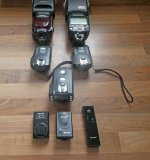
when I use two cameras at once NikonD300/D810 I use A Phottix WXD-188 wireless transmitter sending a signal to two receivers one on each camera.That way both cameras will fire together.
Taking it a stage further by adding Pixel King pro master transmitter and pixel king receiver I can also fire off both cameras and flashguns at the same time.
flashgunsi.jpg

So the Phottix sends a signal to both cameras which then passes onto the pixel Kings master and on the the pixel king slave. this then causes both cameras to take a flash photo at the same time. The great thing about doing this one is not lmited to the number of cameras that can be fired at any one time. Just needs a bit of setting up to work. Range about 100mtr it will work in

different tyhpe of setujp using above

View: https://www.youtube.com/watch?v=oYTF_1W8lPE
 
Last edited:
Back
Top