The correct crop

No comment from about straightening there again I don't have a problem with the angles produced by wide(r) angle lenses. On the crop I am a bit puzzled. If you wanted architectural photography I would like to have seen the base of the building (the ground does not seem to be that far down) whilst that photo would have been fine in a series of photos (from wide to zoomed in) showing the building and its detail.

I am probably missing the point so I will have another coffee.
 
No doubt there was a reason you chose not to include the ground, but if it were me, I would have stood back a bit (assuming there was space to do so) and included the ground level, possibly with a slightly longer focal length lens.
 
As is the case when photographing all buildings where you are not shooting with the camera level to the building you will need to look at applying some keystoning which will help correct the naturally converging lines induced by tilting the camera upwards.
 
I rarely take photos of buildings but did the other day and encountered the same issue as you have. I don't know what editing software you are using, but i used lr to auto correct/straighten (i think it's in the transform tab) and it did a pretty good job.
 
Here's a pretty nasty shot of a church I shot over my shoulder as the bus I was on was passing it -- it nearly took too long to get the camera out.

3684301072_6cc72e8352_z.jpg


Here's the shot after being processed using PTLens to give one point perspective, i.e., all verticals vertical and parallel, and all horizontals horizontal and parallel. Before going to such extremes of perspective adjustment you must correct the residual geometric distortions of your lens, at its focal length if it was a zoom. PTLens does that. Not good photographs, just as an example of how far you can push perspective adjustments. There's at least still a bit of residual uncorrected tilt or something in there, but I couldn't be bothered being finical about it.

3722943265_9d4ca30052_z.jpg


Here is a quick suggestion…


Cliveden%2028-May-17pp.jpg
 
Our eyes expect to see buildings (and other tall things) get smaller towards the top. If you use software to get the verticals all exactly vertical, you run the risk of making the building look top-heavy. It is best to leave a small amount of convergence on the verticals to keep our eyes happy.
 
And in the case of the original image and the one tweaked by Daniel (@Kodiak Qc ) I prefer the original even though Daniel has done a good job with the edit. It just looks as I would expect.
 
Fair points above about keystoning and convergence. Also as said, in this case the building is awkwardly cut off. Not that you should have to include all of a building in a picture, that could be silly, but you do need a sense of composition (framing), irrespective of converging verticals or horizontals.

The funny thing about composition is that you can read about principles and 'rules', but essentially it depends on intuition - a feel for what works and what doesn't. I think this means that it can't readily be taught. It can possibly be acquired (or improved) by studying existing photographs, but overall it's about developing a sensitivity rather than a technique.

Also it's not just to do with shapes within the frame - tonality and focus may also be contributors to a sense of depth and how the picture interacts with the frame that bounds it.

Steve, I've just examined your Flickr and there are some great original and fun shots there, but you are very inconsistent. It's as if you need an editor (or mentor) for what to dump and what to keep. But that person can be you. Keep at it.

 
Last edited:
Steve, I've just examined your Flickr and there are some great original and fun shots there, but you are very inconsistent. It's as if you need an editor (or mentor) for what to dump and what to keep. But that person can be you. Keep at it.

Thanks for the feedback. I agree on the inconsistency. My inner editor is not quite where i want him to be :)
 
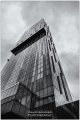
When you look up at a building it 'leans' back and/or inwards due to linear perspective, while wideangles can make this extreme it is a natural effect of looking at something that is parallel and getting further away from you. I don't think there's anything wrong with the OP's photo, whereas the example of correcting verticals looks ridiculous

Imagine how weird it would look of a photo looking along railway lines if they were 'corrected' and didn't appear to be coming together :D

I use the leaning effect all the time in my building photos making it a feature of them rather than a problem, like this one I took yesterday on a walk around Manchester :) Imagine this 'corrected' lol

David Goodier Photography-003 1 - BW Selenium TP WEB.jpg

Dave
 
I think what I am taking from the replies is that the 'lean' is normal


Yes, it is Steve but there are several ways to cope
with it —when the situation permits it, that is.

  • I always shoot much wider so to keep room for PC.
  • I tend to use my 24 PC lens in such case and go
    for stitching if necessary,
Have a good time!
 
I think what I am taking from the replies is that the 'lean' is normal and I should think more on the composition
Photos are pictures. The only real criterion is that they should look good (whatever your 'good' is).
 
Back
Top