
That moment the birds take off...

mani

Suspended / Banned
Messages
470
Name
Imran
Edit My Images
Yes
Now i'm quite keen on getting a nature shot with a bird taking off..

that initial few furious flaps as it takes off.

I've tried a few times and whilst two three times its been timing eg wings not fully extended - the times the wings have been its come out blurry

example
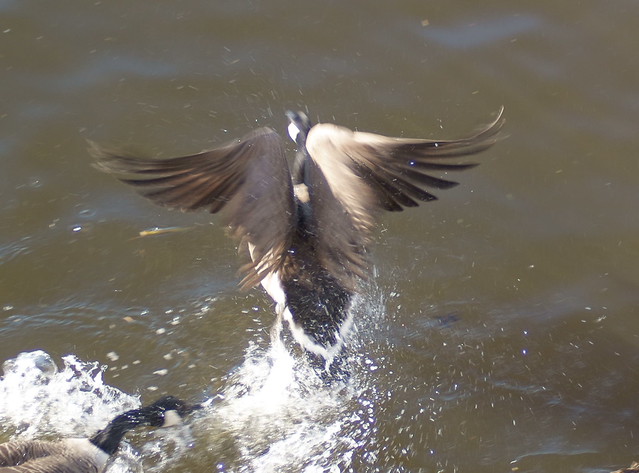
5607621711_6de9c78e59_z.jpg


is it just a case of more practice? faster shutter speed?
 
Anticipating the action and being focus ready(manual maybe?) will help as will a quicker shutter speed. Brace yourself on your elbows, against a tree, etc for an even better chance with less shake blur. And depending on lag, maybe shoot for two hairs earlier. Another trick is to see which is the 'alpha' goose and follow closely rather hunting and reacting.
 
Last edited:
Taken on board.

I think the goose that was chasing the one in the pic was the alpha - this poor thing ran for its life!
 
a faster shutter speed is essential for capturing photos like this, I usually shoot on Auto with the lowest possible F. stop to ensure the highest shutter speed possible, also don’t be afraid of pushing your ISO up to 800 especially if close to the subject because this will allow for and even higher shutter speed, also it is very important to pan with the bird as it moves, this will minimise the burr a lot, it can be tricky when first doing it but become a lot easier to keep the bird in the centre of the frame with practise. one thing that you have to remember is that these photos will always come out better on a bright day because of how much faster you can shoot so don’t be disheartened to quick...

A good way to practise is to take a loaf of bread to somewhere where there are lots of gulls, chuck in some bread and practise shooting and panning as they fly past, you can also get some great shots as they take bread off the surface... plus it’s a hell of a lot of fun...

One other thing that I might recommend, this won't help with reducing the blur but if you get lower down in your shot possibly lying down on your stomach, you can lean on your elbows which will make you steadier but you will be amazed how it can chance the whole look of your picture because you will be on eye level with the subject which makes a massive difference but it also give a better DOF because you’ll be able to see past the bird getting a blurred background, rather than looking down on it, I never thought it would make much difference until I tried it...

I hope this helps, best of luck :)
 
a faster shutter speed is essential for capturing photos like this,

not less than 1/1600 and if you can manage try 1/4000 to see your results and adjust accordingly. AI focus mode will help too. In AI you can lock on the subject not moving and hold half way down, when the subject starts to move the camera changes to servo focus automatically..... Click away
 
Remember that the smaller the bird the faster (normally) the wingbeats. Therefore faster shutter speeds needed

Neil
 
:) thank you for the words guys - really insightful
 
This is where having fast lenses and bodies capable of results with a high ISO setting really does count.

If you have neither, look at the weather forecast before setting foot outside. If there's no chance of bright sunlight forget even trying to get the shutter speed fast enough for freezing the wings. Although a touch of motion blur can be good to emphasise the movement :)
 
Last edited:
Yeah its a bit cloudy today or else the plan was to go to the canal with a few slices and get some shots.

its a very entry level camera i have so though i've not pushed it to that level i doubt it would get the i desire.
 
snipe1.jpg
[/IMG]

This was taken with a Canon 400mm lens at ISO 200, f8 1/400. on a beanbag out of the car window. I had passed it coming n the opposite direction so cruised past it. Set up the beanbag with camer on my lap then turned the car round and cruised back to within range. I got two shots off before it suddenly decided to take off.

I was taken by surprise and just clicked as a reflex. I think I must have nudged the camera because it's not nearly as sharp as it should be.
 
Last edited:
I'm a newbie here and read these comments before heading to the zoo this weekend. As I've only got the kit 18-55 I didn't really have the range to get some great take off shots but got some good in air photo's.

Tried keeping my camera on 1/1000, sometimes having to go up to 1600 ISO as it was cloudy, but got some good shots. When I get home I may resize a few and add them or you can see them on my flickr.

Anyway, just wanted to say thanks to all on this post for the great advice. You'll make a pro out of me soon!!!!

Oh, and little birds are not yet in my talent range yet!
 
very interesting post here ;)
 
snipe1.jpg
[/IMG]

This was taken with a Canon 400mm lens at ISO 200, f8 1/400. on a beanbag out of the car window. I had passed it coming n the opposite direction so cruised past it. Set up the beanbag with camer on my lap then turned the car round and cruised back to within range. I got two shots off before it suddenly decided to take off.

I was taken by surprise and just clicked as a reflex. I think I must have nudged the camera because it's not nearly as sharp as it should be.

Nice shot, I would try and increase your shutter speed to compensate for any spur of the moment shake. 1/400 is probably the minimum (shutter speed on long lens should be at least equivalent to your focal length) you'll get away with in this situation.
 
Nice shot, I would try and increase your shutter speed to compensate for any spur of the moment shake.

Yeah. I reckon 80% of the time exposure choices are a compromise unless the light is perfect for the shot you want. What I had set was good for the shots on the post. and they came out pretty well, the settings just weren't up to flying off which wasn't really the shot I was after.
 
Back
Top