


sk66
Advertiser
- Messages
- 9,557
- Name
- Steven
- Edit My Images
- Yes
First, I'll cover the basics of how I have my Z9 camera set up. To start, the exposure mode is set to either aperture priority (A) or shutter priority (S)... These days I often choose S mode because I am typically using the Z180-600 lens and I'm usually fine with it being set wide open; which is what S mode usually does. And when in S mode the minimum shutter speed for auto ISO is whatever I set with the command wheel. But if I want/need more depth of field, or if I care more about maximum sharpness, I would choose A mode.
The reason I pick the A or S modes is so that I have EASY EC enabled and accessible on the other command wheel. I don't want to be entirely dependent on the metering, and I don't want to have to find a button and then the dial. And because I want Auto ISO enabled. If in A mode it's important to set the minimum SS in the Auto ISO options; and because I am usually using a zoom lens I usually have it set to auto +1 ( 1/(2xFL) ). If I need a specific SS I would select the manual mode and lose Easy EC (e.g. forcing slow SS for panning). The negative of using Easy EC is that it is pretty easy to inadvertently change it, so I see that as more of a trade-off.
And finally, I have it set to highlight weighted metering; which is matrix metering that will purposely underexpose in order to retain smaller areas of highlights. Be aware that it tends to overdo it a bit, so you might want some +EC dialed in by default ( I didn't).
And the point of all of this is to ensure that the camera is automatically protecting highlights by reducing the ISO in order to exploit the Z9's ISO invariance.
This chart shows the Z9's dual gain ISO invariance... kind of.
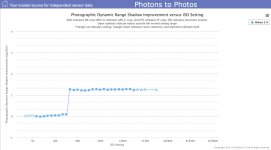
The reason I say "kind of" is because the Z9 (and presumably the Z8) has a quirk where the dual gain switching occurs at ISO 560 when in auto ISO, and ISO 500 when in manual ISO (used for the charts). ISO 560 is not a setting you can select manually, but the camera can select it and report that in the exif.
Here is an example image taken in aperture priority (exif included).
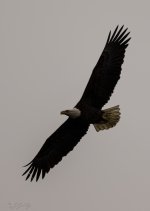
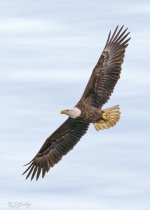
The settings were f/6.3 (wide open), 1/1250 (for motion blur at 600mm), and ISO 72. ISO 72 is almost at base (64), and it is also another ISO that is not user selectable. The feathers on the head are the brightest part of concern and have been protected from clipping. They are actually nearly 1 stop "underexposed," but that doesn't make any difference because it was underexposed using a lower ISO in the ISO invariant range. And ISO isn't light, nor sensor exposure.
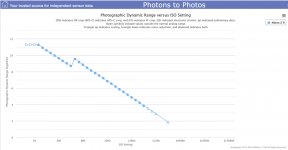
For the Z8/Z9 there is the range between auto ISO 250 and 500 where ISO 560 is actually as much as 1 stop better in reduced shadow noise and dynamic range. But I don't worry about that unless I know I am going to be using elevated ISO's. And in that case I set the minimum ISO to 640 (closest selectable above 560). The problem with setting a minimum (or fixed) ISO higher than necessary is that the camera will actually underexpose the sensor using aperture or shutter speed when the ISO limit is reached; and that's not good. But it's not necessarily worse than letting the camera choose ISO 400... pick your poison.
This is the same image edited in Lightroom Classic, not bad at all. I did use LR's denoise function at 50%; but it probably wasn't necessary for this size web display.
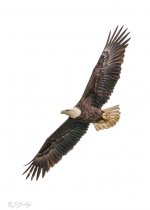
And this is the final image with clouds rendered in Photoshop; I'm quite happy with that.
This method isn't foolproof. If the ISO had reached base (64) and the metering still wanted a lower exposure then the camera would have lowered the sensor exposure using aperture or shutter speed. That's where the EC becomes more important because highlight weighted metering tends to overdo it. But then again, with action photography nothing is ever foolproof.
And this isn't any kind of fix for noisy images. If the aperture and shutter speed means you've collected less light from a dark scene/subject then the result is going to be noisier; nothing can change that fact.
The reason I pick the A or S modes is so that I have EASY EC enabled and accessible on the other command wheel. I don't want to be entirely dependent on the metering, and I don't want to have to find a button and then the dial. And because I want Auto ISO enabled. If in A mode it's important to set the minimum SS in the Auto ISO options; and because I am usually using a zoom lens I usually have it set to auto +1 ( 1/(2xFL) ). If I need a specific SS I would select the manual mode and lose Easy EC (e.g. forcing slow SS for panning). The negative of using Easy EC is that it is pretty easy to inadvertently change it, so I see that as more of a trade-off.
And finally, I have it set to highlight weighted metering; which is matrix metering that will purposely underexpose in order to retain smaller areas of highlights. Be aware that it tends to overdo it a bit, so you might want some +EC dialed in by default ( I didn't).
And the point of all of this is to ensure that the camera is automatically protecting highlights by reducing the ISO in order to exploit the Z9's ISO invariance.
This chart shows the Z9's dual gain ISO invariance... kind of.
The reason I say "kind of" is because the Z9 (and presumably the Z8) has a quirk where the dual gain switching occurs at ISO 560 when in auto ISO, and ISO 500 when in manual ISO (used for the charts). ISO 560 is not a setting you can select manually, but the camera can select it and report that in the exif.
Here is an example image taken in aperture priority (exif included).
The settings were f/6.3 (wide open), 1/1250 (for motion blur at 600mm), and ISO 72. ISO 72 is almost at base (64), and it is also another ISO that is not user selectable. The feathers on the head are the brightest part of concern and have been protected from clipping. They are actually nearly 1 stop "underexposed," but that doesn't make any difference because it was underexposed using a lower ISO in the ISO invariant range. And ISO isn't light, nor sensor exposure.
For the Z8/Z9 there is the range between auto ISO 250 and 500 where ISO 560 is actually as much as 1 stop better in reduced shadow noise and dynamic range. But I don't worry about that unless I know I am going to be using elevated ISO's. And in that case I set the minimum ISO to 640 (closest selectable above 560). The problem with setting a minimum (or fixed) ISO higher than necessary is that the camera will actually underexpose the sensor using aperture or shutter speed when the ISO limit is reached; and that's not good. But it's not necessarily worse than letting the camera choose ISO 400... pick your poison.
This is the same image edited in Lightroom Classic, not bad at all. I did use LR's denoise function at 50%; but it probably wasn't necessary for this size web display.
And this is the final image with clouds rendered in Photoshop; I'm quite happy with that.
This method isn't foolproof. If the ISO had reached base (64) and the metering still wanted a lower exposure then the camera would have lowered the sensor exposure using aperture or shutter speed. That's where the EC becomes more important because highlight weighted metering tends to overdo it. But then again, with action photography nothing is ever foolproof.
And this isn't any kind of fix for noisy images. If the aperture and shutter speed means you've collected less light from a dark scene/subject then the result is going to be noisier; nothing can change that fact.
Last edited:


