Sunny 16 a dry run.

Oldbones

Suspended / Banned
Messages
422
Edit My Images
Yes
I have been reading about this, so today with my DSLR set to manual off I went and gave it a try before I actually do it with film.
Doing this should show me right away if I am getting any thing, as I don't want to take film shots till I am confident that it works.
Can you tell me it I did this correctly.
ISO set to 200
Shutter speed set to 1/200
F stop set to F16
I took a few shots, but it was not a bright and sunny day, so I was doing shots that came out very dark and some were not too bad.
Then to combat that all I did was go from F16 to a lower F stop and this I could see made a difference on the EV meter.
So with adjusting the F Stops I could get thigs to come out good enough.
The SLR has a light meter that works, and that is I think is how to get a reasonable exposure for film.
Set ISO, Shutter Speed and move the F Stops to get a photograph.
Does this sound like the correct way to proceed ?
 
I use sunny 16 a bit.

It seems you are undecided on whether to use sunny 16 or the light meter in your SLR. If it were me and I was confident that the light meter was accurate I would use that. Even better if it has a spot meter.
 
"Sunny 16" is about not using an exposure meter.

A lot more here...

 
Just experimenting as I learn, I am interested in getting a hand held meter, an old one.
So tomorrow I will commit to using a roll of ILFORD HP5 Plus 400, I am going into town, where there is a harbor and cobbled streets so there should be something to look at and photograph.
I will adjust the F stops to suit what I do.
I am only taking one camera, 36 shots.
 
take a bottle of water for the cobbles in case its dry. :)

Have fun!
 
"Sunny, f/16" is pushing it a bit in UK Winter Sun!

Even in Summer, it relies on the latitude of negative films. Handy if using a camera with no metering but at best, only a guideline.
 
In the 1960s, I used the "Sunny 16" rule all the time, because I could buy an exposure meter or film.

I chose the film. ;)
 
I've always found F16 too small an aperture. Even on a very bright day. My digital camera has revealed it to be F11.
 
I've always found F16 too small an aperture. Even on a very bright day. My digital camera has revealed it to be F11.
Likewise. While I don't use Sunny 16 often, I've always considered it to be Sunny 11 in the UK. Sunny 16 is fine in southern Europe, but even the brightest days in the UK are too dim.
 
  • Like
Reactions: Nod
Funny you fellows say that because although the sun was strong and blinding tonight I had to go to lower number F stops right away when I used up the last of my first roll of film.
I am in the NE of Scotland and its dark very early at the moment.
 
Last edited:
The sun is further away at this time of year and the light isn't as bright.

Actually it's currently closer, what it actually is, is a lot lower in the sky (Northern Hemisphere) so the light strikes at a more oblique angle.

The distance of The Sun from Earth is currently 147,553,379 kilometers, equivalent to 0.986333 Astronomical Units.

1 AU is the mean distance to the sun over an orbit... The distance is >1AU in the Northern Hemisphere summer.
 
I just know that at this time of year when its low in the sky its very hard to feel comfortable when walking towards it.
 
"Sunny, f/16" is pushing it a bit in UK Winter Sun!

Even in Summer, it relies on the latitude of negative films. Handy if using a camera with no metering but at best, only a guideline.
Sunny 11 in Lancashire except maybe at the height of Summer.
 
I just know that at this time of year when its low in the sky its very hard to feel comfortable when walking towards it.
Perhaps because of the clearer air, the winter light in Scotland can be very bright, if not warm!

When I first started with a decent camera, I didn't have a light meter for the first 4 years or so. I judged exposure based on the information printed inside the film packets. I think it was basically a version of Sunny 16 specific for that ISO (or rather ASA). f corse at that time I never looked at my negatives, just the 6x4 prints that came back from the chemist. Now I see that quite a lot of them were hopelessly wrong exposures. But still, I had a lot of fun.
 
That's the joy of negatives - there's still a chance to recover bad less than perfect in-camera exposures!
 
That's the joy of negatives - there's still a chance to recover bad less than perfect in-camera exposures!

And the cost of film & processing is a lot cheaper less expensive.
 
I think I'd rather burn my eyes out with a hot poker than rely on sunny 16. Thankfully every film camera I ever had had some way of avoiding using sunny 16.
 
I used to have a Nikon FM2N, a fully manual camera with manual lenses. Whenever I went out (usually with a 50mm f2 attached), I would set the shutter speed to 250th, aperture to f8 and use HP5 B&W film (400ASA); I would set the lens focus to be a little shy of infinity. This way, I could take a sudden shot and still be pretty hopeful that I would get something useable in the camera. Of course, when I had more time to check the setup, I would adjust for the conditions and subject, but for instant point-and-shoot capability, the above settings were pretty good compromise.
 
Well I have been out today to a place in Aberdeen called Footdee (Fitty) and I walked along the beach.
Nikon FG20 B&W film, ISO 400 and shutter speed set to 1/500 of a second.
Just adjusted the F stops to get the meter where I think it should be.
I did not fill the roll but will finish it soon.
But I had a really nice time, just looking at all the shadows created with the very harsh sun today.
I don't have a clue how it went inside the camera, but time will tell.
 
I have been reading about this, so today with my DSLR set to manual off I went and gave it a try before I actually do it with film.
Doing this should show me right away if I am getting any thing, as I don't want to take film shots till I am confident that it works.
Can you tell me it I did this correctly.
ISO set to 200
Shutter speed set to 1/200
F stop set to F16
Those settings would be right for a bright sunny day
I took a few shots, but it was not a bright and sunny day, so I was doing shots that came out very dark and some were not too bad.
Then to combat that all I did was go from F16 to a lower F stop and this I could see made a difference on the EV meter.
So with adjusting the F Stops I could get thigs to come out good enough.
The SLR has a light meter that works, and that is I think is how to get a reasonable exposure for film.
Set ISO, Shutter Speed and move the F Stops to get a photograph.
Does this sound like the correct way to proceed ?
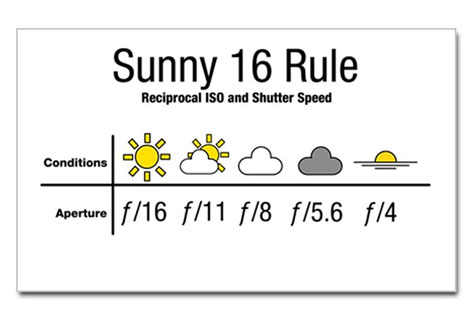
Not a bright sunny day so you need to use the rest of the sunny 16 rule to adjust appropriately..
Adjustments can be made using aperture, or shutter speed or ISO as the subject requires. These values can also be traded (such as shutter faster with aperture wider) without diverging from sunny 16.
 
"Sunny 16" is about not using an exposure meter.

A lot more here...

Spot on :)

It really all boils down to this - if I take a photo, will it come out OK?
Sunny 16 was a guide for the simple box cameras of the day. Aperture (assuming that it even had a lens) fixed at f/16
Shutter speed fixed at 1/100th, or at least at a claimed 100
Iso (OK, ASA back then, or Western), fixed at either 80 or 100

So, given those constraints, Sunny 16 wasn't about working out the exposure, which was fixed, it was a reassurance that, if the sun was shining brightly, the exposure would be within acceptable limits, i.e not too bright and not too dark. It wasn't accurate, but given the very forgiving latitude of B&W negative film and the low public expectations of the day, it was good enough.

The Sunny 16 rule was strongly linked to the standard advice, complete I think with a diagram, printed on every roll of Kodak film, effectively "If the sun is coming from above and behind one of your shoulders then the lighting will be good" - or words to that effect. That lighting would NOT be good for an experienced photographer, but it was pretty much a guarantee that it wouldn't be terrible.

In short, any light meter will do better, and any experienced photographer will do MJCH better, but sunny 16 is better than nothing.
 
May I ask, why are you only adjusting the aperture? And fixing the shutter speed?
Its because I have not a lot of experience or confidence, so I know that if I get the light meter to be around the shutter speed by adjusting the F stop I may get a good image.
Think If I went through a whole roll of film adjusting three things instead of one, I would never really know what adjustment did what.
Next roll of film I may concentrate on shutter speed and see what it does, in sating that I could have done 10 with F stop, 10 with shutter speed and so on.
At this point I really do feel spoiled by digital.
 
Those settings would be right for a bright sunny day

Not a bright sunny day so you need to use the rest of the sunny 16 rule to adjust appropriately..
Adjustments can be made using aperture, or shutter speed or ISO as the subject requires. These values can also be traded (such as shutter faster with aperture wider) without diverging from sunny 16.
It was sunny today, I never had to use F 16, there was a lot of concrete and dark sand etc.
Lots of shadows and all sorts of stuff.
I am enjoying the learning, and I will be sending some film away this week to get done.
 
Its because I have not a lot of experience or confidence, so I know that if I get the light meter to be around the shutter speed by adjusting the F stop I may get a good image.
Think If I went through a whole roll of film adjusting three things instead of one, I would never really know what adjustment did what.
Next roll of film I may concentrate on shutter speed and see what it does, in sating that I could have done 10 with F stop, 10 with shutter speed and so on.
At this point I really do feel spoiled by digital.

Well, really you can only adjust two things not three.

How do you shoot digitally? In Av mode? Or manual?

Is your film SLR a fully manual camera? Or is it an aperture or shutter priority set up? I've had a fully manual Yashica FX3 since the nineties, and about 6 years ago I picked up a Canon Av-1 because I had a bunch of FD primes I was using on my Sony A7. I thought being an aperture priority set up that it would be quicker & easier to use but after a couple of rolls I sold it on because I preferred the FX3 :ROFLMAO: The Canon was also a bit heavier & felt bulkier.....
 
Actually it's currently closer, what it actually is, is a lot lower in the sky (Northern Hemisphere) so the light strikes at a more oblique angle.

The distance of The Sun from Earth is currently 147,553,379 kilometers, equivalent to 0.986333 Astronomical Units.

1 AU is the mean distance to the sun over an orbit... The distance is >1AU in the Northern Hemisphere summer.

It might be nearer for those in the equatorial regions and southern hemisphere. But for us northeners it is further away.
 
The earth is of the order of 8000 miles diameter - the difference in distance to the sun is up to a couple of million miles between (nearest) aphelion (July) & (farthest) perihelion (Jan)

They're not of the same order of magnitude.
 
Last edited:
Well, really you can only adjust two things not three.

How do you shoot digitally? In Av mode? Or manual?

Is your film SLR a fully manual camera? Or is it an aperture or shutter priority set up? I've had a fully manual Yashica FX3 since the nineties, and about 6 years ago I picked up a Canon Av-1 because I had a bunch of FD primes I was using on my Sony A7. I thought being an aperture priority set up that it would be quicker & easier to use but after a couple of rolls I sold it on because I preferred the FX3 :ROFLMAO: The Canon was also a bit heavier & felt bulkier.....
Digitally I shoot with aperture priority.
My SLR is equipped with aperture priority, but I have been using manual.
Mabey I should use the aperture priority !
 
Why ever not?

Exposure is a game of two halves. The first is to get a negative that will give the best possible print. The second is to get either the depth of field you want (select aperture)
or control the degree of subject movement (select shutter speed).

If built in meters didn't get the first right almost every time, they wouldn't be so prevalent. Yes, there are times when you have to override the meter, but if you're at a stage where sunny 16 is the best you have, you aren't sufficiently experienced do it.

My advice is to go fully auto exposure until the results are no longer good enough.
 
Exposure is a game of two halves. The first is to get a negative that will give the best possible print. The second is to get either the depth of field you want (select aperture)
or control the degree of subject movement (select shutter speed).
Yes, entirely!

But the trouble with meters is that apart from reading the light, they're not intelligent enough to interpret it. I'd only advocate full auto to a simpleton, & I don't think Oldbones is that.

Mabey I should use the aperture priority !
Yeah, go for it! As long as the prime subject isn't something in motion (in which case it would be shutter priority, as Stephen said above).

Whatever the exposure mode chosen, any failings of automation are going to be the same - but see below ...

Digitally I shoot with aperture priority.
Combine that with exposure compensation - not always, but when you think it might be necessary. Which could mean when you think there are significant highlights that are going to get blown out (of tone & detail), because such soon makes for not just an incompetent picture, but an ugly one. It's a judgement to think about. The exercise is to see light analytically, how it impinges & reflects within the picture frame, & how it might record on the chosen medium. It's about learning to see light as film, or a sensor, does.

Neg film is pretty lenient, exposure-wise. Slide film is the opposite. Digital is more allied to the last in principle, but gets more forgiving all the time as the tech advances.

There are so many conditions of light. The more contrasty the light, the tougher the exposure dilemmas become.

We may often wing it, but the more tutored the winging is, the better chance of a good result.

Long live modern cameras with a live histogram in the evf - but many of us managed before for years without that convenience!
 
Last edited:
With a dslr & average metering, & no chimping to check exposure, I would commonly dial in exposure compensation to minus one stop as a default to cover eventualities. This was to prevent the above-mentioned blown highlights. Occasionally you'd have up that, but hopefully you'd do that by judging the scene. Luckily in either case, with many a modern camera, you can up the shadows & mid tones later with little detriment, as you adjust the tones in post processing. For the sort of work I'm talking about, you'd have shot RAW in any case to enable the greatest latitude in all this.

I'm not talking about studio work, but about ambient light photography, usually outdoors & done opportunistically as the mood impinged.

And of course there'd be circumstances where you wouldn't stop down to cover yourself as above, but you'd open up (the exposure) instead (prime example - snow scenes).

It's all a mechanical process - I don't think it's at all intuitive, but if you want to make pictures it's worth making your best stab at it.

And hopefully it won't detract too much from the main process of picture making which can be intuitive and involve framing, tonal distribution, what's in focus & what isn't, & the whole organisation of the picture space.
 
Yes, entirely!

But the trouble with meters is that apart from reading the light, they're not intelligent enough to interpret it. I'd only advocate full auto to a simpleton, & I don't think Oldbones is that.


Yeah, go for it! As long as the prime subject isn't something in motion (in which case it would be shutter priority, as Stephen said above).

Whatever the exposure mode chosen, any failings of automation are going to be the same - but see below ...


Combine that with exposure compensation - not always, but when you think it might be necessary. Which could mean when you think there are significant highlights that are going to get blown out (of tone & detail), because such soon makes for not just an incompetent picture, but an ugly one. It's a judgement to think about. The exercise is to see light analytically, how it impinges & reflects within the picture frame, & how it might record on the chosen medium. It's about learning to see light as film, or a sensor, does.

Neg film is pretty lenient, exposure-wise. Slide film is the opposite. Digital is more allied to the last in principle, but gets more forgiving all the time as the tech advances.

There are so many conditions of light. The more contrasty the light, the tougher the exposure dilemmas become.

We may often wing it, but the more tutored the winging is, the better chance of a good result.

Long live modern cameras with a live histogram in the evf - but many of us managed before for years without that convenience!
Yes thank you so much for telling me all of this, it may take some time for it all to sink in and work for me..
I do find my self looking for light when once about a year ago I never did that..
Composition, well that's a great thing, and I have learned a bit over time, and again about a year ago I just was a point and shoot person, but I try and find a better angle or situation before I actually take the shot. There are some shots I want to take again !
Slowly I am beginning to understand what a camera is actually doing. And I understand that I have to control it and not the other way round
In saying that when I do get to a venue to take shots, my mind sometimes goes blank, it is like not knowing where to start.
Yesterday was lovely, I went out and watched and tried to learn, I did 13000 steps in the process and only took 26 images. My afterthought was I will go back and do more.
I returned home sort of disappointed that I never shot the whole roll of film, but also very happy that I made the effort.
Yesterday I saw ships, surfers, cyclists, runners, walkers, cold water swimmers, dogs, kids, surf, sand and lots lots more.
Will it be a disappointment when I get the film back, have I became used to the instant gratification and in a way selfish about photography.
Thank goodness there is an internet to discuss this with others. Nowadays the world is a smaller place, I did see a couple of other people out with proper camera gear, thought about talking to them but could not pluck up the courage to do so.
There were loads of people out with phones, some taking photographs, it was amazing.
One thing I did notice yesterday was there was a lot of people on there own, some looked very lonely even when there were hundreds even thousands of people there,
Saw an old lady sitting hugging her dog and crying, I gave her respect and never pointed my camera at her, at least I have learned that much at the end of the day.
 
I would set the shutter speed to 250th, aperture to f8
In summer sunshine and not taken tricky shots, I found say from about 11:am to about 2:00 pm...you can set a manual camera for 1/250 @ f8 for 200 iso, of course if clouds are around it doesn't always work if the sun doesn't shine on the subject :( , so prefer a modern camera set for AV or tv and don't worry.
 
Definitely use the cameras meter, where you have one but as above, understand what will trip it up.

Which is exactly the same as sunny 16 BTW.

F/16 is for midday on the brightest day of the year (and as others have already said, it’s nearer f/11 in the UK).

And the Sunny 16 rule comes with a little table that tries to tell you how many stops away from f/16 you might want to guess. This dismal morning I’d guess that ISO200 and 1/200 might get me about f/2.8, and I’m wrong! I just checked and it’s actually 1.4. :oops: :$

And if we’re just gonna use f16 cos we don’t understand that the f16 was a guide, then what’s the point? All we’ve done is swapped automation that we can learn to control for a manual process we’re not controlling at all.

There is some merit in learning what light levels look like, so you can guess an exposure, but there are far more important skills you can hone that’ll improve your output more dramatically.
 
Knowing the sunny 16 rule is like learning for our multiplication times tables, we dont have to think that 3x4=12 and work it out with a pen and paper or count it on fingers, we just know its 12.

In photography I find it useful to, continuing the analogy, try figure out how we get there - we can have 4x3 or 3x4 if we need a slightly lighter foreground or background for particular shadows by adjusting shutter and speed a stop or so either way. Or we can use 6x2 and 2x6 and make huge differences between speed and shutter to freeze motion or create aesthetic blur.

F16 = 100 iso @ 100 shutter is the start of the logical process to get you what "YOU" want.

And for those who have established sunny 16 usually works out to sunny 11, there is the consideration of the film itself not achieving its rated iso value, we can lose upto a stop to account for the optimism of the manufacturers. Dozens of tests have proven that invariably almost a stop more exposure is required on many films even good ones.
 
Back
Top