Sky blown out

coling

Suspended / Banned
Messages
261
Edit My Images
No
Just returned from a family holiday and obviously lots of pics and test pics. The mian proble I've got is with the sky blown out on lots of pics. Using Canon 450D and 18-55 lens.

Is there a technique to overcome this or is it down to filters. Frustratingly, the wifes point n shoot has plenty of decent snaps with nice blue sky.
 
Dont think its down to you doing anything wrong as such, Sounds like the camera has done its job exposing the forground but on bright days the sky can be a few stops out.

A screw in circular polariser will help bring back the blue sky's
 
I don't think a CP will help that much with blown highlights, will it? A grad filter would but unless you are shooting a see scape or landscape with a level horizon they can be problematic. Best look for a non filter way IMVHO... You could check what your metering mode is set to. I find evaluative most suitable, rather than centre weighted or spot, for almost everything unless I'm shooting something awkward like white flowers.

If you're already set to evaluative you could try metering for the sky but this could mean that you'll have to boost the shadows too much, or, you could try to find a middle ground setting and try to avoid blowing the highlights and boosting the shadows too much.

The good news is that with digital it costs you little to experiment so the best thing you can do is check your camera settings and shoot and see what works best for you.
 
Hotshots said:
Dont think its down to you doing anything wrong as such, Sounds like the camera has done its job exposing the forground but on bright days the sky can be a few stops out.

A screw in circular polariser will help bring back the blue sky's

A polariser is useful but not for this purpose.

As above, you need an ND grad for even exposures.
 
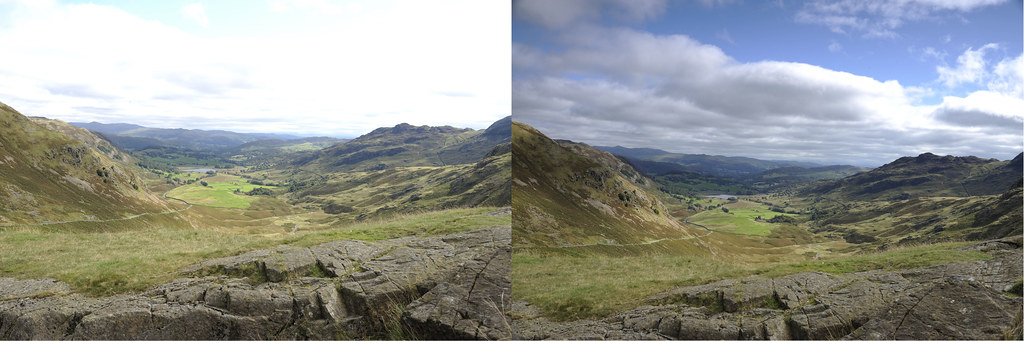
ND Grad - I did a quick comparison a few years ago. Exactly the same (manual) settings for both pictures, taken about a minute apart.

4071940929_de5da95111_b.jpg
 
yeah i use them all the time for holiday snaps of the family, get real!!! i cant remember seeing anyone with a filter holder with grads stuck in it to take snapshots of the family.

A polariser will cut down on glare and reflections and bring back saturation of colours as long as your not using it in direct front or back light where it can have little effect.
 
Trick here is flash....meter the background and fill flash your subject....takes practice and for shutter speeds over 250 you will need high speed sync...this won't work on subjects like buildings or large trees...
 
A polariser will cut down on glare and reflections and bring back saturation of colours as long as your not using it in direct front or back light where it can have little effect.

But that's answering a different question. The op has blown highlights and a CP isn't going to help much with that, if at all.
 
Hotshots said:
yeah i use them all the time for holiday snaps of the family, get real!!! i cant remember seeing anyone with a filter holder with grads stuck in it to take snapshots of the family.

A polariser will cut down on glare and reflections and bring back saturation of colours as long as your not using it in direct front or back light where it can have little effect.

Nice one, give out completely irrelevant advice!

How on earth will it saturate the blue sky's when the camera has blown the sky in the first place?!
 
I had the same problem when I started Photographyt almost 18 months back

I bought a Cokin P series ND Grad kit for around £50, problem now solved

Les :thumbs:
 
RAW + evaluative metering + be aware of shots with a lot of bright sky and dark subjects.

You will be able to recover more using RAW although a complete blow out is a complete blow out!

At least you have blue skies. I am always battling with overcast weather with white skys, have a preference for black and white and use a small sensor camera. I must like making it hard for myself.
 
Last edited:
Didn't see this mentioned but how about taking two exposures (not sure if your camera brackets?) and then combining them in post.
 
If you don't completely blow out the sky then you could bring it back a bit in post processing. For example, using the ND grad filter tool in Lightroom.

As suggested previously if it is landscapes then filters are probably the best bet (or HDR), if it's the family / people then fill flash.

Interesting the point and shoot pictures came out OK though. You say that it produced nice blue skies, but was the foreground not under exposed and dark? I would imagine that the foreground would be exposed better from your DSLR given what you have said.

What mode were you shooting in on your DSLR? Got any pics you can share with EXIF data?
 
yeah i use them all the time for holiday snaps of the family, get real!!! i cant remember seeing anyone with a filter holder with grads stuck in it to take snapshots of the family...

No-one other than you mentioned taking snaps of the family :thinking:

For convenience, I sometimes just hold the filter in front of the lens without a filter holder.
 
I think the best way of improving your photography is understanding the limitations of your camera.

The camera can only capture a certain dynamic range, the difference between the brightest and the darkest parts of the photo. Here are your options

1. Increase the dynamic range of the camera by shooting RAW and using post processing to bring in shadow and highlight detail. Helps but is not a cure all solution.

2. Use HDR to take multiple shots at different exposures and merge them in pp. Helps with landscapes but not with moving subjects like kids on holiday.

3. Use ND grad filters to darken the skies and keep the darker areas unchanged. Works well for landscapes where there is a clearly defined line for the border between bright and dark. Again not a huge amount of good for family holiday snaps.

4. Use flash to lighten the foreground and expose for the sky. Works very well when the sky is not too bright, perfect for sunrises and sunsets, but also other time of the day when the sky is not too bright...
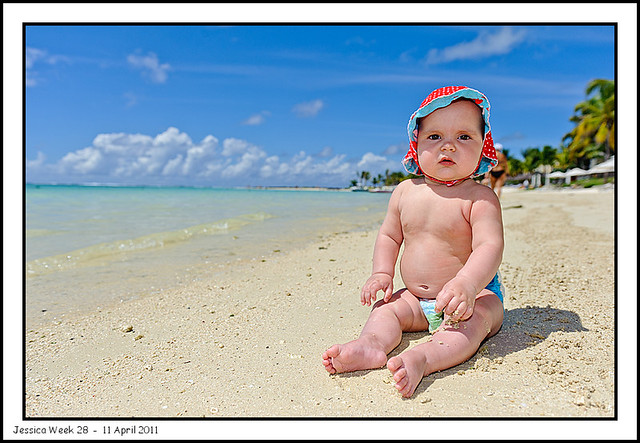

Jessica Week 28 by ShawWellPete, on Flickr


4. Be careful before you take the photo. Shooting a subject close to midday with the sun behind them is just never going to give you a blue sky and a perfectly exposed subject unless you have very powerful lights that can bring the subject up to a similar brightness as the sky. So avoid the sky in the shot and photograph subjects in the shade where the light is soft and flattering. Or use silhouettes for effect. Or choose a scene that is all vey bright and has less contrast between the sky and the ground....
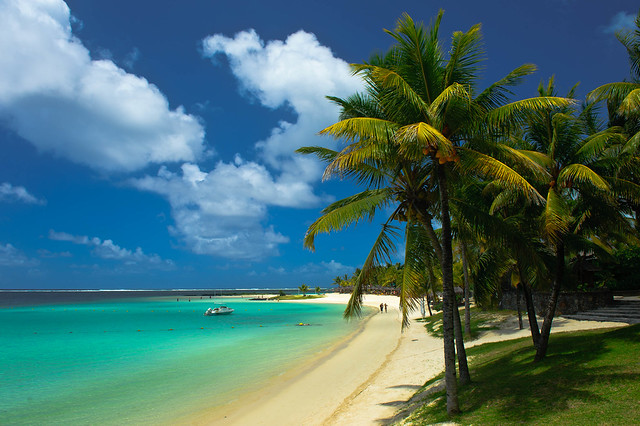

Mauritius at Easter by ShawWellPete, on Flickr

The fun of photography is learning all the options and knowing when is best to use each solution, I have friends who point their camera press the button and expect perfect results every time, unfortunately it doesn't often work!

 
Cheers for info so far.

The main thing is I'm not doing anything drastically wrong other than probably expecting too much from camera.
 
Unless you're shooting once-in-a-lifetime stuff, just bracket either manually or let the came do it for you. Set the bracketing to 2/3rds or so either side and fire off three - one of them will be closer to what you want.

Also, shoot with the highlight clipping turned on the LCD. This will notify you of blow outs....

Personally,I've never ad a problem in just looking at the rear screen, seeing the blown out areas and then reshooting with the right settings.
 
Does that just let me choose from 3 or can i merege them somehow to make 1 best of?
 
If the sky is blue, a polariser will help darken it.

In addition to the suggestions above, I don't think anyone has mentioned the in-camera controls that probably explain why the compact is doing better - they have a lot of in-camera processing applied as default.

With Canons for example, try Highlight Tone Priority and Auto Lighting Optimiser.
 
For high dynamic range situations, you could try pulling back the in-camera contrast setting.
 
Last edited:
I A grad filter would but unless you are shooting a see scape or landscape with a level horizon they can be problematic.

Not at all. A hard edged grad would probably be not ideal but a soft edged grad would help for non level horizons.

The sky is blown as the camera has exposed correctly for the shadows leaving the brighter parts of the image over exposed. A grad filter is the way around this or by taking two exposures (one for the ky and one for the foreground and then blending them in editing) but you'd need software with layers capability and a tripod, ideally.
 
Does that just let me choose from 3 or can i merege them somehow to make 1 best of?

You can pick the best one, or merge two or all three. It's up to you. You also have the option of shooting a couple of images, with one exposed for the sky and the other for the foreground, and merging them, instead of using bracketing. It's a variation on the same technique. This is easier with a tripod to make sure the framing doesn't change, but I daresay you could ballpark it by hand and crop in post processing if necessary.

You will also need software with layers capability to merge the images.
 
Not at all. A hard edged grad would probably be not ideal but a soft edged grad would help for non level horizons.

That'll be a grudging yes to what I said then :)

A soft edged grad could help in some situations but it really depends upon the subject and how the brighter and less bright areas within the image fill the frame. Get a mountain or person or any other object encroaching into the sky and sooner or later your soft edge gets darker. If the sun is low in the sky or image then maybe the soft edge filter would be better employed upside down, but only if you have a reasonably straight transfer from relative light to relative dark. It's not a fix all.

I don't know for sure but I don't think the op would be using a tripod, multiple exposures or layers. My money would be on not.

Personally I'm not a big user of filters these days unless in specific circumstances that suit their use and there must be something pretty basic going wrong here as the Mrs gets good shots and the op gets blown skies. The first thing I personally would check, as I said in my first post, is the metering mode.
 
Last edited:
Agree, the wife's point and shoot must just be using a better metering choice as blown out skies and point and shoots with tiny sensors go hand in hand usually...
 
Wow you guys are complicating things (as per usual)
Also £50 for an nd grad, this guys not ansel Adams so I'm sure a cheaply nd grad would be better for him right now

Your wife's point and shoot is getting better results because it meters for the sky and then brings up the exposure of the ground in camera, your slr expects you to decide which to meter for and then do the processing yourself At home in photoshop, simple as that.

So meter for the sky and then use 'fill light' in Lightroom to bring out detail on the ground. Alternatively take 2 pictures and cut them together. Or use lightrooms nd grad. You've be better spending £50 on a tripod or Lightroom
 
Wow you guys are complicating things (as per usual)
Also £50 for an nd grad, this guys not ansel Adams so I'm sure a cheaply nd grad would be better for him right now

You can pick up an ND Grad off amazon or in Jessops - I'm sure they're about £25. You don't need a holder and all that stuff. I bought all that at first, but then when I improved my lenses to 77mm dia, the small ones didn't fit. Now I bought one larger ND grad and hold it in front of the lens - it doesn't get used all that much as I don't do a lot of landscape except when on holiday ...
 
Your SLR doesn't always expect you to decide any more than the P+S does.

Use evaluative on SLR or P+S and should get similar results. Many P+S have the same metering options too so you could meter for the sky with a P+S too.

More down to how the camera is set and whether the camera operator knows how to use the different metering modes. Maybe the wife is just a more technically aware photographer :eek:
 
coling said:
Cheers for info so far.

The main thing is I'm not doing anything drastically wrong other than probably expecting too much from camera.

From a beginner - ME TOO!!! :/
Well I'm sure I'm doing things wrong but some of the best advise has been just that, I'm expecting miracles when I should be trying to understand more about the lighting and limitation that the seen/subject is giving me to work with.
 
ernesto said:
Agree, the wife's point and shoot must just be using a better metering choice as blown out skies and point and shoots with tiny sensors go hand in hand usually...

Please keep in mind I'm a total newbie. Does the small apiture of the point and shoot have anything to do with it. I read that f4 on a slr is like f9 on a point n shoot (just an example I can't remember exactly). So when you stop it down it goes way down.
 
Don't think it is Aperture related, small sensors are unable to handle the dynamic range as well as a larger sensor, if you have 10 million things on a 1cm square and 10 million things on a 10cm square the things on the 10cm square are way bigger and able to provide a better quality image (less low light noise, more range etc,.)

So while blown skies are a limitation of the camera in that it can't handle as much variance between light and dark as the human eye there is still user involvement so it is not all down to expecting the camera to do too much.
Meter for sky and get dark ground, meter for ground and get blown sky of meter somewhere in between (or use evaluative) and get a slight dark ground and slight over exposed sky which may be able to be sorted out with a quick bit of editing.

Over than that it is filters, combing shots of multiple exposures etc,.
 
Please keep in mind I'm a total newbie. Does the small apiture of the point and shoot have anything to do with it. I read that f4 on a slr is like f9 on a point n shoot (just an example I can't remember exactly). So when you stop it down it goes way down.

The small size of the compact's sensor affects depth of field and diffraction (f/4 is somewhere around f/12 compared to your crop format DSLR) but not dynamic range.

The difference with your other half's compact is a) maybe it got a better balance of exposure, and b) it has a lot of in-camera processing that, in effect, is a kind of built in HDR.

As I mentioned above, things like Highlight Tone Priority and Auto Lighting Optimiser will mimic that.
 
HoppyUK said:
The small size of the compact's sensor affects depth of field and diffraction (f/4 is somewhere around f/12 compared to your crop format DSLR) but not dynamic range.

The difference with your other half's compact is a) maybe it got a better balance of exposure, and b) it has a lot of in-camera processing that, in effect, is a kind of built in HDR.

As I mentioned above, things like Highlight Tone Priority and Auto Lighting Optimiser will mimic that.

Good to know, after I posted that I was thinking about how small the sensor is and how much processing that poor point n shoot must go through. I suppose in full manual that job is given to us.
 
yeah i use them all the time for holiday snaps of the family, get real!!! i cant remember seeing anyone with a filter holder with grads stuck in it to take snapshots of the family.

A polariser will cut down on glare and reflections and bring back saturation of colours as long as your not using it in direct front or back light where it can have little effect.

Re a circular polariser - If it darkens the sky it will do the same to the foreground (so under exposing it) because the exposure reduction is even across the lens. Fine for reducing glare.

A graduated filter darkens the sky but leaves the foreground untouched so is the only choice for this type of shot without flash.

Best option, is expose for the sky and use flash to light the subjects
 
Last edited:
Re a circular polariser - If it darkens the sky it will do the same to the foreground (so under exposing it) because the exposure reduction is even across the lens. Fine for reducing glare.

A graduated filter darkens the sky but leaves the foreground untouched so is the only choice for this type of shot without flash.

Best option, is expose for the sky and use flash to light the subjects

That's not how a polariser works.

While there is an overall reduction in exposure with a polariser, anything from 1.2 to 2 stops, a blue sky can be further reduced by anything up to three stops more.

The problem with grads is that they are not selective about foreground and background. They darken everything in the top half of the frame, and nothing in the bottom. So if you have a building/tree/mountain running above the grad line, it gets darkened regardless.
 
Last edited:
I have both but to be honest Richard I've never used the CP!
 
Back
Top