Shooting 35mm after a long while

GooGaBu

Suspended / Banned
Messages
1,457
Edit My Images
Yes
Being a sports photographer, shooting film isn’t something I do in my everyday work.
But - being someone who loves photography (yes, one can love their job ;-) )

I last week acquired a Voigtlander Bessamatic and Zoomar 36-82mm f2.8 lens.
I know - probably not the sharpest lens there ever was made, but still - first film camera zoom ever made, so thought it’d be worth the punt.

For the next two weeks I’ll put it thought its paces during the EuroBasket 2022 tournament, not that I will use it to take the photos I send to clients

But as a little side project, shooting a major sports tournament with a 35mm lens and the Zoomar lens.
Pictures most likely will be quite grainy - bought ISO3200 Kodak B&W film, as well as Santa-Rae 1000.

Probably gonna shoot good 4-5 rolls during the two and half weeks…

It should be interesting…

I have couple of other Voigtlander cameras I have used before, so interested to see how this one works.. and seeing how the zoom that is over 60 years old works!

Any tips from more exprerienced film shooters… I will gladly accept all the knowledge you have.

Will post here once I get some rolls developed… will be nice to say to the players when they ask for photos.. ’Yes, you may have some photos after I get the film developed…’
 
I can't offer much help on the use of that particular camera, shooting sports, or indeed portraits, but one thing you might consider is using Iford HP5+. While it's a 400 ISO film, it can be pushed with very nice results - even up to 3200. It also means that, should you not need to rate it that high, that you can get pictures with much less grain than you would if you're using a dedicated high ISO film.

I've found that, when I've pushed HP5+ to 1600 / 3200 ISO and then developed it in Ilfotec DD-X I get much nicer results than when I've shot something like Kodak T-Max P3200 or Ilford Delta 3200, with less grain.

The 3200 film you've got will still work just fine though.
 
Last edited:
I last week acquired a Voigtlander Bessamatic and Zoomar 36-82mm f2.8 lens.
I know - probably not the sharpest lens there ever was made, but still - first film camera zoom ever made, so thought it’d be worth the punt.
Well very old film zooms are probably compared to modern zooms, but I've used a couple of old screw zooms and was pleased with the results and they weren't by any well known make.......interesting to see the results.
 
I can't offer much help on the use of that particular camera, shootin sports, or indeed portraits, but one thing you might consider is using Iford HP5+. While it's a 400 ISO film, it can be pushed with very nice results - even up to 3200. It also means that, should you not need to rate it that high, that you can get pictures with much less grain than you would if you're using a dedicated high ISO film.

I've found that, when I've pushed HP5+ to 1600 / 3200 ISO and then developed it in Ilfotec DD-X I get much nicer results than when I've shot something like Kodak T-Max P3200 or Ilford Delta 3200, with less grain.

The 3200 film you've got will still work just fine though.
Thanks - some real good advice there, really haven't thought of using my other film cameras this way .. so not considered the fact I could get something like the HP5+ that you mentioned and then push it. Now trying to look for a some places where I could get film developed in Prague ... otherwise I will have to wait until I get back home to get them developed :-) But it'll be all the more rewarding then (I hope!)
 
Well very old film zooms are probably compared to modern zooms, but I've used a couple of old screw zooms and was pleased with the results and they weren't by any well known make.......interesting to see the results.
One of the reasons to try this with an old zoom/camera is that it might yield some interesting results, and bit of grain, etc is probably what I will look for.Might get some ISO200/ISO400 film just for a few events that I know are happening outdoors (unless they are evening/dark locations).
What kind of screw zooms did you use yourself???
 
One of the reasons to try this with an old zoom/camera is that it might yield some interesting results, and bit of grain, etc is probably what I will look for.Might get some ISO200/ISO400 film just for a few events that I know are happening outdoors (unless they are evening/dark locations).
What kind of screw zooms did you use yourself???

Well one was a Sun 85-200mm I tested with some pics below erm can't get above 600px.......IIRC very old zooms had a problem below 50mm esp wide open..anyway any old screw zooms I gave to a charity shop and only kept screw primes e.g. Pentax, 35mm flektagon, 135mm Sonnar, Meyer Oriston up to 200mm etc etc......... I was amazed at the results of some 135mm screw lenses that no one wants e.g, A 135mm Galaxy (huh) for a 50p at the bootie (a few years ago) gave excellent test shots. But the thing to remember buying any old (or newer) lens s/h is copy variation and how the lens was treated in use, so on forums you get one guy praising a lens and another saying I wasn't impressed (inc me with my copy on a film camera)...and the saying goes on places like ebay:- many owners keep the best lenses (optically) and sell the not so good o_O and you can't tell by looking at a lens appearance as a battered lens could be like that because it gave excellent results and was used a lot.
Enjoy using a film camera, I certainly do and have three digi cameras that are gathering dust.
Sun at 85mm
Sun@85-600px.jpg

Sun at 135mm
sun@135-600px.jpg

Sun a 200mm
sun@200mm-600px.jpg
 
I'm a massive Bessamatic fan and I've had/used all of the lenses for that system over the years. The Zoomar is interesting and can produce very good results in the right conditions.
 
You're an experienced photographer so you are golden in that respect.

Just remember these old beauties don't have any kind of stabilisation so you'll need to use good old camera craft for sharp pictures.

Don't go changing the ISO mid roll like you do on digital.

But I feel you already know this.
 
First two rolls shot - not developed ..
Shot one of Kodak 400 Tri-X (pushed x2.. so shot at ISO1600)
One roll of Santa Rae ISO1000 - just as it is..

Nice challenge to shoot something 'different' - and of course considering whether to take a photo NOW.. or not.

Have found one place in Prague that could develop the film.. but will see whether to do that, or wait until I get home and get all the rolls done there.
 
You're an experienced photographer so you are golden in that respect.

Just remember these old beauties don't have any kind of stabilisation so you'll need to use good old camera craft for sharp pictures.

Don't go changing the ISO mid roll like you do on digital.

But I feel you already know this.
Thanks for this - it'll be interesting to see how the images come out.
Of course a risk in that I have not used this camera/lens combo prior to this trip - so could be that I get rolls of crap.
I am not expecting noise free/pin sharp images... but hoping these come out a bit 'different' (in a nice way)

Been lucky enough to have been able to use shutter speeds of 1/250 and 1/500 most of the time...

And no, haven't changed the ISO mid roll
 
I'm a massive Bessamatic fan and I've had/used all of the lenses for that system over the years. The Zoomar is interesting and can produce very good results in the right conditions.
There is something about the Bessamatic .. and let's just say that the camera/lens combo has gotten quite a few looks on the baseline in the EuroBasket basketball tournament...
And I hope that the 'interesting results' look good when I get the rolls developed!
 
It's the sound as much as the look. The wind on and shutter sounds are just buttery smooth and sound like you would expect from top class German engineering.
In fact I think I need to run a roll of film through it asap.
 
Thanks for this - it'll be interesting to see how the images come out.
Of course a risk in that I have not used this camera/lens combo prior to this trip - so could be that I get rolls of crap.
I am not expecting noise free/pin sharp images... but hoping these come out a bit 'different' (in a nice way)

Been lucky enough to have been able to use shutter speeds of 1/250 and 1/500 most of the time...

And no, haven't changed the ISO mid roll
Hope they come out ok......but what I do with a bought S/H camera is to take a series of shots e.g different shutter speeds and testing for light leaks etc..is not to use a complete roll but make a note what the last shot number is and rewind and put the film in my trusted camera (of course if you haven't got one :() to finish. As you know the frame number just wind on and fire the trusted camera and covering the lens and viewfinder until you get to the frame number and add one (or two) on for luck.....this is assuming that you have added the initial wind on of three frames when installing the film. e.g. frame on unknown camera was 6, then add three for installing film on trusted camera, then add one for luck..so on trusted camera you would have fired it 10 times.
Hope I'm not teaching grandma to suck eggs with my posts o_O
 
Last edited:
Hope they come out ok......but what I do with a bought S/H camera is to take a series of shots e.g different shutter speeds and testing for light leaks etc..is not to use a complete roll but make a note what the last shot number is and rewind and put the film in my trusted camera (of course if you haven't got one :() to finish. As you know the frame number just wind on and fire the trusted camera and covering the lens and viewfinder until you get to the frame number and add one (or two) on for luck.....this is assuming that you have added the initial wind on of three frames when installing the film. e.g. frame on unknown camera was 6, then add three for installing film on trusted camera, then add one for luck..so on trusted camera you would have fired it 10 times.
Hope I'm not teaching grandma to suck eggs with my posts o_O
I take every advice gladly about older S/H cameras... so a big thanks for sharing this.
Really good advice there - but, yeah.. I don't have the benefit of a trusted camera (well - I do, but they are digital mirrorless cameras.. so not quite working on this ;-))
Luckily I do trust the place where I bought the camera from - and they do pretty good checks on the gear they sell (plus they run a 'camera rescue service'. so...)
But yeah.. would have been more confident if I had a chance to run a roll or two of film in this camera prior to this trip... but can't always have everything.

Will try to get one roll developed here in Prague - if they can do it tomorrow.. then we might be wiser.

And even if the photos won't come out perfect.. I am really enjoying the slower photography again - so the passion for shooting on film has been properly rekindled!!
 
I am interested to see these... good luck! I think I have a film body left [in my friend's house in Australia - my case is usually to stuffed tto bring it home].
 
I take every advice gladly about older S/H cameras... so a big thanks for sharing this.
Really good advice there - but, yeah.. I don't have the benefit of a trusted camera (well - I do, but they are digital mirrorless cameras.. so not quite working on this ;-))
Luckily I do trust the place where I bought the camera from - and they do pretty good checks on the gear they sell (plus they run a 'camera rescue service'. so...)
But yeah.. would have been more confident if I had a chance to run a roll or two of film in this camera prior to this trip... but can't always have everything.

Will try to get one roll developed here in Prague - if they can do it tomorrow.. then we might be wiser.

And even if the photos won't come out perfect.. I am really enjoying the slower photography again - so the passion for shooting on film has been properly rekindled!!
...anyway I suspect you also have your digi camera in your back pack ;)
 
Right - firsts roll taken to be developed this morning....
Let's see if we have 36 exposures of photos... decently exposed... in focus...
Should have answers tonight/tomorrow morning... (definitely hope tomorrow before mid-day).
Always the nerves of getting first roll developed from a camera you haven't used before...
 
Right - download of images done...
Positives... there are 36 images developed from a roll of 36 exposures!!
So the camera DOES take photos.
For a FIRST roll of images - it is not too bad, there are some decent images (at least on first glance) in there.

Sure - film being pushed +2 - you definitely see the grain in the images taken indoors.
On some images it works to add to the feel of the image - with others.. maybe a bit too much.

The outdoor images - look like they could be from the 1950's ..

I looked for something different, and definitely got that.
Some work to be done on the exposure.. bit under exposed on many photos.

Will look at the JPEGs with some time during tonight and see which (if any) to share over here.
 
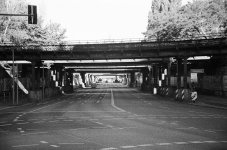
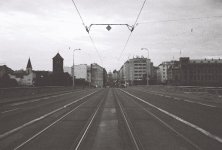
So here is one from walking around Prague - I mean, by no means a perfect photo/exposure, etc.
But in a weird way... I like it (and isn't that kind of what matters in photography??)

I mean the photo is grainy as heck - shadows little to dark .. but still :-)

It does - to me at least - look like this could have been taken 50 years ago.

In all honesty - pulling the ISO400 to ISO1600.. was maybe pushing it (pun intended) too far.

The second roll I shot was a ISO1000 roll - and the one I am going through now is Kodak P3200 that I will pull to ISO1600.

Definitely learned something about exposure setting with this roll - so can take it to the next ones.

Will post inside the Arena photo later..

As a fellow photographer I walked with yesterday said 'When I was studying film photography back in the day, our teacher said - if you shoot a roll of film, aim to have ONE good photo from it!'


TP_image.jpg
 
So here is one from walking around Prague - I mean, by no means a perfect photo/exposure, etc.
But in a weird way... I like it (and isn't that kind of what matters in photography??)

I mean the photo is grainy as heck - shadows little to dark .. but still :)

It does - to me at least - look like this could have been taken 50 years ago.

In all honesty - pulling the ISO400 to ISO1600.. was maybe pushing it (pun intended) too far.

The second roll I shot was a ISO1000 roll - and the one I am going through now is Kodak P3200 that I will pull to ISO1600.

Definitely learned something about exposure setting with this roll - so can take it to the next ones.

Will post inside the Arena photo later..

As a fellow photographer I walked with yesterday said 'When I was studying film photography back in the day, our teacher said - if you shoot a roll of film, aim to have ONE good photo from it!'


View attachment 366401

Well you might notice the grain more as you were used to squeeky clean digi shots ;)
 
So here is one from walking around Prague - I mean, by no means a perfect photo/exposure, etc.
But in a weird way... I like it (and isn't that kind of what matters in photography??)

I mean the photo is grainy as heck - shadows little to dark .. but still :)

It does - to me at least - look like this could have been taken 50 years ago.

In all honesty - pulling the ISO400 to ISO1600.. was maybe pushing it (pun intended) too far.

The second roll I shot was a ISO1000 roll - and the one I am going through now is Kodak P3200 that I will pull to ISO1600.

Definitely learned something about exposure setting with this roll - so can take it to the next ones.

Will post inside the Arena photo later..

As a fellow photographer I walked with yesterday said 'When I was studying film photography back in the day, our teacher said - if you shoot a roll of film, aim to have ONE good photo from it!'


View attachment 366401

I like the subject and composition, but it looks a little washed out. I know you said you shot the 400asa film at 1600asa, but did you request that that it be pushed in development by the lab (sorry if I'm teaching granny to suck eggs here!)? Based on your comments that some of the the pictures from the roll look underexposed, and the way that the picture above looks, I'm wondering if the roll has just been developed normally (as though it was shot at 400asa), which would result in underexposed negatives and subsequent washed out scans (where the scan is attempting to compensate for the under-developed shadows).
 
I like the subject and composition, but it looks a little washed out. I know you said you shot the 400asa film at 1600asa, but did you request that that it be pushed in development by the lab (sorry if I'm teaching granny to suck eggs here!)? Based on your comments that some of the the pictures from the roll look underexposed, and the way that the picture above looks, I'm wondering if the roll has just been developed normally (as though it was shot at 400asa), which would result in underexposed negatives and subsequent washed out scans (where the scan is attempting to compensate for the under-developed shadows).
Yeah.. unfortunately the lady in the store I picked my film from, did not speak a word of English (the guy yesterday did!).. so not sure about the development.
I mean - to get the exposure I used :
- Light meter (I know - an App, but still something)
- My digital camera (set the same settings as the Voigtlander)
- The light meter on the Voigtlander

And all those pretty much agreed always on the correct settings... so I was maybe expecting the exposures to be at least a little more in the ball park of correct exposure.

Guess there is a risk always in developing in places you haven't done it before..

I will take the first few rolls as a learning curve.. and see what works :-)

But.. I have fun using the camera and taking the photos .. so that's a win-win for me!!
 
Yeah.. unfortunately the lady in the store I picked my film from, did not speak a word of English (the guy yesterday did!).. so not sure about the development.
I mean - to get the exposure I used :
- Light meter (I know - an App, but still something)
- My digital camera (set the same settings as the Voigtlander)
- The light meter on the Voigtlander


And all those pretty much agreed always on the correct settings... so I was maybe expecting the exposures to be at least a little more in the ball park of correct exposure.

Those things are all fine when you're pushing film - you're basically underexposing it deliberately by setting things up as though there is (in this case) a 1600asa film in the camera, when it's really 400asa. This means the camera (or your light meter) thinks the film is two stops more sensitive and allows you to use faster shutter speeds and/or narrower apertures than you would if shooting the film at its box speed (400asa in this case).

What also needs to happen though is that this needs to be compensated by developing the film for longer which allows extra detail to be extracted from the under-exposed film. Basically, under-expose and over-develop. Without this compensation at the development stage you will just get results that are (in this case) two stops underexposed. If you're having the film developed by a lab you need to tell them that the film has been pushed by however many stops or they will just develop it for the rating on the canister and you'll end up with thin negatives.

But.. I have fun using the camera and taking the photos .. so that's a win-win for me!!

This is the important bit. :)
 
Last edited:
So here is one from walking around Prague - I mean, by no means a perfect photo/exposure, etc.
But in a weird way... I like it (and isn't that kind of what matters in photography??)

I mean the photo is grainy as heck - shadows little to dark .. but still :)

It does - to me at least - look like this could have been taken 50 years ago.

In all honesty - pulling the ISO400 to ISO1600.. was maybe pushing it (pun intended) too far.

The second roll I shot was a ISO1000 roll - and the one I am going through now is Kodak P3200 that I will pull to ISO1600.

Definitely learned something about exposure setting with this roll - so can take it to the next ones.

Will post inside the Arena photo later..

As a fellow photographer I walked with yesterday said 'When I was studying film photography back in the day, our teacher said - if you shoot a roll of film, aim to have ONE good photo from it!'


View attachment 366401

This is the signature look of a scan of a vastly underexposed negative. It represents a great example to show to those who claim you can expose/develop at random 'so long as you just scan'.

No you can't. What you have here is a negative so thin that any detail was replaced by the scanner sensor's thermal noise, which was then made more visible by the scanner operator/software setup attempting to lift the shadows to reveal some detail.

In other words
- most of this is not grain, it's just digital noise due to underexposure. There is some grain texture in the highlights, and this too was magnified by seemingly some overdevelopment
- you can expect better results from film!

But this is a good start! keep at it!
 
Last edited:
It doesn't look so dark in Prague so why push it at all? Why didn't you just shoot at ISO400?
Pushing is because I mainly shoot images indoors (at basketball venue) - so the outdoors images are just something extra.
And ISO400 would not be anywhere near fast enough indoors - I did shoot a roll at ISO1000 indoors (not developed yet).

Also - as these are the first rolls I shoot with this camera.... probably should just shoot 'normal' - before going pushing/pulling.
But... live and learn.
 
As mentioned above - most shots are taken inside the Arena...
Where I shoot the games at ISO2500/3200 ..
But with Bessamatic only going to 1/500 shutter - not even trying to shoot action with it.

So getting some post game, etc images.. and with the exposures, etc.
It might also come down to 'user error' on these first few rolls..

Image below is from inside the Arena...
(same Tri-X 400 roll as the street image)
 

Attachments

  • ThisWhy.jpg
    ThisWhy.jpg
    152.4 KB · Views: 24
Small update on this one - now after having a second roll developed...
This one was Kodak P3200 - but I shot it at ISO1600 (yes, one never learns that SHOOT WITH THE ISO ON THE PACKET!! ;-) At least when learning a new camera)

The results - so two options, either I got a lot better at handling the camera/exposure on the second roll.
Or.. the first roll was 'messed up' at development...

Still holding judgement on this.

Will post something here when at the end of a connection that allows me to upload images...

On another note VERY difficult to find places to develop film in Finland...
And I have two rolls of 'Santa Rae' film.. that only seems to be touched by one place .. and they are open three hours on Mon/Wed/Fri (and about 100 miles from where I live).

So.. should I learn to develop my own films????
 
Small update on this one - now after having a second roll developed...
This one was Kodak P3200 - but I shot it at ISO1600 (yes, one never learns that SHOOT WITH THE ISO ON THE PACKET!! ;-) At least when learning a new camera)

The results - so two options, either I got a lot better at handling the camera/exposure on the second roll.
Or.. the first roll was 'messed up' at development...

Still holding judgement on this.

Will post something here when at the end of a connection that allows me to upload images...

On another note VERY difficult to find places to develop film in Finland...
And I have two rolls of 'Santa Rae' film.. that only seems to be touched by one place .. and they are open three hours on Mon/Wed/Fri (and about 100 miles from where I live).

So.. should I learn to develop my own films????

Shooting P3200 at 1600 will be fine. I'd perhaps even suggest it will look better that way.

As someone who started developing B&W film when the covid pandemic began, I'd say go for it. It's very easy to do.
 
So - finally got to posting this... so :
Shot with the Zoomar lens on the Voigtlander Bessamatic...
Film was Kodak P3200 - pulled to ISO1600..

These images definitely are much better than the first set I shot..

Not that I can say whether this is normal noise for P3200 film..

But I can look at these images and at least think that 'well - it's an improvement from the previous!'

Have some Santa Rae ISO1000 film loaded at the moment to the camera - so let's see what sort of results I get with that.
And where I find someone to develop it...
TP_Voigtlander.jpg
 
Shooting P3200 at 1600 will be fine. I'd perhaps even suggest it will look better that way.

As someone who started developing B&W film when the covid pandemic began, I'd say go for it. It's very easy to do.
Really should find the time to learn to develop B&W films...
But.. working for myself and my last day off having been on 24th of July (yes, at least in 2022!!)...
Shows that the time seems to be a little bit limited at the moment..

Any tips from where to look for good tutorials for learning this??
 
Really should find the time to learn to develop B&W films...
But.. working for myself and my last day off having been on 24th of July (yes, at least in 2022!!)...
Shows that the time seems to be a little bit limited at the moment..

Any tips from where to look for good tutorials for learning this??
If you search for develop black and white film at home on YouTube, you'll find loads of videos. (y)
 
I couldn't post a link earlier from my phone, but there should be enough tutorials here to keep you busy.


Although the general process is the same (when using a Paterson tank, or similar) there will be variations on agitation depending on who's developing the film, plus the timings, temperatures and dilutions will differ dependent of what film stock you develop, and which chemicals you choose to develop it with.
 
I just started B&W home processing earlier this year and immediately regretted not having done it before. The set-up cost (in the UK) was £100 for a starter kit, £20 for a changing bag, £5 for some measuring syringes. I have been buying liquid chemicals and spend about £35 every 3 or 4 months. Now that I have a bit of experience, from taking the film out of the camera to hanging it up to dry is about 20 minutes.
ps: My training came from youtube :)
 
Last edited:
I couldn't post a link earlier from my phone, but there should be enough tutorials here to keep you busy.


Although the general process is the same (when using a Paterson tank, or similar) there will be variations on agitation depending on who's developing the film, plus the timings, temperatures and dilutions will differ dependent of what film stock you develop, and which chemicals you choose to develop it with.
Thanks - and yes, I am sure YouTube has wide range of videos in every subject...
Will check few ones that seem reasonable :-)

And guess I need to also invest in a scanner to get some files to look at on the computer.

But... birthday and Xmas are coming, so maybe I have been good this year.
Could be something to think about...
 
I just started B&W home processing earlier this year and immediately regretted not having done it before. The set-up cost (in the UK) was £100 for a starter kit, £20 for a changing bag, £5 for some measuring syringes. I have been buying liquid chemicals and spend about £35 every 3 or 4 months. Now that I have a bit of experience, from taking the film out of the camera to hanging it up to dry is about 20 minutes.
ps: My training came from youtube :)
Definitely some savings in the costs there... good €40 to get a single roll developed/scanned over in Finland.

Time to look at YouTube and some starter kits for developing B&W films.
 
Back
Top