

setup for garment shots in limited space

Wookie

Suspended / Banned
Messages
764
Name
Lawrence
Edit My Images
Yes
hi folks,

We're been getting a new small home based business under way and I'm going to need to take some product shots soon, mainly so we can get a website up but also so we can do a portfolio of our garment designs. There won't be many and they'll be at sporadic intervals as we develop the designs, so no point paying for studio time or a pro shoot (not yet).

The garments are embroidered sweatshirts / t-shirts / hoodies with big arty designs, and also irish dance dresses.

I really hate seeing product shots with garments shown hung on the back of a door :lol: and flash shadows, so a proper background needs to be used and some surround lighting. Sadly with a family and a business in the same house we are rapidly running out of floor space so a compact and collapsible setup that does not involve more than a few feet of clear floor space is going to be needed as studio space cannot be dedicated solely to this task.

I found some threads on garment shooting but the setups discussed were way overkill for our situation, and involved far too much space.

I've already got the 400D, decent tripod and a selection of adequate lenses (mainly the 18-55 kit, nifty fifty, 28-105, 70-200F4L ). I've never done any dedicated studio type photography but I reckon my existing lighting systems are utterly inadequate for this task: the popup flash, a sigma EF500DGST with limited control (TTL, full or 1/10th) and an unreliable jessops off camera TTL lead.

Anybody got thoughts on a reasonable basic setup?

I was thinking of a pop-up light tent (maybe 4 or 5 ft cube) that can be placed on a table, with garment on a mannequin inside it, with some form of lighting to the sides of it, either flash or fluorescent based . . . ?
 
I try to be helpful when I answer forum questions and I'll try to help you too, but I have a feeling you may not like my answer.

1. Forget about a light tent. They have their uses but not for your type of product. You need controlled, directional lighting that shows your products at their best.

2. Use mannequins if you really must, but bear in mind the reason that people buy clothes. They buy them for themselves because they want to look sexy. They buy them for someone else because they want the other person to look sexy. Mannequins don't look sexy, they look like a lump of moulded plastic. When did you last feel like a bit of fun with a lump of plastic? Use real people with the right looks for your product.

3. You need a minimum of 3 good quality flash heads, 1 of them fitted with something like a 140 x 80cm softbox for soft but directional lighting, to show the shape of the garment/body beneath it. Another behind the camera fitted with an umbrella to provide fill. Another with a honeycomb to accentuate texture/draw attention to logos etc. Just a starting point of course, the lighting will vary to suit the product/model and you may end up with more lighting than that.

4. If you really feel that you need a background that will be 2 more lights, and a lot more space

Your camera will be fine, so will your tripod, and you have far more in the way of lenses than you need. With product photography especially, the budget should be spent on lighting and on learning how to use it.

If you feel that this is overkill then I'm sorry. It isn't.
 
thanks Garry, valuable advice yet again and I appreciate your reply, even if I don't like the answer :lol:

we're not big and the website is initially just a basic presence for credibility and a reference rather than the primary selling medium. We've only got limited garment production capacity and we're targetting a local market, . . . so if the website photos are too good we'll be swamped ;)

perfection is a wonderful goal for the future but for now we've just got to sort out something better than door frames and big black shadows.
 
we're not big and the website is initially just a basic presence for credibility and a reference rather than the primary selling medium. We've only got limited garment production capacity and we're targetting a local market, . . . so if the website photos are too good we'll be swamped ;)

perfection is a wonderful goal for the future but for now we've just got to sort out something better than door frames and big black shadows.

I don't agree with you, but it's your business and your decision. Perhaps the answer is to start small but to allocate a proper budget to photography as soon as you can - trust me, it really does pay to have good product photos. The unfairness of life (including business life) is that small businesses often can't afford professional photography or even the equipment and space they need to do the job themselves; large companies can, and they reap the benefits...

Revised, temporary advice:
Paint a wall with white emulsion, use that as your background. Use staff/family/friends as models, poses can be copied from fashion magazines.
Get one flash head with a large softbox as key light and a large sheet of polystyrene as a fill light. Get 1 outstanding shot, with model, of each main item and, if necessary use your lump of plastic to model colour variations etc.
 
Have to agree with Garry - poor product photos can do more damage than poor prduct quality.

Obviously Garry took a second look at his original post and found ways to help reduce the investment needed to get some decent shots. Always offers valuable advice and does it honestly.
 
imo models are the best way to do it, what about getting TFCD togs and models to use the clothes they would get clothes for specific shoots and you would get advertising pics.

Doing this with my sisters shop (but I'm the tog :D) but the clothes are of more value to portfolios as its a vintage shop and we have some exceptional pieces
 
...Revised, temporary advice:
Paint a wall with white emulsion, use that as your background. Use staff/family/friends as models, poses can be copied from fashion magazines.
Get one flash head with a large softbox as key light and a large sheet of polystyrene as a fill light. Get 1 outstanding shot, with model, of each main item and, if necessary use your lump of plastic to model colour variations etc.

Spot on advice :thumbs:

TBH it doesn't sound like you need a full-on fashion set, and I actually quite like the idea of mannequins - much easier for customers to imagine themselves in a garment worn by something annonymous. Unless you can get a model who has the absolutely perfect look for your target market.
 
hi again folks, we're still working on the lighting setup problem / challenge, in between all the other excitement of getting the business going

Thanks to all who've given their advice so far on this thread, we've been considering everything suggested. We've also bought "Light Science and Magic" (only a couple of chapters in so far) and read nearly every post here and most of Garry's articles spread across the internet. We think we've got a handle on the direction we'll be going, and its pretty close to Garry's original suggestion.

But today I got the OK from a customer's mum so I could post on here a couple of examples of the shots we're trying to do. This was the photo disaster episode that proved we needed something better

shot in an area of about 7 ft long by 4 ft wide :cuckoo: which was all that was available on the day she collected the new dress
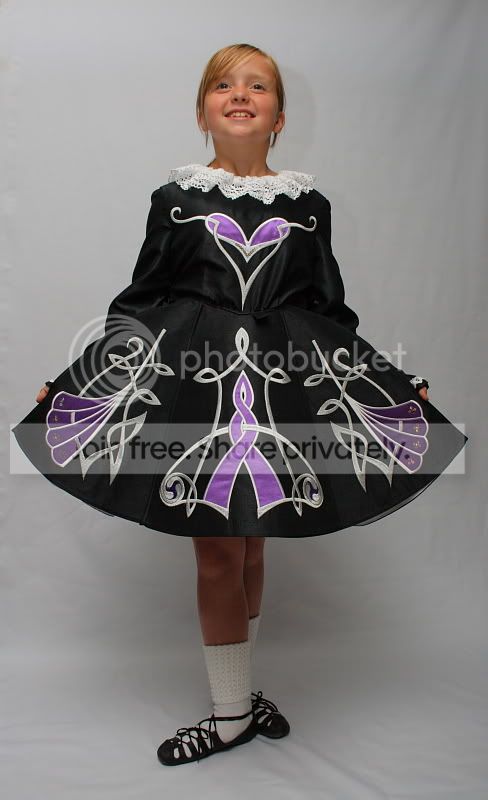
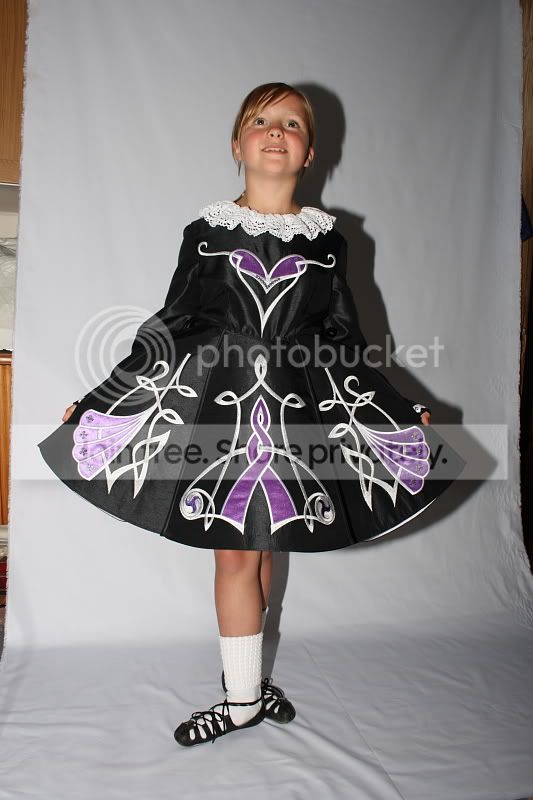
we know this is all wrong but here they are, first the only vaguely acceptable shot from the 30 taken :bang:

IMG_4375web.jpg


and its quite frankly terrible. However it was the best of the bunch and more by luck than judgement. It was shot with the flash head turned round to bounce off the room behind me, resulting in a very underexposed image which because I'd shot in raw I was just able to recover, and low and behold the flash was diffuse enough and the ambient light significant enough that there were no harsh shadows or appalling bright reflections :thumbs:

most of them were more like this one (or worse), really harsh shadows and terrible bright spots on the garment . . .

IMG_4376web.jpg


:bonk:


That's one side of the business, the made to measure irish dance dresses, another side of the business is the "fashion" sales which is bought-in garments with our wierd embroidery designs added, with only small runs of about a dozen before we change colour combinations.

We've looked at pro shoots and studio hire but with the low throughput and sporadic nature of both dress and fashion production its not feasible, we can't build up enough stock to make a shoot worthwhile (each shoot would cost as much as the garments being shot)

So the current plan is still to shoot it ourselves. Primary problem is the small space available, I am convinced we need to control the light or we'll have trouble with bright spots due to the reflective materials we use (embroidery applique, satins and sequins), so I'm thinking brollies are a bad idea and softboxes are going to be better. Also there's going to be insufficent separation to get a clean shadowless backdrop, 6m is not possible :lol:

So the plan:
- clear a bigger area (we can manage 7ft x 9ft, with an 8ft 6in ceiling)
- Lastolite Hilite at the back, 5ft wide by 7ft tall, with 1 studio flash
- 2 studio flashes for front lighting, one fitted with 140cm x 70cm wide softbox as main light, the other probably another 140x70 softbox and a range of toys for whatever is needed
- plus a couple of reflectors and a couple of sheets of cardboard with black drill (we've got massive quantities) glued on ("flags"?)

that I think should do us for both full height and torso shots, with both people and mannequins.

Any thoughts?
 
Well, you've accidentally discovered the value of bounced light:)
It's not a technique I personally need to use because I don't have space problems but I have a friend, one of the top 10 fashion photographers in the world IMO, who uses it a lot.

My immediate thought is that you don't need two softboxes, and you don't have enough space anyway. 1 softbox will do the job fine, use either a reflector on the opposite side, to pick up unused light and bounce it back to the shadow areas (effectiveness is varied by moving it closer or further away) or use a second head next to the camera and bouncing backwards for fill, or even use a hotshoe flash mounted on the camera for fill - fill flash is always from the camera position.

With shots that require oblique lighting (your fancy embroidery and where you need to reveal the texture, another light on the same side as your key light but at a more acute angle, fitted with a honeycomb will do the job nicely. Slightly more measured power than the softbox light, maybe 1/2-1 stop is a good starting point.

Background: Personally I don't like the Hi-Lite, seriously overpriced and I don't like bland backgrounds for most shots, but if you must have a white background then it's probably the only option for the amount of space available.

Hope this helps.
 
i agree 100% with garry, bounce light is invaluable.

also your white balance is incorrect, and thats why your shots come out with the white background being grey. i think that the backgrounds need to match the dress so have a hunt around for patterns even textile shops should have curtains and duvet covers that would be in a nice pattern.

th mannequin is a good idea but it wont show what the product looks like an a real person, mannequins are only reliable for barbie doll clothes (and dont ask how i know that:D)

have you thought of them collapsible backgrounds, you can get the best ones from calumet for around £100 (or around £50 off ebay)and they pop up and fold in, it doesnt even need a background stand for them as they are self supporting.
 
also your white balance is incorrect, and thats why your shots come out with the white background being grey.
The white balance IS out, but the reason the background is grey is because it is unlit.
That problem will persist with a collapsible background that isn't lit separately.
 
stick your current flash in the hilite on either an optical or radio slave and it should have enough guts to blow it white provided the studio head(s) on low power
 
here is the draft shopping list, anybody got any views on this?

A. 3 head studio kit - lencarta smartflash kit (currently a similar price to interfit EX150 but has Bowens S fit) :
3 x SmartFlash 200 (200Ws) Flash Heads (FLA010) - WILL THESE BE SUITABLE?, particularly the low power output (may even be an advantage in small rooms?) and lack of modelling light control
3 x Studio Light Stands (STA002)
1 x umbrella Reflector (MOD006)
2 x 60cm x 60cm Softboxes (SOF004)
1 x 100cm white Reflective umbrella (UMB001)
1 x 5-in-1 reflector kit (REF001)
1 x 16 channel Radio trigger/receiver (TRI001)
1 x Stand carry case (BAG002)​

B. Tall softbox - Lencarta 140 x 70

C. Snoot with honeycomb - Lencarta

D. Reflector Holder arm - Lencarta

E. Lightmeter - Sekonic L-308S , Warehouse Express

there's probably a few holes we need to plug, but never having tried anything more adventurous than a single hotshoe flash we're not sure about what is needed.

Backgrounds:

We're not convinced that white is the correct colour background for us in all circumstances.

We've got a large sheet of white drill to use as a background for now, we can clip that to the bookcases so no support structure needed (we've also got massive quantities of black drill to play with). We suspect that it'll do as a starting point while we experiment with the lights and work out what we really need for a background. A number of reasons:

We'll wait and see what FITP has lined up as a more cost effective alternative to the Lastolite Hilite!

Also we're watch Cowasaki's thread on jewellery shots (http://www.talkphotography.co.uk/forums/showthread.php?t=176318)and thinking about a similar approach to final website presentation using graduated grey backgrounds added in post processing to maintain background consistency between product photos on the website.

Any photos of irish dance dresses being worn MUST include white poodle socks (its part of the dress code), and many dresses will include white lace on collars and sleeves. So rather than fight with them blending into the background we suspect we may need to experiment with contrast or chroma key backgrounds so that they are easy to separate and replace in post processing.​

Any thoughts anybody?

silly question: Do we need to get a background reflector for a flash head if using a non-hilite white or coloured background that we are going to chop out in post processing? :help:

Other toys - any other bits needed to get started?
 
That kit will suit you fine. You may find that you want extra bits as your skills develop, but it isn't really a good idea to play with too many toys at once, nor is it a good idea to buy things that you may not need.

I'm glad that you're having a re-think about white backgrounds - the key here is consistency, and a consistent background that isn't white often looks better and is definately easier to get good results with.

A background reflector would be a very good idea if you want to light any background evenly, but you might want to forget about the background for now, send your files to Thailand so that they can produce clipping paths for you at a fraction of the cost (time) it would take you to do them.
 
I think the Smartflashes only have a four stop power range. You might not need much power, but you do need control especially when you're trying the balance the light from a big softbox with a smaller reflector.

A lot of other flash units have a five stops range, including Lencarta I think. Worth considering :) My little Elinchrom D-Lites do five stops and I use them all from time to time.
 
I think the Smartflashes only have a four stop power range. You might not need much power, but you do need control especially when you're trying the balance the light from a big softbox with a smaller reflector.

A lot of other flash units have a five stops range, including Lencarta I think. Worth considering :) My little Elinchrom D-Lites do five stops and I use them all from time to time.
Fair point, but the lower the maximum power, the less need there is for a lot of adjustment. 200j (Ws) reduced by 4 stops is only 12.5j - how many people need to reduce that to 6?

It's nice to have lots of features, the question is though "Are they worth paying for?" Not so many years ago, people were happy with just 2 stops of adjustment, before that there was only 1 and my very first studio flashes had none - so we created our own adjustment, using ND gels, which are still available and still both effective and cheap.
Come to that, does my mobile phone really need over 200 ringtones? Does the fan on my car heater really need to have 4 speed settings?
Sometimes we can confuse real benefits with marketing hype - the question is really whether that extra stop of adjustment, a bit more power and some more buttons are really worth nearly £200 extra, and the answer will depend on the person and their needs.
 
Fair point, but the lower the maximum power, the less need there is for a lot of adjustment. 200j (Ws) reduced by 4 stops is only 12.5j - how many people need to reduce that to 6?

It's nice to have lots of features, the question is though "Are they worth paying for?" Not so many years ago, people were happy with just 2 stops of adjustment, before that there was only 1 and my very first studio flashes had none - so we created our own adjustment, using ND gels, which are still available and still both effective and cheap.
Come to that, does my mobile phone really need over 200 ringtones? Does the fan on my car heater really need to have 4 speed settings?
Sometimes we can confuse real benefits with marketing hype - the question is really whether that extra stop of adjustment, a bit more power and some more buttons are really worth nearly £200 extra, and the answer will depend on the person and their needs.

Garry, I think you've answered your own question there when you say that you had to cobble together workaround adjustments to modify the power of those old units.

All I would say is that I was using my 200ws D-Lites only last week with a 70cm softbox and was getting f/5.6 on mimimum power. Yes, it was quite close, but sometimes I want it quite close.

When it comes to marketing gimmicks I really don't think power control is one of them. I would much rather have a a lower power flash with good control than 1200ws with none. (Or one with remote control, or thermostatic fans, or user-replaceable tubes and air-damped stands... :lol: )
 
Back
Top