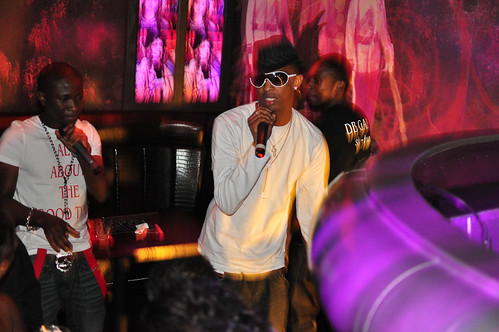
Settings for gig photography (to flash or not to flash?)

chis101

Suspended / Banned
Messages
24
Name
Steve
Edit My Images
Yes
Hi guys,

I'm going to a friends gig tonight and thought I would try and get some practice photographing live music. I was wondering if anyone has any tips for settings and weather or not you would recommend using flash at all?

I've had a bash at gig photography before but I have almost always come away dissapointed with the results. I reckon a faster lens is in order if I'm going to be doing this regularly but for the purposes of tonight I will be using my sony 18 mm - 70 mm f 3.5 to 5.6 kit lens.

This is the first time I have done a gig since buying my flash (minolta 3500 xi) and I was wondering if it is worth taking it... although I obviously would like to retain as much atmosphere as possible...

Last set of gig pictures I took were pretty underwhelming but the best of the bunch (still too underexposed:bang:) was taken at iso 800, f5, exposure 1/20

any suggestions for tonight?
 
You need high ISO and fast glass (at least f/2.8) - flash will just destroy the atmos.
 
What is the venue like? How close to the band can you get? Will there be stage lighting, if so what?

I should imagine it will be pretty difficult to use flash whilst the gig is going on - I have a friend who takes great gig photos, but generally just uses very fast glass.

Your problem with flash is that on camera it will look a bit flat like on a P&S. Any chance you could set it up on a stand really high up to forward and either left/right of the stage with a remote trigger?
 
Also, try going along in sound check and have a bit of a practice while that's going on.
 
Highest Iso
Lowest Aperture lens will allow
Hope that the lighting is good enough to shoot at a half decent shutter speed.
Don't use flash.

There is a good guide here:

http://www.talkphotography.co.uk/forums/showthread.php?t=165114

That might be of help. If you do need to use flash as you cannot get a decent exposeure any other way, use long shutter speeds to add a bit of atmosphere. The flash will freeze the subject and you may get some nice pics. Try 1/3 to 1 second and see what happens.
 
What is the venue like? How close to the band can you get? Will there be stage lighting, if so what?

I should imagine it will be pretty difficult to use flash whilst the gig is going on - I have a friend who takes great gig photos, but generally just uses very fast glass.

Your problem with flash is that on camera it will look a bit flat like on a P&S. Any chance you could set it up on a stand really high up to forward and either left/right of the stage with a remote trigger?

Well it's a dingy cellar pub... I can get as close to the stage as I want and there are two banks of four stage lights either side of the stage (no idea about their wattage) as for setting the flash up remotely, it isn't really an option as my cable only stretches to about 2m and the wireless seems to be ****ed so I guess I'm as well leaving that at home!
 
Well I'd be prepared to not get great shots - it will be really difficult without fast glass - perhaps if you can get some good ones in rehearsals and pretend they were at the gig?
 
Highest Iso
Lowest Aperture lens will allow
Hope that the lighting is good enough to shoot at a half decent shutter speed.
Don't use flash.

There is a good guide here:

http://www.talkphotography.co.uk/forums/showthread.php?t=165114

That might be of help. If you do need to use flash as you cannot get a decent exposeure any other way, use long shutter speeds to add a bit of atmosphere. The flash will freeze the subject and you may get some nice pics. Try 1/3 to 1 second and see what happens.

cheers for the link!
 
You need high ISO and fast glass (at least f/2.8) - flash will just destroy the atmos.

unfortunately faster glass isn't an option (tonight at least) as f/3.5 is the best i can do...

I understand my set up isn't ideal but assuming my apperture is f/3.5 can anyone hazard an educated guess as to a shutterspeed and iso to get me started and maximise the effectiveness of less than ideal gear?
 
Ill go against the grain a little here and say take your flash and use it. Ask venue management if they have any rules, if not: As long as you dont go crazy no one will care. A carefully timed 20-30 shots in a 3-4hour gig will not raise any eyebrows.

My two primary venues are very poorly lit and even with 1.4 glass I've struggled in the past, last gig I went too on Monday I tried no flash all the way through and with ISO3200, 1/80 on a 5d2 and f2.8 my pics were still not happening.

Camera in manual, ISO400, f5.6, shutter 1/125+ flash on ettl. If you get too much background lit up underexpose on the camera, if the performer is too exposed underexpose on the flash.
 
Most venues don't allow flash photography from the press pit so most professional music photographers end up spending out to get very wide constant aperture zoom lenses (think 70-200 f2.8 L) and using high ISO to boost things even more so the better bodies come in handy with their low-noise ISO handling.

With your kit I'd think about shooting some shots wide to get the max aperture you've got available then cropping the image later - with your lens you'll stop down the aperture if you zoom.

Also, keep the ISO nice and high - if the shots look noisy then check out the noise-reduction software available (some free) to reduce the impact of the ISO. Or else convert to B&W which doesn't look so bad noisy.

Also, pick your shots to make the most of the lighting available.
Lastly, shoot in raw so that you've got a little more flexibility later on...


I've got some good results at a couple of gigs in the past with a Canon 400D (not great above ISO 400) and a f4 lens so it's definitely possible!

Have fun and good luck!
 
unfortunately faster glass isn't an option (tonight at least) as f/3.5 is the best i can do...

I understand my set up isn't ideal but assuming my apperture is f/3.5 can anyone hazard an educated guess as to a shutterspeed and iso to get me started and maximise the effectiveness of less than ideal gear?

try 1/80, f3.5, ISO1600 and see how your shot looks. If they dont move about much and motion blur wont be an issue push the shutter, if your ISO can go higher push that, if not you can underexpose on the camera and try to pull back in PP but this will make noise.

And, I forgot the important bit.... Shoot RAW!
 
start at highest iso which will be 1600 or 3200 I would think.

Use aperture priority and set to minimum, in your case f3.5. This will then give you the shutter speed to get a correct exposure. If you cannot get a usable one at that setting, flash it will have to be.

I have shot several gigs in small venues and the lighting is terrible, so you may have to use flash. f2.8 iso 3200 shutter given approx 1/10 sec is not unusual.

I have shot some big name acts who haven't had much better lighting than a pub venue.

If they are happy with it, use flash as you need. Remember though don't panic. If you find you do need to shoot flash, remember to down your iso speed to maybe 400, and play about.


Get a few definite ones shot show they were on stage, then experiment. 1 second exposure with a little flash and then swirling the camera about may make you look like a loon but you will get some interesting (note I didn't say always good) results. Also mess about zooming in and out during the exposure for a different effect.

I am sure your mates will be happy, and you will be able to shoot all gig, so no pressure, enjoy yourself.

If you do want to take it further though you will need to get faster glass as almost every single major bands have 3 song no flash rule

Edit: Lastly remember to post your efforts up in the forum for crit and help on improving.
 
you can use flash at these if you're really clever.
bounce it off a wall behind you etc and fiddle the settings
however, it's rude to distract the band and fast glass is the way forward

you need 1600ISO and 1/80 or less really as rockers just won't stay still FFS
take them in the best quality you can and worry about noise later with noiseninja or similar

p.s posted whilst not reading the above two posts!!
also in RAW you can recover a stop or so
 
Last gig I did, I was using a 1.8 lens and 1600 ISO to get a reasonable shutter speed to allow me to shoot without flash.

For me flash will definitely kill the atmosphere.
 
Ill go against the grain a little here and say take your flash and use it. Ask venue management if they have any rules, if not: As long as you dont go crazy no one will care. A carefully timed 20-30 shots in a 3-4hour gig will not raise any eyebrows.

My two primary venues are very poorly lit and even with 1.4 glass I've struggled in the past, last gig I went too on Monday I tried no flash all the way through and with ISO3200, 1/80 on a 5d2 and f2.8 my pics were still not happening.

Camera in manual, ISO400, f5.6, shutter 1/125+ flash on ettl. If you get too much background lit up underexpose on the camera, if the performer is too exposed underexpose on the flash.


I agree with Kluens....flash isn't always banned and it can be useful when used carefully to just give a bit of fill. Bounce the flash off the ceiling if you can, (it sounds as though it will be low enough) rather than point it at the band and use a diffuser if you have one.

Don't forget your ear defenders; leaning against the speakers if your shutter speeds are a bit low can be really useful, but seriously damaging without protection. :) Have fun!
 
Yes its all about the light!! Hopefully they will have some whitish light! This gives much better exposures even if there are other colours around. I find the blue and red really awful to shoot in.
 
A few of my friends are in to this and they all use f1.8 or faster short ish primes.
 
Right, That's me finishing work and off to Whistlebinkies now... cheers for the tips everyone!

If there are any keepers I'll stick them up...
 
And, I forgot the important bit.... Shoot RAW!

Whatever you do, don't shoot raw.

Raw doesn't make your lens faster, reduce motion blur, prevent noise or increase the light on your subject.

What is does do is slow down your shooting, fill up your card faster, take ages to download and process and clogs up your hard drive.

Good luck with the shoot mate. :thumbs:
 
Whatever you do, don't shoot raw.

Raw doesn't make your lens faster, reduce motion blur, prevent noise or increase the light on your subject.

What is does do is slow down your shooting, fill up your card faster, take ages to download and process and clogs up your hard drive.

Good luck with the shoot mate. :thumbs:

What it does do (amongst other things) is allow you to push the exposure afterwards, reduce noise more effectively, allow you to deal with the sometimes shocking lights, insane colours and white balance issues a lot easier. Create better black and whites if that's your thing.

And unless you go in eyes shut machine gun mode, it won't slow you down at all. ;)
 
Depending on the venue, I use my 50mm f/1.8 or 85mm f/1.8, I occasionally use the 24-105 f/4 if the lighting is good. Since getting the 5DmkII I have been able to up the ISO significantly and get usable pics.

The following were taken in the Captains Rest in Glasgow, great venue for music, but not photography. Used the 85mm f/1.8 and the 24-105 f/4 at ISO speeds up to 6400.

set-72157622735556120


set-72157622735556120


Dave
 
Hi, Thanks again for the advice... I haven't had a chance to go through all the shots yet but here are a couple of the better ones on first glance...

f 3.5, iso 1600, shutter 1/60

http://i74.photobucket.com/albums/i278/thelittleyellowone/web2.jpg

f 3.5, iso 1600, shutter 1/60
http://i74.photobucket.com/albums/i278/thelittleyellowone/web3.jpg

and With Flash bounced off the ceiling at f 5.6 shutter 1/125 iso 400

http://i74.photobucket.com/albums/i278/thelittleyellowone/web1.jpg

lessons from the night...

* The lighting at Whistlebinkies is shocking. (red and green should never be seen except on a bonny irish queen)

*(as expected) To get things as sharp as I want I will need to invest in a faster lens. I couldn't get a decent exposure at anything faster than 1/60 and iso 3200 is so noisy it's not worth it

* Photoshop's noise reduction filter is pretty underwhelming

* It's £3.25 for a pint of calley 80 with no head.

* I don't have a clue how to work noise ninja
 
Whatever you do, don't shoot raw.

Raw doesn't make your lens faster, reduce motion blur, prevent noise or increase the light on your subject.

What is does do is slow down your shooting, fill up your card faster, take ages to download and process and clogs up your hard drive.

Good luck with the shoot mate. :thumbs:

absolutely don't agree with this first bit

I agree with the 2nd but...it will fill up your card. but the ability to muck with the final image is better. if you're shooting for any decent copy or promotional purpose.
but push processing, shooting raw can effectively reduce motion blur/faster lens etc

there is nothing wrong with doing entire photoshoots in JPEG, I often do. but I wouldn't push people away from the options RAW shooting can offer you
 
absolutely don't agree with this first bit

Ooh I put the cat amongst the pigeons there a bit didn't I? :D

I meant for this photographer, with this equipment, for this shoot. I didn't mean no-one, nowhere, never.

My point is really that the OP is clearly a beginner at this sort of shoot (hope you don't mind me saying this Chris). His shots are ok, but a few pointers (see below) could really help. None of the shots he's posted would be improved in any significant way by shooting raw. There are other issues here. Once he's happy with his technique and getting reliable results, he can then think about the subtle improvements raw can give. I think the knee-jerk "shoot RAW!" [sic] is bad advice - why not talk about basic photographic technique first? Raw people know who they are. Plenty of professionals use out of camera JPG - they get it right in camera and move on.

Anyway, let's look at the photos:

Shot 1: I like the diagonal composition, gives a bit of visual tension and interest. Looks out of focus - try and get the face in focus, in this case the cap gives a nice contrasty line for the focus sensor to latch on to. Sometimes you might need focus assist, although (I think) the Canons use multiple preflashes to do this rather than the Nikon focus assist light (I may be wrong for your camera), which can get annoying. The central focus point may be much more sensitive than the peripheral ones - it is with my Nikons - so if you're struggling with focus, try focus-recompose. Try continuous (servo) focus if the performers are moving. Nice bit of motion blur on the hand, one benefit of using a slow shutter speed. I can't see much in the way of noise. There seems to be enough light in it though. A touch of fill flash might have livened this one up a bit.

Shot 2: Pretty much the same as shot 1, except I preferred the diagonal composition of 1. Still looks a bit out of focus to me.

Shot 3: The flash v the blue ambient light on the guitarist has ended up just as a blue blob next to his head. There's lots of light on the left of the photo and not much on the right - of course because that's where the flash was, however it looks unbalanced. Try slowing the shutter down to something like 1/20. This will let in a lot more ambient, hopefully with a nice bit of fill flash as well, maybe something like:

4145540148_e59b3bd25a.jpg


So you get some motion blur but with some sharp frozen bits as well. A lot of low-light flash ends up looking like this, better than the rabbit-in-the-headlights look.

That ceiling looks a bit dark for proper bounce, try firing straight forwards, as long as you capture enough ambient light, you should do ok.

Did you use manual settings or let the camera decide? Low light work is one area where I don't trust the camera, and need more predictable settings. Try metering the ambient light at the start of the night, then underexpose about a stop but use fill flash for the rest.

By the way, don't be afraid to use flash if it's the only way to get good results. It doesn't seem to upset people too much - although I tend to prefer available light, I know a full-time gig shooter who takes 500 shots in a 30 minute set - all with flash!
 
Ooh I put the cat amongst the pigeons there a bit didn't I? :D

I meant for this photographer, with this equipment, for this shoot. I didn't mean no-one, nowhere, never.

My point is really that the OP is clearly a beginner at this sort of shoot (hope you don't mind me saying this Chris). His shots are ok, but a few pointers (see below) could really help. None of the shots he's posted would be improved in any significant way by shooting raw. There are other issues here. Once he's happy with his technique and getting reliable results, he can then think about the subtle improvements raw can give. I think the knee-jerk "shoot RAW!" [sic] is bad advice - why not talk about basic photographic technique first? Raw people know who they are. Plenty of professionals use out of camera JPG - they get it right in camera and move on.

Anyway, let's look at the photos:

Shot 1: I like the diagonal composition, gives a bit of visual tension and interest. Looks out of focus - try and get the face in focus, in this case the cap gives a nice contrasty line for the focus sensor to latch on to. Sometimes you might need focus assist, although (I think) the Canons use multiple preflashes to do this rather than the Nikon focus assist light (I may be wrong for your camera), which can get annoying. The central focus point may be much more sensitive than the peripheral ones - it is with my Nikons - so if you're struggling with focus, try focus-recompose. Try continuous (servo) focus if the performers are moving. Nice bit of motion blur on the hand, one benefit of using a slow shutter speed. I can't see much in the way of noise. There seems to be enough light in it though. A touch of fill flash might have livened this one up a bit.

Shot 2: Pretty much the same as shot 1, except I preferred the diagonal composition of 1. Still looks a bit out of focus to me.

Shot 3: The flash v the blue ambient light on the guitarist has ended up just as a blue blob next to his head. There's lots of light on the left of the photo and not much on the right - of course because that's where the flash was, however it looks unbalanced. Try slowing the shutter down to something like 1/20. This will let in a lot more ambient, hopefully with a nice bit of fill flash as well, maybe something like:

4145540148_e59b3bd25a.jpg


So you get some motion blur but with some sharp frozen bits as well. A lot of low-light flash ends up looking like this, better than the rabbit-in-the-headlights look.

That ceiling looks a bit dark for proper bounce, try firing straight forwards, as long as you capture enough ambient light, you should do ok.

Did you use manual settings or let the camera decide? Low light work is one area where I don't trust the camera, and need more predictable settings. Try metering the ambient light at the start of the night, then underexpose about a stop but use fill flash for the rest.

By the way, don't be afraid to use flash if it's the only way to get good results. It doesn't seem to upset people too much - although I tend to prefer available light, I know a full-time gig shooter who takes 500 shots in a 30 minute set - all with flash!

cheers for the feedback, not offended at all!

re. them being slightly out of focus, this has been the main thing i'm not happy with about gig shots i have taken in the past - I never seem to be able to replicate the sharpness I see in other peoples pictures. I tried both continuous and single shot AF throughout the night. I had always assumed it was a side effect of the relatively slow shutterspeeds needed due to the lens's apperture and I had never considered my AF settings until now....
 
Back
Top