Scanning Film - why would you do it?

wooster

Suspended / Banned
Messages
1,171
Edit My Images
Yes
Hi folks,

I recently bought a film SLR camera just for the lens I wanted. It was pretty cheap so I was pleased. Then I thought, hold on, wooster, you have this film camera, another two 35mm film cameras and a Yashicamat 134 6x6 camera all doing nothing. Why not try film again after all those years? I am going to do just that.

I imagine I should scan the negatives because otherwise I'd be pretty limited without setting up a darkroom ( not practical ) I will use my EOS R5 with macro lens and get a carrier, a light tray, a copy stand and some software and hopefully that's that.

However, I am now wondering if this defeats the point of filming in the first place. Surely all the supposed benefits of filmic quality of gradation etc etc would be lost in the digitisation process? Is this just a precious activity taken for the joy of tinkering or is there really a "character" which is retained in the process other than just getting a sharp picture of some film grain? What am I missing?
 
Last edited:
A scanned film image looks different to a digital file, even though they are both ostensibly formed of pixels. Scanned well, the look of the film is maintained in terms of grain, colour reproduction, dynamic range etc. There are obviously lots of variables that can alter the result, both during development (analogue) and scanning and post processing (digital), which can be tailored to preference.

Depending on the viewer's opinion, it's not better or worse than a digital photograph, it's just what it is - a digital reproduction of an analogue original.

It's also the only way you can share your film work online.
 
A scanned film image looks different to a digital file, even though they are both ostensibly formed of pixels. Scanned well, the look of the film is maintained in terms of grain, colour reproduction, dynamic range etc. There are obviously lots of variables that can alter the result, both during development (analogue) and scanning and post processing (digital), which can be tailored to preference.

Depending on the viewer's opinion, it's not better or worse than a digital photograph, it's just what it is - a digital reproduction of an analogue original.

It's also the only way you can share your film work online.
Thank you. Yes I can see it's the only way to share and I can see all the advantages of that. I do like the look of film very much and I spent some years in the darkroom in my younger days. It's just that I've never scanned a negative and I'm fearful it might make all the film work in vain. I guess you can see prints made from film on websites and enjoy them so what you say makes sense.
 
Have a look on the "Show us yer film shots" thread on here for some excellent examples, specially from @FishyFish and @Kevin Allan recently.

It's not just the film is it, the camera (despite technically being simply a box to keep the dark in) and the vintage lenses all add to the atmosphere.

For me, it's the gear, the film, the process and the community that keeps me on film (I don't own a digital ILC). A darkroom would be a stage too far for me and my relationships! Scanning is what I do to share...
 
As @ChrisR says, for many of us it is the whole process, not just the end result and a scanned neg is just the final step. Even then negative scanning is a process and both an art and science, obviously different to a darkroom print but not a digital photo either.
 
A scanned film image looks different to a digital file, even though they are both ostensibly formed of pixels. Scanned well, the look of the film is maintained in terms of grain, colour reproduction, dynamic range etc. There are obviously lots of variables that can alter the result, both during development (analogue) and scanning and post processing (digital), which can be tailored to preference.

Well said - that matches my experience. My scanned film images have a "look" that I don't get from images from a digital camera. A look that I prefer.
 
What am I missing?
In my opinion, nothing.

To me, the point of photography is to record an image, How I do this is unimportant and I use whatever gets the job done, whether it is film or a sensor chip. Others have different views and I see nothing wrong in that.

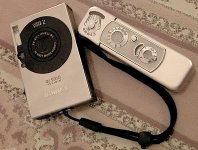
Cameras Canon Ixus 70 and Minox B 705020014.JPG
 
Interesting. I suppose like every hobby, people do it for different reasons.

I've just got an itch. I don't know if it is because I've got this old film gear doing nothing, or if it might be just a novelty.

I suspect for me it's at least in part, a desire to tinker and get my teeth into a new process but I've also been increasingly bored with the relentless march towards digital wonder and technical similarity. All of the perfect images in the world don't seem to give me the pleasure of older prints. It started me using old lenses and now its taking me here.
 
Shoot your film then send it to FilmDev who, for £12, will develop it & scan it in large TIFF format & send you the negs back.

It's what I did when I tested out my Olympus Trip 35 recently.
 
Chances are that if you've had any colour print films D&Ped in the past 20 or so years, the film dev has been "wet" but the printing has been done from scans.
 
I don't think it has been mentioned before in this thread, but mainly I scan for convenience, so instead of searching dozens of sheets of processed film both colour and B&W for a particular picture as a reference, to let me find a particular picture or selection of pictures that I am looking for. It does mean an accurate scan reference number but it does work. So if I am looking for say a picture of a spiders web, in winter of a particular year the reference would look something like SW/W/C/2012/ 6. This to me would translates as:- SW = spiders web. W = winter. C = colour/ 2012 = year/ 6 = sheet number 6.
 
Last edited:
I can see why that makes sense but I was really meaning instead of using a digital camera from the start
 
I can see why that makes sense but I was really meaning instead of using a digital camera from the start
Using film can still be a bit of a challenge, but what is life without a challenge?. Each time if I make an error I learn, that is why after close on 65 years I have few errors. Relying on digital to to everything for you you don't actually learn a lot, and with A.I. and it is going to get worse.
 
Last edited:
instead of using a digital camera from the start

Because the characteristics of film (colour rendering, shadows, highlighht roll-off) are completely different to a digital sensor, and no matter how many presets you work through, it is just not the same.

Scanned film retains the majority of those characteristics
 
Because the characteristics of film (colour rendering, shadows, highlighht roll-off) are completely different to a digital sensor, and no matter how many presets you work through, it is just not the same.

Scanned film retains the majority of those characteristics
Spot on.
 
Going back to when I shot film, 35mm 6x6, 6x7 and 4x5, earlier film was printed via a lovely Besseler enlarger then later scanned and inkjet printed, If I had a water meter in those days it would have cost me a fortune. Now I delve into my negative files and digitise either with a Nikon ES2 with D750 and 60mm macro lens or a Pixel-atr with a copy stand, shooting all in RAW. All new events are shot with DSLR's.I still have all my film camera's, inc Toyo 45A, Mamiya C220 and associated lenses.
 
Last edited:
Sorry. I probably haven’t been clear. I admire prints from film and indeed I used to hand my own darkroom and very enjoyable it was too. I completely agree with all that’s been said about the good stuff about it.

What I wondered about was if scanning - by its digital capture of the image - imposed all the characteristics of a digital picture and therefore made all the film development pointless. I didn’t know of it did that or not and that was my question .

It seems that it doesn’t so I’m now encouraged to get back to film some of the time
 
Now the problem with supply/demand with colour film has for the present time receded that would be an idea. The only thing is the cost of processing, even at hope has leapfrogged upwards and it may be out of the reach of a lot of people.

There is little to compare with getting the colour balance right and a print with all the colours with the correct tonal values. Knowing it is your own experience and not using off the shelf software to get almost the same.
 
Have you seen the current prices for Noritsu or Fuji Frontier scanners lately?

This scans at 3 frames per second fully automated - thats a roll of 36 images scanned in 12 seconds at high res and all colour corrected! It's also new rather than 25yrs old with no chance of any repairs - it offers superb value in my opinion - I have budgeted £3K for this/copy stand/camera (possibly sony A7II) Software and control module.

That's half the price of a Noritsu LS600.

 
Last edited:
I guess if you scan a lot, then I can see that its worth it; I probably digitise 1 roll a month...
 
I guess if you scan a lot, then I can see that its worth it; I probably digitise 1 roll a month...
Most of what I buy is because I love gadgets! If I sat and thought about 'is it worth it' I would give photography, especially film a wide berth!

The way I look at it is it's my hobby and hobbies cost money, my hobbies are there to give me fun & relaxation; how much does a set of golf bats cost these days?
 
Last edited:
Back
Top