I've just seen a good splash shot, with explanation, on FB by our own
@Scooter (AKA Owen Lloyd Photography) - it would be good if Owen could post it here.
Was just reading that thinking - cool - I'll check that out.. oh wait. Reminds me of a time a few years back I was searching to the answer to a very obscure technical problem and searched for a long time in many ways to find any mention of it, and finally one of my searches turned up a Usenet post (what we did before the web) from 5 years previous. I ploughed through the posts for 20 minutes before finding a post describing the exact issue! I read on...and... it was me, 5 years earlier.. asking the same question...
Anyway - here is a shot I took last night:-
View: https://www.flickr.com/photos/owenlloyd/49751095958/in/dateposted-public/
One Lencarta Superfast 600 behind a heavyweight Translum screen, wearing an Aputure Fresnel attachment to create a radial gradient. I use this rather than a grid as it allows me to control the fall-off for a given size of spot, plus, unlike a grid, which blocks and absorbs the light around the edge to create the fall off, a Fresnel lens focuses the light towards the centre - so you keep almost all of the light, just in a different pattern. This becomes important for motion freezing work like this as you need to keep the flash output low: these IGBT controlled lights reduce their output by shortening the duration of the flash. The SF600 is on 5.5 here - ie only half a stop above minimum power, so the flash duration will be in the 1/10000th of a second region - ideal for freezing fast-moving water drops.
Here's the setup:-
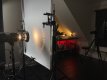
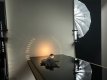
Now, who's idea at Aputure was it to put holes in the side of the Fresnel attachment? Hmm? They don't really show up too much from the flash (it's much bigger than the halogen modelling bulb in these SF600's) and are out of my shot here, but if they were in shot, I FixItWithGafferTape (TM). Also, I have a piece of diffusion gel against the inside of the Fresnel lens, otherwise it projects a nice image of the flash tube... The subject sits on a big sheet of glossy black acrylic to get a nice reflection. It needs to be so long, in front of the object, as the camera is so low, and horizontal.
This is made from 4 shots: one clean one before I started throwing the pieces of er.. ice into it. This is used to get a clean background and base, and then one shot for the main splash, another one for a couple of extra drops, and the 4th is the floating cube (accidentally captured as I fired the camera too early). The ice is cheap fake ice - and not very convincing tbh. I'll buy some better stuff when the Corona situation has calmed down.
Shot this at f/9 and it could do with some more depth of field. There's plenty of room in the lights (half a stop above minimum power for this one), and I ended up knocking two thirds of a stop out of it in post so I'll have another go over the weekend at f/16, and also closer. I'm at about 2m away at 190mm for this one. I like the flat look this gives for this type of shot, and normally, we need to pay close attention to the rim of the glass (ie you don't normally want to be looking up through it) but here there's so much chaos from the splashes obscuring it, it probably doesn't matter too much. I'll also try adding a harder, overhead spotlight to put some sparkle on the water, but this may be a total disaster.
You can do this with a speed-light and some tracing paper btw - you will have less light for a given duration: my SF600 is delivering about 20J of light here and I'm at Iso 64. A speedlight will do about 70J at full power. If you can get away with 1/8th power for motion freezing, then you'll have about 8J to play with so you'll be at ISO 200 or so. 1/16th and ISO 400 may be a better balance between noise and motion freezing.. I wouldn't open the aperture any more though - I think f/9 on my 35mm camera is about the limit. If you have no tripod, support your camera on a bean bag, or clothes. The surface can be anything shiny - tiled floor, granite worktop or chopping board, or some polished or brushed metal.. Glass can be used, although you get two reflections from the two surfaces. If you get the camera down low enough though, these may be far enough apart not to matter. Similar results for mirrors. Some sort of remote trigger is also very useful.. (or a friend to drop the cubes (or fruit or whatever you fancy dropping into the water

)




