Pushing Kentmere 100 to 400asa?

FishyFish

Suspended / Banned
Messages
8,792
Name
Nige
Edit My Images
No
I shot a roll of Kentmere 100 today (well, it was actually Agfa APX100, but it's the same stuff AFAIK) and neglected to change the ASA dial on the camera, so the whole roll was metered at 400asa.

Does anyone have any advice on how to push the film 2 stops please? I have a choice of Ilfotec DD-X or Rodinal to hand.

Massive Dev Chart doesn't give any times for 400asa in DD-X, and quotes 25 minutes in Rodinal 1+50.

I guess I could attempt stand development, but I've never done that before and don't want to b*gger up the film while experimenting.

Thanks.

EDIT: The following page gives approximate multipliers for push processing, but I'm unsure if either Rodinal or Ilfotec DD-X are classed as compensating developers or not.

 
Last edited:
Rodinal 1:100 stand for a hour will be finer grain and less contrasty than the quoted 25min at 1:50

That said it has been ten years or so since I used Rodinal and then only occasionally would I have used it for stand development of pushed APX 400

These days we have been using Xtol which pushed KM400 to 3200 remarkably well but that is another story and of no help to you now.
 
Not sure if it helps, Nige, but I have used Kentmere 100 at EI 400 for exactly the same reason. Luckily I use HC-110, for which MDC gives a time of 10 minutes for dilution B (1+31), compared to 6.5 minutes at EI 100 for the same dilution. I really liked the results.

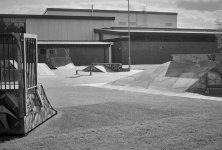
2409APLXBW33 Skate park.jpg

K100 at EI 400, Pentax LX, SMC Pentax K 55mm f/1.8.
 
As much as I like Rodinal, it is a poor choice for pushing IMHO. Also, using Rodinal in stand developing mode gives subpar results as compared to using it 1:50 or 1:25 regularly inverted. You will observe gradients of uneven development across the frame and possibly 'bromide drag'. Nasty stuff.

Do you have some ID11 or D76 kicking around? ID11 1+1 would be my choice. Even better, some Microphen.
 
Not sure if it helps, Nige, but I have used Kentmere 100 at EI 400 for exactly the same reason. Luckily I use HC-110, for which MDC gives a time of 10 minutes for dilution B (1+31), compared to 6.5 minutes at EI 100 for the same dilution. I really liked the results.

View attachment 446929

K100 at EI 400, Pentax LX, SMC Pentax K 55mm f/1.8.
I just did a search on MDC with All developers. Weirdly, it suggests a time of 14.5 minutes for IlfoTec-HC (supposedly a HC-110 clone) at 1+31! This suggests to me (or at least reinforces the idea) that you can be pretty flexible with your times. Looking at other developers that show both EI 100 and EI 400 times for K100 at 20C (always something to watch out for!), I'd dev it in your DDX for anywhere from +50% to +100% of the EI 100 times. And if it works out, you can always submit a time to MDC (though good luck with that; my suggested time for FilmFerrania P33 hasn't turned up 6 months later; in fact neither P33 nor orto have turned up!).
 
Thanks for the replies so far.

My current plan is to shoot another roll at the same speed and develop that first and see how it fares. The shots from yesterday are from a trip to Lincoln which, while it's not too far away, is distant enough that I'll probably not get chance to recreate them for some time, so I want to get the best results I can.

I still have two rolls of the APX 100 from the same batch, so I don't have to buy more film.
 
Thanks for the replies so far.

My current plan is to shoot another roll at the same speed and develop that first and see how it fares. The shots from yesterday are from a trip to Lincoln which, while it's not too far away, is distant enough that I'll probably not get chance to recreate them for some time, so I want to get the best results I can.

I still have two rolls of the APX 100 from the same batch, so I don't have to buy more film.
That's a plan.
You don't even need to use an entire roll, you could run off four or five frames and clip test it by cutting the film in camera in a darkroom or changing bag.
 
I shot another roll of Agfa APX 100 at 400asa on Saturday and then did one hour of semi-stand development in Rodinal at 20°. I gave the film 5 minutes of pre-wash in tap water. Then
1 minute of agitation (inversions) in the Paterson tank, and then a single inversion after 30 minutes. After 1 hour I did a 1 minute stop bath with tap water and then 5 minutes fix, followed by my usual Ilford-method wash.

I used 500ml of water plus 7 ml of developer (I'd read in a few places to ad an extra ml per stop of pushing).

The results are not bad at all, although they are quite contrasty (though the bright sunlit conditions will also have contributed to this somewhat). The shots below are the first few that I've uploaded and have been processed further in Lightroom.

Looking at the first picture of the light aircraft, I can see faint signs of what I presume to be bromide drag. It's not blatant though, and is not really visible at all in any of the other shots I've scanned, so it might just be that fact that this composition is largely blank which makes it stand out slightly. The next roll I develop in this way (my Lincoln shots), I think I'll invert twice - once at 20mins, and again at 40mins in a hope to avoid this problem.

Nikon F80
Tamron 28-300mm F/3.5-6.3 Di VC PZD
Agfa APX 100 (@400)


Bromide highs by fishyfish_arcade, on Flickr


Into Whitwell by fishyfish_arcade, on Flickr


Last year's bracken by fishyfish_arcade, on Flickr


Overgrown lane by fishyfish_arcade, on Flickr
 
Last edited:
I like the almost litho look of the bracken shot.

Looking at the slight banding on the first shot then at the second shot, it looks as though there's a similar pattern of banding on the second, just hidden a bit behind the extra detail - maybe it's a scanner issue rather than developing?
 
I like the almost litho look of the bracken shot.

Looking at the slight banding on the first shot then at the second shot, it looks as though there's a similar pattern of banding on the second, just hidden a bit behind the extra detail - maybe it's a scanner issue rather than developing?
Thanks.

Yeah, you could be right on the scanner issue. I've compared two separate negatives with large low-contrast areas, and the streaks line up on both of them. Luckily it's barely noticeable on any of the other shots and only shows up if I whack the dehaze slider up high.

I'll just have to avoid photographing aeroplanes against flat skies. :)
 
depends on your set up, however, I in my own travails with rodinal and reading a specific persons online website about Rodinal issues, have found that all the dilutions work, but the 1:100 semi stand gives the same results.

Now, i know the hate for Rodinal is far and wide on the internet, and most of the photo related forums enforce that hatrid as part of membership to those forums. However, i have done my own work and found that the only difference between 1:100 and 1:50 and 1:25 is time needed and amount of agitation and amount of chemical.

If i can remove 80% of agitation needed to devolope a roll of film, and remove 90% of the clock watching to get the agitation done at the right minute marks.. its a win. And when i can reduce that much effort by using LESS chemicals its even better.

And i have done delta 400 and Hp5 with 1:100, and gotten results as good as the lesser dilutons of rodinal, and just as good as using Ilford DD-X times. In fact, i found after experimentation that Rodinal created better negatives then dd-x with delta 400./


Who's hating Rodinal? Not me. It's my main developer in medium format.

I do see very different results when I vary agitation and dilution, with the worst outcome for my taste obtained with a) no or reduced agitation ('stand/semistand') or b) when I willingly underexpose and overdevelop ('push').

Try Fomapan 100 exposed at 50EI in medium or large format with Rodinal 1:50 inverted once per minute in contrasty light. A thing of wonder. Only with TMAX 100 do I manage to approximate the same linearity in the highlights.
 
Last edited:
Back
Top