Pinhole camera

Barney

Suspended / Banned
Messages
3,043
Name
Wayne
Edit My Images
No
I had a daft idea yesterday, only one I hear you cry, and that was for a pinhole camera made from a body cap on a 35mm SLR.

This must have been done before, and thought that you guys with vastly more experience would know if it had been tried and failed, about the potential pitfalls, or even if such an exercise is possible?

I can see an upside in using a regular 35mm film which can easily be developed at home.

So, is it possible and will it work?

Any thoughts on what settings may be used?
 
I think you're right that it's been done before. Some where online is a pin hole calculator which will calculate the F stop of a given pin hole size and objective distance. F stops are generally in the hundreds.
 
I think you're right that it's been done before. Some where online is a pin hole calculator which will calculate the F stop of a given pin hole size and objective distance. F stops are generally in the hundreds.

Thanks Sirch, will look.
 
I have a Chroma Cube 35mm pinhole camera, although I'm struggling to finish the 36 exposure film I put in it about 18 months ago! I bought 2 when they came out, planning to give one to my niece, but she lost interest in film photography so I put it in the classifieds here.
There are definitely resources online for size/distance/exposure details though, but I can't recall where.
 
Flipping heck there are loads of pinhole madmen out there, its not just me with daft ideas. :)

I think I have a half thou feeler gauge for the lens, just need to find the size of the laser beam.
 
I made a body cap pinhole camera with a broken Fed 4:

 
Any thoughts on what settings may be used?


If you have a digital body that accepts the same body cap, you can experiment using that and write a list of settings that work in an assortment of light conditions.

Laser cut/drilled pinholes are available or, they're not hard to make yourself - just a bit fiddly.

If you have macro extension tubes for the body, they can be used as "teleconverters".
 
First step is to measure the distance in millimeters from the body cap to the film plane. That is your "focal length"

Then you need to know the diameter of your pinhole. If you buy one readymade the supplier will state the diameter. A homemade pinhole can be measured by scanning the hole than using a ruler in Photoshop.

The aperture can then be calculated as the focal length in mm / pinhole diameter in millimeters.

For example a 25mm focal length and a 0.2mm diameter pinhole gives an f/stop of f/125

The pinhole assist app is one way of calculating the required shutter speed.
 
I buy all of my pinholes from James Guerin (RealitySoSubtle), his are laser drilled so perfectly round and much cleaner than hand drilling;


I generally use 0.2mm diameter for all of my cameras, as I use the same 30mm ‘focal length’ (distance to film plane). This gives an equivalent F/150 aperture and is a sweet spot for me between field of view and exposure.

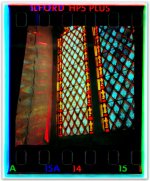
These are some half frame examples from a full frame 35mm pinhole I used to offer, and forgot that I had the half frame insert fitted…


IMG_7529.jpegIMG_7539.jpegPhotoroom_002_20240425_110204.jpeg

With pinhole, the larger the film area the sharper the image, although my Baby Cube used a 24x24 square frame and delivered excellent results for its’ size, because of the decent pinhole used;


dsc05876.jpegdsc05880.jpegdsc05886.jpegIMG_4216.jpegIMG_4215.jpeg

The two colour images are shot on HP5 using the “TriChrome” technique of taking three images, each with either a red/green/blue filter then combining them in post.
 
Oh dear,

what have I done,

I went looking at the darkroom -- all this mornings ideas are out the window, now that I have access to dark working a whole new ball game has opened up and my ideas are now unfettered by restriction of the dark bag.

:naughty:
 
I must say that between Kevin and Steve there are some fantastic images produced.
 
Having slept on my predicament, and with new developments on the Darkroom front, enabling more options, I have decided to make a 10x8 pinhole camera bypassing the 35 film altogether. The information I garnered through you links and kind suggestions, a rabbit warren not a hole, was to use darkroom paper and reversal development process.

So as not to put too much pressure on myself, I have set a target of up and running by summer.

The darkroom is only a part of the facility that is now available, there are also several 3d printers in separate workshop and another woodworking shop with a flatbed CNC router for wood. Need get my g code up to scratch.

My plan is to draught the box in wood and 3d print the paper negative holders, sell thousands of them and make a million, Ha Ha.
 
The darkroom is only a part of the facility that is now available, there are also several 3d printers in separate workshop and another woodworking shop with a flatbed CNC router for wood. Need get my g code up to scratch.

My plan is to draught the box in wood and 3d print the paper negative holders, sell thousands of them and make a million, Ha Ha.

I am very impressed by the facilities you have available, although I wouldn't have a clue how to use them so they would be wasted on me.

I have an 8*10 pinhole. In case you haven't seen this before, here's what I wrote about it:

https://kevinthephotographer.wordpress.com/2025/02/11/going-larger-with-pinholes/

Some key points to consider are:

- you might end up with a very small f stop. Mine is f/375 and that requires some very long exposures with paper negatives. Think 10-20 minutes in bright light and 30 minutes in dull conditions. Interior shots are a non-starter.

- portability - my 8*10 pinhole camera doesn't fit into any bag I have so it's worth fitting a handle and be prepared to carry an unwieldy object around (although I think I did manage to take it on the bus once)

-very worth while having multiple pinholes, for use when photographing tall buildings.

-before I purchased my camera I made an 8*10 camera out of a cardboard box. It was a one-shot camera as it had to be opened up in the darkroom after each shot. It wasn't very sturdy and didn't last long; but it might be worth doing this to try out ideas about overall size, pinhole diameter, and pinhole position, before committing to a design in wood. Also to see some results with minimum effort.

- are you sure that you really need to go to 8*10 ? A 4x5 pinhole camera can give results which are good quality but still look like we expect a pinhole image to look. An 8*10 pinhole can give results which don't immediately look like pinhole images, even with paper negatives.

It sounds attractive to produce film holders using 3d printing, but I wonder why there aren't many on the market already, if it's easy?

 
Since you're confident in the workshop you might want to consider a design which allows the pinholes to be interchanged for different sizes.

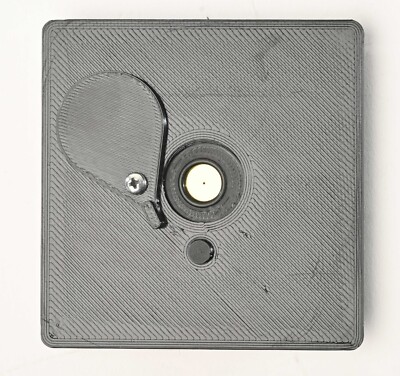
For 4x5 pinholes I currently use a Horseman 45HD camera with this lens board and interchangeable pinholes:

 
use darkroom paper and reversal development process.
Probably my last comment for today .... I know there are a few youtubers using the reversal development process with paper negatives, so it seems to be very trendy. Personally, I've never seen the attraction of direct positives and have only produced paper negatives which can be scanned and inverted to produce a positive image, or contact printed to a positive, or even enlarged to a bigger positive.

A direct positive on paper is a unique item which can only ever be one size. It seems to be quite difficult to achieve satisfactory contrast.

A paper negative can produce as many different positive outputs as you like, just like a film negative. The secondary step which converts from a negative to a positive (whether scanning or in the darkroom) provides additional possibilities for altering contrast or tonality. For example, you can print onto a grade of paper which is different from the negative, and to some extent to can dodge and burn. You can experiment with different print developers, or toners, or stain with tea and coffee, to compare the results of different processes. You can even put pencil marks on the back of a paper negative to lower contrast.

I suggest you try with paper negatives first before considering shooting direct positives.

Just my opinion, of course.
 
Kevin,

Thank you sincerely for all the positive comments and advice.

I thought that reversal process was the normal thing, since you outlined the potential pitfalls and upside of a negative type process I will need another rethink.

Machinery is second nature for me, my home workshop is steel orientated with a couple of lathes, a milling machine, various sanders and grinders a heat treatment oven etc. etc I would have a wood shop but lack of space prevents a lot of things round here, there is only so much you can fit in the garden and I have four sheds already packed to the rafters.

I will keep my eye out for a suitable box!
 
Back
Top