Photos "in the dark"

Sangoma

Suspended / Banned
Messages
2,951
Name
Steve, Coventry, England
Edit My Images
Yes
We live in one of the areas the council switches off street lights to help those who help themselves.

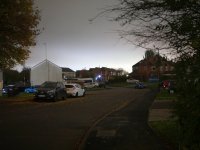
I have been experimenting taking photos with just the streetlamps when they come back on in the morning, and been very surprised by the results.

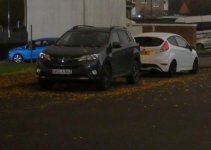
This morning I went down the road to my test spot before the lights came back on, and I find it hard to believe the results, I went outside several time to try and see what the camera saw, but couldn't.

In the full photo, I could not see any colour, the cars on the left, I could make out the individual cars, and see they had number plates fitted, and I could not see the leaves on the road.
On the group of cars on the right, I could see vague shapes, but could not make out individual cars or the shape of the whole car. Again, no colours.

The sky looked almost totally black, except a slight lightening at the bottom.

There is nothing wrong with my eyes :)

f1.7 1/2s ISO 3200

ntf.jpg
ntc.jpg


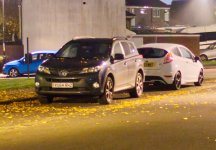
I will add one with the street lights come on

f1.7 1/6s ISO 3200
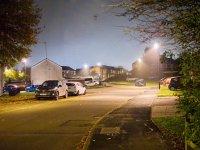
ntsl.jpgntslc.jpg


If you look at the yield sign roughly in the centre of the full picture, it gives a rough reference to the overall lighting.
Unfortunately a light mist had come over by the time the lights came on, which hides a bit of detail below the street lights.


Now, I imagine this is not a surprise to many, but to someone who hesitates to get a camera out in the winter months, let alone after nightfall, I am quite amazed at what can be done, and it certainly gives me more motivation for the next few months :)
 
I seem to remember an advert for Tr-X film back in the past B&W days, "You can shoot when all you can see on the camera is the makers name"
 
Wasn't it the (Nikon) D3 that made "unavailable" light photography possible?
 
I remember when I was a kid how cold British winters can be, but after moving to Canada. A lot of my photography I've shot below -40'C.
 
On Tuesday we went for dinner in the dark. No cameras allowed inside as the backs and controls emit light. I did wonder if the wonders of modern sensor technology could pick up any photons. The restaurant is run by blind and visually impaired people. There are two layers of blackout curtains to stop any light coming in. Quite an experience https://en.m.wikipedia.org/wiki/Blindekuh_(restaurant)
 
I guess our eyes work at ISO 125!
 
I've just tied the same with the 5Diii

With the nifty 50, on P mode the camera sets the ISO right up to keep a useable shutter speed, loads of noise and can't see much.
On manual, setting the ISO to 3200 (same as was used on the GX9), still a huge amount of noise and loads of motion blur, can't hold it still enough.

Tried the L series 24-105 set to 50mm (that is the FL I am looking at), slightly better, but nothing useable.

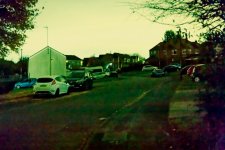
This was the best I got. Noise reduction had to be turned so high detail is getting lost, lots of colour casts in the shadows (been corrected from what it was, but it is not consistent so not easy to get rid of).

Th sky is slightly lighter this morning, there is a reflection off the clouds.

d5d3.jpg

I wouldn't waste my time trying to make it better!

Some things I have noticed though.
In "low light" ie when the street lamps are on, or dawn/dusk, and on a cloudy day, the 5Diii has noticeably less noise than the Panasonic (though processing RAWs from both, it is hard to see a difference) . With very low light, the Canon is not as good as the Panasonic, more noise and there is a lot of unwanted colours.
The Canon also really struggled to focus.

Also shows again the need to look at the whole package, what you want to do with it and how you do it.

The kids want to go to town tonight to take some photos, which do I take, the Canon + 24-105 at 1665g, or the GX9 + 50mm 1.7 at 625g? :)
 
Uhm if you don't mind I do not understand this thread objective at all. The shots are of static (not moving) objects shot at high iso. Why not shoot low shutter speed and a tripod.
 
Uhm if you don't mind I do not understand this thread objective at all. The shots are of static (not moving) objects shot at high iso. Why not shoot low shutter speed and a tripod.
I think the point being made is that the camera can see what the human eye can't, that's all. It's a curiosity, not an attempt at good photographs.
 
Modern sensors are really good at seeing in the dark.

I went to Halloween at Kew earlier this week, and found just using my phone camera revealed things I couldn't see well and didn't want to spoil by using a torch.
 
Back in the day, "nightscape" photography was fairly popular. Ok not what Steve is after, but it occures to me modern cameras make it a much easier play than film as we can see what we get.
Theres a video or two on YT showing a Sony turning night into near enough day. Cameras have come a long way.
 
that is vey nice of your lovely council. I'm guessing labour...

Your eyes switch over to using rods in a greyscale mode when the light goes quite low. Some people seem to struggle seeing in the dark. Cats or night birds would laugh at this so hard
 
that is vey nice of your lovely council. I'm guessing labour...

Your eyes switch over to using rods in a greyscale mode when the light goes quite low. Some people seem to struggle seeing in the dark. Cats or night birds would laugh at this so hard
There was a council, Cornwell somewhere if I remember rightly. They tried turning thestreet lights of the village off alltogether to save money. They hadnt factored in the costs of having it disconnected and reconnected. I cant remember the exact details but it cost them more to have no lights for three months than to have left them on.
 
I did an OU course back in the 1980s called Images and Information and one of the experiments was to take photos in the near dark to see what details you could get. You had to develop the film in the canister, submerged in some liquid with a plastic "stick/fork" that was used to roll and unroll the film in the canister to get the liquid over all the film. Great fun.
You then went on to make some holograms on a roll of film using a laser.
 
Back
Top