

You are using an out of date browser. It may not display this or other websites correctly.
You should upgrade or use an alternative browser.
You should upgrade or use an alternative browser.
Photographing the sun?
- Thread starter mw0dbb
- Start date


OldCarlos
Suspended / Banned
- Messages
- 6,882
- Name
- Carl
- Edit My Images
- Yes
A proper Solar-filter I presume. Probably best to ask on an astronomy forum, or g00gle?
Maybe start here; http://www.nikonusa.com/en/Learn-And-Explore/Article/h20zakgu/How-to-Photograph-a-Solar-Eclipse.html
Maybe start here; http://www.nikonusa.com/en/Learn-And-Explore/Article/h20zakgu/How-to-Photograph-a-Solar-Eclipse.html
Last edited:

- Messages
- 15,745
- Name
- Phil
- Edit My Images
- Yes
Can't offer any tips for serious astro stuff. These were just curiosity shots but I hope they give you an appreciation of the sheer brightness of the sun.
Note - these are at sunset so by no means the brightest but even through a big stopper (ten stop filter) we're down to 1/80 @ ISO100 - f/8.0 - 400mm
Be careful - If you have live view (I don't) then that's the way.
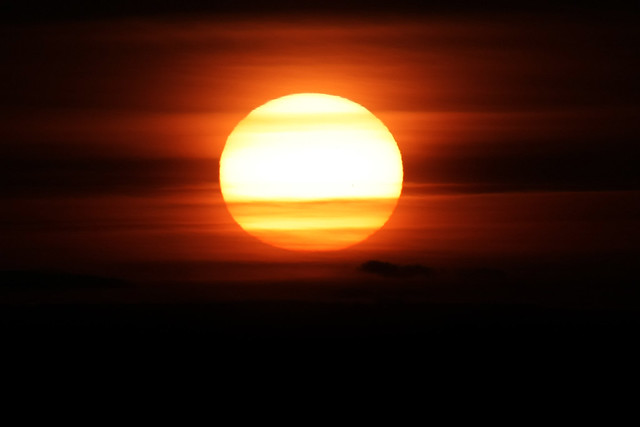
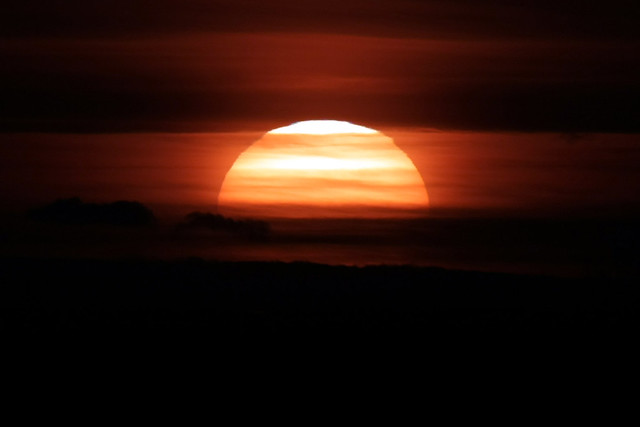
Note - these are at sunset so by no means the brightest but even through a big stopper (ten stop filter) we're down to 1/80 @ ISO100 - f/8.0 - 400mm
Be careful - If you have live view (I don't) then that's the way.
Last edited:

SLRUser
Suspended / Banned
- Messages
- 2,748
- Name
- Stuart
- Edit My Images
- Yes
What are you trying to photograph? Solar prominences, sunspots or just having the sun in the frame? What focal length are you thinking of? It also depends on where the sun is located at the time, if it is close to the horizon you should be okay however always use liveview unless you know what you are doing. Worst case is that you replace your camera, not your eyeballs.
You can make an ND 5.0 filter using the following...
http://www.firstlightoptics.com/solar-filters/baader-astrosolar-safety-film-nd-50.html
I was hoping to photograph the Venus transit, but alas it never happened for me (due to cloud) but I did have a go at sunspots...the following was taken with a Canon 500mm lens + a 1.4x TC and a 2xTC stacked on a 7D recorded via liveview on USB.

You can make an ND 5.0 filter using the following...
http://www.firstlightoptics.com/solar-filters/baader-astrosolar-safety-film-nd-50.html
I was hoping to photograph the Venus transit, but alas it never happened for me (due to cloud) but I did have a go at sunspots...the following was taken with a Canon 500mm lens + a 1.4x TC and a 2xTC stacked on a 7D recorded via liveview on USB.
Last edited:

hollis_f
Suspended / Banned
- Messages
- 3,696
- Name
- Frank
- Edit My Images
- Yes
You can make an ND 5.0 filter using the following...
http://www.firstlightoptics.com/solar-filters/baader-astrosolar-safety-film-nd-50.html
Here's a link to how I made a screw-in solar filter for my 100-400.

chadders
Suspended / Banned
- Messages
- 547
- Name
- Jim
- Edit My Images
- No

DaveS2
Suspended / Banned
- Messages
- 486
- Name
- Dave
- Edit My Images
- No
Imaging the Sun in White Light, which will show Sun Spots, Faculae, and some surface granulation, is quite straight forward, using a home made filter from Baader Solar Film (already mentioned in this 'thread'). This will not show Solar Flares and Prominences.
If you want to image Solar Flares and Prominences, then a specialised Etalon filter (very expensive), set to the narrow Hydrogen Alpha (Ha) part of the Spectrum is necessary. These filters usually have a band-pass of between 0.5 a 1.0 Angstrom. These are not normal photographic filters, ND or otherwise.
Imaging the Sun, should not be taken lightly, get it wrong and it could cost you your eyesight, or the sensor in your camera.
I you use a White Light filter, Solar Film (Baader), or Metalised Glass (Thousand Oaks), make sure that there are no pin-holes in the film of coating.
If you use a telescope, make sure that you either filter the finder-scope, or leave it capped, in case you inadvertently glance through it.
Dave
If you want to image Solar Flares and Prominences, then a specialised Etalon filter (very expensive), set to the narrow Hydrogen Alpha (Ha) part of the Spectrum is necessary. These filters usually have a band-pass of between 0.5 a 1.0 Angstrom. These are not normal photographic filters, ND or otherwise.
Imaging the Sun, should not be taken lightly, get it wrong and it could cost you your eyesight, or the sensor in your camera.
I you use a White Light filter, Solar Film (Baader), or Metalised Glass (Thousand Oaks), make sure that there are no pin-holes in the film of coating.
If you use a telescope, make sure that you either filter the finder-scope, or leave it capped, in case you inadvertently glance through it.
Dave
Last edited:

Danger_MouseUK
Suspended / Banned
- Messages
- 103
- Edit My Images
- Yes
Just to emphasise the point, this is what a laser of low enough power that it can be shone into a crowd can do to your camera's sensor...
If you planning to have a go, make sure you camera is protected.
If you planning to have a go, make sure you camera is protected.
tommillski
Suspended / Banned
- Messages
- 49
- Edit My Images
- No
Just to emphasise the point, this is what a laser of low enough power that it can be shone into a crowd can do to your camera's sensor...
If you planning to have a go, make sure you camera is protected.
Ouchhhh - never seen this before. Pretty scary really...
Those figures for the sun at sunset are miles out a ten stop filter F8 @100 iso 1/80th = 160000 th(sixteen thousand) of a second at f22 iso 100 without the 10 stopper.LOL. The attached photo is taken at sunset NO big stopper is required at all and the settings were 1000th sec f5 ISO 100.Can't offer any tips for serious astro stuff. These were just curiosity shots but I hope they give you an appreciation of the sheer brightness of the sun.
Note - these are at sunset so by no means the brightest but even through a big stopper (ten stop filter) we're down to 1/80 @ ISO100 - f/8.0 - 400mm
Be careful - If you have live view (I don't) then that's the way.
View attachment 8308
- Messages
- 15,745
- Name
- Phil
- Edit My Images
- Yes
Those figures for the sun at sunset are miles out a ten stop filter F8 @100 iso 1/80th = 160000 th(sixteen thousand) of a second at f22 iso 100 without the 10 stopper.LOL. The attached photo is taken at sunset NO big stopper is required at all and the settings were 1000th sec f5 ISO 100.
You've got me thinking now but they were a few years back so perhaps those were without the filter.
I just know that I've used B&W 10 stop for the sun and when I was looking for some sun shots I noticed that one was call big stopper test and when I looked at the exif it was....
Camera Canon EOS 40D
Exposure 0.013 sec (1/80)
Aperture f/8.0
Focal Length 400 mm
ISO Speed 100
It won't be with a big stopper. If the sun was just before it set you might have had to go as low as 80th/ ISO100/ f8 without a big stopper easy.I have noticed that when I do these sunsets that the light drops a real lot just before the sun disappears and if you have some thin cloud it knocks the light down, but I usually increase the ISO rather than drop as low as 80th specially with a 400mm on. I do quite a few sunsets with big telephoto lenses, attached is crop sensor with 300mm + 1.4 convertor = 420 ff or 630mm on the crop 1000th sec /f6.3 /ISO 100.I would never need any sort of ND filter.You've got me thinking now but they were a few years back so perhaps those were without the filter.
I just know that I've used B&W 10 stop for the sun and when I was looking for some sun shots I noticed that one was call big stopper test and when I looked at the exif it was....
Camera Canon EOS 40D
Exposure 0.013 sec (1/80)
Aperture f/8.0
Focal Length 400 mm
ISO Speed 100
View attachment 8318
Last edited: