Photographing Original Drawings on White Paper?

Two_In

Suspended / Banned
Messages
182
Name
Andrew
Edit My Images
Yes
I've been photographing drawings and original prints on white paper. I'm using x2 studio flash and have bracketed shutter speed and aperture. It's difficult to find the perfect settings. And it's difficult to select the best result too - what's deemed acceptable? Or is that subjective? Can anyone please offer some advice?

Thanks
 
I've been photographing drawings and original prints on white paper. I'm using x2 studio flash and have bracketed shutter speed and aperture. It's difficult to find the perfect settings. And it's difficult to select the best result too - what's deemed acceptable? Or is that subjective? Can anyone please offer some advice?

Thanks
With flash, bracketing shutter speeds will get you nowhere. "Acceptable" is subjective, but you want to avoid hot spots (uneven lighting), and generally whites should be white and blacks black. Maybe post an example for critique?
 
As above, usually 1 stop below sync speed is a good start point for using wireless flash, and if you cross light it creates the most even lighting.
ie 2 lights at 45degrees point each at the opposite side of the picture.

Just to clarify any confusion, remember that (except in exceptional circumstances) As long as the camera is below sync speed SS isn’t affecting the flash exposure. However if you drop it too low, you’ll be introducing an ambient light exposure into the mix, you want to avoid that. For instance 1/125 f8 iso 100 indoors in the U.K. out to be a black frame without the flash, but with the flash if it’s overexposed you can turn the power down.
 
I'm not sure that what you are doing is the same as what I had to do, so this may not work for you -

I was once asked to photograph 200+ marked up blue prints about 2' X 3' in size (actually black ink on white paper) with manually marked changes in red pencil on them. This shoot was needed because the manually marked drawings were being sent off to a contractor who would be using the markups to update the original CAD drawings. Concern existed that the drawings might be damaged or lost in transit or before the changes could be made to the CAD files, and also to be able to do a comparison check to assure that the contractor had made the changes correctly, so a record of these markups was needed for safety. Actually seven of the original prints did end up needing the use of the photo files of them for some reason not disclosed by my contact, but he was very happy with my work.

Since the walls of the office given to me for use were made of metal modular partitions, I found a wall where the ceiling fluorescent light ran parallel to the wall and out about 2' from the wall surface. This provided very even light on this wall surface. I then hung the drawings one at a time on this wall with magnets to hold them flat against the wall. With the camera on a tripod and positioned correctly, It only took a few test shots to get the camera adjusted for good results. Then, using a remote trigger for the camera and a large table off to the side to hold the prints in two separate piles, I was able to just place each drawing on the wall one at a time and trigger the camera with the remote. No flash was used at all. The ceiling light was more than adequate, as long as the magnets were holding the paper perfectly flat on the wall. I was able to complete this shoot in one afternoon with no help from anyone. This took place over 10 years ago, so I don't remember the camera settings or even which digital camera that I was using, but all of the resulting image files were in jpeg and about 1/2 meg each in size. The shutter speed was slow, like about 1/25 second, so no flicker problems resulted from the light. I made duplicate CDs of the image files, kept one, and gave the other to my customer contact, after assuring myself that I had a good file for each of the original blueprints which had page numbers marked on them, so visual identification was easy.

Charley

 
Wouldn't a scanner be the best answer? There are plenty of businesses who offer that sort of service for very large source documents.
 
At the time (10+ years ago) scanners that large were not readily available (for 2 foot X 3 foot sheets) and none were available near here. Rather than scan in multiple sections on a small scanner to be later merged, it was much easier to just photograph the whole sheets. They didn't need to be high photograph quality, just good enough to see the red mark-ups and the black lines on the drawings well enough that a new down level CAD print could be produced and then the red mark-ups manually applied to it, if the original drawing should somehow be damaged or disappeared before being entered into the CAD system by the contractor. These one-of-a -kind marked up prints needed to travel across the USA two times, once to the CAD contractor and then back to the originator to be compared with the new updated CAD files so the accuracy of the new CAD drawings could be verified. It would have taken much longer to scan all of these drawings on a small scanner and then merge the files, probably with some human produced failures along the way.

Charley
 
At the time (10+ years ago) scanners that large were not readily available (for 2 foot X 3 foot sheets)
Indeed, what was then and what is now are generally very different.

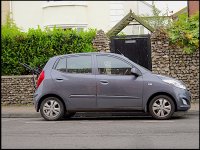
I was made aware of that when I was looking at a restored Renault Dauphine a few weeks ago, very similar to the one my father drove in 1959. In those days, it was considered a good, mid-range small car and sold for something like £550, which is the equivalent of £13,000 or so. My last small car was a top of the range Hyundai i10 which cost much the same. The facilities, comfort, safety and quality of construction were totally different. The past really is a different country...

Hyundai I10 grey Radway Sidmouth DSC00023.JPG
Instrument panel Hyundai i10 Panasonic TZ40 1000650.JPG
 
Back
Top