One for the Techies FOV v pixels in the frame

mipevo6

Suspended / Banned
Messages
2,624
Name
Martin
Edit My Images
Yes
Folks,

One for the techies.

I know this is navel contemplating and a very narrow view of the world, but more than anything I am just wondering what other folks thoughts on this are and hopefully to stimulate a positive discussion, not open a rat hole.

I am just wondering if someone can validate or disprove my thoughts on camera sensor size v FOV for Wildlife.

I have been kicking around the math for Canon cameras for wildlife of coverage v sensor size and megapixels to decide if it is worth me upgrading or not.

The reason I was calculating the below is that I am often in a hide shooting wildlife/birds etc.. where I can't get any closer physically, I could upgrade my lens to get closer (I would have to go to something like a 500/600 to get closer) which would get very expensive :). I was then kicking around a body upgrade to see if it made sense.

I currently have :-

5D3 and a 7D2
300 F2.8 II with 1.4 and 2.0 extenders

I know many factors come into play such as AF and ISO with wildlife, but given the requirement to get a decent image

I included all the decent Canon semi pro bodies in the calculation for completeness

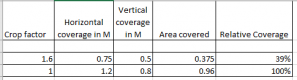
So the first thing to understand is that the FOV differs between crop sensor and FF sensors, the Crop only shows approximately 39% of the image of the full frame (image 1)
upload_2016-9-12_16-9-57.png


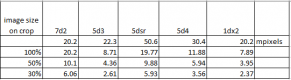
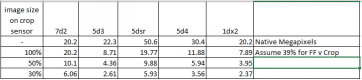
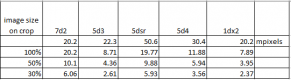
The second picture shows how many "pixels" will be contained in the picture based on a photographer sat in hide unable to get closer to the subject and assuming the same lens used in all cases.

I calculated it for a picture filling subject on a crop camera then show for a subject filling 50% of the frame, and then only 30%..
upload_2016-9-12_16-11-46.png

Interesting calculations that IMOHO show that if you want to use a FF for wildlife (especially small birds) you better get a damn big lens or a sensor with lots of Megapixels if you want a decent resolution image afterwards.

Did I get this completely wrong?

Had you ever thought of it in these terms?

Thoughts?

Cheers

Martin
 

Attachments
  • upload_2016-9-12_15-58-0.png
    upload_2016-9-12_15-58-0.png
    9.5 KB · Views: 20
  • upload_2016-9-12_16-9-38.png
    upload_2016-9-12_16-9-38.png
    9.5 KB · Views: 20
Last edited:
Hmmm I thought I put this in Talk Photography.... not Equipment.
 
Yes, you're absolutely right. If all you want to do is maximise the number of pixels on target, all other things being equal, then it's obvious that you want the smallest pixels and the highest pixel density. The crop factor for Canon DSLRS is 1.6, so in area terms that's 1.6 x 1.6 = 2.56. That means a full frame camera would have to have 2.56 times as many pixels as a crop sensor camera in order to have the same pixel density.

In round numbers, a 20 megapixel crop sensor camera (7D Mk II) has roughly the same pixel density as a 50 megapixel full frame camera (5DS).


Funnily anough I wrote about this on TP back in 2007. Here's my post:
https://www.talkphotography.co.uk/threads/visualisations-of-the-camera-crop-factor.34152/

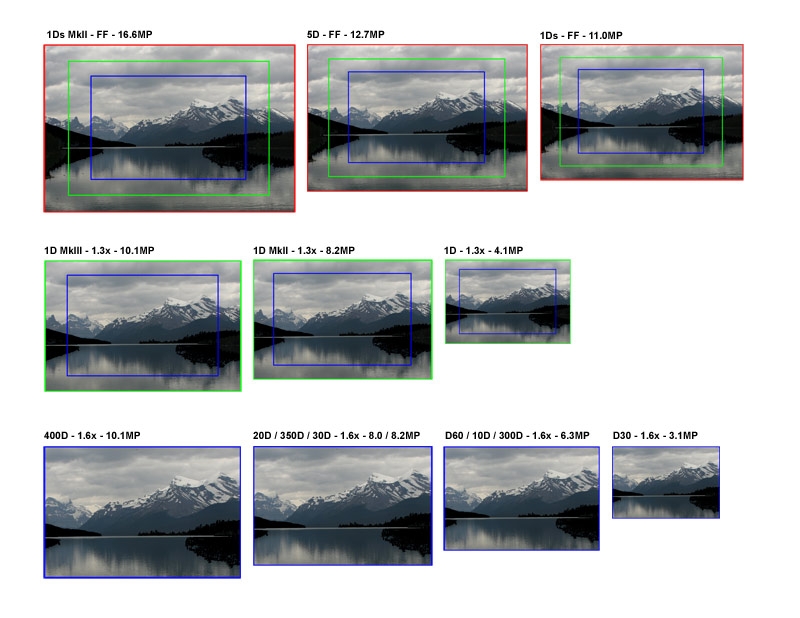
and here's the key graphic which I made to illustrate the point:
16396-1473694204-b78325dc17561c71a96b6cbbe8bab0eb.jpg


It might be fun to update this one!
 
Stewart,

Thanks for the post, I know I am a bit of an engineer but this makes a big difference if you are going to make the jump to FF for wildlife.

Glad to see I am not the only nerd around ;)

Martin
 
... if you are going to make the jump to FF for wildlife.
Don't. Just don't. Unless your wildlife photography really really needs something which you can do with a full frame camera and not with a crop sensor camera, such as ... er ... er ...
 
Don't. Just don't. Unless your wildlife photography really really needs something which you can do with a full frame camera and not with a crop sensor camera, such as ... er ... er ...

Better ISO?
Better AF?
Better Image Quality? (although given the pixel density discussion above maybe not....)
 
If your lens collection is up to it, then I'd whole heartedly recommend full frame over crop for wildlife. I've used a 20d, 7d, 7d2, 5d3 and now a 1dx, and there is no doubt in my mind that the ISO improvement in itself is more than enough for me to justify going full frame.

Granted, I'm lucky enough to have a 500mm f4 which sometimes needs a 1.4x converter added as well, but for the 'regular' wildlife shots my results on full frame are far superior.

If you intend to go down a more 'artistic' route, then you might not need the ISO capabilities a much, but for stopping action with our wonderful British light, then FF has proved invaluable for me.

Even having to crop a little more, having the sharper frame to begin with is a real benefit.

Mike
 
I've got a 6d and a 7d mk2 and I use both for wildlife dependant on subject and lighting (static subjects, fast erratic stuff, poor light etc)

My rather skewed thought process is that I'd rather have x1 low noise pixels than x2.56 high noise pixels for slow stuff and a noisy but crisp image for fast stuff ( hope that makes sense)
 
If it were only about pixels it would be easy... but it's not. A larger sensor always generates a sharper image as long as the pixels are larger. This is due to several factors, but primarily it's the fact that larger pixels/sensors are less demanding of the lens.

Here's your lens on the 7DII and the 5DIII... both are essentially 20MP sensors.

Screen Shot 2016-09-12 at 2.35.05 PM.png Screen Shot 2016-09-12 at 2.35.19 PM.png

Notice that at f/11 the 5DIII is recording an actual 12+MP where the 7DII is only recording ~5.5MP actual. You could crop the 5DIII image to 50% and still have ~ the same actual resolution in the image as the 7DII has.
And they would display/print at any equivalent size very similarly because:
-the remaining physical sensor size is ~ the same
-the recorded resolution is ~ the same
-they recorded the same amount of light in the remaining area

Or you could put a 2x on the 300/2.8 for the FF. You will incur a loss of max sharpness/resolution, but I highly doubt it would be by anywhere near 50% (I use a 400/2.8 with TC's extensively on FF, usually the 2x).

Very seldom do we ever manage to record the full resolution of the sensor (I would say just about never with the higher resolutions). But what most don't realize is that we only need around 12-14MP *max. ~7MP is more than enough for most uses. And the sharpness "standard COC" for FF requires less than 2MP actual.

My recommendation is to use the largest sensor you can fill. Second to that would be the highest resolution that doesn't incur excessive penalties (i.e. prefer AF performance over MP). There are other benefits to a higher resolution sensor even if it is not in the recorded resolution (i.e. color accuracy/DR/etc). But you usually won't need/notice the difference... IMO, those benefits are not worth paying much penalty for.

(DXO's P-Mpix is the lens' actual MTF resolution (LP/mm) as tested on that camera, converted into the # of pixels on the sensor used to record it)
 
Last edited:
Folks,

Thanks for the responses, lots to think about.

WRT the charts from SK66 is am primarily shooting at F7.1 -8.0 and below so should be both operating in the green.

I will try my 5d3 and see what i think of the results.

I was intrigued by the 30.4 mp of the 5D4 and wondered if it would be somewhere between the 2....

Cheers

Martin
 
At f/8 on the 7DII you'll be at about 8MP which is good. With the 5dIII you'll be around 15MP recorded (estimated because DXO doesn't chart beyond 12MP).
But what matters more is not the # of pixels, it's the physical sensor area. It used to be that if you wanted to print/display larger you used larger film negatives for better results. The same holds true with digital. It's only on a monitor where "pixels" has any real relevance to "size."

Generally, more MP's will get you a somewhat higher recorded resolution, but it's usually nowhere near what you might think. For instance, at f/8 on the 20MP 7DII you'll be at ~8MP, and on the 10MP 400D it's ~5MP.
 
Last edited:
May I throw something into the mix. The farther away from your subject. The more air you have between you and the subject. There fore the more crap you have floating about in that air. Flys, heathaze. dust ect. Which also helps degrade the image.
 
Last edited:
If it were only about pixels it would be easy... but it's not. A larger sensor always generates a sharper image as long as the pixels are larger. This is due to several factors, but primarily it's the fact that larger pixels/sensors are less demanding of the lens.

Here's your lens on the 7DII and the 5DIII... both are essentially 20MP sensors.

View attachment 73581 View attachment 73582

Notice that at f/11 the 5DIII is recording an actual 12+MP where the 7DII is only recording ~5.5MP actual. You could crop the 5DIII image to 50% and still have ~ the same actual resolution in the image as the 7DII has.
And they would display/print at any equivalent size very similarly because:
-the remaining physical sensor size is ~ the same
-the recorded resolution is ~ the same
-they recorded the same amount of light in the remaining area

Or you could put a 2x on the 300/2.8 for the FF. You will incur a loss of max sharpness/resolution, but I highly doubt it would be by anywhere near 50% (I use a 400/2.8 with TC's extensively on FF, usually the 2x).

Very seldom do we ever manage to record the full resolution of the sensor (I would say just about never with the higher resolutions). But what most don't realize is that we only need around 12-14MP *max. ~7MP is more than enough for most uses. And the sharpness "standard COC" for FF requires less than 2MP actual.

My recommendation is to use the largest sensor you can fill. Second to that would be the highest resolution that doesn't incur excessive penalties (i.e. prefer AF performance over MP). There are other benefits to a higher resolution sensor even if it is not in the recorded resolution (i.e. color accuracy/DR/etc). But you usually won't need/notice the difference... IMO, those benefits are not worth paying much penalty for.

(DXO's P-Mpix is the lens' actual MTF resolution (LP/mm) as tested on that camera, converted into the # of pixels on the sensor used to record it)


How did you get it to chart this?

I am still kicking my thoughts around using my 5d3 , upgrading to the 5d4 or 1dx MK II to use with my 300 2.8 and 2 x

Martin
 
How did you get it to chart this?

I am still kicking my thoughts around using my 5d3 , upgrading to the 5d4 or 1dx MK II to use with my 300 2.8 and 2 x

Martin
You start with DXO lens test for the 300/2.8 and select the camera it was tested on... then it's under "measurements."

With those cameras I don't think you will see much difference in IQ from the lens (if any). I would be more concerned with other factors (AF, FPS, Cost, etc)
 
You start with DXO lens test for the 300/2.8 and select the camera it was tested on... then it's under "measurements."

With those cameras I don't think you will see much difference in IQ from the lens (if any). I would be more concerned with other factors (AF, FPS, Cost, etc)

Ahhh ok I don't think they have put that lens on either of the cameras yet...

I might just need to rent them and see what works best....
 
Back
Top