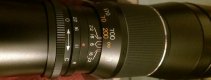
O=Open
C=Closed
That is the 'stop down' ring.
Focus in 'O' for bright view-finder.
Meter in 'C' & shoot in 'C'..... to stop down to set f-no, (or you'll be metering and shooting wide open).
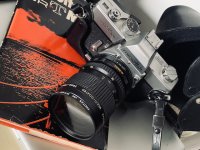
It's a simple over-ride of the aperture setting ring, a quick control to switch between set aperture and open, common on a lot of T mount and M42 lenses, co-incident with 'automatic' linses that had a pin to stop down to 'set' aperture on meter or shutter 'automatically'.
22,16,11,8 by red dot are the aperture iris settings. Make sure red dot is aligned to whatever f-stop you want before you meter, or release.
Front ring is focus, with distance scale on the ring, red-dot lining up to set focus range. Scale beneath, (by red dot) is the DoF brackets, the line from each F-No indicating furthest & closest 'acceptable focus' distance around set, at that f-no.
As long as its not mossed up inside, cracked, chipped or delamnated, you will likely find it actually performs bloomin well, and likely better than many modern electric lenses, thanks to its very simple and 'true-focal-length' construction, and fact that on a crop-sensor camera, you will only be taking an image off the sweet-spot in the center of the lenses image circle, the crop-sensor cropping an awful lot of possible edge abhoration over the 'full-frame' it was originally intended to cover on a 35mm film camera.
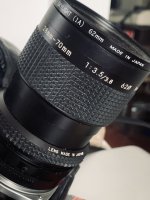
Main issue, especially if it's a T-Mount lens, is the calibration of the mount, and possibility of the mount moving lens body closer or further from the sensor/film focal plane. If 'out' it will likely mean that the focus scale isn't quite accurate, but in bad cases it can mean you cant actually get infinity focus or close closest focus distance. On better T-Mounts, there was often a grub-screw or three so that you could 'lock' the barrel of the lens to the mount at critical mount length to calibrate, rather than screw it tight down, and possibly have the lens a thread width or so out of cal. (Worth mentioning that some folk would actually exploit this, and wind the lens 'out' on the mount thread, to get a closer near focus, at the expense of infinity focus, like short range extension bellows, for portrait or close-up work)
As they have been mentioned, these True-Focal-Length 'long' lenses were common and favored over mirror lenses, as they were true-focal length, and optically less compromised than a mirror, as well as offering variable aperture setting, where construction of a mirror usually means a fixed aperture. Advantages of a mirror were usually that they were cheaper, as much as they were any more compact.. and maybe halo-highlight effects!
Fit it up; check focus cal is close enough; remember to meter and shoot closed down, and enjoy. Its a LOT of reach for the money, and as said, likely a lot of IQ with it! Possibly a bit long, especially on a crop-sensor camera, for an awful lot of situations, to my mind.. but I find 210mm a bit on the long side on film, most of the time... still, you'll fill the frame with moon well enough with it!