Now That's Just Brilliant!

Ricardodaforce

Self requested ban
Suspended / Banned
Messages
18,340
Edit My Images
No
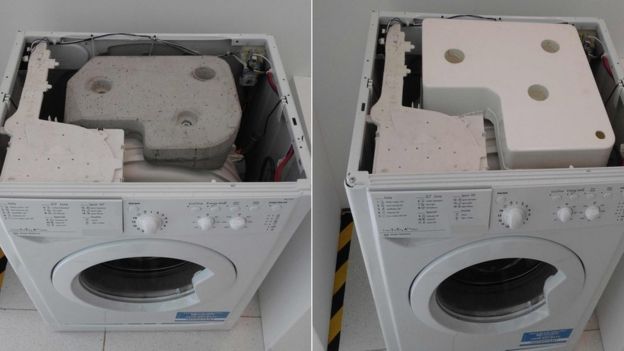
A simple device to cut the weight of washing machines could save fuel, cut carbon emissions, and reduce back injuries, according to researchers.

Full story here.

What an elegant, simple solution to improving a product we all have.
 
How on earth was something so simple not thought of before???
 
It would also prevent some folks wrecking their new appliance the first time they use it, by not removing the restraining bolts on the concrete weight, the result of which is generally the collapse of the weight and destruction of the drum.
Yep, great idea.
 
How on earth was something so simple not thought of before???
Indeed. We've all got washing machines, we've all lugged the around, and none of us ever thought of it. Amazing.
 
Dishwashers have tanks in them that fill to use as storage keeping the water usage down. Do something similar?
 
You could fill the container with helium and they`d be even easier to move!
 
Great idea, but I'm just thinking that the tank will need to be pretty durable, maybe double or even triple lined.
If it splits, all that water + all that electricity = a bit of a bang at best case scenario.
Worst case scenario ... :(
 
The problem is making sure the tank fills correctly. Spin an egg on a flat smooth surface, put your finger on it then release and the egg will still continue to spin. How will the tank respond as a body of water to the constand stop start spinning of a machine, the change in temperature, what happens if air is introduced, would the tank need extra treatment to stop bacterial buildup. Regular flushing? How much clean water would be used over the lifetime of the machine to keep this servicable and would it be a "carbon" saving? Fluid mechanics are a lot different to a brick of concrete.
 
The size of the tank (s) would have to be bigger than the concrete blocks and there is not much room ( in the correct places ) in a modern washing machine.
 
The problem is making sure the tank fills correctly. Spin an egg on a flat smooth surface, put your finger on it then release and the egg will still continue to spin. How will the tank respond as a body of water to the constand stop start spinning of a machine, the change in temperature, what happens if air is introduced, would the tank need extra treatment to stop bacterial buildup. Regular flushing? How much clean water would be used over the lifetime of the machine to keep this servicable and would it be a "carbon" saving? Fluid mechanics are a lot different to a brick of concrete.

Hmmm, maybe not such a good idea!!!

I guess if the water 'tank' was a series of pipes/tubes that were in there it wouldn't slosh around too much?
 
It sounds like a solution to a non existent problem to me. How often do you move a washing machine? Think I've moved ours twice in five years. Yes transport costs would be less but then the problems just get passed on to the end user:

The tank would need to be quite thick to resist splitting: plastic isn't environmentally friendly to make or dispose of either. Or there's repair bills if they make it thinner and it then splits.

What happens to the liquid inside the tank over time? It would need a chemical additive to stop it going green: where does that end up? Bet you couldn't just flush it down your drain. Or it would need to be automatically filled with ordinary water and then emptied and refilled every now and again? Extra circuitry to potentially go wrong, something extra to scale up if you happen to live in a hardwater area and a big increase in water usage.

I'll stick with concrete thanks. :D
 
Last edited:
Hmmm, maybe not such a good idea!!!

I guess if the water 'tank' was a series of pipes/tubes that were in there it wouldn't slosh around too much?

For all we know it might be properly baffled to prevent most of the water movement, also if you design it so the tank is a holding tank for water the machine is going to use instead of permanent storage, the longest the water will sit there is the time between washes. It does have potential.
 
Having recently had to move our machine (it feels like!) 1,000 times over the past couple of weeks, anything to make it lighter would have been most welcome. The kitchen fitter told us about a customer who didn't remove the transit bolts from their machine and it caused several grand's worth of damage to their brand new kitchen.
 
For all we know it might be properly baffled to prevent most of the water movement
That would have to be the case, having driven "tankers" I can vouch for the fact that liquid is very "mobile" ;)

the longest the water will sit there is the time between washes.
That's counter productive though surely? isn't the "modern way" to use less and less water when washing?

1L of water weighs 1Kg.
from the article A typical budget washing machine is weighted by 25kg of concrete.

So thats 25L water down the drain every wash. Or every few washes.
 
That would have to be the case, having driven "tankers" I can vouch for the fact that liquid is very "mobile" ;)


That's counter productive though surely? isn't the "modern way" to use less and less water when washing?

1L of water weighs 1Kg.
from the article A typical budget washing machine is weighted by 25kg of concrete.

So thats 25L water down the drain every wash. Or every few washes.

Given a modern washing machine can use 40-50l of water per wash... 25l used as weight during the wash then stored for the next cycle and used again is possible.
 
As far as I can see from the article, the water is purely ballast and you only need to fill the tank once. No need to keep draining it and refilling, unless you want to drain it to move the machine. The tank only needs to be as thick as a car cooling system expansion bottle.
 
Given a modern washing machine can use 40-50l of water per wash... 25l used as weight during the wash then stored for the next cycle and used again is possible.
Worse case scenario, that's an increase of 50% on water usage, 25% if it lasts 2 washes etc ..
It would need replacing on a fairly regular basis ( what "every" that maybe) though I would assume, due the the bacterial risk, legionaries even..
So flushing / cleansing is going to be pretty important, at some point too .
I would go as far as to say there would need to be another tank / device to hold "cleaner" ( A bactericide, Chlorine, "other" disinfectant, what ever) for the flush too, more chemicals down the drain.
 
As far as I can see from the article, the water is purely ballast and you only need to fill the tank once. No need to keep draining it and refilling, unless you want to drain it to move the machine. The tank only needs to be as thick as a car cooling system expansion bottle.
Though possibly need to be less prone to cracking than some Ford ones. ;) :D
 
Worse case scenario, that's an increase of 50% on water usage, 25% if it lasts 2 washes etc ..
It would need replacing on a fairly regular basis ( what "every" that maybe) though I would assume, due the the bacterial risk, legionaries even..
So flushing / cleansing is going to be pretty important, at some point too .
I would go as far as to say there would need to be another tank / device to hold "cleaner" ( A bactericide, Chlorine, "other" disinfectant, what ever) for the flush too, more chemicals down the drain.
But it will be sealed and there is no reason to have to drain it unless you plan on rearranging your kitchen every month.
 
Why not just run the plumbing through it? Water in the top and out the bottom then pumped onward into the detergent drawer/heater.

Smooth sides, gentle sloping bottom to avoid dead ends.
 
But it will be sealed and there is no reason to have to drain it
Fair point but having circ 25L of stagnant water albeit in a seal container laying around is maybe not the smartest move,
As before there will be the possibility of a leak.

And its going to be quite a sizeable tank too, a Gerry can is 20L
Try fitting one of those on top of your washing machine and then slide it under the work top ;)
 
Water sloshing around would not be an issue when it's full, nowhere for the water to slosh. Add some internal baffles as they do in fuel tanks if needed.
 
A car fuel tank is 'plastic' and they are reliable enough so no reason why the same material cannot be used in a washing machine.
 
Fair point but having circ 25L of stagnant water albeit in a seal container laying around is maybe not the smartest move,
As before there will be the possibility of a leak.

And its going to be quite a sizeable tank too, a Gerry can is 20L
Try fitting one of those on top of your washing machine and then slide it under the work top ;)
It fills roughly the same space as the concrete block.
_97202001_washingmachinebeforeandafter.jpg
 
A rare occurrence and they won't have to cope with hot and cold water. (y)

Not rare at all. Indeed a "known issue" for rather a lot of years, according to Haynes Ford of Maidstone when I picked mine up. :-) (y)
 
Not rare at all. Indeed a "known issue" for rather a lot of years, according to Haynes Ford of Maidstone when I picked mine up. :) (y)
100 dyno cells at work all using the same expansion bottles, some have two, none have failed, they have probably been in constant use for almost 20 years. Considering the millions of various Fords around the world fitted with the exact same tank that haven't had a failure, yes it is rare. That's not to say that there won't be the odd bad batch made by a vendor from time to time.
 
My point is...things fail.
Yes, the subject of the thread is a damn fine idea, but I bet it suffers failures just as the blocks can.
The point of the change is to make washing machines easier to relocate, and I don't think anyone can argue this alternative won't do that.
 
The tank doesn't need to be filled with water. Some builders sand poured in via a funnel would solve the problem of the extra space needed and reduce the likelihood of leaks and stagnant water. A few bolts to remove it and empty it out should the machine need to be moved.
 
I had a washing machine with shock absorbers, instead of a dead weight.

I presumed that was the way the manufacturers would go, but obviously not?
 
It fills roughly the same space as the concrete block.
It looks to me to be at least twice as thick and 50% larger.
As I said previously about the size of a jerry can. Are the drums getting smaller to accommodate or machines getting larger?
I don't know about yours, but I only have circa an inch clearance under my work top.
 
It looks to me to be at least twice as thick and 50% largedimensionssaid previously about the size of a jerry can. Are the drums getting smaller to accommodate or machines getting larger?
I don't know about yours, but I only have circa an inch clearance under my work top.


Looks to me that the outer cabinet of the machine is designed to fit nicely under the standard worktop .... but the concrete has a lot of space around it which could be used for the water tank with no need to make the drum smaller. :)


...... actually there are a few large load machines about with bigger drums but the same external dimensions!
 
Last edited:
I thought so too but concrete is 2.4x heavier than water, you would need a lot more space for this to work and it wouldn't fit under your counter
 
Worse case scenario, that's an increase of 50% on water usage, 25% if it lasts 2 washes etc ..
It would need replacing on a fairly regular basis ( what "every" that maybe) though I would assume, due the the bacterial risk, legionaries even..
How will water in a sealed tank, kept in the dark (so no photosynthesis for any algae present), cause a bacterial or legionnaires risk?
 
Even if there were nasty bugs in the tank they'd need to survive in there until the tank failed and they could get out... but just in case a squirt of something in there at manufacturing should be enough to prevent any bugs surviving.
 
Legionella can build up in unused pipework spurs, especially if the water in that pipework can reach temps of 20°C+
A static tank above a washing machine drum would be a great place for them.
I don't know WTF the little buggers actually eat, but they would grow in such an environment.

If it's not coming into contact with the clothes at all, a bottle of thin bleach in the tank, topped up water, should help stop any build up.
 
Legionella can build up in unused pipework spurs, especially if the water in that pipework can reach temps of 20°C+
I'm fairly certain Legionella needs to be aerosolised in order to affect humans, and won't survive at 50*C or above. Hence showers are dangerous but taps aren't.
 
There's HSE regulations in place to control the excessive buildup in any/all commercial water systems. I don't believe they apply to domestic installations, but the tone seems to imply that the more there is, the greater the risk; splash-back from a fast flowing tap can't be guaranteed 100% safe if it's really bunged up with bugs. I'd guess there's a chance retailers or repairers may refuse to deal with really slimy old washers on those grounds.

I'd say it'd just be best to avoid any potential risk by adding bleach, or (as mentioned above) using sand.
 
Spin an egg on a flat smooth surface, put your finger on it then release and the egg will still continue to spin.

I tried that and the egg stopped.


It was hard boiled though.
 
Back
Top
