North Yorkshire wildfire

Garry Edwards

Moderator
Messages
13,475
Name
Garry Edwards
Edit My Images
No
Worrying, especially as the fire, late last night, was just 4 miles away from our farm . . .

It seems to be utter chaos. The fire has been burning for 3 days, but it was only yesterday that the fire service started to bring in help from other areas. Apparently the Forestry Commission did create a backfire to make a firebreak, but it didn't work. The fire brigade are hopelessly under-resourced, the only source of large quantities of water is the sea, and they have to pump and pipe it vast distances. There's talk of bringing in ONE helicopter today, but we simply don't have either the resources, experience or infrastructure to deal with this type of fire in the UK.

The fire has already jumped one river and several becks, all of which are currently very narrow due to the lack of rainfall. Local farmers are standing by with ploughs to create firebreaks, but nobody is telling them what to do. They are also filling up all available bowsers and muck spreaders with water (which they are having to pay for themselves) but it's a slow process because they don't have access to fire mains, but again are waiting for some kind of organisational input. It all seems to depend on the wind, right now it's very mild, but if that changes this situation can become a disaster.

The harvest has made things worse, everything has been cut in the last couple of weeks, leaving just very dry stubble in nearly all of the fields.
 
Worrying time for you. Wildfires are bad enough, but when they, invariably threaten lives and your business , put's a whole new spin on it.
Unfortunately the whole country is up sh*t creek without a paddle, AND the creek is dry.
Hope all resolves with little, preferably no damage.
Could be days before you read this.
 
Worrying time for you. Wildfires are bad enough, but when they, invariably threaten lives and your business , put's a whole new spin on it.
Unfortunately the whole country is up sh*t creek without a paddle, AND the creek is dry.
Hope all resolves with little, preferably no damage.
Could be days before you read this.
No, I'm reading it now, I'm at my other home because there's nothing that I can personally do. Neighbouring farmers will, as always, step in and help everyone else.
 
Dare I say , go and get some photographs. Said very light heartedly, don't seem to get " emojis " to work.:):). Maybe just did, let me know please.
 
We live in different worlds:)
We all know each other very well, and if I turned up with a camera instead of a tractor they'd probably lynch me :eek:
 
The fire has now jumped the A171 (Whitby to Scarborough) road, so both sides of it are now burning, road closed from the A171/Harwood Dale turnoff, The whole area is a peat bog, the peat is apparently burning well, spreading unseen beneath the surface - that will be difficult to put out:(

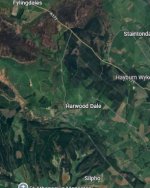
My personal area of concern is at Silpho, at the bottom of this map, as you can see, there's a lot of forest between us and the fire, and fires like forests ...
Locals are ready to plough firebreaks in the Harwood Dale area if the fire isn't stopped before then, but the people in charge (whoever they may be) will probably be happy now because the wind has changed and Fylingdales RAF station is now at reduced risk.
fire.jpg
 
Well, thankfully the fire now seems to be under control, and as long as there aren't any unexpected strong winds everything should now be OK, although it will probably be a few weeks at least before it's completely out. The wind is fairly gentle, and keeps changing direction, and because of this good luck the fire is running out of fuel, at least above ground, although the peat will probably burn for a very long time.

But this success is nearly all down to the local farming community, with their donated time, diesel, heavy plant, skills, hard work and even their own water, with plenty of other labour provided by other locals. There was a contractor there for a while too, with 5 large water tankers, and I'm told that they were paid £500 per hour per vehicle, I've been told why they weren't there for long.

And the fire brigade were there too, and will remain for a couple of weeks or so, but it was the farmers who were effective - the fire brigade were far more concerned with safety than with actually extinguishing the fire, and they didn't have either the numbers or the machinery to hit the fire hard.

One of the issues of concern is the old army training base, closed many years ago but nobody bothered to remove the unexploded munitions - well, the fire has dealt with some of those issues, adding to the danger.

We - as a country - need to learn from this shambles, we were simply overwhelmed by it, we need to have adequate infrastructure and the right people in place to deal with the inevitable future wildfires.
 
Not winning. A strong warm southerly wind has picked up and is now spreading the fire north at speed. Farmers and other local people now back on scene or on their way.
 
Not winning. A strong warm southerly wind has picked up and is now spreading the fire north at speed. Farmers and other local people now back on scene or on their way.
I don't understand why foresters don't cut adequate firebreaks and keep them clear, throughout the year, to avoid situations like this.

Whatever your interest is in trees: forestry, ecology, etc. fire is always a risk. The bigger the stand, the worse the consequences. The bigger the gaps, the easier it is to damp a fire down. Surely this isn't rocket science?
 
I don't understand why foresters don't cut adequate firebreaks and keep them clear, throughout the year, to avoid situations like this.

Whatever your interest is in trees: forestry, ecology, etc. fire is always a risk. The bigger the stand, the worse the consequences. The bigger the gaps, the easier it is to damp a fire down. Surely this isn't rocket science?
Well, I don't know the history, but local feeling seems to be very strong on this and allegedly the maintenance and management of the moorlands has been taken away from the locals, who are saying that this is why there are now no firebreaks
 
My first update for a while, because the people who know what's going on have been rather busy - forget whatever you've seen on the TV:(

Thankfully, the fire is now surrounded and under control. Basically, the massive firebreaks have done their job, and wind changes have caused the fire to run out of fuel. So, unless something terrible happens in terms of high winds, the danger should be over, although of course the peat is still burning underground and may take months, at least, to stop burning.

But, although the fire brigade front-line people have done a great job, the lack of organisation and lack of resources is a disgrace. I think that it was only on Wednesday that the fire brigade asked for nationwide help, until then there were only a maximum of 20 fire pumps on scene, each pump can only carry 1800 litres of water, designed for emergency fire-fighting in towns and cities whiles firefighters connect up to fire hydrants, but there are no hydrants in the countryside and very little was done to pump water from the local reservoir and the sea, several miles from the fire. Just one pump I believe, with just 1 kilometre of pipe.

Without the farmers and other local people, it would have been a total disaster. A lot of farmers have large bowsers, slurry tankers, muck spreaders and so on, they kept the fire brigade supplied with their water, as well as fighting the fire themselves.

A lot of them have large drotts too (or bulldozers if you prefer), and there were plenty of diggers too. Diggers, fitted with road wheels, can be driven on public roads but don't have much grip on mud, , drotts can’t be driven on roads because they have metal tracks that destroy road surfaces, I happen to know that several farmers just transported their drotts on their plant trailers, ignoring the 31 tonne limit, and it’s just as well that they did. The biggest and most effective machines can, in theory, only be transported by HGV, but that isn’t practical in an emergency situation.

And it wasn’t just the farmers with large machinery, it was everyone else too. Local shops and takeaways donated vast quantities of drinking water and food, and small farms and plenty of other people transported the food and drinks to them, using small tractors, quad bikes and everything else that would do the job. Nobody cared that many of the quad drivers were underage, don’t even have a driving licence and that the bikes are limited to 2 km of public road use per week anyway…

And local people have also raised a lot of money via crowdfunding etc to try to cover the cost of the farmers’ diesel, who went into this with no thought about their costs being covered.

One of the logistical problems for the farmers has been their supply of diesel. Other farmers have constantly replenished their supplies, at their own cost, towing bowsers behind tractors and ATVs. Heavy machinery gets through a lot of diesel. Just as an example, our own big tractor, a 270 hp 10-ton Case machine, holds 650 litres of diesel but gets through a tankful in about 8 hours and the drotts get through far more . . .

We don’t know what the future holds. A lot of trees had to be felled, a massive amount of earthworks and firebreaks have been built. Much of this is on moorland, but a lot is on grazing and arable land, which is now effectively lost, unless the work is undone again at enormous cost – but it really needs to stay, to safeguard against future fires. The National Front Parks Authority will probably insist on it being put back to what it was, because they like it to be pretty . . .

A fantastic community effort, but a disappointing official one.
 
My first update for a while, because the people who know what's going on have been rather busy - forget whatever you've seen on the TV:(

Thankfully, the fire is now surrounded and under control. Basically, the massive firebreaks have done their job, and wind changes have caused the fire to run out of fuel. So, unless something terrible happens in terms of high winds, the danger should be over, although of course the peat is still burning underground and may take months, at least, to stop burning.

But, although the fire brigade front-line people have done a great job, the lack of organisation and lack of resources is a disgrace. I think that it was only on Wednesday that the fire brigade asked for nationwide help, until then there were only a maximum of 20 fire pumps on scene, each pump can only carry 1800 litres of water, designed for emergency fire-fighting in towns and cities whiles firefighters connect up to fire hydrants, but there are no hydrants in the countryside and very little was done to pump water from the local reservoir and the sea, several miles from the fire. Just one pump I believe, with just 1 kilometre of pipe.

Without the farmers and other local people, it would have been a total disaster. A lot of farmers have large bowsers, slurry tankers, muck spreaders and so on, they kept the fire brigade supplied with their water, as well as fighting the fire themselves.

A lot of them have large drotts too (or bulldozers if you prefer), and there were plenty of diggers too. Diggers, fitted with road wheels, can be driven on public roads but don't have much grip on mud, , drotts can’t be driven on roads because they have metal tracks that destroy road surfaces, I happen to know that several farmers just transported their drotts on their plant trailers, ignoring the 31 tonne limit, and it’s just as well that they did. The biggest and most effective machines can, in theory, only be transported by HGV, but that isn’t practical in an emergency situation.

And it wasn’t just the farmers with large machinery, it was everyone else too. Local shops and takeaways donated vast quantities of drinking water and food, and small farms and plenty of other people transported the food and drinks to them, using small tractors, quad bikes and everything else that would do the job. Nobody cared that many of the quad drivers were underage, don’t even have a driving licence and that the bikes are limited to 2 km of public road use per week anyway…

And local people have also raised a lot of money via crowdfunding etc to try to cover the cost of the farmers’ diesel, who went into this with no thought about their costs being covered.

One of the logistical problems for the farmers has been their supply of diesel. Other farmers have constantly replenished their supplies, at their own cost, towing bowsers behind tractors and ATVs. Heavy machinery gets through a lot of diesel. Just as an example, our own big tractor, a 270 hp 10-ton Case machine, holds 650 litres of diesel but gets through a tankful in about 8 hours and the drotts get through far more . . .

We don’t know what the future holds. A lot of trees had to be felled, a massive amount of earthworks and firebreaks have been built. Much of this is on moorland, but a lot is on grazing and arable land, which is now effectively lost, unless the work is undone again at enormous cost – but it really needs to stay, to safeguard against future fires. The National Front Parks Authority will probably insist on it being put back to what it was, because they like it to be pretty . . .

A fantastic community effort, but a disappointing official one.
Thanks for a very informative update Garry, this needs to be publicised to a wider audience but how to do that?
 
Thanks for a very informative update Garry, this needs to be publicised to a wider audience but how to do that?
Does anyone care?
My guess - and it's nothing more than that - is that the national media just haven't taken this seriously, or at least they only started to take it seriously earlier this week when the situation worsened dramatically. I also think that they've been a bit lazy, they've spoken to the fire brigade on camera many times, but the fire brigade operation centre is at Pickering, many miles from the fire but easily accessible by road. By contrast, the fire scene, which covers a very large area, is very difficult to access by road, partly because nearly all of the roads have been closed for a long time because of the fire. Maybe the media have just taken the easy route, and not bothered to speak to the people on the ground. That, in my limited experience, is what the media tends to do.

I've seen a couple of media interviews today where they asked the fire chief whether he should have called in nationwide support much earlier, but they gave him a very soft ride when he fudged the issue, maybe that's their policy, I don't know.

Also, farmers as an occupational group just get on with things, but tend not to be great at communicating.
 
Glad it all worked out and quite heartwarming in these times to read about communities coming together.

.The media don't really get in to the way public services have been destroyed and Global warming is making these events more and more common combined with less water to fight the fires with in the first place. If the UK(maybe the Western World) was a computer I think we would be in dire need of a new operating system as the one we have used since 1979 has destroyed every component at its disposal. Hopefully some compensation comes teh farmers way and teh authorities can come up with a plan to move any earthworks to a suitable position that suits all parties and provides protect for future fires which are almost inevitable if we want the countryside to continue to look the same
 
We've had similar issues with wildfires on the Mournes and other moor-type areas in Northern Ireland - the FB have been much better than your experience seems to have been, but on the other hand they've been terribly hampered by the terrain and lack of water supply. They've had to carry themselves with full kit up miles of track - no way to drive vehicles up to the fire, even tractors in many cases - and fight the fires with beaters, not even water. Thankfully it's not been too bad recently but it was a few months ago.

IMHO there needs to be a UK-wide service facility of firefighting aircraft (fixed and rotary wing) supported by mobile firebase equipment. The expertise is readily available in Portugal, Spain and Canada amongst others. It would require an investment of maybe £500m to kit out a basic service with a few fixed wing aircraft and the kit that could be attached to military helicopters when needed. It's definitely do-able, but only if the will and investment is available. But it's needed, because these problems will only get worse with the years, thanks to climate change.
 
Another update, I wouldn't believe it myself if it hadn't come from someone who I trust absolutely and who has been fully involved in the firefighting from the start . . .

1. 1 of the farmers' drotts has been lost, it simply sank into the soft ground. Uninsured, but at least the driver managed to get out. Another drott crashed into and wrote off a fire engine, blinded by smoke, again not insured, and a tractor left the road and overturned for the same reason, don't know whether that one's insured or not.
2. Yorkshire water has now stopped farmers taking water from their reservoir; they can't stop the fire service doing it but the farmers have no legal right, and Yorkshire Water are saying that they can't spare the water. The only other source of water is from the sea at Whitby, a long way away, and there's only enough space to fill 3 bowsers at a time anyway.
3. Either the police or VOSA have stopped some tractors this morning, drivers reported for using red diesel other than for agricultural purposes.

If I was a cynic I might think that the authorities might now think that they don't need the farmers anymore.
 
Back
Top